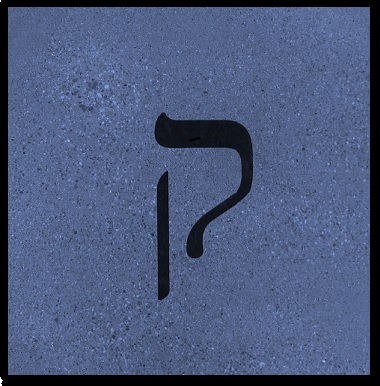
Why the letter Kof?

In response to those reader who ask why I use the Hebrew letter ק (Kof) as the symbol for my blog.

slfuchs's avatarFinding Ourselves In The Bible

The Hebrew letter Kof stands as a symbol of my web page.  I chose it because it is the first letter of the Hebrew word “Kadosh” which means holy.

One of the most famous lines of the Torah teaches (Lev. 19:1) “You shall be holy for I the Lord your God am holy.”

“Holy” really means set apart or different from the ordinary.  Torah came into the world because the ordinary values of the ancient world were not good enough for our people. Our tradition calls on us to be different: to strive for an ever higher standard of justice, righteousness, kindness and compassion than those which prevailing societal norms uphold.

In terms of time we are taught to make a distinction between ordinary time — the time to do the work of living — and time that is Kadosh, holy.  In Kadosh time we step back and ponder why…

View original post 220 more words

For my German Readers: Kurz-Kommentar: Tora-Lesung für den letzten Tag des Pessachfestes

Dieser Schabbat birgt ein Tora-Lesungs-Dilemma für Reformjuden. Es ist der achte Tag des Pessachfestes, aber die meisten Reformjuden feiern nur sieben Tage. Die offizielle Lösung progressiven Judentums – die ich willkürlich finde und unbefriedigend – trennt sich vom Rest der jüdischen Welt und teilt den Toraabschnitt Shemini (Levitikus 9-11) in zwei wöchentliche Abschnitte. Eine Hälfte wird an diesem Schabbat gelesen, die andere nächste Woche. Ich bevorzuge den Toraabschnitt des achten Tages des Pessachfestes wegen seiner herausragenden Lektion. Sie zu würdigen müssen wir auf einen krassen Widerspruch im Text achten.

In Deuteronomium 15,4 lesen wir ein kategorisches Statement das mit dem kategorischesten aller hebräischen Worte beginnt: “efes”, d.h. “null” oder “niemand/ keine”. “Es soll keine Bedürftigen bei euch geben.”Aber nur wenige Sätze weiter (Deuteronomium 15,11) heißt es: “Es wir immer Arme in eurem Land geben.”

Wenn jeder Gottes Geboten folgen würde und seine Hälfte aus dem Bund, den der EwigEine mit Abraham begann, erfüllen würde, gäbe es tatsächlich keine Bedürftigen. Dieser Bund ruft uns auf,

  • ein Segen zu sein (Genesis 12,2).
  • so gut wir können Gottes Weisungen zu verstehen und ihnen zu entsprechen (Genesis 17,1).
  • und unsere Nachkommen so gut wir können zu lehren, die Welt mit Tzedakah und Mishpat, mit “Rechtschaffenheit und Gerechtigkeit” zu füllen (Genesis 18,19).

Ja, die Tora lehrt, dass es keine Bedürftigen gäbe, wenn jeder so handeln würde. Aber es bleibt bei der bitteren Wahrheit, dass nicht jeder diese Lehren befolgt. Deshalb wird es immer Bedürftige unter uns geben.

Der Imperativ für uns, die wir die Tora ernst nehmen, ist also, dass wir das uns Mögliche tun, um die Armut zu lindern, die wir um uns herum sehen. Wir wagen es nicht, unsere Herzen hart zu machen oder unsre Hände zu verschließen angesichts der Armen, die nach uns rufen. So gut wir können müssen wir Verantwortung für sie übernehmen und tun, was wir können um zu helfen.

Natürlich bedeutet das für jeden Menschen etwas anderes. Die Tora sagt uns nicht was exakt wir zu tun haben. Sie zielt darauf unsere Einstellung zu beeinflussen. Jeder von uns muss selbst entscheiden, ob wir für die Verbesserung der Lebensbedingungen in der Welt Verantwortung übernehmen oder ob wir nur über unsere selbstbezogenen Bedürfnisse nachdenken. Die Antwort der Tora ist klar und das Ende des Festes, bei dem wir verkündet haben “Lass alle Hungernden kommen und essen!” (Haggada), ist der passende Moment uns an diese Weisung der Tora zu erinnern.

Translation: Pastor Ursula Sieg
Quick Comment: Torah Reading for the Last Day Of Passover

A Torah Reading Dilemma

This Shabbat presents a Torah reading dilemma for Reform Jews. It is the eighth day of Passover, but most Reform Jews observe only seven days. The movement’s solution– which I find arbitrary and unsatisfactory–is to separate from the rest of the Jewish world by dividing the Torah portion Shemini (Lev. 10 12) into two weekly portions. Half will be read this Shabbat and half next week.

A Magnificent Lesson

I much prefer to read from the eighth day Passover portion because of the magnificent lesson it teaches. To appreciate that lesson we must pay heed to a stark contradiction in the text!
in Deuteronomy 15:4 we read a categorical statement beginning with one of the most categorical of all Hebrew words, אפס (efes), which means, “zero” or “not a single one.” “There shall be no needy among you.”
But just several sentences later (DT:15:11) we read,”For the poor shall never cease to exist in your land!”
The lesson is that if everyone followed God’s commandments and fulfilled our half of the covenant the Eternal One first made with Abraham and Sarah, there would indeed be no needy among us. That covenant calls on us to
–be a blessing in our lives (Genesis 12:2)
–try as best we can to understand and be worthy of God’s teachings (Genesis 17:1)
–and to our best and teach our progeny to do their best to fill the world with Tzedakah and Mishpat, “righteousness and justice.” (Genesis 18:19)

Yes, if everyone did those things, there would be no needy among us!
But the hard truth remains that not everyone will live up to those teachings, and therefore, there will always be needy among us.

Our Mandate

The imperative, then, for those of us who take Torah seriously is to do all that we can to alleviate the poverty around us. We dare not harden our hearts nor tighten our fist in the face of the poor who cry out to us. Rather to the best of our ability we must take responsibility for them and do what we can to help.

Not a Formula But an Attitude

Of course that will mean different things to difference people. The Torah is not telling us each precisely what we must do. It’s goal is to affect our attitude. Each of us must decide: do we take responsibility for improving life in our world or do we simply consider our own selfish needs? The Torah’s answer is clear, and the end of the festival during which we have proclaimed,”Let all who are hungry come and eat, (Haggadah)” is a perfect time to remind ourselves of that lesson.

Role Reversal

Yesterday was a special day because I played tennis with my older son Leo. Tennis is a strong bond between us, but at this point he clearly does  me a favor by hitting with me. Leo is a good local tournament player, who at 38 is a little—but not much—past his prime. At 69 I do not come close to matching his pace, consistency or stamina.

Once upon a time …

But it seems like yesterday when he was very small, and he sat transfixed next to Vickie by the side of the court as I won a hard fought final to claim my third Columbia, MD, Memorial Day Singles title. The moment my opponent and I shook hands (that was his signal) he gleefully came running down to the courts with his racket ball racket for me to play with him. That became our ritual every time I played a match.

Who’s your coach?

We played a lot over the years. I loved it, and I taught him everything I knew. As he got older he also took clinics from pros. But when he started playing Junior Tournaments, the first question people asked him was, “Who’s your coach?”

Unlike the other players he didn’t really have coach, but I was the closest thing to it. So jokingly I suggested that when people asked he should say, “I go to O.M.P.T.A.” No one ever asked, but O.M.P.T.A. stands for, “Old Man Pops Tennis Academy.”

A Treasured Gift

Looking back, I am not precisely sure when the balance tipped and he became the better player. By the time he became Brandeis’ number one, though, he had long since snatched the baton. One Fathers’ Day, when he was in college, he presented me with a gift I still treasure. It was a warm up suit, with O.M.P.T.A. embroidered on the back of the jacket in big letters, and “Head Coach” stitched in small letters on the front. When I would play Sr. Tournaments, he gave me advice, and I listened very carefully. It always helped.

Coming Full Circle

Yesterday, we played again. Although it was certainly not a challenge for him, I am glad he enjoyed it. As for me,  I took to the court filled with the same joy I saw on Leo’s face when he ran to play with me—after the handshake—when he was very small.

This I Believe About God

The more I learn the more of a mystery God becomes. And the greater my faith grows that life has purpose and meaning!

slfuchs's avatarFinding Ourselves In The Bible

http://http://www.last.fm/music/Garth+Brooks/_/Unanswered+Prayers

My Unanswered Prayer

God and I have always had a very personal relationship. So it seemed natural to me that when I was 18 years old and stepped onto the ice for my first hockey practice at Hamilton College I offered God a deal: “God, if you make me an all-American hockey player, then, I’ll become a rabbi.” As any witness to my Hamilton hockey career can attest, God categorically rejected that proposal.

Now, a half-century later, I think God must have laughed at my offer and said. “Miracles I can perform, didn’t I part the Red Sea? But, Steve, you are asking too much. No, I have given you just enough athletic talent so that if you work really hard, you may achieve some limited success but you will learn important lessons that will help you for the rest of your life. As far as becoming a rabbi…

View original post 708 more words

Quick Comment: Torah Portion for the First Day of Passover (Exodus 12:21-51)

After 430 years on this very day I the Eternal One brought you forth from the Land of Egypt (Exodus 12:41)

The Passover Haggadah insists: “In every generation each of us should act as though we ourselves came for on this day from bondage to freedom.”

More than a Party

The Passover Seder is more than a nice family dinner. It is more—at least it purports to be more—than four questions, hiding the matzah, singing Dayenu, and having someone shake the table to indicate that Elijah has drunk from the cup set aside for him

An Annual Journey

Each year we leave slavery behind and begin a 50-day journey to Sinai where on Shavuot we joyously bind our selves to the Covenant God first made with Abraham to pursue justice and righteous by caring for the poor, the elderly, the hungry, the homeless and the disenfranchised.

We count each day of the journey, thinking of ways to use our talents to make the world a better place

Interestingly, Passover falls almost midway in the calendar year. At the beginning of the year we review the wrong we have done in the year just ended. We repent, we ask forgiveness and we resolve not to repeat those actions, which cause pain to another or diminish the Divine Image in which God created us.

But at year’s midpoint we yearn for more. We relive our journey from slavery to freedom determined to help others make that same journey.

What will we do? We each must answer that for ourselves. We each have different talents and abilities. The Passover Seder touches each of our senses—sight, taste, sound smell and touch—in its call to us to make a sacrifice not of a lamb but of our time talent and energy toward the goal of creating a more just, caring and compassionate society for everyone.

Guest Blog: No! Christians Should Not Convert Jews! By Pastor Ursula Sieg

Pastor Ursula Sieg, who arranged an coordinated every aspect of the ten weeks Vickie and I spent in Germany this past fall, has written a thoughtful, scholarly Christian response to my essay “Should Christians Convert Jews?” It is my privilege to share it with my readers.

No! Christians should not convert Jews!

That is the essence of the answer Rabbi Stephen Fuchs gave in his blog essay to his own question: “Should Christians Convert Jews?” He argues against Christians who are dedicated to convert every single Jew and whose methods are far beyond respect, politeness or fairness. I can understand his outrage and his effort to provide his Jewish readers good reasons and strength against these never- ending, annoying attempts to make them Christians.

Unfortunately, his arguments don’t touch just those particular Christian groups. They don’t have a different Jesus or a different Bible than other Christians all over the world. All Christians share Bible based faith in Jesus as the Christ (which is Greek for “Messiah.”). But we have many different interpretations.

I will try giving the same answer as Rabbi Fuchs does “No! Christians should not convert Jews!” But I base my response on my faith in Jesus Christ.

But before doing it, I need to address something quite important for me as a German Christan: Our responsibility for the Holocaust.

Christianity contributed to the Holocaust in Germany and Europe.

Werner Bergmann, Professor at Zentrum für Antisemitismusforschung at Technische Universität Berlin describes the makeup of anti-Semitism before and during Nazi-time:

“The new dimension of antisemitism in contrast to the traditional religious animosity towards Jews, was in first instance not so much its racist orientation but the fact that this hostility assumed the form of a political or social movement. The reason for its emergence must be seen in the larger transformations taking place in 19th century Europe, in the social conflicts, economic upheavals, cultural dislocations and social-moral crises. antisemitism, therefore, was not caused by religious conflicts; on the contrary this new kind of hatred against Jews originated from the “great transformation,” the upheaval of the whole way of living in the formation of the industrial world. This transformation led to a “clash of economic mentalities,” and parts of the middle classes and of the peasant population adhered to the “moral economy” of the traditional world. Unable to grasp the new capitalist mentality, they accused the Jews of being responsible for this transformation. The religious tradition of animosity towards Jews in this context served as legitimacy for the new antisemitic rage. Moreover Catholic, Protestant as well as Orthodox clergyman, fearing the cultural upheaval, accused the Jews of being responsible for the social and political conflicts of the 19th Century. Paradoxically, in this way, the Christian Churches played an important part in the making of the new non religious and secular political movement of antisemitism.”

Werner Bergmann, Ulrich Wyrwa, The Making of Anti-Semitism as a Political Movement. Political History as

Cultural History (1879-1914), in “Quest. Issues in Contemporary Jewish History. Journal of Fondazione CDEC”, n.3 July 2012 url: http://www.quest-cdecjournal.it/index.php?issue=3issue

Christian anti–Judaism was not the sole cause of the Holocaust, but it contributed to it.

During Nazi–time individual Christians rescued Jews, but the churches did not speak out against the persecution of Jews, not even the church-movements, which were against Hitler. After 1945 this failure gave the churches in Germany a huge shock and they started to eliminate anti–Jewish interpretations of the New Testament and anti-Judaism in current preaching and teaching.

The churches today also relate to Judaism and Jews in a totally new way. Most German churches are recognizing the covenant between Adonai and the Jewish people as ongoing and eternal. The church I belong to has it in its constitution:

Die Evangelisch-Lutherische Kirche in Norddeutschland bezeugt die bleibende Treue Gottes zu seinem Volk Israel. Sie bleibt im Hören auf Gottes Weisung und in der Hoffnung auf die Vollendung der Gottesherrschaft mit ihm verbunden.

Translation: “The Protestant-Lutheran Church in North Germany affirms the continuing love of God for His people of Israel. It feels connected to it in listening to God’s teachings and in the hope for a fulfillment of God’s Rule.”

As a consequence our Church also rejects every Christian mission to Jews.

Our churches take very seriously the word Paul said regarding Israel: “For the gift and the calling of God are irrevocable” (Letter to the Romans 11,29). For Paul it is clear, that Jews need Jesus for salvation, but it remains God’s secret how it will happen (11,33-36). Paul’s “Mission to the Jews” is praying and being a good-as-possible missionary to the Gentiles. That is the Christian responsibility. It is up to us to bring the salvation that started with Abraham to the world. That is our responsibility. God has his own way for His people Israel. If and how it is related to Jesus is not up to us to decide or figure out, it is God’s secret. That is not our responsibility!

I am happy and grateful that God connected us to God’s covenant with Israel through Jesus and let us participate in their vital relation with God “by effecting atonement for the collective sins of humanity or the sins of the individual.”

In What’s in It for Me? Finding Ourselves in Biblical Narratives, Rabbi Fuchs points out that the first chapters of the Bible teach about three societies: Eden, post-Eden, and post-flood. All three failed. The last two became violent in a way God would not endure. But God learned from the flood that punishment would not teach human beings anything. So God tried a completely different approach and chose Abraham, his family and people to be a good example. Good! Thanks be to God!

But what happened to the other tribes and nations? How did they survive their own violence? Rabbi Fuchs gives a hint in his chapter about the tower of Babel: “The wickedness of that generation was so great and their disregard of human life so extreme that if a brick fell from a scaffold, all work would stop until the brick was retrieved and placed back in the tower. If, however, a person fell from a scaffold, that was no big deal. They would simply plaster over the injured person and built him into the tower.”

Society needed a sacrifice

That’s what a society needed: a sacrifice. Human sacrifice is the foundation of pagan society. In South-India you can see at a house construction a puppet as tall as a man. It symbolizes the human sacrifice they don’t act out any more. And as a child I read in school a novel (“Schimmelreiter” from Theodor Storm) about the construction of a dike, a very important issue in our country between two oceans. They built a dog in it replacing a baby.

René Girard describes how that works (Easiest access: The Girard Reader. Ed. by. James G. Williams. New York: Crossroad. ISBN 0-8245-1634-6). To build something big, a house, a tower, a dike, a society, people need to be united. But they are not. Jealousy and desire drive them to conflict. There is always something to argue about, one thing which two or more persons or tribes claim to possess. They claim to be right, and the other is wrong and guilty. Both sides are responsible. They are quite similar, but they can’t see it. It is very, very difficult, it not impossible to settle the conflict through negotiations. Hate and violence have their own strong power. They are infectious. They rage out of control until somebody dies. Only blood ends the violence. The one way out of the annihilation is to kill one as a scapegoat. He, she or it is a person for whom nobody would claim revenge.

If a conflict is going to become violent the dynamic between the combatants selects the victim by chance, but everybody including the victim is unwittingly persuaded that the guilty one died. This death immediately ends the conflict and reconciles those who are fighting. In this moment they are able to create laws, taboos and rituals, and they are able to built something together. But the peace does not last forever. New arguments arise, and the society needs new sacrifices to create peace. Over the course of time they replace the real violence and the random sacrifice with a ritual play of violence and a ritual sacrifice with a person carefully chosen and sometimes elected and prepared for this role since birth. In further development they replace the human being with an animal. The sacrificial festivals provide peace as long as they match the structure of society. In processes of transformation the rituals lose power, and violence rises again until it finds a new scapegoat.

The fear the sacrifices create is also the starting point of oppression.

These societies are not just, and the people are not free. The violence is still there but banned and channeled. The original scapegoating and the later sacrifices are in fact murder, but nobody could see this. Those who act them out–the kings and priests–are in power and hold positions of honor.

I guess this his hard to understand for Jews because it it not a Jewish story. It is a pagan story. It is not what God wants for humanity, but it is better than the self-extermination of humanity. So God was patient with it, but thinking of a salvation by choosing one people to show what God really wants for humanity. The Torah teaches how to live without violence and in justice, love and compassion. But because this chosen people also knew jealousy and the desire to do evil, sacrifices are still needed, but not human beings! No murder!

A hallmark of Jewish thought is compassion for the victim. Adonai is the inventor of compassion. And the Bible stories reveal the truth about violence and scapegoating. As Stephen Fuchs writes in his book: “Very often the bible does not tell us how life should be, but how life is.” That is the reason the Bible is often so violent compared to other old stories. Other books hide the violence, but the Bible reveals it. Societies are based on murder, often on fratricide (Cain and Abel, Romulus and Remus are the most famous ones.), but the Jewish people is founded on a attempted murder of a brother, that changed into a learning, rescuing, forgiveness and reconciliation process: Joseph and his brothers. (Quite interesting in this regard: Vanessa Avery, The Jewish Vaccine against Mimetic Desire. A Girardian Exploration of a Sabbath Ritual.)

God wanted the Jewish type of society and lifestyle to spread all over the world to free the people. But did that work? It did not. We, the nations did not listen or look to Israel for learning. Instead of emulation of Israel there was hatred toward her because Israel was so different and challenged the pagan societies based on murder. And we proud nations did not like somebody to teach us. There was (and is) not enough humility to say: Yes, we need Gods teaching though Israel!

Now it is going to become a Christian story:

God still wants a just and peaceful world, not only one just and peaceful people. And the world around Israel was drowning in violence. The Roman empire was highly violent. It was based on war and slavery. The Roman state- religion with it ́s public sacrifice was already too weak to ban greed and violence (Guy G. Stroumsa: The End of Sacrifice: Religious Transformations of Late Antiquity, Chicago University Press, 2009). There was an urgent need to bring the teaching of the Hebrew Bible to the nations. This is what Jesus achieved. He collected like a lens light traditions and teachings of the Hebrew Bible and reflected them into the world.

It is essential for Christianity that Jesus was based on the Hebrew Bible. There is no other salvation than that God shared with Abraham. There is no other liberation than the Exodus. Jesus opened a door to participate in God’s story with Israel. Jesus was deeply grounded in the Hebrew Bible. Yes, the authors of the Gospels created stories mirroring stories from their Hebrew Bible. But the very core was that Jesus himself read his Bible with the question: What is in it for me? He found the purpose of his life in the Bible. He asked: What teaches the Bible how God seeks to deliver the world from violence? How can I contribute to it?

With the answers and consequences he found he was in some ways close to the Pharisees. When he sent his disciples to teach the nations (Matthew 28), they did not start with something completely new, but with new interpretations of the old message of the Tanach.

What of Jesus’ death?

And his death? At that time Jewish society was highly afflicted by the Roman violence – as victims and as collaborators. Jesus became the scapegoat of their conflicts. Jesus was aware of the danger, but let it happen to cease all scapegoating, to end all exclusion and victimizing, to end all (ritual and non-ritual human and animal) sacrifice all over the world:

With his success and independence Jesus challenged those in power and the scapegoat- circle worked to stabilize their power once again. It looked perfect, but there was something different. Usually at the end everybody is sure that the killed person is guilty. Everybody is at peace with this death. And indeed all his friends escaped him or stood apart. It worked, but not perfectly. It could not work in a Jewish society. There were too many individuals dedicated to truth, and there was too much knowledge and feeling about righteousness. Some were not convinced of Jesus’ guilt. Jesus friends turned back to him. Empowered by Jesus resurrection and by Gods spirit they started to claim: Jesus was not guilty! That was the beginning of the worldwide destruction of the scapegoat-mechanism. People started to question it, to call it unjust und murder. For René Girard the story of The Passion is central (René Girard: I See Satan Fall Like Lightning. Maryknoll: Orbis Books, 2001, p.153). It describes detailed the power play and the scapegoating-circle. This revelation destroys the scapegoating- circle because it only works in complete unconsciousness. Since it is revealed, it is losing power. But that is a long, still ongoing process.

In this way God is delivering us from the fear of dishonor, exclusion and death, the most efficient means of oppression. God again is delivering us from slavery to act out justice, love and compassion. The liberation from slavery, the connection to the Living God, which includes eternal live, and the gift of Torah – that Israel has long had — is now delivered to the nations.

We are all students!

That started a learning-process for the Gentiles that Israel has had for 4000 years. I think one of the biggest mistakes Christianity made is to think we are perfect: We got it! We have the truth! Jesus said very clear in Matthew 28: “So you must go and make disciples of all nations.” We became disciples. That is what we still are: students! Until the end of our lives and the end of this world we are nothing else but students. We are not judges over others faith or world-views. We all have to learn how to live without scapegoating. The world made huge progress in inclusion–that is currently a main agenda in the EU–and evolving systems to implement justice into the whole society and the whole world. But we still have huge and strong mechanisms of exclusion which are very often lethal.

Learning to live without scapegoating includes to not scapegoat Jews. If a society gets into trouble and seeks for a scapegoat Jews – when they were available–used to be the first choice. I believe it was Jesus’ deepest desire to replace his people in becoming scapegoats. Jews don’t want to be replaced by Jesus. We Christians must accept that. Nevertheless following Jesus does not allow us to say: Let them become scapegoats! Following Jesus necessitates standing against anti-Semitism. It means we Christians must stand with Jews in danger becoming society’s scapegoats and – in the worst case – to rescue Jews from persecution. Such actions are the only legitimate “Mission to Jews” – without any attempt of conversion.

Those who tried to rescue Jews during Nazi-time are our most important teachers. It was the biggest mistake in Christian history, to abuse the death of Jesus as a excuse or reason to cause or to join scapegoating Jews. We still have to unlearn it.

For me in daily life believing in Jesus means: Jesus replaces me if I am in danger to become others scapegoat. Being “in” Jesus ensures me that I am not guilty although everyone around points at me. That is for me the meaning of Joel 3,5 quoted in Romans 10,13: “Everyone who calls on the name of the Lord will be saved.” And Jesus replaces those who are going to become my scapegoat. Jesus teaching is – like the teachings of the Torah – to live in justice and mutual respect, in love and mutual support. But we fail.

The Power of Holy Communion

Being in need of a scapegoat to end our arguments and conflicts we ought to celebrate Holy Communion, in which Jesus serves as an everlasting scapegoat. Holy Communion has the signs of a sacrifice: slaughtered body and shed blood. And I very often felt: It enables me and others to end conflicts, to reconcile and live in peace.

One of my most treasured memories is of a Holy Communion we celebrated at a JCM – Conference (www.jcm-europe.org). This conference of Jews, Christians and Muslims takes place at Wuppertal each year for a whole week. The participants celebrated everything together: The Muslim Tariqa meeting at Thursday evening, the Friday prayer, the whole Shabbat and finally the Sunday service. It was the protestant turn to prepare the service and I had the honor to lead it and give the sermon (about Genesis 22). That was a big challenge. For the Holy Communion we served at the altar as clergies and deacons from three denominations and four countries: Latvia (Lutheran), Hungary (Reformed), Turkey (Assyrien), Germany (Lutheran). We invited everybody but made very clear, that celebrating Holy Communion means to unify with Jesus and to confess faith into Jesus.

An invitation

Of course the group standing apart was huge and I asked them if they could, while not believing in Jesus like Christians do (Muslims believe in Isa as one of the biggest prophets and many Jews honor Jesus as a good example) they could still praise God about our Christian connection with God through Jesus and express it by singing: “Bless the Lord my soul and bless God’s holy name. Bless the Lord my soul who leads me into life.” (By Taizé-Community) during Holy Communion. They did! What a gift and blessing!

I would love for the world to be like this! Bad Segeberg, Germany, 2014-3-29

Six Women Made Passover Possible

I don’t think we need “Women’s Seders” (although I have no objection to them), nor do we need an orange on the Seder plate. What we need is to discuss at our Seders the heroism of these six women who made Passover possible.

slfuchs's avatarFinding Ourselves In The Bible

Passover will soon be here, and sociologists tell us that more Jews will participate in some form of Passover Seder than will participate in any other religious event during the year!

From a religious perspective, the Exodus from Egypt enabled all subsequent Jewish history to unfold. Without Passover we would still be slaves in Egypt! Moses, of course is God’s agent in the liberation and the story’s foremost hero. The Book of Exodus, however, makes it clear that the role women play in that event is crucial. Without the actions of no fewer than six women heroes, Moses never would have gotten so far as to say to Pharaoh, “Let my people go!” Without these six women the Exodus could not have taken place, and we would have no Passover to celebrate!

Shiphrah and Puah were humble midwives. Pharaoh ordered them to kill every baby boy that emerged from his…

View original post 327 more words

For My German Readers: Bring den Müll raus! (Kurzkommentar zum Tora-Abschnitt Tzav)

Der größte Hit der Coasters von 1958 „Yakety Yak“ beginnt: „Bring das Papier und den Müll raus…!“. Diese Liedzeile und der Song begannen in mir zu klingen, als ich Tora-Abschnitt für diese Woche bedachte: Tzav (Levitikus 6, 1-8 und 36).

Yakety Yak The Coasters

by oldiesdude8807

Aber in der Tora ist es kein geplagter Teenager, der den Müll rausbringen muss. Es ist der Priester höchstselbst. „Und er … soll die Asche hinaustragen aus dem Lager an eine reine Stätte.“ (Levitikus 6,4) Es ist als sagte der EwigEine: „Du hast die Unordnung angerichtet, nun machst du das auch sauber.“ Wenn wir gut zuhören, können wir in dieser Anweisung Gott zu uns sprechen hören. Die Anführer des Volkes glänzten nicht nur im Ruhm ihres Amtes. Sie mussten die dreckige Arbeit machen. Sie mussten die Asche wegputzen von den Feuern, die sie entzündet hatten.

Auch wir müssen unseren Müll wegräumen!

Wir entzünden auch etliche Feuer und hinterlassen Asche. Mit geliebten Menschen leisten wir uns feurigen Streit. Wenn die Flammen verloschen sind, müssen wir einem Weg finden, wie wir die Asche des Ärgers und der Ressentiments los werden, die unsere Beziehungen zerstören können, wenn wir es versäumen sie “aus dem Lager hinaus zu bringen”.

Die Coasters haben Recht
Auch wir müssen in Ordnung bringen, was wir angerichtet haben. Unsere Asche hinausragen bedeutet:
· Hör auf die Gefühle derer, die du verletzt hast
· Bitte um Verzeihung, wenn nötig vielleicht mit einem Tut-Mir-Leid-Geschenk.
· Sei entschlossen, zukünftig nicht so verletzend zu sein.
Das ist viel leichter gesagt als getan. Aber die Coasters haben recht: Nur die, die „den Müll raustragen“ werden auch „Samstag Nacht ausgehen“ (Natürlich nach dem Schabbat), und werden auch in Zukunft liebevolle Beziehungen pflegen können.

Translation: Pastor Ursula Sieg

Book Excerpt: The Meaning of Passover

As Passover approaches, I am pleased to share this excerpt from my book, “What’s in It for Me? Finding Ourselves in Biblical Narratives

slfuchs's avatarFinding Ourselves In The Bible

To understand the Exodus narrative, we must view it as a war – a boxing match if you will –between gods. In one corner, we have the Egyptian god, Pharaoh. Pharaoh is like any pagan god. One worships him by glorifying him with monuments, pyramids, sphinxes, and garrison cities. If slaves are required in order to build these structures, so be it. If it is necessary to beat those slaves in order to keep them working, or even kill one or two occasionally to send a message, that is fine too. And if overpopulation becomes an issue (see the First Chapter of Exodus), simply throw their baby boys into the Nile.

In the other corner, though, we have the one true God of the Hebrew Bible, who created us in God’s image! God’s highest goal is that we create a just, caring, and compassionate society. God wants us to treat…

View original post 328 more words