At the end of the same chapter Aaron also dies, but we read of his death in greater detail because the Torah’s final editors were descendants of Aaron’s hereditary priestly line.
I would argue, though, that Miriam’s legacy is more significant.
Our enduring memory of Aaron is as the one who weakly capitulated to the Israelites demand to make the golden calf. (Exodus, 32)
But our picture of Miriam is one of strength. The Torah identifies her as a prophet (Exodus 15:20), and she is the only female the Torah does not identify as someone’s wife or mother.
Rabbi Hama bar Hanina taught: “The righteous are more powerful after their death than during their life. (B. Hullin 7b)” That teaching underlies a rabbinic tradition that the deaths of righteous individuals can effect atonement for an individual’s sins.
Anna Urowitz-Freudenstein notes (The Torah: A Women’s Commentary, p. 932) that this is a troubling idea. To clarify she cites Rabbi Menachem Ben Solomon Meiri (13th c.) who taught: The deaths of righteous individuals “often move the living toward introspection and private acknowledgment of wrongdoing, which then result in personal prayer for repentance.”
Surely Miriam is a person whose righteousness inspires us.
She saved Moses from the waters of the Nile.
She led the rejoicing of our people at the waters of the sea
She inspired God to have a well of water accompany the Israelites in the desert. (Rashi, comment on Numbers 20:2)
Yes, Aaron receives a more grandiose burial, but Miriam’s legacy moves us to ask ourselves: How can we be more like her? Is our goal honor and glory today? Or will we care more that people remember our righteousness in years to come
52 years ago, I was part of the largest ordination class in HUC history. We were a class of 54 all male, all white, straight (at least to outward appearances because an out gay would have been expelled), almost all of us between 27 and thirty years old. Most of us entered HUC straight out of college to prepare for careers as (for the most part) pulpit rabbis.
Our ordination ceremony was formal and impersonal. Except for a few liturgists, our participation was minimal. When they called our names, we walked across the stage, heard several seconds of kind words from President Alfred Gottschalk, who then conferred the priestly blessing of ordination on us. We received our beautiful ordination diplomas and walked back to our seats.
What a sharp contrast there was between that ceremony – meaningful as it was – with the ordination-graduation exercises Vickie and I attended on March 27, 2026, at the Academy of Jewish Religion. We were there because our Cantorial soloist at Temple Beth Shalom in Vero Beach, FL, Kelly Onickel received ordination from the academy as both a rabbi and a cantor. Kelly and I worked together last year when I served as Temple Beth Shalom’s interim rabbi. Because her support did so much to make my year successful, I wanted to be there to share this pinnacle moment in her life.
The ordination class was much smaller than mine: three men and seven women became rabbis and cantors. Throughout the proceedings, which began at 2:00 p.m. and ended at around 6:30, each candidate received extensive recognition and affirmation. The ordainees differed in age and sexual orientation. Beyond that, it seemed like none of them was there to prepare for a profession. All had either been working in the Jewish community, and most were not moving on to different jobs by virtue of their ordination.
Kelly Onickel, for example, had worked as a cantorial soloist for many years before and during her years of study. She had already served Temple Beth Shalom for two years, and she plans (at least we all hope she plans) to stay with Temple Beth Shalom for the foreseeable future.
In other words, the primary purpose the students studied at AJR was to deepen and intensify an already deep and intense connection to and desire for Jewish learning. The care the students clearly feel for one another was heartwarming. They marveled at each other’s journey, and they were genuinely thrilled with all their academic and personal milestones. They love one another.
To be sure, some deep friendships developed among my classmates back in the day, but the truth is we were also competing with one another for what felt at the time like a limited number of jobs.
The ten individuals ordained at AJR have such idiosyncratic careers, two as army chaplains, one as a hospital chaplain, one as a pastoral counselor, and some in congregations. It struck me that none of them seemed in competition with any of the others.
Perhaps the starkest difference between the two ceremonies was the connection between the faculty and the graduates. To be sure some of us back then developed special relationships with professors. But for the most part, we viewed the faculty as a set of obstacles we had to get over, under, around, or through, to receive that coveted rabbinical ordination diploma.
By contrast, the AJR faculty knew each student and his or her story intimately. They were fellow travelers and friends with the students on their journey to deeper Jewish knowledge. It was a beautiful sight to behold. The way the Dean and CEO of the seminary, Rabbi Dr. Ora Horn Prouser, could speak with deep knowledge and genuine affection about each of the ordainees was beyond heartwarming.
To witness a ceremony so warm, so personal, so loving, and so affirming of the long journey each of the ordainees has completed was beyond inspiring.
So, I wish more than a hearty Mazel Tov to Kelly and her classmates. I extend my gratitude to them and to the AJR faculty for a truly inspiring day that I shall always remember.
Rabbi Stephen Lewis Fuchs was born in East Orange, New Jersey. Upon graduating from East Orange High School, he matriculated at and graduated from Hamilton College in Clinton, New York. After five more years and four summers of full-time study, he was ordained as a Rabbi at Hebrew Union College in Cincinnati, Ohio where he earned his MA in Hebrew Letters and a graduate certificate in Jewish Communal Service from the Hebrew Union College branch in Los Angeles, CA.
Rabbi Fuchs and Victoria Steinberg Fuchs, a now-retired elementary school teacher, married on June 9, 1974 in San Francisco, CA. They currently reside in Vero Beach, FL. They have three children and nine grandchildren.
In 1992, Rabbi Fuchs earned a Doctor of Ministry (D.Min.) degree in biblical interpretation from Vanderbilt University Divinity School in Nashville, Tennessee. He received a Doctor of Divinity Degree, Honoris Causa, from the Hebrew Union College—Jewish Institute of Religion in New York in March of 1999.
Rabbi Fuchs’ pulpit career spans over fifty years. He served as the first full-time rabbi of Temple Isaiah in Columbia, MD for thirteen years. He then served for eleven years as Senior Rabbi of The Temple, Congregation Ohabai Sholom in Nashville, TN before arriving in West Hartford, CT in 1997 to serve as Senior Rabbi at Congregation Beth Israel, until 2011,when he retired for the first time. In the fall of 2017, he assumed the pulpit of rabbi at Bat Yam Temple of the Islands in Sanibel, Florida.
On July 1, 2011, Rabbi Stephen Fuchs began his appointment as President of the World Union for Progressive Judaism (WUPJ). In that role he traveled to over 65 communities on five continents as a proponent of Reform Jewish values and legitimacy.
Career Highlights and Life Achievements
• In 2003, Rabbi Fuchs was the first recipient of the first annual Judaic Heritage Award from Charter Oak Cultural Center. In 2011, he was the only Caucasian of the eleven recipients who received the Unlimited Love Humanitarian Award from Bethel AME Church.
• Rabbi Fuchs held the position of Clergy Co-Chair of the Interfaith Fellowship for Universal Health Care . The IFUHC played a pivotal role in the passage of SustiNeT, Connecticut’s Universal Health Care Initiative in 2009.
• In 2006 Rabbi Fuchs received the Four Chaplains Award—in honor of the four heroic military Chaplains who perished with the Dorchester in WWII after giving up their life vests to save the lives of sailors.
• He is the author of seven books, one of which, Finding Ourselves in the Bible, has been translated into German, Russian and Spanish and is also available as an audio book.
• For several weeks each year, between 2014 and 2019, Rabbi and Mrs. Fuchs lived in Germany where they taught together about the Holocaust in German Schools. During those visits Rabbi Fuchs taught in Synagogues, at the Abraham Geiger Rabbinical College and preached in more than two dozen German churches.
• On November 6, 2015, Rabbi Fuchs conducted the first Jewish service in the city of Friedrichstadt, Germany, since Kristallnacht.
• During his tenure at Congregation Beth Israel, Rabbi Fuchs was particularly pleased with the launch and overwhelming success of the temple’s Yom Kippur Food Drive, one of the largest of its kind in the United States.
• Upon his retirement from the pulpit at Congregation Beth Israel in West Hartford, FOODSHARE instituted and designated a food-transportation fund in Rabbi Fuchs’ name in honor and recognition of his tireless efforts to end hunger in the state of Connecticut .
•
• “I see the essence of Jewish values expressed in concrete acts of caring and
kindness that make a difference in the lives of others.”
• On October 17, 2017, Rabbi Fuchs accepted the Vanderbilt Divinity School’s Distinguished Alumnus Award. To be considered for the school’s Distinguished Alumni/ae Award, one must demonstrate excellence and distinction in justice-making through their efforts in congregational ministry, religious institutions, non-denominational/all-inclusive organizations, community–based organizations, government, or other social institutions.
• In the fall of 2017, Rabbi Fuchs assumed the position of rabbi at Bat Yam Temple of the Islands in Sanibel, Florida.
• In the summer of 2024 Rabbi Fuchs assumed a one year position of interim rabbi at Temple Beth Shalom in Vero Beach, FL.
• He has now retired for the fourth time and looks forward to spending more time with his beloved wife, children, grandchildren as well as reading, playing more tennis and traveling.
Your recent election victory made clear that a significant majority of American voters favored your candidacy and wished to see you back in the White House.
Surely, though, you are aware that a substantial minority of Americans consider your election a frightening development that will lead America down a path of totalitarian fascism. Would it not be wonderful, and would it not make our country stronger if a substantial number of those who dislike you and fear your presidency became your supporters? Here is how you can do it:
If you wish to “Make America Great Again.” Embrace our great heritage of welcoming and assimilating immigrants.
Instead of sealing our borders, I suggest you open and monitor them. Carefully vet those who would live in our country, Keep out the criminals, drug dealers and those released from mental hospitals. You are right. We should not have to deal with them. But open our doors wide to the hundreds of thousands of eager hard working potential citizens who will enrich our nation. Among them are future doctors, nurses, teachers, computer experts, entrepreneurs, social workers skilled and unskilled laborers who will expand and strengthen our industrial, informational and mercantile strength. The potential is limitless.
Because you are a believer and exponent of significant symbolic gestures, here is one I suggest you do. Donate your Mar a Lago estate back to the National Park Service to whom Marjorie Merriweather Post bequeathed it in 1973. Designate it for remodeling and subsequent use as “The Donald J. Trump Official United States Immigrant and Absorption Center.” Think of it as the Ellis Island of the twenty-first century. But it can and should be so different than Ellis Island.
Ellis island was a place of fear and trembling. Accommodations were spartan, lines were endless and the treatment of those knocking on our doors was often cruel and harsh. Many were refused entrance because of medical conditions that today are easily treatable and curable.
I have visited Ellis Island several times, and I was always struck by the exhibit of newspaper and magazine editorials from the 20’s, 30’s and 40’s urging the closing of our border keeping the dirty unwashed, Irish, Italians, Germans, Jews –the group names were interchangeable—away from our shores and keep America for Americans. How fortunate our nation is that those strident editorials did not completely close our border to so many of us who thrive here today. The new Trump Absorption Center could be a place of kindness and compassion
In such a center our nation could employ thousands of health care professionals, security personnel, teachers and social workers. They could ease the process of resettlement. They could provide first rate medical care. They can provide English lessons and job training. The possibilities for meaningful service to our country they could provide are limitless.
Incredulously, there are those who say we don’t have room for millions of new immigrants. As one who has driven frequently from the west coast of Florida to the east, I know this is ridiculous. In Florida alone there is some much space that could be turned into wonderful new villages, towns and cities. Multiply Florida’s vast open spaces by those of every state in the union. Think of the amazing example of James Rouse who began in the sixties to buy up farmland two thirds of the way between Washington DC and Baltimore. He turned it into Columbia, now the second largest city in Maryland and one of the most desirable places to live in the country. Across this great land there are endless possibilities for Columbia, Maryland facsimiles with good schools, affordable housing, hospitals and medical clinics and industry—everything need to provide opportunity and meaningful living.
If you want an example of how this can be done, send a team of experts to Israel, a nation, like ours built by immigrants. Between 1990 and 2010 more than a million Immigrants flooded into Israel, a country barely the size of New Jersey, from the former Soviet Union.
Between 1984 and 2000 Operation Moses and Operation Solomon brought 90,000 Ethiopian Jews to Israel. That, Mr. President was the first time in history that Black people were taken from one country to another not in chains as slaves but as brothers and sisters with love. The absorption of so many from the Former Soviet Union and from Ethiopia was not easy, but Israel did it. And these immigrants have transformed Israel for the better in so many ways.
Their successful absorption is comparable to the United States absorbing the populations of France and Holland. New immigrants to the Land of Israel received housing, job training and intensive instruction in modern Hebrew. They come as refugees, but they did not remain refugees for long. Very quickly they become productive, tax-paying Israeli citizens.
The same can happen here, Mr. President.
Yes, just as Israel barred the criminal Meyer Lansky from seeking citizenship in Israel, so we should bar criminals from our country. But so many others could with a warm welcome and a little help contribute to our greatness.
Emma Lazarus’ poem inscribed on the base of our Statue of Liberty can once again become our nation’s calling card:
“Give me your tired and your poor,
Your huddled masses yearning to breathe free…”
Open wide our “Golden Door,” Mr. President, and lead hundreds of thousand of future U.S citizens to new lives of freedom, prosperity and service to our nation. In so doing, you will indeed, “Make America Great Again.”
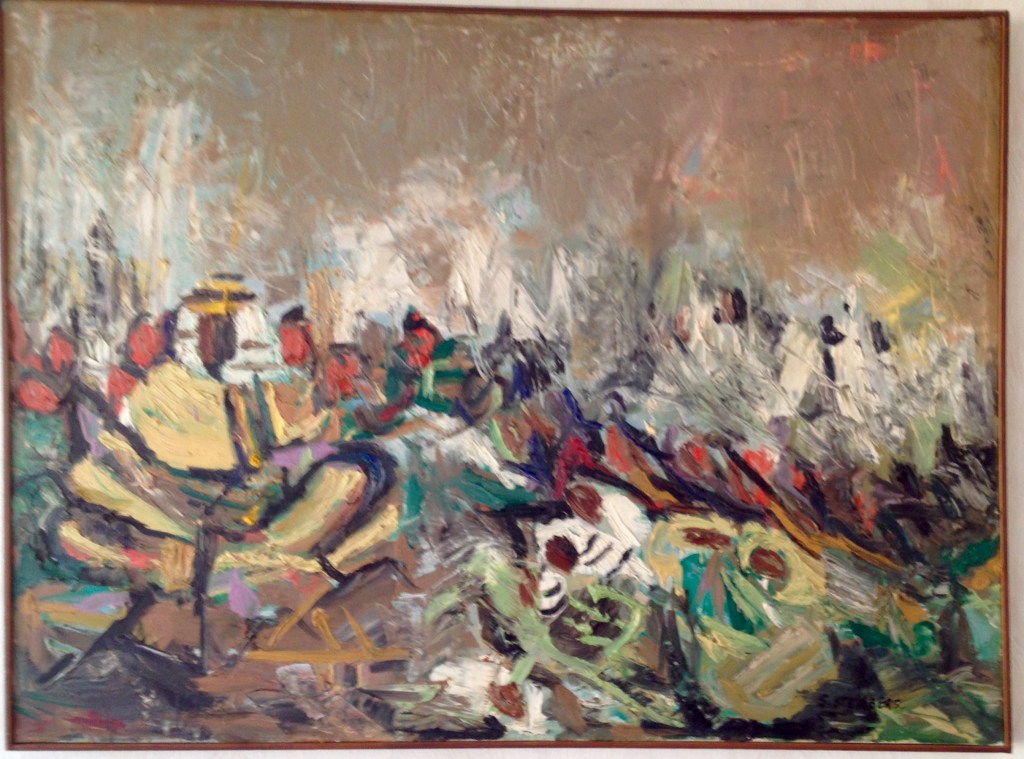
Joseph’s brothers bowing before him in Egypt (Original oil painting by Stefanie Steinberg, 1921 – 2023)
The painting above, by my late mother-in-law, captures the palpable anxiety of Joseph’s brothers. They fear for their lives as they bow before him in Egypt. At the climax of the story, Joseph reveals himself to his brothers. He forgives them for selling him as a slave to Egypt.
He moves his entire family to Egypt to escape the famine that gripped the Mediterranean world and set them up in the finest part of the land. After 17 years, their father Jacob dies. The brothers fear that Joseph will take revenge on them now that their father is dead.
But Joseph’s speaks tenderly to them saying, “Although you intended to do me harm, God has turned it to good…enabling me to save many lives.”
And so the book of Genesis ends with the animosity between Joseph and his brothers resolved, and his brothers ensconced comfortably in Egypt. If Genesis was a fairy tale it well have ended, “And they all lived happily ever after.
Unfortunately, we only get to enjoy this happy ending for one week. Then, we turn the page and begin the Book of Exodus.
For then we read that a new king arose. He either “knew not” or chose to ignore all that Joseph had done to save Egypt from famine and starvation. The economy, we may assume turned downward, and the Hebrews —once welcomed as honored guests — became personae non-grata.
The Torah’s narrative is the paradigm of our people’s experiences in every country we have ever lived. This has continued until the present time. We have no reason to think that our freedom and the status we enjoy here in North America will change. Still, we must not assume that the events that occurred in every place Jews have ever lived cannot happen here.
Iraq and Iran once hosted (as Babylonia and Persia) two of the most prosperous And well-acclimated Jewish communities in history. Ditto for the Jewish community in Spain before the expulsion and Inquisition beginning in 1492.
And of course, the Shoah perpetrated by the Nazis murdered one out of every three Jews in the world. It killed two out of every three Jews in Europe.
If you had asked a well-off Jewish person ten years before things went bad in any of the societies I cited above, they would have said, “It cannot happen here.”
So it should not surprise anyone that most Jews in North America today would also say, “It cannot happen here.”
I hope and pray that it won’t, and there are lots of good reasons to think that it won’t. But only a person who chooses to ignore history completely will say, “It can’t”
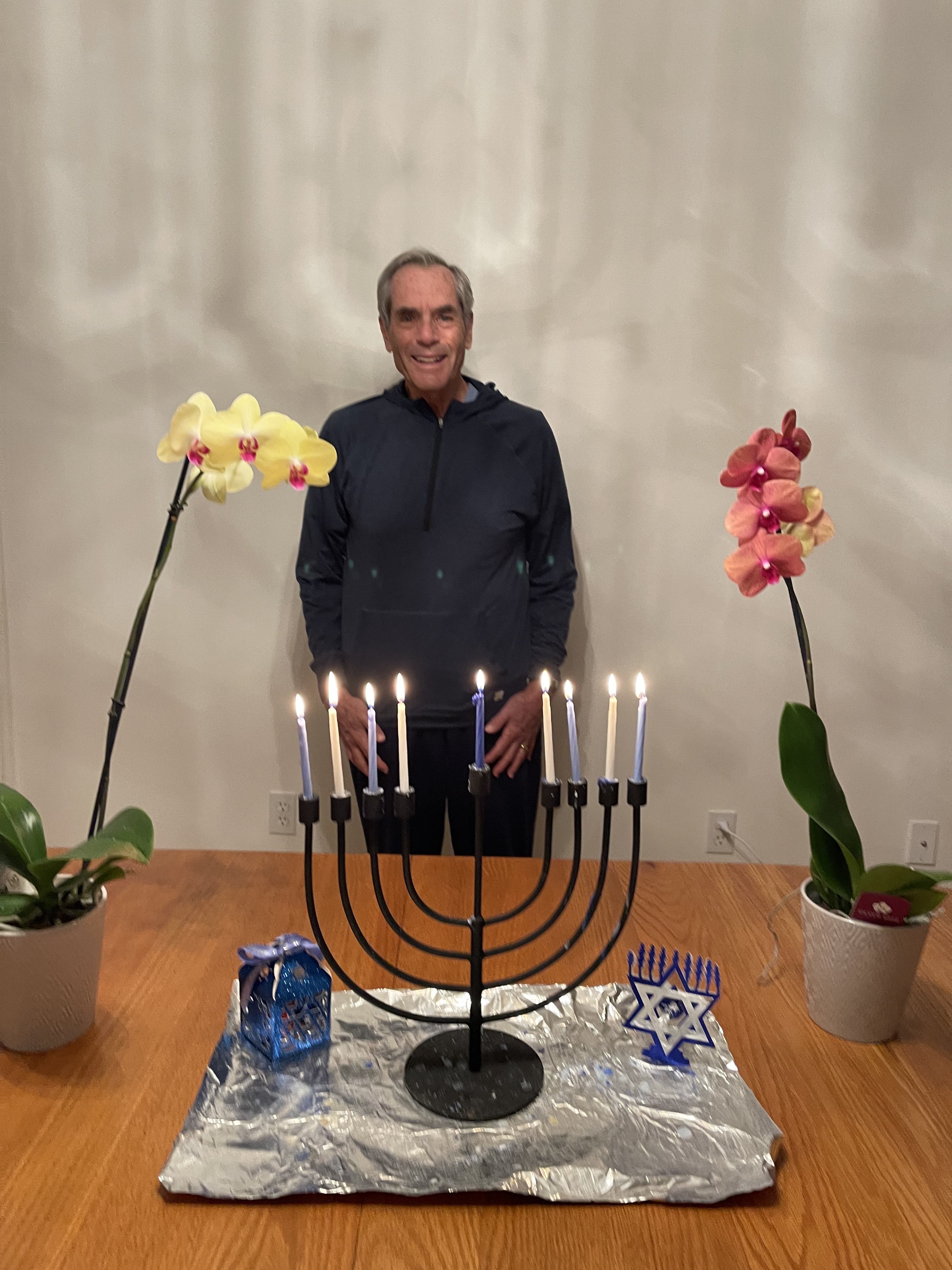
The candles glow brightly as the Chanukiah is full. While it is not a cold, snowy winter here in Vero Beach, it is still the darkest time of the year, and the Chanukah lights push back the darkness.
Coincidentally this year, the eighth night of Chanukah falls on New Year’s Day, a day that beckons us to contemplate the dreams of health and fulfillment that we hope the new year will bring.
Vickie and I chose to spend a good part of the day previewing, “The Boy in the Woods,” which I will discuss as part of the Treasure Coast Jewish Film Festival this Sunday.
It is what I call “hardcore” Holocaust film giving us yet another glimpse at the full extent of Nazi brutality. It is the true story of a boy who survived the horror, after his parents, sister and extended family were all murdered, by hiding in the woods for more than a year.
Now that I have seen the film, I have begun to read the book.
Maxwell Smart, born Oziak Fromm, is now 94. As a 12-year old boy he survived the Shoah by living in the woods, often in great peril, from Ukrainian or Nazi Jew hunters. He has survived and fulfilled his childhood dream of becoming a noted artist.
Inevitably, the film brings to mind the one and half million Jewish children who did not survive.
Were it not for the glow of the Chanukah lamp, the heart wrenching story would depress me even more than it does. The Shoah is not the first time Jews have suffered persecution and discrimination, and I fear it will not be the last.
But Chanukah lights remind us that no tyrant from Pharaoh in Egypt to Antiochus of Assyria, to Torquemada or Spain, to Titus of Rome, to Hitler in Germany, and the many others interspersed with these devils will ever succeed.
Only we Jews through indifference to our sacred heritage can destroy ourselves.
And so acknowledging what history has so frequently imposed upon us, we light and bless the candles in our full Chanukiot walking toward the light with courage and with hope.
Th Warrior Queen celebrates one year since major surgery for non-smoker’s lung cancer.
One year ago, on New Year’s Eve, my Warrior Queen was in the hospital of the Moffitt Cancer Center recovering from major surgery that removed 1/3 of her left lung that was afflicted with non smoker’s lung cancer.
Her recovery has been by no means easy. But she has been indefatigable!
With enormous courage Vickie has dealt with more kinds of pain than I can describe, adverse reactions to medication, coughing fits, sleepless nights and a never-ending array of tests, pokes and probes.
And yet she movesforward and continues to make amazing progress!
She has embraced — and been lovingly embraced by — the community of Temple Beth Shalom of Vero Beach, which I currently serve as interim rabbi. She does weights, Pilates, plays tennis (her overhead is better than mine as she does not hesitate to point out), and cheerfully endures lots of physical therapy.
I am in awe!
It would be premature to claim that she is “out of the woods,” but what is perhaps even more important is she lives and acts and strides forward as though she is.
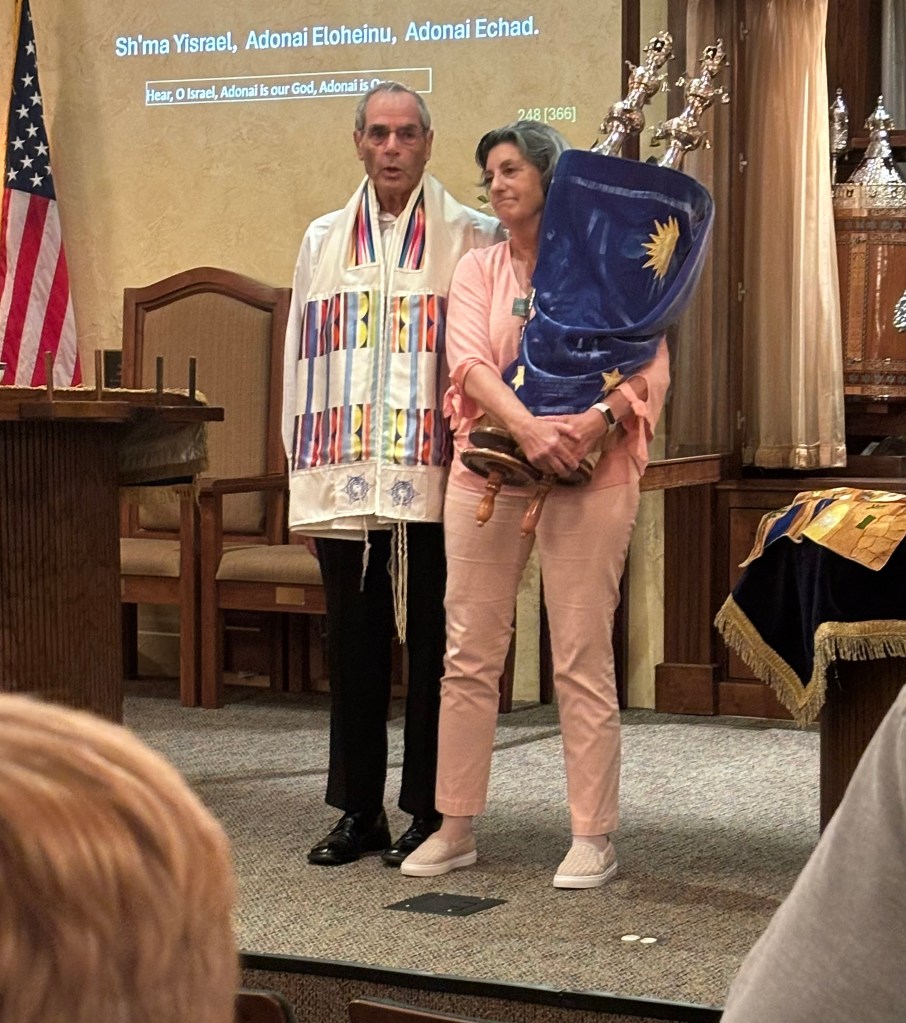
In the photo above she is holding the scroll of the Torah. As I stare at that photo, I find myself unsure of where The Torah ends and Vickie begins. She embodies all of the attributes of kindness, caring and courage which the Torah represents.
As we are about to enter a new secular year, my most ferventprayer is that she willcontinue to stride forward to thePromised Land of Cure.
“Caring, kind and brilliant,” are three words I would use to describe Doctor Andrew Packer.
Maybe, I thought, the reason he spent so much time and took so much care diagnosing and treating my retina issues was because I was his rabbi. In time, though, I came to know that Dr. Packer took the same exquisite care of every one of his patients.
I have seen more than my share of physicians over the course of my life, but Andy was one of the very few whose office I looked forward to visiting. His staff responded to him as though he walked on water. He was unfailingly considerate and gracious.
I thought of him as equal parts, physician, philosopher and Renaissance man! Often after services, he would ask a thoughtful question or share an observation that made me look closer at a text or make me rethink something I had said.
He was also in great physical shape, and he shared his passion for healthy living and the value of exercise with others. Often, I saw him at the JCC dressed in his bike riding gear just before or after he taught one of his spinning classes.
There is one other word I would use to describe Andy: gentle. When he put on that contraption with the bindingly bright light that Ophthalmologists use and looked deep into my eyes to examine my retina, it could be very uncomfortable. But knowing Andy’s face was behind that glaring lamp made the experience more bearable.
It has been several years since I have seen him at the gym, in his office or at the synagogue, but his soft-spoken caring manner I observed in each of those places still inspires me. His memory will endure in my eyes and in my heart as a blessing.
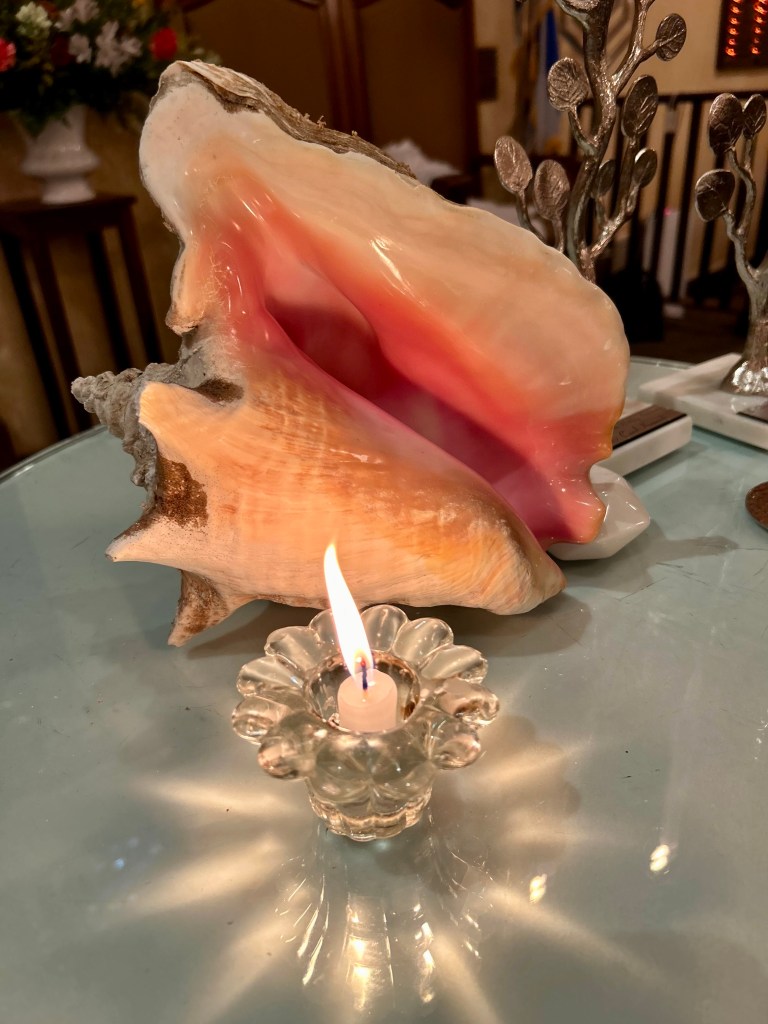
My Conch on the pulpit of Temple Beth Shalom, Vero Beach, on Rosh Hashanah
One of my always on file petitions to the Eternal One is, “Please, God, no deaths in the days before Rosh Hashanah because I am too busy preparing for the Days of Awe, Amen.”
As has happened several times over the years, God recently gave this prayer a, “No.” It saddened me to learn Gary Hodgkin’s, a congregant at Temple Beth Shalom in Vero Beach, FL, which I am serving this year as Interim Rabbi, had died.
I met with his widow Megan who shared they were both marine biologists and that they had met and gotten to know one another through their work. I had never met a marine biologist, so I asked, “What specifically do you focus on?”
“Conch,” she answered, a subject about which I knew nothing.
“And what do you do with these ‘conches,’” I asked?
“I grow them,” she answered modestly.
As we continued to talk, I learned that these magnificent shells with the eerily beautiful pink interior are pronounced, “Conk” and the plural is pronounced the same way, “like sheep,” she added.
A bit of research after I returned home revealed that professionally, Megan Hodgkins was Dr. Megan Davis, the world’s foremost expert on Conch. She is a research Professor at Florida Atlantic University and Principal Investigator at their Queen Conch Lab. She sets up conch aqua farms at several places along the Florida Keys and the Caribbean Islands. In these laboratory farms she and the many scientists she trained cultivate and grow conch embryos.
When they are sufficiently mature, she introduces them back into the ocean. There they continue to mature and feed on plankton which cleans up the seagrass and helps reverse some of the horrible ways we humans have polluted the ocean waters and grossly overfished Queen Conch for their meat and their beauty.
Dr. Davis’s work intrigued me, and I asked if might include some of what she had taught me in the Rosh Hashanah sermon I planned to deliver on how we humans have done a terrible job of fulfilling God’s charge in Genesis’ Creation Story to oversee and exercise prudent responsibility in caring for this planet God has entrusted to our care.
In agreeing, Dr. Davis helped re-steer my sermon from a lament of our failure to a hopeful concrete example of how we can reverse the ravages to the environment we humans have perpetrated.
When we met a second time in my office, Dr. Davis presented me with a gift I shall always cherish: A magnificent Queen Conch shell of my own. I placed it on the Bima in front of the congregation on Rosh Hashanah, and now it sits proudly on display in my office at the Temple. It will always symbolize for me that each of us can do something to make our world a better and more beautiful place.
Of course, I am very sorry for the reason I met Dr. Davis, but I hope it comforts her to know how her sacred life’s work of repairing the oceans eco system inspired the congregation on Rosh Hashanah.
Personally speaking, it will always inspire me to try to fulfill the essential message of this Holy Day season: to continually strive to do more to improve the world around me.
Since the presidential campaign of 2016, the mantra, “Make America Great Again,” has had a polarizing effect on our country. For supporters of Donald Trump they symbolize his plan for America’s future. For others they portend a frightening totalitarian society where bigotry, nativism, and restricted rights for women loom.
For me, the words, “Make America Great Again,” resonate with hope, but not in the way the former President intends.
While Trump, his acolytes, and his Republican challengers see America’s future greatness linked to severely restricting foreign immigration, I see large scale immigration as a great opportunity.
“We are overcrowded as it is,” some proclaim! “Where are these people going to live, and what are they going to do?”
We have room!
Over the past year and a half, I have driven several times between our home in Sanibel and the east coast of Florida. I have driven even more frequently between Sanibel and Tampa. The amount of open space I see on those drives boggles my mind. Throw in vast stretches of empty land in Texas, Oklahoma, Kansas… I went to college in upstate New York…lots of room there. In fact there is hardly a state that does not have enough empty space to comfortably build a small city for immigrants. So make no mistake, we have room.
Israel is a great example
In the 76 years of its existence, Israel, a country about the size of New Jersey, has thrown open its borders to afford an open-arms welcome to immigrants facing oppression in Arab lands, Nazi-occupied Europe, South America, the former Soviet Union, and Ethiopia.
Moreover, Israel provides a wonderful example to the United States in the way it prioritizes immigrant absorption as its most important industry. Israel offers its immigrants vital language immersion, job training, health care, low cost housing and many other services gratis. Providing the infrastructure for these services creates hundreds of thousands of jobs in that tiny country for engineers, contractors, construction workers, teachers, urban planners, doctors, nurses and support personnel. If tiny Israel can do it, so can we.
We hear so much about the Palestinian refugees displaced by the establishment of Israel in 1948. We hear far less about the equal number of Jewish refugees displaced during that same period from Nazi Germany and the Arab countries.
The Difference
The difference is that the Arab world, despite financial resources that dwarf those of Israel, chose to maintain its refugees in squalid camps that became and remain —like Gaza today— breeding grounds for hatred and terror against the tiny Jewish State.
Israel by contrast welcomed displaced Jews from all over the world, housed them, taught them Hebrew, and trained them for productive work. The result: The “Jewish Refugee Problem” problem quickly dissipated while the “Arab Refugee Problem” remains a shameful scar on the soul of the oil-rich Arab world to this day.
And so I suggest:
Let the United States take a huge step toward renewed greatness by welcoming refugees from oppressive regimes and making their successful absorption and acculturation into American society a top national priority.
Some years ago I proposed the former President donate his Mar A Lago estate to become an immigrant absorption and Welcoming Center. That would be a good symbolic first step
We could then build development cities all across the country, along the lines of those built by James Rouse in Columbia, Maryland and Reston Virginia. We need self-sufficient enclaves with affordable housing, fine schools, first class health care, and English language and job training.
Let us follow Israel’s example and put the Welcome Mat on America’s borders. My mind easily visualizes the number of outstanding potential doctors, lawyers, engineers, teachers, musicians, and other productive citizens that lie behind the frightened eyes of the children imprisoned in holding pens awaiting deportation back to the countries their parents fled with them in terror.
I think of the thousands of vital contributions made in America by those not born in America. I think of the nativist arguments promulgated by so many in the thirties and forties that condemned millions of Jews to death at the hands of the Nazis because — except for a fortunate few — those arguments closed America’s doors.
And finally, I think of the vision of what this country can be, symbolized by the words of Emma Lazarus engraved in the base of the Statue of Liberty:
Give me your tired and your poor, your huddled masses yearning to breathe free.
I believe with all my heart that the future greatness of America lies in the hearts and minds of today’s huddled masses yearning to breathe free. If we find the will to commit the resources and resolve necessary to welcome them and get them on their feet, they will become citizens whose talent and effort will help make America great again.