A Living Torah! Quick Comment: Parashat Massey (Numbers 33:1-36:13)

The Book of Numbers ends with a modification to the ruling that Zelophehad’s daughters could inherit their father’s property (Numbers 27).

The tribesmen of Zelophehad appeal the ruling saying if the daughters marry outside the tribe, the tribe’s holdings would diminish.

God and Moses uphold the appeal and rule that Zelophehad’s daughters are free to marry whom they wish but only within their tribe of Manasseh (Numbers 36:12).

Without diminishing the enormous gain for women’s rights that the original ruling represented, the appeal verdict maintains tribal integrity (perhaps not important to us but certainly important then).

As it turns out Zelophehad’s daughters victory opened the door to the expansion of women’s rights in subsequent Jewish law, a process that the rabbis of the Mishnah (200BCE – 200CE) pursued enthusiastically.

By the first pre Christian century Jewish law instituted the Ketubah, a contract, as the basis for marriage. It’s most important provision was a lien on the husband’s property for a substantial sum to be paid to the wife if he divorced his wife or if he died (Babylonian Talmud, Ketubot 82b).

Although technically a woman could not divorce her husband, the rabbis approved a broad array of circumstances under which a woman could take her husband to court, which would force the husband to divorce and pay his wife the value of her Ketubah. These circumstances included changing jobs or location without his wife’s consent, (Babylonian Talmud, 52b, 110b; Mishnah Ketubot 13:10) and refusing to try to meet her sexual needs, (Mishnah, Ketubot 5:6).

The final words of the Book of Numbers testify that the Torah must prudently adapt to changing realities while maintaining Torah’s sanctity. The Rabbis of the Talmud and MIshnah were up to that challenge. Are we?

We Need to Listen More — Quick Comment Parashat Mattot (Numbers 30:2-32:42)

The Greek philosopher Epictetus (55 CE -135) taught: “We have two ears and one mouth so that we will listen twice as much as we speak.”

Moses might have heeded this advice.

When the tribes of Reuben and Gad asked to settle on the east side of the Jordan to avail themselves of the fertile grazing land for their cattle, Moses flew into a rage and interrupted them saying, “How can you let your kinsmen go to war while you remain safe outside of the fray?

Only after a long angry rant did he hear them say:

“We will go as shock troops at the head of he invasion. Only when the land is settled and at peace will we return to our holdings on this side of the Jordan.” With the misunderstanding cleared up Moses and God consented to the tribes’ request. (Numbers 32:2-20)

Our Sages taught that the exile from Jerusalem and the destruction of the Temple (70 CE) came about not because of Roman might but because of “baseless hatred” among Jews.

More listening and less talking might have saved Judaean society in Roman times. More listening might save Israeli society today where the question burns? Who is a Jew?

Ultra-Orthodox authorities frequently declare that non-Orthodox Jews are not really Jews. Yet non-Orthodox Jews are the vast majority of the North American Jewish world. Without non-Orthodox Jewish support Israel could not survive.

Orthodox and non-Orthodox Jews have much to gain from constructive conversation and much to lose by avoiding it.

Hopefully we will learn to listen to one another, learn from one another, accept our differences as Jews, and put them aside when it comes time to work for a better world for all of God’s children.


For My German Readers: Korachs Kinder Kurzkommentar zum Tora-Abschnitt Pinchas (Nummeri 25, 10 – 30,1)

“Die Söhne Korachs starben nicht.” (Nummeri 26,11) Obwohl ihr Vater viele zu schwerer Sünde verleitete und Gott ihn entsprechend bestrafte, machte Gott Korachs Söhne nicht verantwortlich.

“Die Söhne Korachs starben nicht”, ist eine Metapher dafür, warum meine Frau Vickie und ich letztes Jahr zehn Wochen in Deutschland verbracht haben und werden es mit Eifer in diesem Herbst wieder tun.

Einer der beeindruckendsten Momente unserer Reise war, als unsere Gastgeber Pastor Martin Pommerening und Pastorin Ursula Sieg und ich Exodus 34,6-7 studierten. Der Abschnitt lehrt, dass Gottes Liebe und Güte bis in die tausendste Generation reichen, aber Gottes Ärger nur bis in die dritte Generation.

Jeder von uns predigte am nächsten Tag in einer Lutherischen Kirche über diesen Text und wir lernen alle voneinander.

Für mich ist der entscheidende Punkt des Abschnittes die große Differenz zwischen den Tausend und den Vier – zwischen Gottes Fähigkeit zu Liebe und Güte im Gegensatz zu seiner weniger ausgeprägten Fähigkeit zu Ärger und Strafe.

Es gibt einige biblische Beispiele (Deuteronomium 24,16; Jeremia 31,28-29; Hesekiel 18,19-20), die betonen, dass Kinder nicht verantwortlich gemacht werden dürfen für die Vergehen ihrer Eltern.

“Die Söhne Korachs starben nicht”, ist vielleicht das herausragendste Beispiel für diese wichtige Lehre.

Ich zitterte als ich in der Michaeliskirche sprach, weil es in dieser Kirche einen Pastor gab, Ernst Biberstein, der aus der Kirche austrat, um als Nazi ein Oberkommando zu übernehmen. In den Nürnberger Prozessen wurde er wegen des Mordes an tausenden Juden verurteilt.

Ich rief dem Geist Bibersteins zu: “Du wirst weiter in der Hölle verrotten, aber wir Juden sind immer noch hier!”

Dann sah ich Tränen bei vielen der Gottesdienstbesucher, als ich sagte:

“Ihr seid nicht verantwortlich für das, was dieser Mann tat. Wir können die Vergangenheit nicht ändern, aber die Zukunft gehört uns, um sie gemeinsam zu gestalten!”

Translation: with thanks to Pastor Ursula Sieg

Korach’s Children: Quick Comment: Parashat Pinchas (Numbers 25:10-30:1)

The sons of Korach did not die.” (Numbers 26:11)

Although their father led many into a grave sin, and was punished accordingly, God did not hold Korach’s sons responsible.

“The sons of Korach did not die,” is a metaphor for why my wife Vickie and I spent ten weeks in Germany last fall and will eagerly do so once again this year.

One of the most meaningful moments of our trip was when our hosts, Pastor Martin Pommerening and Pastor Ursula Sieg and I studied the Exodus 34:6-7. The passage teaches that God’s love and mercy extends a thousand generations, but God’s anger to only three or four.

We each preached in a Lutheran church on this text the next day, and we each learned from one another.

For me the point of the passage is the vast difference—between one thousand and four–between God’s capacity for love and mercy opposed to God’s much smaller capacity for anger and punishment.

There are specific biblical examples (Deuteronomy 24:16; Jeremiah 31:28-29; Ezekiel 18:19-20) that emphasize children are not accountable for their parents’ sins.

“The sons of Korach did not die,” is perhaps the most magnificent example of this vital teaching!

I trembled as I spoke at the Michaeliskirche in Kaltenkirche because the one time pastor of that church, Ernst Biberstein, left the church to become a Nazi Oberkommando. The Nuremberg tribunal convicted him of the deaths of thousands of Jews.

I addressed the ghost of Biberstein, saying, “You continue to rot in hell, but we Jews are still here!”

Then, I saw tears in the eyes of many worshippers when I said:

”You are not responsible for what this man did! We cannot undo the past, but the future is ours to shape—together!

Before You Sing Mah Tovu Again, Please Read This! // Parashat Balak (Numbers 22:2-25:9)

This essay originally appeared in:

Torah from Around the World

Published by The World Union for Progressive Judaism,


By: Rabbi Stephen Lewis Fuchs, Former World Union president, author of What’s in It for Me? Finding Ourselves in Biblical Narratives, and Rabbi Emeritus of Congregation Beth Israel, West Hartford, CT, USA. He can be reached at sl.fuchs@comcast.net, and his website, http://www.rabifuchs.com.


So many times, I have heard rabbis or Cantors announce, “We begin our service with Mah Tovu!” And then the rabbi, Cantor, choir and congregation or some combination of those resources begin to sing: “How lovely are your tents, O Jacob, your dwelling places, O Israel!“ (Numbers 24:5)

As thinking Jews, and especially as Progressive Jews, we should not be content to simply intone our prayers mindlessly.

We will enrich ourselves and our worship if we make the effort to understand what they mean, what their literary-historical context is, and most importantly, how can they help us live more meaningful Jewish lives.

This is particularly important with Mah Tovu.

When I first came to Israel as a student in 1970, I purposely woke up in time to hear the radio station begin its broadcast day with the singing of Mah Tovu! We say Mah Tovu each and every morning when we enter the sanctuary to remind us of the lesson of the biblical story from which it comes.

As the Children of Israel neared the end of their forty-year journey from slavery in Egypt toward the Promised Land, Balak, King of Moab, was afraid that we would overrun his land. So he hired Balaam, a world famous sorcerer, to put a curse on us so that his forces could defeat us. Despite all the riches Balak could offer, Balaam – try as he might – could only bless us with the words: “Mah Tovu! How lovely are your tents, O Jacob, your dwelling places O Israel…” (Numbers 24:5)

Balaam is perhaps the most enigmatic character in the Torah.

He was smart enough to be considered a prophet and even the intellectual equivalent of Moses. (Numbers Rabbah, 14:20; Babylonian Talmud, Sanhedrin 106A) And yet he was so dumb that he was clueless when even his donkey – an animal synonymous in all cultures with stupidity – perceived God’s will.

Indeed, it is a perplexing exercise to reconcile Balaam’s brilliance and his spiritual blindness, but in the end he sees the light and blesses Israel with the words we use to begin our prayers.
When we understand its biblical context, the prayer teaches us a vital lesson.

It is a lesson I have been privileged to teach over the past five years as visiting rabbi in Kiel, Potsdam, Berlin, Cologne, Hannover, Bad Segeberg, Prague, Vienna, Milan, Florence and Turin. It is a lesson I was proud to proclaim in my visits to 65 Progressive communities in Israel and around the world during my tenure with the World Union. It is a lesson that I hope lies at the heart and soul of our mission as Progressive Jews wherever we find ourselves on this planet.

No outside force – no Balak, King of Moab, no Pharaoh, no Haman, no Antiochus, no Torquemada, no Tsar, and no Hitler, no one – can ever destroy us! Only we can %destroy ourselves. We can destroy ourselves by turning away from our sacred Covenant. We can destroy ourselves by not seizing every opportunity we have to re-enforce the Covenantal imperatives with which God charged Abraham and Sarah in order to make our world a more just, caring and compassionate place for everyone:
Be a blessing (Genesis 12:2)
Walk in God’s ways and live lives that are worthy of them (Genesis 17:1)
Be living examples and teach our children to be living examples of Tzedakah and Mishpat, of justice and righteousness. (Genesis 18:19)

No! No outside force has ever destroyed us, and please God, none ever will. But we can destroy ourselves through apathy to our ideals and assimilation to the ways of the world around us.

We can destroy ourselves by ignoring our obligation to care deeply not only about Jewish life in our own communities but about the viability of meaningful Progressive Jewish life and its ideals in all of North America, Israel, Europe, the Former Soviet Union, Africa, Australia and New Zealand–everywhere.

No! No outside force can destroy us, but we can destroy ourselves by failing to apprehend and appreciate the message of the prayers we say, and failing to find purpose and meaning in our lives as Jews! With and only with that understanding, should we begin our service with Mah Tovu!

“Wir sind alle verschieden dumm!” Kurzcommentar: Balak

Bileam war ein Weltklasse – Zauberer, der – so behaupten die Weisen – so brillant war wie Mose selbst (Bemidbar Rabbah 14, 20). Aber in dieser Geschichte ist der Bote Gottes für Bileam völlig verborgen, aber sein Esel sieht den Engel deutlich. Wow!

Die Geschichte lehrt uns niemals auf jemanden herab zu sehen!

In der Grundschule war ich ein guter Schüler und (ich geb das nicht gerne zu) schaute auf die herab, die Schwierigkeiten hatten. Aber in Werken war ich der Schlechteste! Als mein erstes Werkstück fertig werden sollte, ging ich zum Lehrer um es mir erklären zu lassen. Aber es verwirrte mich und ich bat ihn, es bitte zu wiederholen.Er schrie mich wütend an und sagte: “Du hast nicht zugehört! Für heute bin ich mit dir durch!” Da saß ich nun mit den Tränen kämpfend und brachte nichts zustande, während die anderen ihre Arbeit machten.

Ich hab’s begriffen!

In Werken war ich der “Blödmann” und all die, die in den wissenschaftlichen Fächern nicht so gut waren, waren plötzlich viel klüger als ich. Was für eine wichtige Lektion war das für meinen Beruf als Rabbi!

 Wie mein früherer Eishockey Trainer Gilbert F. Adams zu sagen pflegte: “Wir alle sind verschieden dumm!”

Alle haben wir Stärken und Schwächen. In der Bileam-Erzählung war der Esel, das dümmste aller Tiere, fähig dem intelligentesten Menschen der Welt zu helfen das Licht zu sehen.

Was lehrt die Geschichte mich und dich?

Rabbi Simeon ben Zoma sagt es am besten: “Wer ist weise? Derjenige, der von allen lernt!” (Pirke Avot 4:1)

Dem möchte ich bescheiden hinzufügen: Und wer auf niemanden herab sieht!

Translation: with thanks to Pastor Ursula Sieg

Übersetzung: Pastor Ursula Sieg

Steffi

Steffie's 94th birthday celebration
Steffi’s 94th birthday celebration
Vickie sits with our Pastor friends Ursula Sieg and Martin Pommerening in the sukkah they built for us at their home in Bad Segeberg, Germany.

A Surprising Request

Vickie and I were thrilled to learn that Pastor Ursula Sieg and her husband Pastor Martin Pommerening were coming to visit us in America. When we asked if there was anything special they wanted to do during their visit, they said, “If it is at all possible we would like to travel with you to San Francisco to meet Vickie’s mother, Stefanie Steinberg.” Although the request surprised us, it was an opportunity we eagerly embraced.

For our visit to Germany last fall, Ursula created and curated a remarkable exhibit about Stefanie’s life and travels. As a young child, Steffi had to leave her native Breslau and flee to Spain with her parents when the Nazis took over Germany.  Not long thereafter, they had to flee again—this time to Switzerland—during the Spanish Civil War.

Eventually Steffi made her way to New York, then across the country to Los Angeles and ultimately to San Francisco. At 94, she is still active as an artist, who is well-known for her paintings, photography and collages. For several years now, she has done much of her work on her computer. She lives independently and keeps alert and in great shape by attending lots of lectures and classes, and working in her garden. She gave her most recent presentation to the San Francisco Women Artists, of which she is a past president, earlier this year.

“Why do you want to go to Germany?”

When we told her that we planned to spend ten weeks in Germany last fall, Steffi did not like the idea. Given all she had endured at German hands, her reaction did not surprise us.

As the weeks unfolded, it pleased her that her life had become the vehicle for German students to learn about the Holocaust and the basics of Jewish living in a more effective way than books alone could ever teach. Many of these students had never met a living Jew before Vickie and I came to their school.

Never Again!

By the time Vickie and I left Germany, several of the students had sent Steffi very touching emails and voice messages. They wrote that they would do all in their power to insure such horrors never happened again to anyone. The bond the students forged with her has been a healing balm for Steffi.

In addition, Vickie and I had the joy last January of presenting Stefanie Steinberg with an honorary diploma from the Holstenschule in Neumünster accompanied by a beautiful letter of gratitude from the Headmaster. The gesture touched Steffi deeply especially since the Nazi take over in Germany forced this erudite and accomplished woman to suspend her formal education years before she could graduate from high school.

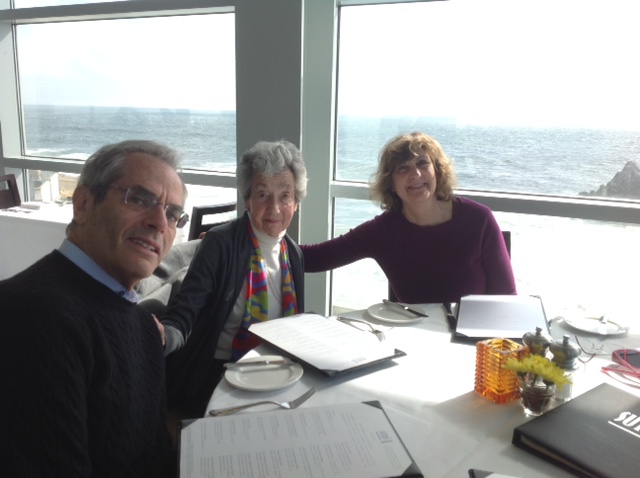
For all of these reasons Steffi was thrilled when Vickie told her that Ursula and Martin were coming to visit her. When the big day came, they embraced like long-time friends. Steffi found more photos to give to her visitors because the exhibit will travel to other schools when Vickie and I return to Germany in September. Then the five of us enjoyed a sumptuous dinner overlooking the Pacific to celebrate Steffi’s 94th birthday.

A Fitting Celebration

It was a wonderful way to honor a remarkable woman whose life and work will always stand to testify against the horror that the Nazis reigned upon Europe. And it was a wonderful way as well to honor two visionary Lutheran pastors who are making heroic efforts to help Germans confront the horror of their past and replant Jewish life in the land where it once bloomed so beautifully.

Vickie presenting the honorary diploma to her mother.

For my German readers: War Gott unfair? Kurzkommentar zu Parashat Hukat (Numeri 19-22:1)

Der Tora-Abschnitt dieser Woche erzählt, dass sich die Israeliten beschweren, weil sie kein Wasser haben. Gott weist Mose an, zu einem bestimmten Felsen zu sprechen, dann wird Wasser heraus kommen. Aber Mose verliert die Beherrschung und haut seinen Stock drei mal gegen den Stein und das Wasser sprudelt heraus (Numbers 20: 10-11).

Gott ist außer sich. Mose ließ es so aussehen, als wenn er, nicht Gott, den Felsen dazu gebracht hätte, Wasser hervor zu bringen.

Doch Gottes Urteil erscheint unangemessen hart.

“Weil du nicht genug Vertrauen hattest mich zu heiligen vor den Augen der Kinder Israels, sollst du sie nicht in das Land führen, dass ich ihnen geben will” (Numeri 20:12).

Wie kann Gott so gemein sein?

Auch wenn wir zustimmen sollten, dass es ein schwer wiegendes Vergehen war, erscheint die Strafe zu schwer.

Letztlich verfehlt das Gerede gegen Gottes Übermaß den springenden Punkt. Moses Zeit war vorüber. Er war zu alt um die Militäroffensive anzuführen, die nötig war um das Verheißene Land zu erobern. Sie erfordert einen jungen, energischen Anführer, dem das Volk ohne Zögern folgt. Das war Josua. Und wenn Mose noch dabei wäre, wenn Josua befiehlt: “Angriff!”, würden einige auf Mose blicken mit der Frage, ob “Angriff!” Wirklich das ist, was sie tun sollten.

Was können wir aus dieser Geschichte lernen?

Jeder von uns hat nur begrenzte Möglichkeiten zu leiten und zu beeinflussen. Wenn unsere Zeit um ist, müssen wir wie Mose, abtreten und neuer Leitung platz machen.

Zu viele Menschen lamentieren darüber, was sie hätten tun können, als sie die Möglichkeit dazu hatten.

Unsere Zeit ist begrenzt.

Also müssen wir wie Mose tun was wir können, wenn wir es können. Hoffentlich werden wir dann auch bemerken, wann es Zeit ist, die Herrschaft abzugeben.

Translation: with thanks to Pastor Ursula Sieg

Was God Unfair? Quick Comment: Parashat Hukat (Numbers 19-22:1)

In this week’s Torah portion, the Israelites complain because they have no water. God tells Moses to address a certain rock, and water will come forth. But Moses loses his temper and bangs his staff three times against the rock, and water comes gushing forth. (Numbers 20: 10-11)

God is furious! Moses has made it appear that he, not God, had caused the rock to yield water.

But God’s sentence seems unduly harsh.

“Because you did not show enough faith in me to affirm my holiness in the eyes of the Children of Israel, you shall not lead the community into the land I am giving them” (Numbers 20:12).

How could God be so cruel? Even if we agree that, the offense was serious, the punishment seems too severe.

Ultimately, ranting against God’s excess misses the point.

Moses’ time had passed. He was too old to lead the military campaign necessary for the Israelites to conquer the Promised Land.

Such a campaign required a young, vigorous leader whose voice the people would obey without hesitation. Joshua was that man, and if Moses were still around when Joshua said, “Charge!” some would look to Moses to see if “Charge!” was what he really wanted them to do.

What does the story teach us?

Each of us has limited opportunities to lead and to influence. When our time is up, we like Moses, must step aside for new leadership.

Too many people lament what they should have done when they had the chance. Time is finite, and so like Moses, we must do what we can, when we can. Hopefully, we will recognize when it is time to relinquish the reigns.

For My German Readers: Ein Leckerbissen für Antisemiten und eine Warnung an uns! Kurzkommentar zu Korach (Numeri 16-18)

Der Abschnitt Korach ist ein “Leckerbissen für Antisemiten”. Sie zitieren ihn als Beleg, dass der Gott der Tora und der Hebräische Bibel eine rachsüchtige, wütende Gottheit ist, die die Erde öffnet um die zu verschlingen, die Moses Autorität in Frage stellen.

War Gott wirklich so böse?

Obwohl es so scheint, als würde der Tora-Abschnitt es so erzählen, handelt diese Geschichte überhaupt nicht von Mose. Es geht um die Autorität von Aaron und der erblichen Priester-Klasse, die die Kontrolle über die alte jüdische Gesellschaft übernommen hatten. Sie wollten Widerspruch zum schweigen bringen.

Als die Tora ihre heutige Form erhielt (in der Mitte des 5. vorchristlichen Jh.) ist Mose eine verehrte historische Person, wie wir sie nie wieder sehen werden. Aber er ist eben Geschichte.

 Die Aaroniten (die erblichen Nachkommen Aarons) waren zu der Zeit an der Macht, und die Geschichte von Korach und seinen Leuten war die beste Möglichkeit, ihrer Autorität die göttliche Imprimatur zu verleihen. Es ist eine Botschaft an jeden, der es wagte die Autorität der Priester in Frage zu stellen, dass der EwigEine die Erde öffnen und sie verschlingen würde.

Aber was steckt da für uns drin? Wie spricht dieser Tora-Abschnitt heute zu uns?

Die Korach-Geschichte ist eine wunderbare Warnung vor Anmaßung. Sie erinnert uns daran, dass wir uns, bevor wir gegen Autorität protestieren, fragen ob wir eine legitime Beschwerde haben, oder ob wir, nachdem sie all die Arbeit gemacht haben – bloß Ehre und Aufmerksamkeit auf uns ziehen wollen.

Der Gott, dem ich diene, begrüßt aufrichtigen Widerspruch und Meinungsverschiedenheit, wenn wir versuchen die Welt zu einem besseren Ort zu machen.

Es ist unglücklich, dass die Priester in alter Zeit denen, die das Judentum verachten, eine Rechtfertigung geliefert haben, das wahre Wesen des EwigEinen anzufeinden.

Translation: With thanks to Pastor Ursula Sieg