Eine der wichtigsten Neuerungen des Reformjudentums war es, die Tora-Lesung für den Morgengottesdienst von Jom Kippur zu ändern, wenn wahrscheinlich mehr Menschen die Toralesung hören als irgend sonst.
Die traditionelle Lesung ist Levitikus, Kapitel 16, über den Sündenbock. In dem Abschnitt überträgt der Priester symbolisch die Sünde des Volkes auf den Kopf eines unschuldigen Ziegenbocks, der sie von den Menschen wegträgt in die Wildnis.
Den Abschnitt, den unsere frühen Reformer stattdessen auswählten, ist eine brillante Wahl: Deuteronomium 29 und 30. Hier wird die Verantwortung für Wiedergutmachung und Besserung direkt auf unsere eigenen Schultern gelegt. Wir können unsere Übertretungen nicht auf einen Sündenbock übertragen.
Die Rabbiner kämpften lange mit den Ideen des freien Willens und dass Gott alles weißbevor es geschieht.
Der große Weise des Mittelalters Rambam (Moses Maimonides 1135-1204) hat ausführlich über diese Frage geschrieben (Hilkhot Teshuvah, Kapitel IV). Ich versuche seine Sicht so kurz wie möglich zusammen zu fassen:
Jeder hat den freien Willen gut oder schlecht zu sein. Aber wer kann immer tun, was er oder sie tun möchte? Könnten wir überhaupt etwas tun, wenn Gott es uns nicht erlauben würde?
So wie Gott will, dass Feuer und Luft aufsteigen und sich Wasser und Erde abwärts bewegen, so wünscht Gott, dass Menschen einen freien Willen haben. Deshalb musst du wissen, dass deine Handlungen in deiner eigenen Macht liegen und du dafür Rechenschaft ablegen musst.
Für den Fall, dass das verwirren sollte, schließt Rambam mit den Worten:
Wisse, dass der menschliche Geist das wahre Wesen des Schöpfers nicht verstehen noch offen legen kann.
Am Ende kann der Rambam nur das rätselhafte Talmudisch Wort ausführen: ”Alles ist vorhergesehen, aber der freie Wille ist gegeben.” (Pirke Avot 3:19)
Aus meiner Sicht fasst dieses Wort zusammen, warum der Abschnitt aus Deuteronomium (gipfelnd in 30:19) die perfekte Lesung ist für Jom Kippur: “Siehe, ich habe dir heute vorgelegt Leben und Tod, den Segen und den Fluch. Deshalb wähle das Leben und deine Nachkommen werden leben.”
Translation: with thanks to Pastor Ursula Sieg
Unsere Wahl ist entscheidend und der Versöhnungstag ermahnt uns, sie in der Weise sorgfältig zubedenken, wie von ihr unser Leben abhängt.
One of the great innovations of Reform Judaism was changing the Torah reading for Yom Kippur morning when arguably more people will hear the Torah than any other.
The traditional portion is about the scapegoat from Leviticus, chapter 16. In that portion the priest symbolically transfers the sins of the people onto the head of an innocent goat that carries them away from the people out into the wilderness.
The portion our early Reformers substituted was a brilliant choice, a passage from Deuteronomy 29 and 30 that places responsibility for atonement and self-improvement squarely on our own shoulders. We cannot transfer our transgressions onto a goat.
The rabbis long struggled with the contradiction between the ideas of free will and of a God who knows everything that will happen.
The great medieval Sage Rambam (Moses Maimonides 1135-1204) wrote extensively on this question (Hilkhot Teshuvah, chapter IV). To summarize his view as succinctly as possible:
Everyone has free will to be righteous or wicked. But how can one always do as he or she wishes? Can we ever do anything with God’s permission?
Just as God wishes that fire and air ascend and water and earth descend, so God wishes humans to have freedom of will. Therefore, know that what you do is in your power, and you must give a reckoning
(If this seems confusing, the Rambam concludes):
Know that the human mind cannot apprehend or discover the real essence of the Creator.
In the end the Rambam could only elaborate on the enigmatic Talmudic statement: ”All is foreseen yet free will is given.” (Pirke Avot 3:19)
For me that conclusion sums up why the Deuteronomy passage (culminating in 30:19) is perfect for Yom Kippur:
“See I have set before you this day life and death the blessing and the curse. Therefore choose life that you and your descendants may live.”
Our choices matter, and the Day of Atonement admonishes us to consider them as carefully as if our lives depend on them.
Der Anfang dieses Wochenabschnittes der Tora ist so wichtig, dass wir ihn das Jahr hindurch dreimal lesen.
Erstens bezieht sich der Anfangsvers ganz klar auf das “Fest der ersten Früchte”, das Schawout – Fest: “Wenn du in das Land kommst … nimm die ersten Früchte… leg sie in einen Korb… reise nach Jerusalem und freue dich dort vor dem EwigEinen, deinem Gott, du und der Fremde, der bei dir wohnt. (Deuteronomium 26, 1-11)
Wir feiern unsere Ernte indem wir anerkennen, dass es nicht unsre eigene Kraft, sondern Gottes Segen ist, der unseren Wohlstand möglich macht. Deshalb müssen wir großzügig mit den Armen und den Fremden teilen.
Zweitens beginnt der wichtige Abschnitt Maggid (Erzählung) der Pessach-Haggada mit Worten aus diesem Wochenabschnitt. Sie erzählen von der Entstehung unseres Volk. Wir fingen mit nichts an, wurden Sklaven und kamen da heraus zu Freiheit und Wohlstand. Deshalb ist es unsere heilige Verpflichtung anderen zu helfen, den gleichen Weg zu finden.
Es kann kein Zufall sein, dass wir nun wieder auf diesen Abschnitt stoßen, zwei kurze Wochen vor Rosch haSchanah, zur Zeit der Erforschung und Ordnung unseres Lebens.
Drei Mal im Jahr betont unsere Tora-Lesung den Bund, dass Gott mit unseren Vorfahren ist und mit uns! Als Gegenleistung erwartet Gott von uns Fremde unter uns gerecht zu behandeln.
Tatsächlich sind es nicht nur drei Mal im Jahr, sondern 36 Mal – mehr als jedes andere Gebot -, dass die Tora uns ermahnt, Fremde mit Würde und Respekt zu behandeln.
Wie behandeln wir die Fremden? Das ist eine Frage, auf die, so glaube ich, Gott von jedem von uns persönlich und von Israel als dem Staat unseres Volkes, bessere Antworten erwartet, als wir sie derzeit geben.
The beginning of this week’s Torah Portion is so important that we read it three times during the year.
The opening verses clearly refer to the Festival of First Fruits, the Festival of Shavuot. “When you come into the land … take your first fruits … put them in a basket …” travel to Jerusalem and “rejoice there before the Eternal One your God, you and the stranger who is among you.” (Deuteronomy 26 1-11)
We celebrate our harvest by acknowledging that it is not our own might but God’s blessing that makes our prosperity possible. There for we must share generously with the poor and the stranger.
Second, words from this portion begin the vital maggid (narrative) section of our Passover Haggadah. They tell of our emergence as a people. We started out with nothing, became slaves and emerged to freedom and prosperity.
It is our solemn obligation, therefore, to help others make the same journey.
It cannot be an accident that we come upon this portion again now, two short weeks before Rosh Hashanah, a time to examine and reorder our lives.
Three times a year our readings emphasize the Covenant that God with our ancestors and with us! In return God demands that we act righteously to the stranger among us.
Actually it is not just three times a year but thirty-six times—more than any other commandment—that he Torah insists that we treat the stranger with dignity and respect.
How should we treat the stranger? I do not have all the answers.
But it is, i contend, a question to which God demands better answers than we now give, from each of us as individuals and from Israel as the nation-state of our people.
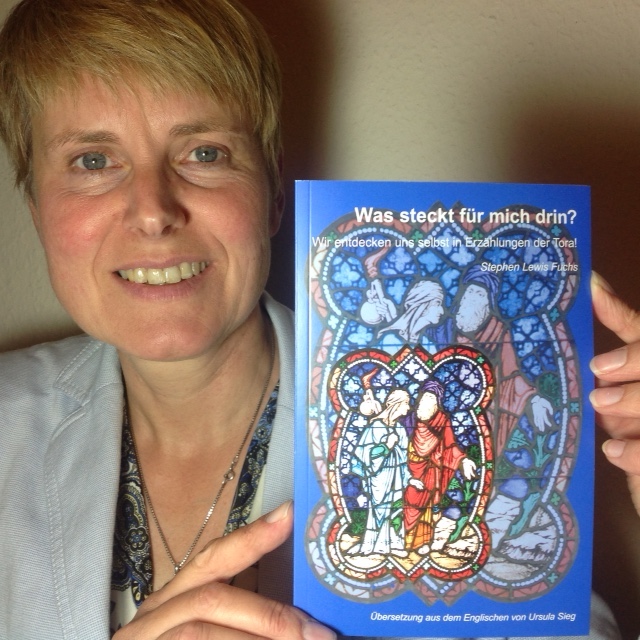
The photo above represents the fulfillment of a dream. Pastor Ursula Sieg undertook to translate and see to the publication of a German edition of my book, What’s in It for Me? Finding Ourselves in Biblical Narratives. On a trip to the United States Ursula and her husband Pastor Martin Pommerening and I spent hours in the magnificent sanctuary of Congregation Beth Israel with professional photographer Lena Stein searching for just the right cover art for the German edition. The photo they chose—most appropriate—is of Abraham and Sarah beginning the faith journey that launched not only the Jewish religion but Christianity and Islam as well.
In order to bring this project to fruition, Pastor Sieg enlisted the expert editorial skills of Dr. Serafine Kratzke and established a publishing house that she named “Mutual Blessing Edition.” Pastor Sieg’s passion for creating greater inter-religious harmony and her belief in the value of What’s in It for Me?inspired her to put many months of effort into the publication.
It all began in the summer of 2012 when Pastor Sieg and I met during the time she studied at Hartford Seminary while on Sabbatical from her post as Head of School-Church Relations in a district of the Lutheran Church in Northern Germany. Neither of us realized at that time how mutually beneficial our conversations would become.
A year later Pastor Sieg then visited Vickie and me for Chanukah while I was serving as Visiting Rabbi at Congregation Beth Shalom in Milan, Italy. Pastor Sieg made a very positive impression on all of the congregants who met her.
There our conversations deepened, and she began making arrangements to bring Vickie and me to northern Germany for ten weeks the following year. In preparation for that her husband, Pastor Martin Pommerening convinced his church board to remodel their pastorate to accommodate Vickie and me in a gracious manner as their guests for ten weeks.
Vickie and I will never forget looking from our balcony as Sukkot approached and seeing Ursula and Martin in the garden secretly constructing a sukkah so that we could celebrate our harvest holiday as we do at home. They then welcomed local guests to sit in the pastorate’s Sukkah! It was also our pleasure to invite them for Shabbat dinner in their own home several times.
Vickie sits with our Pastor friends Ursula Sieg and Martin Pommerening in the sukkah they built for us at their home in Bad Segeberg, Germany.
As a major focus of our visit Pastor Sieg conceived, created and curated a marvelous exhibit, Back Home – New Jewish life in Schleswig-Holstein, together with several students and their teacher Wolfgang Henke at the Holstenschule in Neumünster.The museum quality exhibit chronicled the life and travels of Vickie’s 94-year-old mother, Stefanie Steinberg.
Born in 1921, Stefanie’s childhood came to an abrupt end when her family had to flee her native Breslau from the Nazis and settle in Spain in 1936. Six months later the Spanish Civil War broke out, and Stefanie’s family had to flee again all to different places. Stefanie lived in an orphanage in Switzerland until barely a month after her seventeenth birthday. In 1938 she and her mother boarded ship in France to begin a new life in a new country for the third time in two years. Eventually she made her way to California by herself. She reconnected there with a gentleman she met on the ship coming to the USA, Richard Steinberg. They married and settled in Los Angeles and then in San Francisco.
The Holstenschule displayed the exhibition of three weeks. Hundreds of students saw it and met Vickie and me for lectures and conversation. Many of them had never before met living Jews.
In other duties I served as visiting rabbi at the Jüdische Gemeinde in Kiel, preached in several Lutheran Churches and spoke at the Anne Frank Schule in Bargteheide. I also delivered the semester opening lecture of the University of Potsdam School of Jewish Theology and conducted a seminar for rabbinical students at the Abraham Geiger College in Berlin.
Pastor Sieg also arranged for me to experience one of the emotional highlights of my life: Speaking at three different Kristallnacht commemoratives in Leipzig, the city where my father, of blessed memory, was arrested that fateful night. I spoke at the stream that flows through the city zoo where Jews were forced to stand while people jeered and threw mud at them, at the site of the Great Synagogue in Leipzig, burned to the ground on Kristallnacht and now a haunting memorial, and at the famous Thomaskirche where Johan Sebastian Bach once served as organist and choirmaster.
Whenever I spoke in English, Pastor Sieg translated my words into German as I went along. When I wanted to deliver two of my Leipzig speeches in German, I wrote them out, and Pastor Sieg translated them for me. Then she painstakingly drilled me—over and over—on my German pronunciation.
Our trip last year inspired Pastor Sieg to want us to come back again this year. Again she spent many hours over several months making all of the arrangements.
This year Back Home will tour six different schools. Vickie and I will visit each of them to talk with the students. Pastor Sieg has also arranged several events promoting the German edition of What’s in It for Me? I shall once again, preach and speak in several Lutheran Churches, and it will also be my privilege to conduct two seminars at the Abraham Geiger College in Berlin.
I have also accepted the invitation to conduct High Holy Day services at the Reform synagogue in Bad Segeberg. Currently, the Bad Segeberg community worships and holds its educational and social activities in a beautiful building. But when the synagogue first started 13 years ago, the leaders knocked on the door of Ursula and Martin’s pastorate who welcomed their Jewish neighbors with open arms and provided the facilities for them to meet during their early years. Without Ursula and Martin’s enthusiastic cooperation, the Bad Segeberg synagogue might never have gotten off the ground.
At that time Pastors Sieg and Pommerening took the initiative to establish an annual interfaith community event to show the public in Bad Segeberg how different religions live together peacefully. The purpose of this event is to prevent attempts to misuse the differences between religions to create hate or resentment. It was a joy for Vickie and me to participate in this Day of Harmony last year.
A few months ago, Pastor Sieg suggested that I write a short (300 words) Quick Comment on the Torah portion of the coming Shabbat. She offered to translate each one into German so that German readers will have greater access to my ideas and will therefore be more eager to read the German edition of my book. We began this process at the end of Exodus and think that a side-by-side edition of English and German Torah commentaries might one day make another worthwhile book.
What motivates Ursula to do all of these wonderful things? First she is a lover and keenly critical reader of the Hebrew Bible. She believes my thoughts and teachings about the Torah can deepen it’s understanding for Jews, Christians and everybody else. Second she hopes to help repair the broken relationship between and Jews and non-Jews in Germany and to ease the pain of Holocaust survivors. Finally she wants Germany to be a warm, welcoming place for people of all faiths to live together in harmony.
If Pastor Sieg simply tended to the day-to-day needs of her very busy schedule, she would have more than enough to do. The fact that she eagerly and cheerfully works so hard to create a positive interfaith climate in Germany is truly remarkable.
“Du sollst dich, wenn du siehst, dass deines Nachbarn Ochse oder Schaf sich verlaufen hat, nicht abwenden. Ganz gewiss musst du es zu ihm zurück bringen.”
Ein früherer Abschnitt (Exodus 23, 4-5) erinnert uns daran, dass diese Pflicht sogar besteht, wenn der Besitzer des verloren gegangenen Tieres unser Feind ist.
Die Tora ist unnachgiebig, wenn es darum geht, wie wir unsere Mitmenschen behandeln sollen, auch die, die wir nicht mögen.
Eine Anekdote, die vom berühmten Gelehrten des 19. Jh. und Gründer der Musar – Bewegung. Yisroel Salanter erzählt wird, illustriert diese Idee: Es war der Abend des Yom Kippur, dem heiligsten Tag des Jahres. Die Synagoge war rappelvoll mit Gottesdienstbesuchern, die auf den Rabbi warteten, um die das Kol Nidre zu beten. Aber der Rabbi war nirgends zu finden. Das Fehlen des Rabbiners erschreckte die Gemeindeältesten, denn er kam immer sehr rechtzeitig vor Beginn des Gottesdienstes zur Synagoge.
Ein eilig organisierter Suchtrupp suchte alles ab und fand den Rabbi schließlich. Er lenkte ein störrisches Kalb zurück in den Stall seines nicht-jüdischen Nachbarn.
“Rabbi, wo bist du gewesen,” forderten die Gemeindeleiter eine Erklärung?“Weißt du denn nicht, dass alle auf dich in der Synagoge warten, um das Kol Nidre zu beten?”
“Ja”, sagte Rabbi Yisroel, “es tut mir leid. Aber ich konnte einfach meinen heiligen Pflichten des Versöhnungstages nicht nachkommen, solange dieses arme, hilflose Tier in sein Verderben läuft.”
Somit erlaubt der die jüdischen Gesetze streng befolgende Rabbi Salanter keiner jüdischen Vorschrift, der Pflicht, einem Menschen zu helfen, zuvor zu kommen.
Was für ein wunderbares Beispiel für uns alle!
Erläuterungen:
Musar – Der Begriff musar stammt aus den Proverbien (Sprüche Salomos) 1,2 und bedeutet: Disziplin. Die Beschäftigung damit wird gegenwärtig wieder populär.
Kol Nidre – “Alle Schwüre”: ein Gebet, das nur einmal im Jahr zu Beginn der Gottesdienste zu Jom Kippur gesprochen wird.
“You shall not watch your fellow’s ox or sheep gone astray and hide yourself from them. You must certainly bring them back to him.” (Deuteronomy 22:1)
An earlier passage (Exodus 23: 4-5) reminds us that this obligation applies even if the owner of the lost animal is our enemy.
The Torah is adamant in telling us how we must treat our fellow humans, even those we do not like.
An anecdote told about the famed 19th century scholar and founder of the Musar* movement, Yisroel Salanter, illustrates this idea:
It was the Eve of Yom Kippur, the holiest day of the year. They synagogue was packed full of worshippers waiting for Rabbi Salanter to chant the Kol Nidre*. But the rabbi was nowhere to be found.
The rabbi’s absence shocked the community elders because he always arrived at the synagogue well in advance of the time to begin worship.
A hastily organized search party looked everywhere and finally found the rabbi, leading the stubborn calf of a gentile neighbor back into its stall.
“Rabbi,” the leaders demanded, “Where have you been? Don’t you know everyone is waiting for you in the synagogue to chant the Kol Nidre?”
“Yes,” Rabbi Yisroel answered. “I am sorry, but I simply could not attend even to the sacred duties of the Day of Atonement while this poor, helpless animal wandered about lost.”
Though a strict observer of Jewish law Rabbi Salanter allowed no religious principles to come before the obligation to help other human beings.
What a wonderful example for all of us today!
*Notes:
Musar: The term musar is found in Proverbs 1:2. It means “discipline,” and its study is gaining new popularity today.
Kol Nidre: “All Vows.” Prayer recited only once during the year to begin worship on Yom Kippur.
As the High Holy Days draw near I am reading, as I have for each of the past forty-five years, Days of Awe, by Israel’s Nobel Prize-winning author, Shmuel Yosef Agnon.
I read it each year because it is so rich that even after so many readings, I learn new things from it.
As much as the book means to me, the person who gave it to me means more. It was a gift from my father’s first cousin Dr. Judith Kaplan, whom I first met when I came to Israel as a rabbinical student in July 1970.
Another of my father’s cousins was to meet me at the airport, but there was a mix-up, and she was not there. I shall never forget the sinking feeling in my stomach as the crowded reception hall at Lod airport slowly emptied out leaving me just about the only one there. This was, of course, way before computers and cell phones revolutionized the way we communicate. I never felt more alone.
All I could think of was that my father had told me, “Judith is an angel.”
Well, we would soon find out how this angel would react to a cousin she had never seen waking her up at three in the morning. I found the number and figured out how to use the strange Israeli public phones. My heart pounded as the phone rang.
“Judith,” I began when she picked up the phone. “My name is Stephen. I am Leo’s son from America. I am here to study in Israel. His cousin Hedwig was supposed to be at the airport, but no one was here.”
Judith said, “Come immediately.”
Those were the most comforting words I could imagine. I got into a taxi, gave the driver the address in Tel Aviv, and before long I was at her door. She and her husband Lazer greeted me with hugs, kisses and genuine joy.
Lazer owned a thriving hardware store in the heart of Tel Aviv. Judith was a successful and busy dermatologist, but she was also a Jewish mother. Her first reaction after greeting me was, “You must be hungry; you have to eat.” And I did.
Judith was excited that I was going to be a rabbi, but she herself was a secular Jew. Yet, I had heard and now I could see that she lived her life infused with the Jewish values of caring and compassion. And, she lived in the Jewish homeland.
The next day, Judith and Lazer sent me on my way to Jerusalem. I visited often, and I loved her very much.
A few months later, my father died, and I, heartbroken, went home for the funeral. I stayed home a month to be with my family. When I returned to Israel, Judith’s house was once again my first stop.
She was there with love and comfort and took a full day out of her busy schedule to be with me. She had been very close to my father when they were children in Germany and told me wonderful stories about him as we walked along the beach in Tel Aviv
The months passed, and when it was time for me to return to my studies in the United States, Judith gave me Days of Awe, by S. Y. Agnon.
This year, Vickie and I are once again in Germany for the Days of Awe and two months thereafter. Days of Awe is the only hard copy book I brought with me.
Oh, it was a soft copy when Judith gave it to me,with a cover price of $2.95 back in 1971, but it fell apart from continual re-readings. The $65 I paid to have it custom rebound with my name embossed on the cover is one of the most meaningful gifts I have ever given myself.
Judith has been gone for several years now, but I think of her every time I pick up Days of Awe. I think of her love and dedication and how she was there for me not once but twice when I needed her most. I think of of her smile, and I pray that my efforts here in Germany will be worthy of her blessing
No matter how many times I explain, the question still comes up. Sometimes people ask respectfully and sometimes scornfully to “prove” that the “Old Testament” is a book of harsh vengeance.
“An eye for an eye, a tooth for a tooth” (Deuteronomy 19:21; also Exodus 21:24 and Leviticus 24:20) is not instruction that we should understand literally. In all Hebrew Scripture (thirty-nine books), you will not find a single case where punishment involved amputation or mutilation. No! An “eye for eye” is a vital commentary on the Torah portion’s flagship statement. “Tzedek Tzedek Tirdof, Justice, Justice shall you pursue (Deuteronomy 16:20).”
That statement truly capsulizes the ideal of Hebrew Scripture and later Jewish thought. It is in stark contrast to Jesus’ teaching as recorded in the Sermon on the Mount (Matthew 5:38): “Do not resist an evildoer.“
A completely just society will always elude us, but we must always strive toward that goal. As Rabbi Tarfon put it in the second century CE, “It is not incumbent on you to complete the work, but neither are you free to desist from it (Pirke Avot 2:21).”
Understood as part of the ongoing quest for justice, the “eye for an eye” passages mean the punishment should fit the crime. The Talmud (B. Baba Kama 83b-84a) clearly states that when the action of another cost a person limb or an eye, judges must levy financial compensation commensurate with the loss.
Punishment should neither be too lenient nor excessive. “An eye for an eye” reminds us to constantly pursue Tzedek (true justice) the elusive balance of punishment and compassion as we seek to create a world that lives up to God’s hopes!
One of my most precious possessions is a copy of the Talmudic tractate Kiddushin printed in Munich in 1946 on presses once used for Nazi propaganda. A Talmud printed on an erstwhile Nazi printing press is a powerful symbol of our privilege to use our time, our talent and our material resources to help replant vibrant, progressive Jewish learning and living in the places where the Nazis tried to destroy them.
In this volume (page 40B) we find one of the most uplifting of rabbinic teachings whose message is particularly appropriate during the last month of the year, the month of Elul: Each of us should see ourselves as half innocent and half guilty, as though our good deeds and our bad deeds completely balance one another. If we then commit one good deed, we tip the scales in our favor!
What a marvelous metaphor! How wonderful a place would our world become if each of us went through life committed to making our next deed a good one.
My late and beloved Ulpan teacher in Israel, Sarah Rothbard, used to say, “It is not just a gift for Jews that we created a Day of Atonement (Yom Kippur) and the forty-day period (starting at the beginning of the month of Elul) leading up to it. It is a gift for all humanity.
Assigning a numerical value to each Hebrew letter our Sages deduced that the word, Elul (Aleph, one. Lamed, thirty, Vov, 6 and Lamed, again, thirty) has the same numerical value, sixty-seven as the Hebrew word binah (Bet, two, Yod, ten, Nun, fifty and Hay, five) which means, “understanding.” Elul, then, becomes a special month to seek self-understanding.
We each have talents and abilities, and our goal—particularly during this special month–is to ask ourselves, “What particular talents and abilities do I posses? How can I use them to benefit others?
In the middle of the month of Elul my wife Vickie and I will travel to Germany as we did last year. There we will spend the Days of Awe (the period between Rosh Hashanah and Yom Kippur) and two months thereafter speaking and teaching in synagogues, churches and German schools. I will also offer two seminars at our seminary, the Abraham Geiger College in Berlin.
We go with the hope that we may spread knowledge, understanding and appreciation of Jewish ideals and thought in a place that once tried to extirpate the practices, the wisdom and, indeed, the very gene pool of our people.
Like my prized Talmud tractate I was born in 1946. I hope our presence in Germany will represent the message that the Munich Talmud conveys. In a place which once was ravaged by hatred and destruction, may we testify to the vitality and relevance of Jewish life and thought.
When I was younger, I dreamed of doing more grandiose things, but I was not given the talent to cure cancer or bring about peace in the world. But I can help Jews and non-Jews understand and appreciate the meaning of the Torah’s lessons and the wisdom of our Jewish heritage. By using these talents productively I hope to tip the balance scales in my favor as I enter the New Year and contribute in a small way to making the world a better place.


 Finding Ourselves In The Bible