I Was Wrong!

There is no other way to put it:

I was wrong!

I wanted to honor our constitutionally mandated electoral process and give Mr. Trump 100 days to show America that he would grow into his office and implement policies that benefit us all.

I was wrong!

The list of his egregious actions is too long and too well-known to merit full elucidation here, but two put me over the top:

  • The  Executive Order on immigration! My goodness! What kind of a heartless cretin thwarts the reunification of families for no good reason? So many of those whose lives you disrupted, Mr. Trump, have rendered valuable service that has made our nation a better place. How dare you? Bravo to all who flooded our airports in protest!
  • I stand in solidarity with our Muslim neighbors who have suffered most from this outrage.

  • The Holocaust Remembrance Day Declaration that made no mention of Jews! I know that for many this incredible statement—that he had the nerve to defend—is far down the list of the new president’s sins, but for me as a Jew, a rabbi and the son of man who was arrested and abused on Kristallnacht it is a tipping point.

Yes, Mr. Trump, many more millions of people were victims of Hitler’s madness than the six million Jews who perished! But what other ethnic group had—by Hitler’s design—its worldwide population reduced by one-third?

What other European group saw its population reduced by two-thirds?

What other religious group saw 4/5 of its religious leaders massacred?

One might expect such a statement from Stalin’s Russia but not from the United States of America.

There can only be one word to aptly describe a presidential declaration re the Holocaust that makes no mention of Jews:

Disgraceful!

The fact that your Jewish daughter and son-in-law did not react publicly to this dreadful omission tells me all I need to know about the “Jewish identity” of both of them.

And again, these are just two of many grievous acts by the President that have violated  the basic values for which America should always stand.

And so Mr.Trump, consider the 100 days of grace I wanted you to have EXPIRED!

It took longer than it should have for me to reach this conclusion. I apologize to those who put stock in what I mistakenly thought was a magnanimous gesture of reconciliation.

There is no other way to put this:

I was wrong!

From now on look for me among those who dissent and protest!


Dear Mr. Trump:

You are making me feel like the boy with his finger in the dike!

What’s worse you are scaring thousands of good American citizens and registered immigrants and students who have made significant contributions to American society!

That is not what I call making America great again!

Look, I’ll admit: I actively opposed your election. But I urged those who read what I write to give you chance. I feel that is the American way! I criticized those who tried to overturn the election results. I publicly scoffed at those who said you won because of Russia or the CIA or any other reason except that your election reflected the resonance of your message among the American electorate.

I’ve lost some friends because of you.

Many responded to my essays with anger and a long list of the things you’ve done to convince me that you have already blown any chance you might have had.

The most positive responses were gentle rebukes of my naiveté.

I’ll be honest. You’re making me look bad!

Like most Americans, I resonate to your pledge to crack down on,”Radical Islamic terrorism. And I do not object to your use of the phrase. I hate terrorism, and, as a rabbi, I particularly condemn when I see it perpetrated by Jews. The activities of the Jewish Defense league of Meir Kahane in the United States years ago, of Baruch Goldstein and those who perpetrated the 1994 Hebron Massacre and those who attack Palestinians today or who glorify violence of any kind bring disgrace to my people. I want them hunted down and stopped as much as I want ISIS brought to its knees.

But what you are doing Mr. President, is putting fear into the hearts of so many who are loyal to the ideals of American democracy.It is the worst form of prejudice to brand all members of any group as evil because of the actions of a few. Jewish terrorists do not represent Jews, and ISIS does not represent Muslims.

So please, in the name of all that America stands for, go on national TV (or at least TWEET) to proclaim that all registered foreign-born people are welcome to remain in this country. Please reassure us that while we will vet those seeking to enter,  we shall hold all potential immigrants to the same standard of worthiness.

If we ever cease (to paraphrase Emma Lazarus’ immortal poem engraved on the Statue of Liberty) to welcome the tired, poor, huddled masses yearning to breathe free, America will lose any hope of greatness, past, present or future.

Mr. Trump, there are many other issues I would love to raise with you and for which many of my friends will chide me for ignoring. But reassuring law-abiding residents that they will always be welcome here would be an important first step.

As I write these words in San Francisco I look out of my hotel window and see “Old Glory” proudly rustling in the wind above a nearby building. May your words and actions, Mr. President, insure that now and always, “…proudly she waves!”

Sincerely,

Stephen Fuchs

The Connie Golden Story

At the 2017 convention of the National Association of Retired Reform Rabbis, Rabbi Connie Golden honored me by asking me to officiate at her installation as the president of the organization. These are the thoughts I shared about this remarkable human being.


When I first met Connie and Jerry Golden, our seats were together on a plane to Jerusalem for the 1988 Central Conference of American Rabbis convention. For most of the eleven-hour journey Jerry slept while Connie and I talked.

“I wanted to make more people happy.”

On that flight I learned that in her pre-rabbinic life Connie had worked first in publishing and then as a casting director for stage and television productions. Her unease in that role was one of the factors that moved Connie toward the rabbinate. “As a casting director,” she said, “I could make one person—the one who got the part—happy, but it meant making fifty or sixty others unhappy. I wanted to make more people happy.”

A Beautiful Love Story

I learned on that flight also that Connie and Jerry had met while she was providing extraordinary pastoral care to Jerry’s first wife, who was dying of cancer. His wife had told him about a woman rabbi who had been visiting her, and as a bereaved widower Jerry sought counsel with the rabbi who had done so much to ease his wife’s final journey. So began a beautiful love story.

Probably the most important thing I learned on that flight, though, is that Connie is the perfect example of the famous teaching: “God gave us two ears but only one mouth so that we would listen twice as much as we speak.”

In fact, by the time we landed I was sure that God had blessed Connie Golden with a third ear, one attached to her heart.

Whether in a huge congregation in Memphis or a tiny one in Meridian, Mississippi, whether at a hospital bedside or on a cruise ship, Connie’s ability to really hear what others say and feel is extraordinary. No wonder the CCAR entrusted her with the most sensitive issues involving colleague misconduct by putting her on the Ethics Committee, where she served for 8 years.

Yes, Connie listens, but when she expresses herself—as her many published poems attest—she does so with skill, precision, empathy and eloquence.

Those who have studied with me, or read my books or web page essays, know that for me the most vital reason to study Torah is to find ourselves in the biblical text.

So when I study the parashah, Vay’hi, at the end of the Book of Genesis, I know beyond doubt that it is “The Connie Golden Story.” Like Connie, Joseph listens with an ear that hears more than the words his brothers speak. Joseph knows that when his brothers approach him, they are afraid, thinking “loo yist’meinu Yosef? what if now that Pop is dead, Joseph takes revenge on us? (Genesis 50:15)”

In the brothers’ fright, they tell Joseph a tale of how Jacob, before he died, told them to urge Joseph to forgive them. Yet surely Joseph would have known that if Jacob had wanted to say such a thing he would have said it to Joseph himself. But no matter.

Joseph responded to his brothers’ understandable anxiety the way Connie responds to us, with empathy and love: “Vay’nacheim otam vay’dabeir al libam. He comforted them and spoke tenderly to them. (Genesis 50:21)

Thus the Book of Genesis ends the way this Convention ends. All issues are dealt with, all conflicts resolved, and “they all lived happily ever after.” So enjoy this moment of joyous felicitations, Connie!

Now if that were truly the end of the story we would not have to ask the Eternal One to bless Connie at this time. All we would have to do is say, “Mazal Tov!” But “The Connie Golden Story” will continue, just as does the story of our People. As we know, the “happily ever after” at the end of Genesis turns, as Exodus begins, into the avodat pareich, the hard labor, of Presidential responsibility. Beginning soon—maybe even tomorrow—Connie, the phone calls, texts and emails will begin, and the privilege of the Presidency will meld into the duties and responsibilities which we know you will deal with so capably.

Yes, as surely as Genesis turns to Exodus, Connie, you will indeed need the help of the Eternal One to deal with the many burdens we shall lay before you. For that reason, I ask our colleagues to rise and join me in asking God’s blessing upon you:

Y’varech’cha Adonai v’yish-m’recha

Ya-er Adonai panav eilecha vichuneka

Yisa Adonai panav eilecha, v’yaseim l’cha SHALOM!

Amen


Why I Am Giving Trump One Hundred Days

In “He Won the Election So Give the Guy a Chance” I pleaded that we should try to start the new administration on a note of good will and cooperation rather than confrontation. Many expressed anger at my suggestion. The most gentle of the critiques call my idealism, “Naïve.”

The gist of the criticism is, “Trump’s past actions and statements are so egregious and his appointments so frightening that it is beyond belief to think he will ever change and govern with the goal of compassion, equity and justice.”

I get that.

I was a vocal opponent of Donald Trump for eleven months leading up to the election. My anti-Trump web page essays were read by thousands more people than have read any of the other 383 essays that appear there.

But the fact is that none of the outrage so many of us expressed changes the reality that he is now President of the United States.

I believe it is in our selfish best interest to engage rather than estrange the new president.

To paraphrase him: “We have nothing to lose,” because all the protests and marches that we can organize will not remove him from office.

But there is another reason for my “naïve” position. I am a passionate believer in the lessons of our Torah.

For me the truth of Torah has nothing to do with, “Did this really happen?” For me the truth of Torah lies in the ability of its stories to influence how we live and how we think.

One of the Torah’s most important “truths” is that people can change! Here are three examples:

Jacob

  • Jacob was the worst sort of miscreant. He exploited the fact that his own brother was tired and hungry to extort the birthright from him
  • Even worse, he stood shamelessly before his blind father and proclaimed not once but three times that he was Esau in order to steal the blessing Isaac wished to give his first born.

Despite these disgraceful episodes, Jacob grows and becomes worthy enough in God’s eyes Yisrael-Israel, the one who gives his name to our people.

Joseph

  • He tattled on his brothers.
  • He lauded over them the fact that he was his father’s favorite.
  • He eagerly told his brothers of his grandiose dreams that he would rule over them.

But Joseph grew and changed. He finds it in his heart to forgive his brothers for selling him as a slave and leads Egypt through a horrible period of famine.

Judah

Judah callously convinced his brothers to throw Joseph in a pit and then sell their hapless brother as a slave. But Judah learns well the lesson taught him by his daughter-in-law Tamar (Genesis 38). Judah, like Jacob and Joseph, grows to eschew venal self-interest and demonstrate inspiring leadership.

Benjamin, Jacob’s favorite son since the loss of Joseph, was caught—although he didn’t do it—stealing the Egyptian overlord’s (Joseph) special divining cup and sentenced to slavery. But Judah, in perhaps the most eloquent address in all of literature, offers to remain a slave to spare his father from suffering the loss of his beloved Benjamin.

I am a passionate believer in the “truth” of Torah that people can change.

If people who did things as horrible as Jacob, Joseph and Judah could change, then I am holding out my “naïve” hope for Donald Trump.

That is the most important reason I am giving him 100 days to prove himself worthy of the office he now holds. I am hoping, and I am praying.

And the clock is ticking.


He Won the Election So Give the Guy a Chance

Many of my liberal friends will not like this essay, but I am disappointed with the attitude of so many.

Face it. Whether we like it or not, Donald Trump won the election. Like George Bush in 2000 he lost the popular vote but no matter. According to the laws that govern elections in the United States of America he won.

He won quite handily.

He won despite the fact that everyone predicted he would lose. He won despirte the fact that the mainstream media ganged up on him and transparently wanted Hillary Clinton to win.

From the day of the election to this, many have campaigned to overturn the results. Professors, pundits, ordinary citizens have protested. Some Congresspeople  will actually boycott the inauguration.

To me it is just sour grapes!

My background is in athletics as a high school, college and local tournament tennis player. I learned very early: You play as hard as you can. You do everything you can to win, but if you lose you don’t make excuses.

You shake your opponents hand, congratulate him and hope to do better next time.

That is exactly what we should do as Donald Trump becomes the President of the United States.

I actively campaigned against him. The essays I wrote detailing why I thought Mr. Trump was totally unfit to be the leader of the free world attracted many times more readers than any of the other  350 plus entries I have written on this blog.

Despite my best efforts and those of so many others he won.

To compound matters, since he won, he has made appointment after appointment that fill me with trepidation for our country’s future.

But he won, and he has the right—with the advice and consent of the United States Senate–to appoint anyone to whatever position he pleases.

 Give the guy a chance!

If we truly want what is best for our country, then we must stop being sore losers and give the president our support and well wishes as he embarks on the world’s most difficult leadership role.

There is nothing to gain by trying to thwart the man before he begins

Let’s give him 100 days and see what he has done!

At that time if I am unhappy with the direction of his leadership, count on me to raise my voice in whatever way I can to protest.

That is the American way, and that is the way I think is best for our country!


Shabbat in Jerusalem

There is nothing that I have seen anywhere that compares to Shabbat morning when we have been in Jerusalem. 

There are fewer cars on the road on Shabbat than other mornings and an aura of holiness envelops the city.  Vickie and I walk leisurely to synagogue and wish everyone we see a “Shabbat Shalom!”  Some return our greeting and others do not. We pass by residents of the city and others from other parts of Israel and the world. There are religious and secular. And one can always know the visitors who gaze in awe at the beauty of the city confirming the rabbinic teaching that the Almighty gave ten measures of beauty to the world of which nine were allotted to Jerusalem.  (Babylonian Talmud)

The secular are out walking, jogging, and biking and there are the religious of all types in their Shabbat finery on their way to or from worship.

In the Diaspora we all know too well what divides Israel’s Jews, but we rarely dwell on what they have in common and what makes them a people in their own land.

Our Shabbat mornings brings our shared beings and for us reaffirms our reason for being in Israel: to join the struggle for our rights as Progressive Jews in our own country.

It is this task that seems so hard to grapple with every day of the week, but on a glorious Shabbat morning walk that difficulty tends to fade as we share our Shabbat with others in this way. On Shabbat morning what divides us is so less urgent than what brings us together.   Clal Yisrael, our oneness, pushes aside our weekday concerns.

We are all charged by the Almighty in Genesis to:

  • “Be a blessing.”
  • Walk in God’s ways and strive to be worthy of them!”
  • And to  “keep the way of the Almighty” and teach our children to practice “Tzedakah v’mishpat –righteousness and justice.”

We are all obligated by the covenant G-d made with Abraham to use our talents in every way to fulfill the prophetic vision of a day when, “everyone shall sit under their vines and fig trees with none to make them afraid.”  (Micah 4:4)

In his best-selling book, The Gifts of the Jews, Irish Catholic author, Thomas Cahill, noted that among our greatest gifts to humanity is the idea of Shabbat.  It is a day to refresh our souls, and to remember our covenential obligations.  Shabbat is also the day that lights our way for the rest of the week.

Progressive Jews can do no less than use the transforming powers of Shabbat in Jerusalem to attempt to connect Jews around the world to one another and to make them one with this blessed land.

Little Things Mean a Lot


For nine weeks in 1954, Kitty Kallen’s “Little Things Mean A Lot” was the number one song in America. Miss Kallen died last January at 94, but her message endures. Little things do mean a lot, and they can make a difference.

“Secular it is,” would begin the last Bulletin column in December by my Rabbi, Charles A. Annes, of blessed memory, “but I wish all of you fulfillment,  joy and meaning in the New Year”

“Secular it is” but whether we are Jewish or not, we can make something Jewish out of it.

“Secular it is” but no matter what our faith, or even if we profess no faith, we can make something more of the beginning of the New Year than just an occasion for revelry.

The contrast between the significance of Rosh Hashanah, the Jewish New Year, and the secular New Year is striking.

The Jewish New Year is a time for intense self-examination and introspection. Ideally we prepare for it the entire month before the New Year arrives. We examine our deeds, ask those we have offended for forgiveness and resolve to not repeat our wrongdoings in the year ahead.

Something of that process does reflect itself in the secular custom of “New Year’s Resolutions,” but we can enhance its significance.

The beginning of the secular year is three to four months after Rosh Hashanah. It is a good time to bring ourselves in for a spiritual “tune up.” It is a good time to ask ourselves how we are doing with the “little things.”

Rosh Hashanah celebrates the values in Genesis’ Creation Story.

Most significantly we remember that we are created in God’s image. That does not mean we look like God because no one knows what God looks like.

It does mean that of all the creatures on earth we have the most responsibility. We more than any other being shape this world, physically and morally, for better or for worse.

The beginning of the secular New Year is a perfect time to ask ourselves, how are we doing?

How are we using the powers and abilities with which God has entrusted us? Will the world be better or worse because of what I do in the year ahead?

I have often said: We will not all cure cancer or bring about peace between warring nations. But we all can do the little things that make a difference.

We can be kinder to those we love and to those with whom we interact. We can be more conscious of our impact on the environment. We can be on the lookout for things we can do that will make a positive impact on the lives of others.

Yes, as Kitty Kallen sang so beautifully way back in 1954, “Little Things Mean a Lot.”

“Secular it is” but the new year provides a perfect opportunity to examine the little things we do or don’t do that can help to make ourselves more just, caring and compassionate reflections of “Gods image” than we were last year.

Treasure Beyond Measure

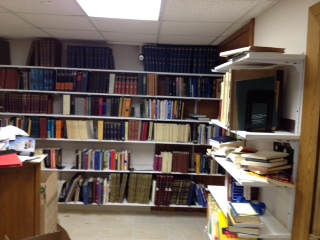
libray-emptylibrary-in-progress
(Top) Library empty; (Bottom) Library in progress

When I retired from the pulpit of Congregation Beth Israel in 2011, David Ward packed all of my books.  Most of them have remained in boxes in our basement since then.

To tell the truth, I did not really miss them.

The ones I use all the time are in my home study, and almost everything else I wanted to know I could find on line. That is still the case.

Nevertheless I felt ill at ease. My older son Leo contributed to that feeling when he pointedly remarked, “Those books in your basement are treasures, and they will eventually rot in those boxes.”

In Germany this past fall, our host, Pastor Ursula Sieg, challenged me to rescue one book a day from the basement dungeon where I had imprisoned them. I did not know how to do that as my study upstairs already overflows its bookshelves.

When we returned from Germany, the challenge from Leo and Ursula finally impelled me to action. Since our younger son Ben moved out from the finished portion of our basement several years ago, we really have not used the space very often.

So I asked Vickie if we could hire our wonderful handyman/carpenter, Glen Tracy, and ask him to line the wall with bookshelves. She agreed, and Glen and his helper installed the shelves in one long day. “Now,” he said when he finished, “comes your job, to unpack and shelve all those books.”

An arduous task but infinitely rewarding

I have begun to do so. I have been at it a week. Leo and his family were here for several days, and he was an immense help. Still carrying the books from the storage area of the basement to the finished area, organizing and then shelving them has been far more tiring than I ever imagined. It has also been very rewarding.

I still have a long way to go, but the library is definitely beginning to take shape.

I am amazed at the number of books I own. I am also amazed at how many I had forgotten and am rediscovering anew. Among them are some inscribed with touching words from the authors. Inscribed books have their own special section.

I am organizing the rest into Biblical Studies, Talmud, Midrash, Commentaries, Jewish History, Contemporary Jewish Thought, Study and Research Aids, Pastoral Counseling, Christian Thought, Islam and Other Religions, Classical literature, Humor, Hebrew Literature, Prayerbooks and Life Cycle, Children, Adolescent, Anti-Semitism, Novels, Paperbacks, Israel, Biographies, Sports, and Miscellaneous.

The hard truth is that I probably will not read or study many of these books again, and with so much on line, there was no place to which I could have donated them. Clearly, the practical thing to do would have been to get rid of most of them. But I just could not bring myself to do it.

They are the story of my life, and it has been an amazing experience to handle them anew!

I think back on the hours I pored over many of them. I think of the places I read them and the people I associate with them. So many memories come flooding back with each book that I rescue from the boxes and restore to a dignified home.

And while, it is true, there are many I probably will not read or even handle again, one thing is sure. The fact that they are now accessible means that I will certainly study and read some, and  will learn new things.

In addition, with each book I shelve I silently pray: May it be Your will, Eternal One, that one day my children and grandchildren will peruse the collection and find something of enduring value calling to them from the once empty walls.

Amen


A Chanukah Miracle

Cindy Stowell's inspiring journey continues as four-day "Jeopardy!" champion

For me this year, Chanukah is all about Cindy Stowell!

2300 years ago a small group of loyal Jews defeated those among our people who cared so little for our faith that they were willing to give it up to “be just like everyone else.”

Only after civil war broke out among the Jews of Judaea did the Assyrian-Greek army of Antiochus IV invade Judaea, pollute the temple and outlaw all Jewish observance.

A small army of Jews took to the hills and fought the invaders, eventually driving them out of Jerusalem. They rededicated the temple that the Greek soldiers had defiled with idols and the sacrifice of pigs.

The story of Chanukah is about the first armed struggle for religious liberty in history.

The festival symbolizes of triumph over impossible odds. So does Cindy Stowell.

Cindy Stowell died on December 5, but as of this writing she has just won for the fifth day on Jeopardy! The breadth and depth of her knowledge are most impressive.

Because Jeopardy never allows the results of shows to air before the telecasts, no one outside of the program staff knows when her streak ended.

As the lights in our Chanukah lamp increase each day of the eight-day festival, so will the memory of Cindy Stowell’s intellect and courage.

Yes, Ms Stowell died on December 5. How long will she remain “alive” on TV’s most popular quiz show? A day? Two? A week?

It does not matter! To me she is Jeopardy’s all-time champion.

Those of us who have watched all of her episodes that have aired so far and that were taped in August are not surprised to learn that she was battling a high-grade fever and was on painkillers during her shows’ tapings. We can see she is growing weaker and her voice is growing softer each day.

In my heart it will never be stilled! The courage of this woman who played so brilliantly while battling stage-four colon cancer is my Chanukah miracle!

One of the reasons we celebrate Chanukah at this season is to kindle light during the darkest season of the year.

The light of Cindy Stowell will last much longer than the eight days of Chanukah. She embodies all that is precious about the Festival, and her light will shine forever.

Guest Blogger: Greg Marcus, “My Moment of Truth”

Only rarely do I invite guests to share my blog, but the excerpt from Greg Marcus’ The Spiritual Practice of Good Actions below struck a deep chord in me. Why? The experience Greg describes in this essay is a perfect example of what I mean by “Finding Ourselves in Biblical Narratives.” It is a wonderful example of a moment when we see the Torah not just as an ancient text but as spiritual instruction that speaks directly to us. Greg finds spiritual enlightenment and a greater sense of self-worth through Mussar. I find those things through intense wrestling with the stories in the Torah. Jewish thought offers many paths to greater self-awareness that can benefit us whether we are Jewish or not.   Thank you, Dr. Marcus, for allowing me to share your wisdom with my readers.
                    —Rabbi Stephen Lewis Fuchs

 My spiritual journey started about ten years ago, at an unexpected time and place. At the time, my focus was almost entirely secular. I had my dream job, and I thought I was living a dream life. I had a great wife, two young daughters, and I was working at a Silicon Valley company that was literally revolutionizing human genetics research.

At first, the fact that I was working 90 hours a week did not bother me, and I took pride in my toughness. But my devotion to the workplace left me vulnerable, and I came to a place where despite my Ph.D. from MIT, I felt worthless. I felt like a bad husband, a bad father, and a bad employee. I was like an eggshell with all of the egg sucked out, hollow, dark, and empty inside. It started at the apex of my career – I was marketing the flagship product, and was leading the team developing the fourth generation, with the scope and features that everyone wanted. As luck would have it, this project was the first one with major technical hurdles and setbacks. We made our launch date because I was not going to let us fail. We worked every weekend and through almost every vacation for an entire year. We got to launch, we shipped the product, and it flopped. It flopped in every single customer’s hands. And management blamed me.

A few weeks after launch, I was sitting in a meeting with the top company leadership. None of the VPs and directors would make eye contact with me. Someone very senior started peppering me with questions: How much until this, how long until that, how many of this? I fumbled with my spreadsheets and she asked,

“Don’t you know how important this is?”

I wiped my sweaty hands on my pants and said in a quiet voice, “Yes.”

“Well, it is time to start acting like it.”

I walked out of that room with my shoulders down and said to myself in the hall, “Wow, I have really let the company down. I was the person in charge. This happened on my watch.”

The following week, I was at the largest human genetics meeting of the year. I was in a room full of our best customers and prospects when our featured speaker presented the product in a very poor light. I spent the rest of that afternoon at our booth in the trade show hall explaining over and over again that things would be just fine because we would have fixes for all of the issues.

That night, a bunch of us were walking to a bar to blow off some steam when my cell phone rang.

“Greg, it’s mom. Grandma died today.”

I stood on the corner with an umbrella in one hand and my cell phone in the other watching my colleagues file into the bar. My mother said to me,

“Surely you are not thinking of skipping the funeral.”

She was right. I was on the verge of not going. I walked back to my hotel room, and burst into tears, thinking how proud my grandmother had been of me. When the meeting was over, I flew directly to the funeral. They waited an extra day so I could make it.

A few weeks after the funeral, I was still really down. Now it was Yom Kippur, the holiest day of the year for the Jewish people. The key thing on Yom Kippur is that, we fast from sundown to sundown, we don’t go to work, and we spend the day in prayer and reflection. It was 3 in the afternoon, and I was sitting towards the back by myself. My head was back, and my eyes were closed. I was conserving my strength because I hadn’t had any food or water since the night before.

At the front, they were chanting from the Torah in Hebrew. I opened my eyes, and looked down at the translation: Don’t turn to idols or make for yourselves molten gods. My immediate thought was, Idol worship, that ancient statue-worshipping thing is no longer relevant in the modern world… And then this phrase popped into my head. It was like a clear quiet voice saying, “You need to do what is best for the company.” My stomach clenched, and I started sweating.

We only used the phrase, “Do what is best for the company” to justify something that was unpopular, like a layoff, a canceled project, or asking someone to skip a vacation. I thought about the nature of the company, an amorphous entity with a brand logo. I thought to myself, “Doing what is best for the company is not the same as doing what is best. My God, have I turned my company into a false idol? I guess I can’t really be a family first person when I’m working 90 hours a week.”

I realized that my priorities were upside down, and I decided right then and there that I had to stop doing what is best for the company, and start putting people first. I needed to take care of myself, and I needed to take care of my family.

Within a year, I had cut my hours by a third without changing jobs. Not a single person at work noticed. In fact, my career was thriving because I was no longer strung out and exhausted.

My life at home became a joy. One afternoon, I walked past the door of the living room, and stopped to watch my preschool daughter play with a friend. The scene was different from the wild rambunctious play that was the norm. They were sitting on the floor cross legged, talking quietly to each other. I couldn’t hear what they were saying, but they were so intense and serious. My eyes teared up as I saw this part of her I had never seen. I thought to myself “If I hadn’t been home, I would have missed this irreplaceable moment.”

The moment of change

For years, I looked back and wondered where those words that popped into my head came from. If you are of a certain spiritual bent, you may be thinking that those words came from God. The collective view of how God speaks to us has been influenced by the movie The Ten Commandments – a powerful deep voice, booming in a way that we can’t deny. While that makes for good Hollywood, that is not how these things actually work. Today, I have no doubt that God spoke to me, but it certainly was not what I believed back then. And you don’t need to believe it now to keep reading.

It doesn’t matter whether it was a actually a message from the Divinity, because whatever the cause, that moment of quiet changed my life. I began to act differently, and because I was acting differently, I began to feel differently.

Spending less time working greatly improved my life, but it did not answer what inside me was driving me to work so much in the first place. I am a bit of a seeker, and I wanted answers to some of the bigger questions about myself, and life in general. Unexpectedly, the answers came from Judaism.

Judaism, as I perceived it at the time, was largely focused on rituals and traditions. I had not yet been exposed to the richness of Jewish thought that has developed through debate and scholarship over the last few millennia. Sages and scholars puzzled over great philosophical questions, AND how Jewish values can be applied in everyday life to answer those questions. It was the practice of Mussar that brought it all together for me, and helped me find the answers.

From The Spiritual Practice of Good Actions by Greg Marcus, PhD. © 2016 by Greg Marcus, PhD. Used by permission from Llewellyn Worldwide, Ltd. http://www.Llewellyn.com. Greg is a practitioner, facilitator, and innovator of American Mussar, a 21st century spiritual practice for an authentic and meaningful life. To learn more, please visit Greg at AmericanMussar.com.