Guest Blogger: Greg Marcus, “My Moment of Truth”

Only rarely do I invite guests to share my blog, but the excerpt from Greg Marcus’ The Spiritual Practice of Good Actions below struck a deep chord in me. Why? The experience Greg describes in this essay is a perfect example of what I mean by “Finding Ourselves in Biblical Narratives.” It is a wonderful example of a moment when we see the Torah not just as an ancient text but as spiritual instruction that speaks directly to us. Greg finds spiritual enlightenment and a greater sense of self-worth through Mussar. I find those things through intense wrestling with the stories in the Torah. Jewish thought offers many paths to greater self-awareness that can benefit us whether we are Jewish or not.   Thank you, Dr. Marcus, for allowing me to share your wisdom with my readers.
                    —Rabbi Stephen Lewis Fuchs

 My spiritual journey started about ten years ago, at an unexpected time and place. At the time, my focus was almost entirely secular. I had my dream job, and I thought I was living a dream life. I had a great wife, two young daughters, and I was working at a Silicon Valley company that was literally revolutionizing human genetics research.

At first, the fact that I was working 90 hours a week did not bother me, and I took pride in my toughness. But my devotion to the workplace left me vulnerable, and I came to a place where despite my Ph.D. from MIT, I felt worthless. I felt like a bad husband, a bad father, and a bad employee. I was like an eggshell with all of the egg sucked out, hollow, dark, and empty inside. It started at the apex of my career – I was marketing the flagship product, and was leading the team developing the fourth generation, with the scope and features that everyone wanted. As luck would have it, this project was the first one with major technical hurdles and setbacks. We made our launch date because I was not going to let us fail. We worked every weekend and through almost every vacation for an entire year. We got to launch, we shipped the product, and it flopped. It flopped in every single customer’s hands. And management blamed me.

A few weeks after launch, I was sitting in a meeting with the top company leadership. None of the VPs and directors would make eye contact with me. Someone very senior started peppering me with questions: How much until this, how long until that, how many of this? I fumbled with my spreadsheets and she asked,

“Don’t you know how important this is?”

I wiped my sweaty hands on my pants and said in a quiet voice, “Yes.”

“Well, it is time to start acting like it.”

I walked out of that room with my shoulders down and said to myself in the hall, “Wow, I have really let the company down. I was the person in charge. This happened on my watch.”

The following week, I was at the largest human genetics meeting of the year. I was in a room full of our best customers and prospects when our featured speaker presented the product in a very poor light. I spent the rest of that afternoon at our booth in the trade show hall explaining over and over again that things would be just fine because we would have fixes for all of the issues.

That night, a bunch of us were walking to a bar to blow off some steam when my cell phone rang.

“Greg, it’s mom. Grandma died today.”

I stood on the corner with an umbrella in one hand and my cell phone in the other watching my colleagues file into the bar. My mother said to me,

“Surely you are not thinking of skipping the funeral.”

She was right. I was on the verge of not going. I walked back to my hotel room, and burst into tears, thinking how proud my grandmother had been of me. When the meeting was over, I flew directly to the funeral. They waited an extra day so I could make it.

A few weeks after the funeral, I was still really down. Now it was Yom Kippur, the holiest day of the year for the Jewish people. The key thing on Yom Kippur is that, we fast from sundown to sundown, we don’t go to work, and we spend the day in prayer and reflection. It was 3 in the afternoon, and I was sitting towards the back by myself. My head was back, and my eyes were closed. I was conserving my strength because I hadn’t had any food or water since the night before.

At the front, they were chanting from the Torah in Hebrew. I opened my eyes, and looked down at the translation: Don’t turn to idols or make for yourselves molten gods. My immediate thought was, Idol worship, that ancient statue-worshipping thing is no longer relevant in the modern world… And then this phrase popped into my head. It was like a clear quiet voice saying, “You need to do what is best for the company.” My stomach clenched, and I started sweating.

We only used the phrase, “Do what is best for the company” to justify something that was unpopular, like a layoff, a canceled project, or asking someone to skip a vacation. I thought about the nature of the company, an amorphous entity with a brand logo. I thought to myself, “Doing what is best for the company is not the same as doing what is best. My God, have I turned my company into a false idol? I guess I can’t really be a family first person when I’m working 90 hours a week.”

I realized that my priorities were upside down, and I decided right then and there that I had to stop doing what is best for the company, and start putting people first. I needed to take care of myself, and I needed to take care of my family.

Within a year, I had cut my hours by a third without changing jobs. Not a single person at work noticed. In fact, my career was thriving because I was no longer strung out and exhausted.

My life at home became a joy. One afternoon, I walked past the door of the living room, and stopped to watch my preschool daughter play with a friend. The scene was different from the wild rambunctious play that was the norm. They were sitting on the floor cross legged, talking quietly to each other. I couldn’t hear what they were saying, but they were so intense and serious. My eyes teared up as I saw this part of her I had never seen. I thought to myself “If I hadn’t been home, I would have missed this irreplaceable moment.”

The moment of change

For years, I looked back and wondered where those words that popped into my head came from. If you are of a certain spiritual bent, you may be thinking that those words came from God. The collective view of how God speaks to us has been influenced by the movie The Ten Commandments – a powerful deep voice, booming in a way that we can’t deny. While that makes for good Hollywood, that is not how these things actually work. Today, I have no doubt that God spoke to me, but it certainly was not what I believed back then. And you don’t need to believe it now to keep reading.

It doesn’t matter whether it was a actually a message from the Divinity, because whatever the cause, that moment of quiet changed my life. I began to act differently, and because I was acting differently, I began to feel differently.

Spending less time working greatly improved my life, but it did not answer what inside me was driving me to work so much in the first place. I am a bit of a seeker, and I wanted answers to some of the bigger questions about myself, and life in general. Unexpectedly, the answers came from Judaism.

Judaism, as I perceived it at the time, was largely focused on rituals and traditions. I had not yet been exposed to the richness of Jewish thought that has developed through debate and scholarship over the last few millennia. Sages and scholars puzzled over great philosophical questions, AND how Jewish values can be applied in everyday life to answer those questions. It was the practice of Mussar that brought it all together for me, and helped me find the answers.

From The Spiritual Practice of Good Actions by Greg Marcus, PhD. © 2016 by Greg Marcus, PhD. Used by permission from Llewellyn Worldwide, Ltd. http://www.Llewellyn.com. Greg is a practitioner, facilitator, and innovator of American Mussar, a 21st century spiritual practice for an authentic and meaningful life. To learn more, please visit Greg at AmericanMussar.com.

 

Jacob Becomes Israel

After twenty long years of exile Jacob decided to travel home even though he knew Esau had vowed to kill him and was on his way to meet him with a regiment of 400 men. As he prayed to God for help, Jacob acknowledged that he was “unworthy of all the kindness” that God had showed him (Genesis 32:11).

On the night before he met his brother, Jacob struggled with everything he had been and hoped to be.

It was a life-altering struggle. After he wrestled with God, his conscience, and all he had done to Esau, he emerged a new man with new determination. He resolved to reconcile with Esau and to ensure they could cooperatively co-existeach in his own land. He also limped on an injured hip to teach us that truly coming to grips with God–and the way God wants us to live–involves pain as well as progress and reward.

With whom did Jacob struggle on that eventful night?

Was it an angel, his conscience, or did he struggle with God? Perhaps it was the spirit of his brother Esau, or a combination of the above. We cannot be sure. We can be sure that after the struggle, Jacob awoke a new man with a new name. He became Israel, which means “one who struggles with God.” Only after that night did Jacob begin to realize his full potential as a covenantal partner with the Almighty.

Note that the name Israel does not mean to believe in God or to understand everything about God. It means to struggle with the idea that despite all the evil and immorality we see in the world, there is a good, caring God who implores us to use our talents to make the world a better place. The invitation to that struggle–to and the way each of us can use our talents to make a better world–emerges from the Hebrew Bible, but is open to all of us whether we identify with a particular religion or not.

After the struggle, Jacob knew that Esau prepared to wage war (Genesis 32:7), but he prepared to make peace. He sent his brother a generous offering (Genesis 32)an abundance of cows, bulls, goats, camels, ewes, rams, and donkeys. Through this gesture, Jacob endeavored to return to his brother the material value of the birthright he had wrested from him long ago (Genesis 25:29).

With this offer Jacob, who is now Israel, was saying, “I acknowledge and regret the pain I caused you.” The gift was so substantial and so sincere that by the time Esau and Jacob met, Esau abandoned the course of violence that he had planned for twenty years. The two brothers embraced, as brothers should.

Jacob’s growth and development make him worthy to bear the name Israel.

In his transformation, he becomes a worthy role model for us. The Hebrew Bible knows no perfect people. All of its characters have significant flaws. Jacob grows through the mistakes of his youth and becomes the responsible leader of our people. He blesses Joseph’s sons and brings them into the Covenant of Abraham. Although he lives as a pensioner in Egypt for seventeen years, he makes his son Joseph swear that he will ensure his burial not in a foreign country but in the land God promised to his fathers, Abraham and Isaac, the land that Abraham purchased at an exorbitant price in the sight of all the people of Heth long ago.


My Thanksgiving is November 29

presurgerySurrounded by Leo, Ben, Vickie and Sarah before my surgery, November 29, 2012
Thanksgiving this year was wonderful. Sixteen relatives filled our house with laughter, mutual empathy and joy. Vickie made a fantastic meal, and it was a very special day.

Thanksgiving falls each year on the fourth Thursday in November, but for me—since 2012 and for as long as I live—Thanksgiving will always be November 29.

On that day in 2012 I was not sure whether I would live or die.

On that day Dr. Lars Svensson and his skilled surgical team at the Cleveland Clinic opened my chest to repair an ascending aortic aneurysm and at the same time replace a malfunctioning mechanical aortic valve with a tissue valve.

My Connecticut cardiologist, Dr. Robert Chamberlain, of blessed memory, did not overstate the case when he said, “You will feel like you have been hit by a truck.”

In addition to the physical pain and the prospect of a long recovery, there was nothing whatsoever on my professional calendar.

I was physically and emotionally devastated.

  • I could not have imagined on that painful but life-saving day that four years later Vickie and I would have spent three months working in Milan and more than half a year—over a three year period—teaching and speaking in schools synagogues, churches and universities in Germany.
  • I could not have imagined that I would finally publish the book I have been thinking about since 1975 and that it would be translated into German and Russian or that I would record it as an audio book.
  • I could not have imagined that I would have published a second book as well.
  • I also could not have imagined that I would publish 375 web page essays that thousands of people would read.

Many people held my hand and guided my steps from November 29, 2012, to today. I pray that they know who they are and that they know how deep my gratitude is.

While I am so very grateful for the opportunities given me, I realize that I have not ended world hunger, cured cancer, made peace between Israel and the Palestinians or solved any major world problems.

Still, I will always cherish the day in when I began my journey back from the physical and spiritual abyss.

I pray that there will be more days and more opportunities. And I pray the Eternal One will grant me the strength and the wisdom to use those opportunities to make this world—in ways however small—a more just, caring and compassionate place.


Where is the line?

Where is the Line? When will we know that we must leave?

These are serious questions asked by serious questioners.

The election of Donald Trump has turned the world upside down.

At a lesson for adults at the Reform synagogue in Kiel, Germany last week, a highly respected and caring OB-GYN raised this question because of her concern about what might happen in next year’s German elections. She is proud of being Jewish and makes sure that the many Syrian refugee women she treats in her home city of Flensburg know of her heritage.

Shortly after we arrived home, my older son Leo asked the same question, “Where is the line?” Leo helped found a college preparatory elementary school—which he continues to serve as Principal— to give disadvantaged students a better chance at life in the inner city of Oakland, California.

Both of these individuals work tirelessly to make the world where they live a better place. Now both ask, “When is it time to realize that we cannot make our world better any more, and when should we leave our homeland for another?”

My response to both is, “Not yet! Let’s wait, watch vigilantly and see what happens.”

As a government major in college I learned the importance of giving a new administration every opportunity to succeed before manning the barricades in opposition.

I believe that we should follow President Obama’s wonderful example of facilitating a graceful and gracious transition. Nobody wanted Trump to lose more than our president. But his high road approach to the defeat of his candidate should be an example for all of us.

A disappointing number—to my mind—of Jews and other Clinton supporters are wasting their time and energy by trying to convince the electoral College to do something it has never done in the 240 years of the American Republic: Elect as president the candidate who by the established rules of the election suffered a decisive defeat.

Just imagine the turmoil and violence that will result if they succeed in this effort!

I believe there is much to be gained by Jewish leaders trying to meet with Trump and help him see the light about some of those his campaign has attracted. Engagement is always preferable to estrangement until we are quite certain that engagement will get us nowhere.

“Who is the greatest of all heroes? The one who turns his enemy into a friend (Tosephta to Chapter 4 of Pirke Avot)

It is a worthy goal, and before we organize demonstrations and protests, we should try that with the President Elect!

With Trump’s election  many are raising alarming comparisons to Germany in 1933 when that country legitimately elected Adolph Hitler as Chancellor

When Hitler came to power in Germany, there were two responses in my family. I call them the “Judith Response” and the “Dad Response.”

Dad and Judith were first cousins. They lived close to one another in Leipzig and loved each other deeply. When Judith left Germany in 1935, Dad drove her to the train station.

Judith must have been one of the first female dermatologists in Germany in the early 30’s. She paid close attention to what was happening there. When she saw the writing on the wall, she safely settled and re-established herself with her Husband Lazer and her infant daughter, Devorah (who also grew up to become a physician specializing in nuclear medicine) in Tel Aviv.

Dad—and there is no other way to put this—waited too long to leave. He was arrested on Kristallnacht and taken to Dachau where Nazi soldiers beat him and shaved his head.

But my father was fortunate. His brother and uncle already in the United States petitioned Governor Herbert Lehman of New York, a Jew whose father immigrated to the United States from Germany in 1848, whose office secured his release.

If I could ask my father one question, it would be why did you wait so long?

I do not think it is time yet for American Jews to leave the USA because of fear of Trump, but I do think it is time for us to:

  • Keep a sharp eye on all that Trump and his administration do. We must not become the lobster who does not realize he is being boiled before it is too late.
  • And we should weigh our options: where would we go if we do want to leave?

Yes, we must be vigilant, and we must weigh our options.

But the crucial question, “Where is the line?” is one that each of us must answer for ourselves.


The Feminist Leaning of the Hebrew Bible

Over and over again in the Bible it is the woman who gets it and the man who is clueless.

Eve has been maligned for generations for the so-called fall of man, but really she is the heroine of the elevation of humanity. It was she not her husband who perceived that life in Eden –while idyllic – was sterile and essentially without meaning. It was she who saw (Genesis 3:6) ונחמד העץ להשכיל the tree of knowledge was desirable as a source of wisdom; she took of its fruit and ate.

Other examples abound.

Rebecca, though her actions are morally questionable, understand’s God’s will while Isaac is literally and figuratively in the dark. Judah evolves from the man who sold his brother to the man who would not leave his other brother behind through the tutelage of his daughter-in-law Tamar. Hannah is savvy and aware. Her husband Elkanah and Eli the high priest of Israel just don’t get it. Rahab, Vashti, Esther, Ruth, Deborah, Yael…the list of female heroes is long, and their influence is substantial.

Moses is unquestionably the Bible’s most important figure, but he owes his entire career to the vital intervention of no fewer than six women:

Shifrah, Puah, Miriam, Yocheved, Pharaoh’s daughter and Zipporah all play crucial roles in our people’s signature story: The Exodus from Egypt. Without them Moses never would have become our liberator, lawgiver and leader. Through their stories and commentaries the rabbis of the Midrash embellish each of their roles.

The task of our generation is twofold:

  • Underscore the vital role women play in biblical stories and give them the enormous credit they are due but do not receive in traditional circles.
  • Continue the forward progress in women’s rights until society views women and men as completely equal.


God Picks Abraham Purposefully

In chapter 12 of Genesis, when we meet Abram, who later in the portion becomes Abraham –God has tried three times to encourage human beings to create a just, caring, and compassionate society on earth. From the time of creation, such a community has been God’s highest goal.

But the societies in Eden, after Eden until the flood, and after the flood all have failed.

Even though God is frustrated and disappointed, God does not give up.

In a fourth attempt, the Eternal One chooses Abraham, Sarah, and their descendants to be God’s “special agents” in the ongoing quest to make the world a better place.

Early in my career as a rabbi, a Protestant minister said of Abraham. “He was like a random lottery winner. It was just a mysterious act of God’s grace that God chose him.

From a Jewish perspective, nothing could be further from the truth.

True, the Bible says nothing about Abram until he is 75, at which point God tells him, “Go forth from your native land from your father’s house to the land that I will show you.” I will make a covenant with you, God continues, and I expect you to “be a blessing” so that all the nations of the earth will find blessing through you and your descendants.

A Golden opportunity for the rabbis!

For Jewish tradition, the choice of Abraham is not random at all. The sages saw the Torah’s silence about Abraham’s earlier years as a golden opportunity to illustrate why God very intentionally chose Abraham as a covenantal partner in the quest to make the world a more just, caring and compassionate place.

Two classic midrashic stories illustrate the rabbinic outlook.

  • When Abraham was born, the ruler of the world was Nimrod, mentioned earlier in Genesis as a mighty hunter. Nimrod’s astrologers tell him of a baby born who will overthrow his kingdom, and so Nimrod orders all the babies killed. To protect his son, Abraham’s father, Terach, hides him in a cave.

At the age of three, he wandered out of the cave and being a most precocious child asked what could hardly be considered a typical question for a three-year-old: “Who created the heavens and the earth – and me?” He looked up at the sun and, imagining that it was the creative force, he worshipped it all day. That night when the moon came out, he thought it must be stronger than the sun. So he worshipped the moon all night. When in the morning the sun came out again, Abraham reasoned that there must be a God more powerful than both the sun and the moon who is responsible for creation. So, according to this story, Abraham – at a very young age – chose God, which helps explain why God chose him (Bet ha-Midrash, chapter 2).

  • Another story – one of the most famous of all midrashic themes – tells that when Abraham was a boy, Terach was the proprietor a shop selling idols that people worshipped as gods. One day, Terach went on a business trip and left Abraham in charge of the store. While he was cleaning up, Abraham accidentally broke one of the idols. Rather than try to hide it from his father, he placed a stick in the hands of the largest idol in the shop and left the broken idol on the floor.

“How did this happen?” asked Terach.

“Oh,” Abraham answered, “the broken idol was misbehaving and the bigger idol beat him with the stick.”

“Fool,” said his father, “Don’t you know that idols can’t do anything?”

“If so,” Abraham, responded, “why do you worship them?” (Bereshit Rabbah 38:13, retold with variations many times)

The story illustrates that Abraham rejected idolatry, and further explains why he was God’s choice as a covenantal partner.

Four thousand years later we who claim to be Abraham’s descendants should still be hard at work – each in our own way – to make a righteous and just society on earth. When the task seems overwhelming, we should remember Rabbi Tarphon, a second-century sage who famously taught:

“It is not incumbent on you to complete the work, but you are not free to desist from it!” (Pirkei Avot 2:21)

Back to Kaltenkirchen


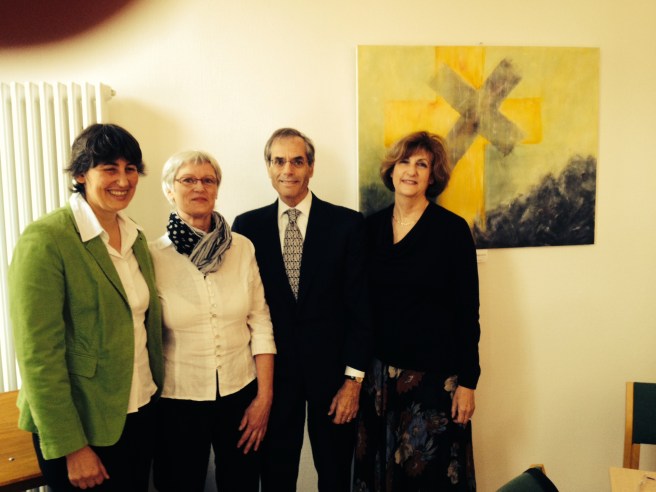
Broken Cross
(L to R) Pastorin Martina Dittkrist, artist Hannelore Golberg, me, and Vickie standing in front of Ms Golberg’s painting of “The Broken Cross” symbolizing the ongoing atonement of the community of the Michaeliskirche in Kaltenkirchen for the crimes of the one time Pastor Ernst Biberstein who became a Nazi tried and convicted at Nuremberg of mass murder.

kaltenirchen-class

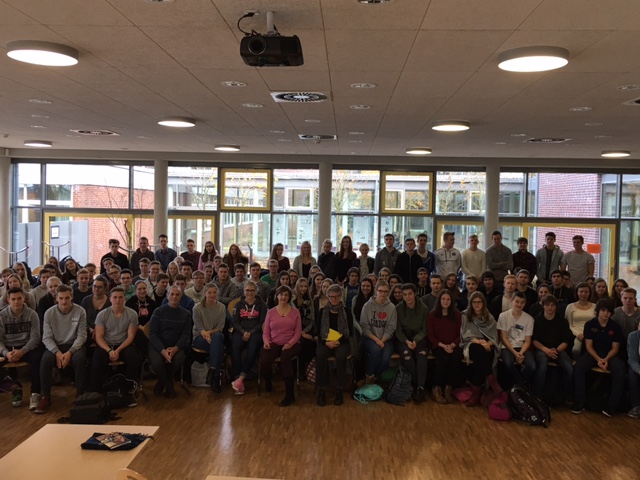
Vickie and I among the students we taught at the Gymnasium Kaltenkirchen


Kaltenkirchen was one of the first places Vickie and I visited on our first extended trip to Germany in 2014.

Then we visited a tiny Concentration Camp site and noted the stately houses just across the street where people lived their lives and said nothing.

Two weeks later I became the first rabbi to  preach at Michaeliskirche in that village. Their wonderful Pastor, Martina Dittkrist was eager for me to do so because the church’s history was marred by a previous Pastor, Ernst Biberstein, who served during the thirties. Biberstein left the church and became a Nazi officer who was convicted of atrocity war crimes at the Nuremberg Tribunal and held responsible for the deaths of 2000-3000 Jews.

In the Social Hall of the church, a painting by Hannelore Golberg symbolizes the impact of Biberstein’s ministry on the church. It depicts a cross that is uprooted from the ground and tilted on its side. There is also a tasteful plaque in the main sanctuary expressing the church’s sorrow that they had once trusted such a man as their spiritual guide. I named a previous essay about that experience, “The Church of the Broken Cross.”

That sermon was the first time that I used what has become in many speeches in Germany since, my catch phrase:

We cannot undo the past, but the future is ours to shape.

It was a gratifying but gut wrenching experience!

Those words could also describe our recent visit to the Gymnasium Kaltenkirchen.

There we met for 90 minutes with a group of combined classes totaling some 80 students. They listened with rapt attention—some had tears in their eyes—as Vickie spoke about her mother and I spoke about my father. We emphasized how her mother and my father were among the truly lucky one’s to escape the inferno before it engulf Europe’s Jews. Still both Vickie’s mother and my father suffered, and it is important for students to understand their history.

Although the message of these two experiences was similar, our mood in the respective settings was quite different.

During the church service people looked back and realized the horror of the era with genuine regret. There was visible emotion, but most of those in the congregation had lived most of their lives.

By contrast the teenagers at the Gymnasium present a different picture. They are part of the group that will shape the future of Germany and Europe.

We left with a feeling of great hope. They seemed as determined as any group we have ever seen to insure that they want to create a better future for themselves, their children, grandchildren and generations to come.

Their responses to the lessons we taught made us very glad that we were there.


Melchizedek: Prototype of the Righteous Gentile

Book excerpt from ToraHighlights:

torahighlights2016vorderseite

One of my objectives in ToraHighlights is to focus on aspects of some of the weekly Torah reading that I had not considered in other contexts. This weeks portion tells of the beginning of Abraham and Sarah’s Covenant with God. Melchizedek offers invaluable assistance.Melchizedek is one of the characters to whom I have given little thought for many years.

As we welcome the final Shabbat that we will spend this year with our friends and hosts, Pastor Ursula Sieg and her husband Pastor Martin Pommerening, it feels appropriate to share this reflection in honor of those who  like them are spiritual descendants of Melchizedek. They are not Jewish, but they do so much to promote and enhance Jewish understanding. As Melchizedek sustained Abraham, Ursula and Martin sustain Vickie and me in all of the activities we do in Germany.


On a hot spring day in Los Angeles 45 years ago, ten other rabbinical students and I gasped with horror when we opened our final exams for our Bachelor of Hebrew Letters degree in Bible. Why? Our beloved Professor of Bible, Samson H. Levey, z’l, was requiring us to translate chapter 14, the most complex Hebrew passage in Genesis.

In this passage Abram (not yet Abraham) does battle to save his nephew Lot who has been captured in a desert war. After Abram’s victory, we read, “And Melchizedek, King of Salem, brought forth bread and wine. He was a priest of El Elyon (God Most High). And he blessed him and said, ‘Blessed be Abram of El Elyon, possessor of heaven and earth. And blessed be El Elyon, who has delivered your enemies into your hand. And he gave him a tenth of all.’” (Genesis 14:18-20)

According to the Zohar’s (Cabalistic Midrash) comment on Genesis 14, Melchizedek blessed Abram with the letter ה (‘Heh‘) that changed his name from Abram to Abraham and made him a ”father of nations.” Of course Salem is ancient Jerusalem, and El Elyon, scholars say, was likely the chief pagan deity of that area. But El Elyon becomes one of the names Jews use for the one true God. In fact we call God, El Elyon, in the first benediction of the Amida prayer in our liturgy.

What’s in this story for us?

Melchizedek is the prototype of the non-Jew who practices the Covenantal values of Justice and righteousness (Melchizedek means, “King of righteousness”) that Abraham represents. We have much in common with people like this, and we should seize every opportunity to join hands and hearts with them in efforts to make our world a better place.


A Different Type Of God

When we were slaves in Egypt, the Pharaoh was not just the country’s king. Pharaoh was a god.  

That pagan god was afraid that we Hebrews were becoming too numerous. So he called in the Hebrew midwives Shifrah and Puah and told them: when you help the Hebrew women give birth, if you see that the child is a boy, kill it. If it is a girl, let her live.

But the midwives ignored the instruction of that god-Pharaoh. They listened instead to the voice of the one true God, a different type of God, and kept the boys alive.

The pagan god-Pharaoh then ordered his soldiers to throw every Hebrew baby boy into the Nile. But Yocheved was loyal to a different type of God and would not give up her baby.

With a fervent prayer she set her precious child in a basket and floated him in the water. It was a desperate move by a desperate woman. When Pharaoh’s daughter found the baby, she knew it was a Hebrew. She knew that her father her king and her god ordered Hebrew boys drowned. If she were faithful to him she would have simply tipped over the basket and went on with her bath. But Pharaoh’s daughter heard and heeded the voice of a different type of God, named the boy Moses, and adopted him as her own.

For that reason the rabbis give her the name Bityah, which means “daughter of The Eternal One (B. Megillah 13a).”

Before the Torah introduced the world to “a different type of God,” people viewed their gods as forces that they presumed had power. The whole purpose of religion was to appease those gods –to keep them from using their power to hurt, or perhaps to entice the gods to use their powers to help, the worshippers.

So, if I were a farmer I would plant my crops and then make an offering to the agriculture god. If I had a good harvest I would assume the god accepted my offering.

But if there was a problem-–a drought, or a famine or a plague of locusts — then I would assume that the god had found my offering inadequate, and I would make a larger offering the next time.

Eventually and inevitably these escalating offerings to pagan gods led to human sacrifice.

Our God—the God the Torah introduces to the world—is completely different.

Our God is more than a dispenser of rewards and punishments in response to offerings.

  • Our God abhors and utterly rejects—as the story of the binding of Isaac teaches—the abominable practice of human sacrifice.
  • Our God created the world with one overriding purpose: For human beings to create a just, caring and compassionate society.

In pursuit of that goal, God made a Covenant with Abraham, Sarah and their descendants. That Covenant underlies everything we do today as Jews.

In our Covenant God promises to protect us, give us children, make us a permanent people, and give us the land of Israel.

In return God charges Abraham and all of us: Be a blessing, walk in God’s ways and be worthy, and use our talents to establish a society filled with Tzedakah Righteousness and Mishpat, justice!

Several generations later we found ourselves enslaved to Pharaoh in Egypt. The value systems of Pharaoh and God were so different that they could not coexist. Pharaoh was a typical pagan god. He enslaved us to build his monuments and pyramids for no greater purpose than to glorify and exalt him. If his taskmasters beat us so that we would work harder that was fine. If they threw our baby boys into the Nile as a sacrifice to their river-god, they saw nothing wrong with that.

But God, the Torah teaches, remembered our Covenant, went to war with the pagan god Pharaoh and got us out of there.

Because God freed us from Egypt and brought us to Mt Sinai to renew our sacred Covenant, we owe God a debt we can never fully repay. But we should spend our lives trying!

 Are these biblical stories true?

I honestly do not know. But the truth of these stories does not depend on their historical veracity. The truth of these stories lies in the world-changing ideals and values we learn from them.

At Sinai our narrative teaches in much greater detail of God’s hopes that we worship no other gods, keep the Sabbath holy, not murder, steal, commit adultery, bear false witness or covet. We learned not to spread false rumors and to treat the poor, the widow and the stranger with dignity and respect.

Later on we adopted the ideal that study and learning were vital ways of worshipping our God.   We were to study and learn, our tradition taught, not just so that we could be successful, but also so that we could use our talents and training to worship God by making the world a better place.

All of our Jewish practices—Shabbat, Holy Days, Chanukah, Passover, weddings, Bar or Bat Mitzvah, all of them, even funerals—have one main purpose: to inspire us to work toward the ultimate goal of creating the type of society God wants.     

Tutoring kids in reading or math, conducting food drives, becoming a big brother or sister, healing the sick, teaching and philanthropy are some of the ways we fulfill our covenantal responsibilities. We do these things because long ago our ancestors became partners with a different type of God, who wants us to use our talents and abilities to make the world a better place.


Why Trump Won

There was a plethora of things Clinton’s camp and the media miscalculated:

  • The fear for their safety with which so many live
  • The economic hardship under which so many suffer
  • The resonance of Trump’s simplistic promises which Clinton could not effectively refute
  • The backlash the derisive dismissal of Trump’s supporters by an overwhelmingly pro-Clinton intellectual and media establishment would cause.
  • The smugness so many discerned in Ms Clinton’s demeanor.
  • The smugness with which many in Ms. Clinton’s base dismissed any criticism of her at all.
  • The scent of scandal that has dogged her on so many fronts for so many years
  • The feeling many held that she was unduly influenced by sinister foreign interests.
  • The feeling that the Clinton Foundation was—despite whatever good it  did—primarily fraudulent enterprise to enrich the Clinton’s and further their political goals.

Many will find these realities hard to read.

For many, myself included, Mr. Trump’s liabilities and scandals far outweighed Ms. Clinton’s debits, but the Clinton camp—for all their technical skill and political experience—could not make their case at the end of the day in a way that resonated with the overwhelmingly red stripe of middle America.

By portraying Trump as a buffoon and his supporters as in large measure “deplorables” the Clinton camp mobilized the sentiment against her to a degree her camp grossly underestimated.

There is also, for certain, the pendulum factor.

In ugly terms it was indeed a “white backlash” against  America’s first Black president. But it is also a consistent factor in American politics. Pendulums swing and after eight years of Bush, the country was ready for eight years of Obama. After eight years of Obama the pendulum swung back.

When congregations pick a new rabbi, they so often choose someone they perceive does not possess the traits or way of doing things that they did not like in the rabbi who is leaving or retiring. The retiring or leaving rabbis strengths, they feel, they can do without.

The American electorate choosing a new president is much like a congregation choosing a new rabbi. There is a natural tendency to choose a candidate unlike the retiring incumbent. Clinton’s camp underestimated the impact of Trump’s contention that, “Electing Hillary would be like another eight years of Obama.”  Again for Clinton’s base, who largely revere Obama, that would have been fine. But many were ready to forego Obama’s skillful statesmanlike style for the blustery “Tell it like it is” Trump.

The desire for change is especially important when people perceive their economic future is not bright, that their streets are not as safe as they should be and that a significant foreign threat looms with which the incumbent did not deal to their satisfaction.

Like many, I am frightened by the prospect of President Trump. I pray that our democracy will withstand the challenge ahead, and that our nation will find a way to move forward in a manner that promotes “liberty and justice for all.”