
So Rabbi, What Do You Really Think about Jesus?

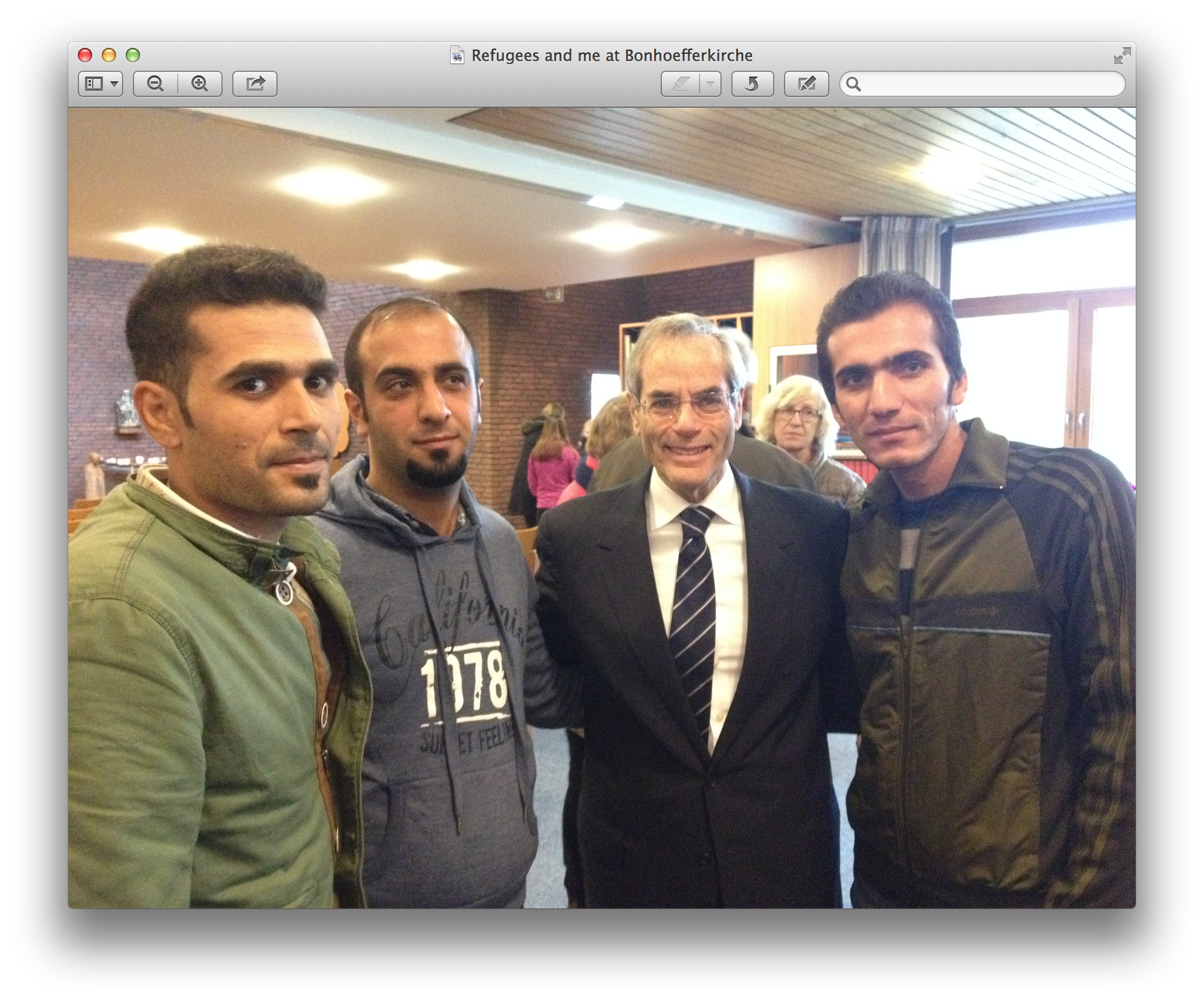
Standing with some of the refugees whom I joyfully welcomed to worship on October 18 when I preached at the Bonhoeffer Kirche in Neumünster.
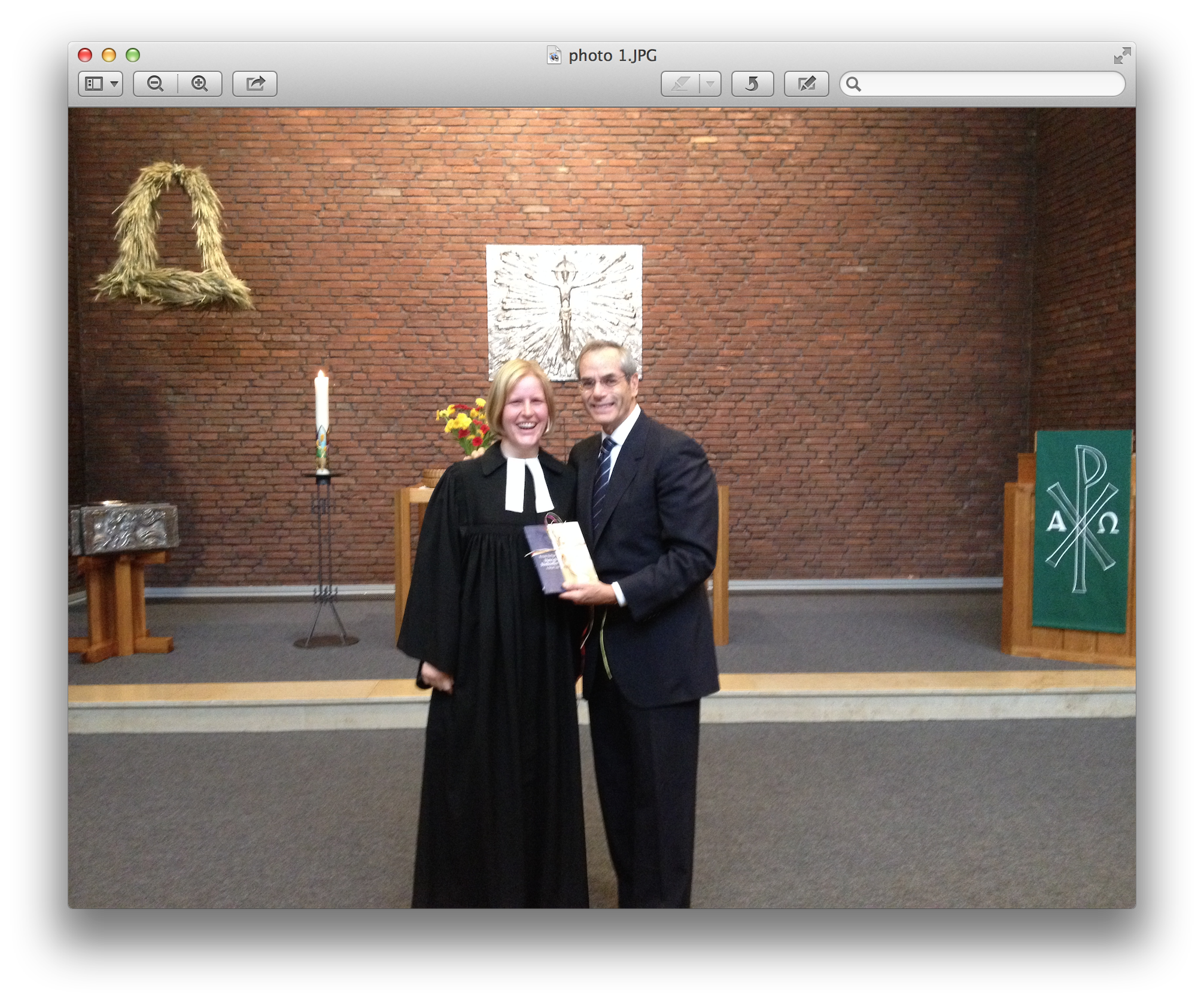
Pastorin Ulrike Wohlfahrt has just presented me with a copy of Renate Bethge's, "Dietrich Bonhoeffer: A Brief Life."
Pastorin Ulrike Wohlfahrt has just presented me with a copy of Renate Bethge’s, “Dietrich Bonhoeffer: A Brief Life.”

On October 18, I had the privilege to preach at the Church in Neumünster named after the great Protestant theologian, Dietrich Bonhoeffer.

Bonhoeffer was a brilliant student who turned away from a promising career as Professor of Theology to live the teachings of Jesus’ life among everyday people as a pastor. He actively opposed Hitler even before he took office and through all the twelve years of his reign.

Opportunities to escape Hitler came to Bonhoeffer from prestigious institutions in New York and London, but like Moses at the Burning Bush, Bonhoeffer could not resist the call to return to Germany despite the danger he faced.

The Nazis executed Dietrich Bonhoeffer at the Flossenbürg concentration camp shortly before the end of the war.

One of his most famous teachings is: To be silent in the face of evil, is to be complicit in evil.

Near the church is a center welcoming and processing thousands of refugees from tyranny in Syria and several other countries. It was my great privilege during my sermon to welcome these Islamic and Christian refugees as my cousins through Abraham.

I noted that on display in the church was the exhibit about Vickie’s 94-year-old mother, Stefanie Steinberg, who fled Germany as a 14-year-old refugee in 1936.

“Though she experienced difficult times,” I said, addressing the refugees, “her story has a happy ending. I hope and pray that each of yours will too.”

Three wonderful pastors ably lead the Dietrich-Bonhoeffer Kirchegemeinde:

Pastor Tobias Gottesleben came to our Simchat Torah service in Bad Segeberg and hosted the study evening at which I spoke two weeks ago. When I preached there, though, he was visiting the church’s mission community in the Congo.

Pastorin Ulrike Wohlfahrt led yesterday’s service with warmth and deep spiritual feeling. It was a privilege to be there. She led the worship with inspiring respect of the Jewish roots of Christianity, saying, “We have so much to gain by listening to and learning from each other.”

Pastorin Isabel Frey-Ranck organizes and coordinates the church’s sacred mission of helping the waves of refugees that have come to Neumünster from Syria and several other countries acclimate to their new home.

I see each of these wonderful people as very worthy to lead a church that bears Dietrich Bonhoeffer’s name.

During my sermon I noted that Christians often ask me what do I think of Jesus? My answer: It depends on what his followers make of him.

If, as has been the case far too often over the past 2000 years Jesus name has been invoked as justification for persecuting Jews, forcing us to convert, exiling and killing us, then Jesus does not rate high with me.

Of course Jews will never see Jesus as God or as an object of worship as Christians do.

But when Jesus is the inspiration to feed the hungry, clothe the naked and do the things I see so many churches in Germany do today in his name, I look at him very positively.

And when—as in the case of Dietrich Bonhoeffer— Jesus’ example is the impetus to sacrifice position, comfort and even his life to oppose the scourge of Nazism, then I become an admirer of Jesus. In fact I become a very big fan indeed.

A Chance to Be a Geiger Counter

Vickie and I have just spent two very fulfilling days teaching at the Abraham Geiger Rabbinical College.

On Thursday I conducted a two and a half hour seminar on Preaching about Passover. I hope I was able to give these students, who come from five different countries, ideas and texts that will spread out across the borders to add depth and meaning to their teaching and preaching about our most observed religious celebration.

Yesterday morning after I led a short reflective worship—hat I chose to do without prayerbook—to emphasize the ideas that motivate and the context that underlies selected prayers.

We then spent another two and half hours discussing the Torah portion about Noah and the Tower of Babel. Again, I  hope our time together planted seeds that will sprout to expand the ways these soon-to-be rabbis understand and share lessons from these famous stories.

Last night the entire college community—students, professors and administrators—filled the chapel for a  service, followed by a delicious dinner, to welcome Shabbat. In all of my yeas of rabbinical studies I never experienced such a joyful community-wide celebration.

As I entered the building for the service, the student in charge of the worship said to me, “Oh we forgot to ask you earlier, but we are hoping you will deliver tonight’s sermon.” After getting over the shock of the request to prepare an instant sermon in my head,  I said yes.

Sure I would have liked more notice. But the privilege of addressing a congregation of professors, future rabbis and Cantors in the country where  my father was arrested on Kristallnacht and had to leave as a refugee because he was Jewish was too great to pass up

Honestly, the spirit of the service moved me so that when it was time for me to speak I felt like I had been preparing for the opportunity for years.

One of the challenges I imposed on myself was to speak about the Torah portion dealing with Noah without repeating any of the points I made to the students in the two and a half hour seminar we shared earlier in the day.

So I chose to speak about the Zohar—the mystical skylight that lit up the ark.

Was it necessary for God to have a skylight that would illumine the ark so the Eternal One could see what went on there? Of course not.

But the zohar was necessary to remind the people to be aware that God was aware of all that went on.

As rabbis and cantors—I told my soon-to-be colleagues—you will find that people are aware of what goes on with you. There will be those who see you as a target. They will pay scrupulous attention to you to an extent you cannot imagine. Let the skylight in the remind you never do or say anything—especially in this lightning media age—that you do not want to become known in the community.

Therefore remember, as Maya Angelou taught: Although people may in fact forget what you say. They may even forget what you do,

But they will never ever forget how you made them feel.

Der trauernde Gott. Wochenabschnitt Noah, Genesis 6,9-11,32

Der Midrasch ist ein Quelle lebhafter Diskussionen über Noah. Wenn die Tora ihn “rechtschaffen in seinem Zeitalter” (Genesis 6.9) nennt, ergreifen die Rabbinen Partei.

Meint der Text, dass er nur besser war als andere in einer Zeit, in der alle furchtbar waren, wie Rabbi Yohanan meint?

Oder bedeutet es, dass er so rechtschaffen war, wie Resh Lakish behauptet, dass er tatsächlich mit Gott lebte und vorbildlich war für alle Generationen? (Bereshit Rabbah 28,8)

Welcher Meinung wir auch zustimmen, die Flutgeschichte der Tora ist einzigartig im Vergleich zu vielen anderen Flutgeschichten in alten Texten. Warum?

Nur im biblischen Bericht ist ein guter, fürsorglicher Gott traurig über die Unfähigkeit oder Unwilligkeit der Menschheit rechtschaffen zu handeln.

Der Midrasch erzählt, dass Gott durch Noah die Generation zur Zeit der Flut bedrängt, von ihren bösen Wegen umzukehren. 120 Jahre hindurch appellierte Noah an die Menschen, aber sie wollten nicht hören. Erst dann sandte Gott die Flut. (Tanhuma, Noah, section 5)

Dieser Midrasch unterstreicht die wichtige Einsicht aus der Geschichte von Kain und Abel. Nachdem Gott Abels Opfer akzeptiert hat und nicht seines, ist Kain wütend und neidisch. Gott warnt Kain diesen Gefühlen nicht nachzugeben, aber Gott stoppt Kain nicht, als er seinen Bruder dennoch tötet.

Ähnlich hier: Vor der Flut warnt Gott die Völker der Erde ihre bösen Wege zu ändern, aber Gott zwingt sie nicht dazu.

Auch heute möchte Gott, dass wir unsere Talente für Gutes einsetzen, aber Gott zwingt uns nicht. Wir sind keine Puppen und Gott ist kein Puppenspieler.

Der freie Wille, den Gott Menschen zugesteht, gibt unserem Leben Sinn.

Wir, nicht Gott, müssen wählen, ob wir Gutes schaffen wollen oder Böses. Doch zu oft hinterlässt unsere Wahl einen trauernden Gott in Tränen.

Translation: with thanks to Pastor Ursula Sieg

The Grieving God (Quick Comment, Parashat Noah, Genesis 6:9-11:32)

The Midrash is a fertile debating ground for the character of Noah. When the Torah calls him “righteous in  his age (Genesis 6:9),” Sages take sides.

Does the text mean that he was just better than others in a time when everyone was horrible as Rabbi Yohanan argues? Or does it mean that he was so righteous, as Resh Lakish contends, that he truly walked with God in a way exemplary to all generations? (Bereshit Rabbah 28:8)

Whichever opinion one favors, the Torah’s flood story is unique among the many that proliferate in ancient texts. Why?

Only in the biblical account is a good, caring God grieved because of humanity’s inability or unwillingness to act righteously.

The Midrash recounts that God through Noah urged the Generation of the Flood to repent their evil ways. For 120 years, Noah persisted in his plea to the people, but they would not listen. Only then did God send the flood. (Tanhuma, Noah, section 5)

This Midrash underscores one of the vital messages of the story of Cain and Abel. After God accepts Abel’s offering and not his, Cain is angry and jealous. God warns Cain not to succumb to those feelings, but God does not stop Cain when he kills his brother anyway.

Similarly, God warns the people of the earth to change their wicked ways before the flood, but God does not make them do it.

Today too God wants us to use our talents for good, but God does not make us. We are not puppets, and God is not a puppeteer.

The free will God allows human beings is what makes our lives meaningful.

We not God must choose whether to act for good or for ill.. Too often, though, our choices leave a grieving God in tears.

Is Genesis’ Story of Creation True?

As we’ve recently turned again to the beginning of our Torah, I want to address an important question: Is it true?

For me, the stories in the Torah represent a religious or poetic truth – not necessarily an historical or scientific truth. This type of truth is the reason I cherish the Torah, place it lovingly in a special ark, and even hold it up proudly after I have read it, proclaiming in Hebrew and English, “This is the Torah that Moses gave to the children of Israel at the command of God.”

So what do I mean by a religious or poetic truth?

Leonard Garner offers this example in Genesis: The Teacher’s Guide:

“If I am walking through a meadow, and I say with a sigh as I gaze at my beloved, ‘Your eyes are like two beautiful pools,’ I do not mean that I may dive in to take a swim. Neither, though, am I lying. I am expressing a profound type of truth that wells up from the depths of my soul.”

As another example, consider the story of creation. When the ancient rabbis studied the story, they did not ask scientific or historical questions such as, “Did this really happen this way?” Rather they asked questions along the lines of, “Why did God choose to begin the account of creation with the letter bet, the second letter of the Hebrew alphabet, rather than with aleph, the first?”

They answered that just as the top and bottom of the letter bet are closed, so too are secrets of the essence of God above, and of what happens when a person is laid to rest in the ground below. Just as the back of the letter bet is closed, so, too, is knowledge of God’s actions before the world was created closed to us. But the front of the letter bet is open, teaching us that we should concentrate our efforts and our energies on that which is open to us – this world and its mysteries.

In other words, one truth the rabbis derived from the story of creation is that the mysteries of what happened before the world was created, what happens after we die, and a complete knowledge of God’s ways are beyond us and should not be our main concerns. Rather, living lives of purpose and meaning and making this world as good as we can while we are here – these things, the rabbis urged, should be the object of our efforts.

Going a bit further, then, the truth of the story of creation lies not in the contention that it happened as written.

The truth to be gleaned is that creation was not an accident, but rather that God is the initiator of creation, and just as it is meaningful and purposeful, so too can our lives have meaning and purpose. Furthermore, as creatures created in God’s image, we human beings – not the tiger or the rhinoceros – are in charge of and responsible for this world and what happens to it. Indeed, it is an awesome responsibility.

The final element of truth to the story for Jewish thought is that it includes the idea of Shabbat. If God can rest, as the story concludes, so too can we make time to rest and reflect on the meaning and purpose of our lives.

– See more at: http://www.reformjudaism.org/blog/2015/10/13/what-truths-can-we-learn-story-creation?utm_source=Share&utm_medium=social&utm_content=Fuchs&utm_campaign=BlogPost#sthash.3wvg8YNI.dpuf

Revidierte Übersetzung von “und er soll über dich herrschen” (Kurzkommentar zum Wochenabschnitt Bereshit)


Der Vers ist bekannt: “Und dein sexuelles Begehren soll deinem Mann gelten, und er soll über dich herrschen!” (Genesis 3,16) Ich möchte diese Übersetzung wegen der Jahrtausende, in denen sie Unterwerfung von Frauen befördert hat, ausrangieren.

Die hebräische Wurzel משל mashal bedeutet herrschen. Aber sie kann ebenso “Ähnlichkeit” bedeuten. Ein mashal ist in der rabbinischen Literatur ein Gleichnis. Es wir oft eingeleitet durch die Frage: “Mit was ist diese Sache zu vergleichen?”, oder einfach “Wem ähnelt es?”

Mit dieser Interpretation übersetze ich den Vers: “Dein sexuelles Begehren soll nach deinem Mann sein, und (in dieser Hinsicht) soll er wie du sein.”

Ein Hindernis für diese Übersetzung findet sich im nächsten Kapitel, wo das Wort תשוקה “sexuelles Begehren” zusammen mit der Wurzel משל erscheint (Genesis 4,7). Hier vergleicht Gott den starken Drang zum Sündigen mit sexuellem Begehren und erklärt Kain, dass wir die Kraft haben, es zu beherrschen.

Unsere Weisen lehren, dass sexuelles Begehren eine angeborene Eigenschaft ist, ohne die wir nie heiraten würden und Kinder bekommen (Genesis Rabbah 9,7).

Wie Feuer kann sexuelles Begehren unser Leben bereichern, aber unkontrolliert kann es großes Leid hervorrufen.

Somit können wir formulieren: Die Neigung zum Bösen ist “wie wir”, also ein natürlicher Teil von uns. Und Gott will, dass wir es annehmen und für gute Ziele nutzbar machen.

Unterstützung findet meine Übersetzung von משל mit “ähnlich sein” ganz sicher in dem einzigen weiteren Gebrauch von תשוקה im Tanach. Das ist im Hohe Lied der Liebe (7,11), wo die Frau bekennt, dass das sexuelle Begehren ihres Geliebten auf sie gerichtet ist – ein Gegengewicht zum Eden-Abschnitt.

All das zusammengenommen, denke ich, gibt es gute Gründe, die Übersetzung in Genesis 3,16 “er soll über dich herrschen” abzuschaffen und zu ersetzen durch “er soll dir ähnlich sein”.

Translation: with thanks to Pastor Ursula Sieg


The Future of American Jewish Life?

When the German-Amerika Society in Bad Segeberg asked me to address them on the History of American Jewish Life and prospects for the future, I responded:

I can do a credible job of reviewing the history of Jewish life in America, but the future comes with a question mark.

The official outlook—as the widely publicized two-year-old Pew Study makes clear—is bleak.

While Orthodoxy is growing, and while Orthodox families are producing lots of babies to fuel that growth, non-Orthodox movements—with birthrates at or barely above replacement are shrinking.

The fastest growing “movement” among Americans born Jewish is the “nones,” those who claim no specific religious affiliation.

Change has marked Jewish life since biblical times. I would argue that our ability to change is what has allowed us to survive.

Rabbinic Judaism looked very different from biblical “Judaism” (if that word were even appropriate to describe biblical Israelite religion), Medieval Judaism was different than in the rabbinic period, and the modern period has seen sea changes in the ways Jews live and practice.

The Reform Jewish services that I have witnessed in the past four years in my visits to more than 70 communities in the United States and around the world bears very little resemblance to the Reform Jewish services I attended as a boy in New Jersey.

There is also no doubt that the pace of change is accelerating at comparative warp speed due to the Internet speed at which people can exchange ideas and adapt innovations.

The sociological changes in recent years in non-Orthodox Jewish movements have been huge as well.

The first female rabbi in the American Reform movement, Sally Priesand, was ordained in 1972. I remember not long thereafter a very prominent member of the Hebrew Union college faculty said to me, “No one will ever allow a female rabbi to conduct a funeral.” Now it will not be long before half of our spiritual leaders are female, and they occupy top positions of leadership in non-Orthodox movements and congregations.

The open embrace of gay, lesbian, bi-sexual and transgender Jews into the community has been for me a very welcome development. The head of the Reconstructionist movement and the President of the (Reform) Central Conference of American Rabbis are both lesbians. At last we have proclaimed our understanding and acceptance of the fundamental principle on which all of Jewish life stands:

All of us are created ”in the image of God,” and that only our ability should determine our suitability for leadership roles.

Today most Reform Jews in the United States who marry, marry someone who was not born Jewish. In general people are marrying much later (My average first time bride over the last twenty years has been 31 years old) and having fewer children.

Outreach to attract and welcome non-Jewish partners to our synagogues has been very successful.

Still it is hard to deny (though some try) that the likelihood of raising a Jewish family is far less for a Jew and a non-Jew than it is for two Jews.

Recently the Reconstructionist movement opened its rabbinical school to Jews partnered with non-Jews. The Reform movement also considered this idea, but it has rejected it, at least for the time being. Only ten years ago, such a notion would have been unthinkable.

For the present, one thing is clear, non-Orthodox Jews are staying away from their synagogues.

High Holy Day attendance—once an almost universal given for American Jews—is down markedly nationwide.

Rabbis, Cantors, Educators and Program Directors are striving energetically to create enticing programs and activities. Despite the occasional “special event” that draws a crowd, attendance at “regular” services is far lower than it used to be. As a result many predict—some gleefully—that non-Orthodox Judaism is doomed.

I believe they are wrong.

Surely had their been a “Pew Study” at the time the Romans destroyed the Second Temple or at many junctures in Jewish history our future has looked very bleak.

As recently as the ‘60s LOOK Magazine predicted our demise. As many have noted LOOK is gone, but we have endured. True, the challenges we have overcome in the past are the challenges of oppression. The challenge we face today is one of assimilation and apathy. Everyone prays that it will not take a serious dose of anti-Semitism for us to shake off our lethargy.

What of the future? I have two predictions:

  • The practice of Judaism 50 years from now will be very different than it is today for the reasons I have cited above. It may not be the Judaism that nurtured my peers, and me but we will no longer matter.
  • Non-Orthodox Judaism will survive and thrive. I   believe that the creative minds so hard at work to find the direction for Jewish life that will attract the younger generation will eventually find formulae that work. The younger generation of Jewish leaders is too smart, too committed and too creative for Judaism to ultimately fail.

History is on our side.

On a fundamental level, I believe that the Eternal One still wants us around. The Covenant that launched the way of life that developed into what we now know as Judaism is 4000 years old. If we continue to do all we can to uphold our part, God will not let us down.

Retranslating “ … and he shall rule over you.” (Quick Comment Parashat Bereshit)

The verse is familiar: “And your sexual desire shall be for your husband, and he shall rule over you!” (Genesis 3:16) I would like to put this translation aside because for millennia it has supported female subservience.

The Hebrew root משל mashal does mean “rule.” But it can also connote similarity. A mashal in rabbinic literature is a parable. It is often preceded by the question, “What does the matter resemble?” Literally, “To what is it like?”

Using this interpretation, I translate our verse this way: “Your sexual desire shall be for your husband, and (in that regard) he will be like you!”

An obstacle to this translation confronts us in the next chapter where the word תשוקה “sexual desire” appears with the root משל. (Genesis 4:7) Here God compares the strong urge to sin to sexual desire and declares to Cain that we have the power to “rule over it”.

Our Sages teach that sexual desire is an innate human feature. Without it, we would never marry or have children. (Genesis Rabbah 9:7) Like fire the sexual urge can add great meaning to our lives but unchecked it can cause great harm.

So we can say the inclination to evil is “like us” in that it is innate to our nature, and God wants us to embrace and harness it for positive purposes.

Real support for my translation of משל as “to be like” comes from the another use of תשוקה in Tanach. That is in Song of Songs (7:11) where the woman states that her lover’s sexual desire is towards her, a counterbalance to the Eden passage.**

All evidence considered, I think there is very good reason to scrap, “he shall rule over you,” in Genesis 3:16 in favor of, “he shall be like you.”

** In addition to its use in the two passages reference here, the only other time the Hebrew word תשוקה appears in the Bible is in the Story of Cain and Abel (Genesis 4:7)

Is The Creation Story in the Torah True?

As we turn again to the beginning of our Torah, I want to address the question of, “Is it true?”

For me the stories in the Torah represent a religious or poetic truth–not necessarily historical or scientific truth.  That type of truth is why I cherish the Torah, place it lovingly in a special ark and even hold it up proudly after I read it to proclaim in Hebrew and English:  “This is the Torah which Moses gave to the children of Israel at the command of God.”

For example, if I am walking through a meadow, and I say with a sigh as I gaze at my beloved, “Your eyes are like two beautiful pools,” I do not mean that I may dive in to take a swim.  Neither, though, am I lying.  I am expressing a profound type of truth that wells up from the depths of my soul. (This example is found in Leonard Gardner, et.al., Genesis: The Teacher’s Guide, published in 1966 by the United Synagogue Commission on Jewish Education, on pages 18-19.)

As an example, let us consider the story of Creation. When the rabbis studied the story they did not ask scientific or historical questions like, “Did this really happen this way?”  Rather they asked questions like “Why did God choose to begin the account of creation (I.e. why does the first word of the Torah begin) with the letter Bet (ב,the second letter of the alphabet rather than Aleph, א, the first)?

They answered that just as the top and bottom of the letter are closed, so too are secrets of the essence of God above and of what happens when a person is laid to rest in the ground below.  Just as the back of the letter is closed, so are God’s actions before the world was created closed to our knowledge.  But the front of the letter is open!  That teaches us that we should concentrate our efforts and our energies on that which is open to us–this world and its mysteries.

In other words, one truth the rabbis derived from the story of creation is that the mysteries of what happened before the world was created, what happens after we die, and a complete knowledge of God’s ways are beyond us and should not be our main concerns.  Living lives of purpose and meaning and making this world as good as we can while we are here—these, the rabbis urged, should be the object of our efforts. (See Midrash Bereshit Rabbah 1:10 and/or Eugene Mihaly’s book A Song to Creation, published by Hebrew Union College press in 1975, pages 38-41)

Going a bit further, then the truth of the Story of Creation lies not in the contention that it happened as written.  Rather the truth to be gleaned is that Creation was not an accident, that God is the initiator of Creation, that Creation is meaningful and purposeful and therefore our lives can have meaning and purpose.  Furthermore as creatures created in God’s image–we human beings–not the tiger or the Rhinoceros– are in charge of and responsible for this world and what happens to it.  It is an awesome responsibility. The final element of truth to the story for Jewish thought is that it includes the idea of Shabbat.  If God can rest, we too can rest and reflect on the meaning and purpose of our lives.

“Sea Cruise” Reaches Its Final Port


https://youtu.be/5SEjy9C_ZWw

Frankie Ford, who died last week at 76, sure got a lot of mileage out of a one-million selling record. He was only 19 when—at a time when black artists got little air play on mainstream stations—he covered Huey (Piano) Smith’s  composition, Sea Cruise.

It is one of those songs that has found its way into the repertoires of many artists and countless performances over the years. Sea Cruise laid the foundation for Mr. Ford’s successful show business career that spanned more than half a century. Those who remember the movie American Hot Wax will recall Mr. Ford’s performance as a highlight.

Sea Cruise peaked at number 11, but its legacy is far greater than most number 1’s.

Yes, he had only one huge hit, but he was a fine singer, a fantastic piano player and a marvellous entertainer. He  considered his flamboyance “a marriage” of sorts between the styles of Liberace and Little Richard.

I feel privileged that I saw him just a couple of years ago at the Warner Theatre in Torrington, Connecticut. It was apparent that he was quite ill, and he could hardly walk. When he was announced, I was not alone when I feared he would tumble over before he reached his piano. He sat down slowly—very slowly— and settled himself.

But when he played the opening riff of Sea Cruise applause rocked the building, and the years and the infirmity disappeared. It was unforgettable.

Now Sea Cruise has reached its final port, but I remain grateful to Frankie Ford for sharing his talent and his incredible flair with so many for so many years. Watch the clip above, and you will see what I mean. Mr. Ford had quite a journey, but now he is safe at home.