A Purim Message from Bad Segeberg in 1936

Purim in Bad Segeberg, 1936.png

In little more than a month, Purim will be here again. In addition to masks, groggers, and fun-filled Purim spiels, I hope part of our preparation focuses on the vital messages this festival and the Book of Esther, the text that underlies it, send to us today

The faces in the photo that hangs in the new synagogue in Bad Segeberg haunt me. They seared themselves into my brain the first time I saw it, and they do not let go.

What were these 26 souls thinking when—in hiding–they celebrated Purim in 1936? Their eyes and their smiles betray fear as well as their resolve to celebrate the festival with joy.

There are those who demean Purim and the basis for the festival, the Book of Esther. They say:

“It is the only book in the Tanach that does not mention God!””

“The story reads a cartoon melo-drama. It is obviously a work of fiction”

“I am turned off by the excessive violence described as the Jews take their revenge.”

These criticisms notwithstanding, Esther is our prototype story of triumph over forces that have tried to destroy us.

So what if the story is fictionalized and over drawn? It is an inspiring tale of courage.

First of all there is the courage of Vashti. What a role model she is for women of today who face sexual harassment! When the King wanted her to show her beauty (in the altogether, commentators claim) to his drunken friend, she had the courage to refused. She put her dignity and self-respect above position and power.

Then there is the question of destiny. When Mordecai told Esther to tell the King she was Jewish, she replied, “I can’t” No one sees the king without an invitation, and he has not invited me for thirty days.

This is your Moment, claimed Mordecai. “Who know if you did not become queen just for this opportunity that is uniquely yours to stand up for our people?” What a powerful message.

If we look for them, we all have moments when we are in a unique position to make a positive difference. Esther seized her moment. Will we seize ours?

Certainly the Jews of Bad Segeberg seized their moment in 1936. Their celebration testified that they would not allow the Nazis to cow them.

Each time I stare at the photo I wonder: What befell these brave souls? How many—if any—survived Nazi tyranny and celebrated Purim in freedom at some later time?

Regardless, these brave celebrants are the lineal heirs of Vashti and Esther who placed pride and dignity over expediency and ease.

Few Jews remained in Bad Segeberg when the period of Nazi horror ended. The once proud synagogue in the city crumbled from disuse and was torn down in 1962.

But thanks in large measure to an influx of Jews from the former Soviet Union, and thanks to the skill and determination of the community’s leader Walter Blender who saw to every detail of the construction of the new building, where the 1936 a miracle occurred. Thanks are also due to the kindhearted support of the Christian community led by Pastors Ursula Sieg and Martin Pommerening who extended the hospitality of their church to the new Jewish community as it reformed.

Every time I climb the stairs to the sanctuary of Bad Segeberg’s Reform (and only) synagogue Mishkan HaTzafon, I look at the 26 brave faces in the photo, and I wish I could thank each and every one.

I have no doubt. Because of the courage of the Jews of Bad Segeberg in 1936 there is Jewish life-–a thriving and God willing growing Jewish life—in Bad Segeberg in 2016.


Rabbi Stephen Lewis Fuchs is the author of What’s in It for Me? Finding Ourselves in Biblical Narratives. He is the former President of the World Union for Progressive Judaism and Rabbi Emeritus of Congregation Beth Israel in West Hartford, CT. In 2014 and 2015 he and his wife Vickie spent ten weeks in Germany speaking in synagogues, churches, universities, the Abraham Geiger College, and high schools. He served as guest rabbi at Mishkan Ha Tzafon in Bad Segeberg for the Days of Awe and Simchat Torah last year and is scheduled to do so again during the next High Holy Day season.
Wo die Sonne nicht hinscheint…

Kurzkommentar zu Terumah, Exodus 25,1-26,19

„Mach einen Kasten aus Akazienholz… und überzieh ihn mit reinem Gold! מבית ומחוץ תצפנו (Mi-bayit u’mi-hootz ti-tzah-peh-nu.) Du sollst ihn innen und außen überziehen” (Exodus 25,10-11).

Warum wertvolles Gold verschwenden, um die Innenseite des Kastens zu überziehen, wenn es niemand je sehen wird?

Das Gold auf der Innenseite des Kastens lehrt, dass Gott will, dass nicht nur unsere Taten rein sind, sondern auch das Herz, das die Taten hervorbringt. Wie der Talmud lehrt: „Eine weise Person, deren Inneres nicht dem Äußeren entspricht, ist nicht wirklich weise.“ (B. Yoma 72b)

Als ich am berühmten Concord Hotel in New York’s Catskill Mountains Tennis unterrichtete, hatte ich die Ehre Joe Frazier zu treffen, der spätere Box-Weltmeister im Schwergewicht. Er trainierte in dem Hotel für einen Kampf. Wir gingen gelegentlich spazieren oder unterhielten uns nach dem Abendessen.

Frazier hatte kein Abitur, aber eine seiner Beobachtungen ist so weise wie die der Rabbinen: „Du musst dein Ausdauertraining machen. Jeder hat solch ein Training. Für mich sind es täglich 9 km Laufen. Für einen Rechtsanwalt ist es das Lesen dieser dicken Gesetzbücher. Für einen Sekretär ist es Schreibmaschine schreiben. Jeder hat sein Ausdauertraining. Ich habe gelernt: Wenn mann es nicht macht, wenn die Sonne nicht scheint, wird es bei Tageslicht ganz sicher rauskommen.“

Zuletzt müssen wir alle dem Ewig Einen Rede und Antwort stehen.

Unser Leben hindurch ist es manchmal möglich, Menschen mit einer Fassade von Vertrauenswürdigkeit, Wissen und Freundlichkeit zu täuschen. Die Innenseite der Kiste lehrt uns, dass Gott von Güte als Fassade nicht beeindruckt ist. Gott sieht sehr klar – und wird von uns dafür Verantwortung fordern -, was Menschen nicht sehen.

Translation: With thanks to Pastor Ursula Sieg


“Where the Sun Don’t Shine”

Quick Comment, parashat Terumah, Exodus 25:1-26:19

“Make an ark of acacia wood… Cover it with pure gold. מבית ומחוץ תצפנו . (Mi-bayit u’mi-hootz ti-tzah-peh-nu.) You shall cover it inside and out” (Exodus 25:10-11).

Why waste precious gold to cover the inside of the ark when no one will ever see it? 

The gold on the inside of the ark teaches that God wants not only our deeds to be pure but the heart that prompts them as well. As the Talmud teaches, ”A wise person whose inside does not match his/her outside is not truly wise.” (B. Yoma 72b)

When I taught tennis at the famous Concord Hotel in New York’s Catskill Mountains, I had the privilege of meeting the late, Joe Frazier, who later became heavy weight boxing champion of the world. He was training at the hotel for a fight. We sometimes took walks and talked after dinner.

Mr. Frazier never finished high school, but an observation that he made is as wise as that of any Talmudic rabbi:

“You’ve got to do your roadwork. Everybody has roadwork. For me my roadwork is to run five miles every day. If you’re a lawyer your roadwork is to read those big heavy law books. If you’re a secretary your roadwork is to practice typing. Everybody has roadwork. I’ve learned that if you don’t do your roadwork where the sun don’t shine, it’s sure to come out in the light of day.”

Eventually, all of us must answer to the Eternal One.

In life it is possible to fool people sometimes with a false façade of confidence, knowledge and kindness. The inside of the ark teaches us, that God is not impressed by a façade of goodness. God clearly sees—and will hold us accountable for–what people cannot see.

Yahrzeit in Edinburgh

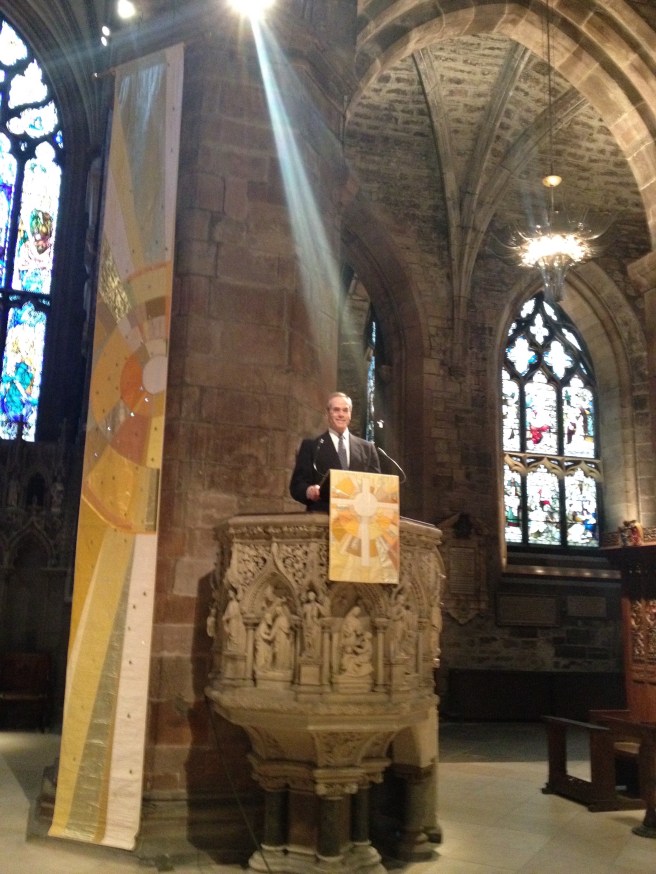
St Giles photoOn Sunday, January 31, I had the privilege of being (I was told) the first rabbi to deliver a sermon at the historic St. Giles Cathedral, the Mother Church of Scotland.

I consider it more than a coincidence that event took place on the 45th anniversary of my father’s death.

The connection is particularly stark because my sermon was part of an interfaith Holocaust Memorial Service, and my father was a survivor.

He was arrested on Kristallnacht, November 9, 1938, and taken to Dachau where the Nazis shaved his head and beat him. But he was so very fortunate because seven out of every nine Jews who lived in his native city of Leipzig in 1935 died in the Shoah.

Because my father’s relatives in the United States had the necessary papers in order, they were able to secure his release after only a few weeks. He came to this country, met and happily married a beautiful American woman, and fathered my sister and me.

Yes he was so fortunate to escape, but I know the residual effects of his suffering contributed to his death at age 57 while his two older brothers—who left Germany earlier—lived well into their eighties.

When the Beadle of the Cathedral formally summoned me to ascend the St Giles pulpit, my mind flashed back 45 years to when I received that horrible call from my mother while I was studying in Jerusalem.

Back then an international phone call was a very big deal. If you got one, it was your birthday, some other special occasion, or something was very wrong.

When my landlady, Mrs. Daniel Auster, widow of the former Mayor of Jerusalem came into my room at 5 AM to tell me my mother was on the phone, I knew it could only be one thing. My precious father, in my mother’s words, “was gone.”

The long plane ride home—which stopped in Paris was excruciating. Sitting next to me on the first leg of the flight was an ebullient woman on her way to Paris to celebrate her daughter’s wedding.

I did not have the heart to deflate her joy by sharing the reason I was on the plane. My stomach was in knots as I listened to her.

I spent thirty days at home before returning to Jerusalem to continue my studies. They were precious days of reflection and remembrance.

They confirmed for me the wisdom of our tradition in advising us to take sufficient time to absorb the blow when a loved one dies.

I loved my father and admired him, but there are so many questions I would have liked to ask that I never did.

Why didn’t you leave Germany earlier? What was it like when you first came to the USA?

You always acted like you loved me, but why did you never tell me?

In the days following my second open-heart surgery in 2012, I found myself depressed and concerned for my future. I sought therapy and was not surprised when the doctor zeroed in on my relationship with my dad.

“You seem to have never been able to please him,” he noted.

I credit the Eternal One and the therapist for the blessings I have enjoyed since my surgery: the three months I spent as rabbi in Milan, Ben’s marriage to Kristin, the birth of our fifth grandchild, Flora, the completion of my book, it’s translation into German, the two extended periods Vickie and I spent in Germany, the many places I have been privileged to speak, and of course, our recent trip to Scotland.

Indeed, the future about which I fretted at the time of my surgery has turned out very nicely.

I believe in the things I am doing and hope they make a small difference for good.

But I know the doctor was correct. I still want to please my father. And maybe, just maybe I am beginning to believe I am.


Das Saphir-Surfboard

Kurzkommentar zum Wochenabschnitt Mishpatim: Exodus 21,1 – 24,18

Worte sind das unzulängliche Werkzeug, das Menschen gebrauchen, um Unbeschreibliches zu beschreiben. Im Tora-Abschnitt dieser Woche haben Mose und die Ältesten ein spektakuläre Begegnung mit dem EwigEinen: Sie “(ויראו/ ויחזזו) sahen Gott (Exodus 24,10, 11).” Gottes Füße berühren einen Boden, der „wie mit Saphir ausgelegt war, so klar wie der Himmel“ (Exodus 24,9).

Als Michael Hyman, jetzt ein bekannter Software-Unternehmer, vor fast 40 Jahren mit mir für seine Bar Mitzwa lernte, beschrieb er die Vision so: Gott reitet mit einem „Surfboard aus Saphir“auf den Wellen des Himmels.

Unbeschadet dieser wunderbaren Beschreibung besteht die Tora darauf „Niemand kann mein (Gottes) Gesicht sehen und es überleben“ (Exodus 33,20).”

Die Vision des „Saphir-Surfboards“ gab den Ältesten einen kurzzeitigen Glaubensschub, aber das wirkte nicht lange. Denn als Mose vom Gipfel des Berges nicht so schnell wie erwartet runter kam, forderte das Volk „einen Gott, den wir sehen können“ – und Aaron machte ihnen das goldene Kalb. (Exodus 32,1-4)

Glaube entsteht nicht immer durch spektakuläre Visionen wie die des „Sapir-Surfboards“.

Elijah, der Prophet, konnte Gott weder im Donner noch im Blitz finden, aber in der „leisen Stimme“ im Innern (1. Kings 19,12).

Aber auch dieser Moment wirkte nicht lange. Als Elijah Verzweiflung und Sinnlosigkeit seiner Arbeit spürte (1. Könige 19,14), weist Gott ihn an, Elisa zu beauftragen, seine Arbeit weiter zu führen (1. Kings 19,16).

Dauerhafter Glaube ist Glaube, der andere inspiriert!

Mögen wir, wie die Ältesten Israels und Elijah, Augenblicke des Staunens erleben, die Worte nicht angemessen beschreiben können. Bevor aber die Flammen unserer Inspiration erlöschen, mögen sie Glauben in anderen entfachen, der sie inspiriert – wie immer sie können – zu arbeiten für eine gerechtere, fürsorglichere und mitfühlendere Gesellschaft auf Erden.

Translation: with thanks to Pastor Ursula Sieg


The Sapphire Surfboard

(Quick Comment Parashat Mishpatim 21:1 – 24:18)

Words are the imperfect tools humans use to describe the indescribable. In this week’s Torah portion Moses and the elders of Israel have a spectacular encounter with the Eternal One:

They “(ויראו/ ויחזזו) saw God (Exodus 24:10, 11).

With imperfect tools—words—the Bible describes God’s feet on “a paved work like sapphire stone as clear as the heavens (Exodus 24:9).”

When Michael Hyman, now a renowned entrepreneur in the software world, studied with me for his Bar Mitzvah nearly 40 years ago, he described the vision as God riding the heavenly waves on “a sapphire surfboard.”

This awesome description notwithstanding, the Torah insists, “No one can see my (God’s) face and live (Exodus 33:20).”

The vision of the “sapphire surfboard” gave the elders a short-term shot of faith, but it did not last. When Moses did not return from the mountaintop as soon as they expected, the people demanded “a god we can see,” and Aaron made them a golden calf. (Exodus 32:1-4)

Faith does not always come from spectacular visions like “the sapphire surfboard.”

Elijah the prophet could not find God in thunder or lightning but in the “still small voice” within (I Kings 19:12).

But even that moment did not last. When Elijah felt despair and that his efforts were for naught (I Kings 19:14), God instructed him to anoint Elisha to carry on his work (I Kings 19:16).

Enduring faith is faith that inspires others!

May we, like the Elders of Israel and Elijah, experience moments of amazement that words cannot adequately describe. And before the flame of our inspiration wanes, may it kindle faith in others that inspires them to work—however they can—to create a more just, caring and compassionate society on earth.


Ein verborgener Edelstein!

Kurzkommentar zum Wochenabschnitt Yitro  (Exodus 18:1-20:23)

So leicht übersehen wir einen Lehr-Edelstein, der unscheinbar hinter den Zehn Weisungen schlummert, aber unser Leben verändern kann: „Und wenn du Mir einen Altar aus Steinen machst, sollst du ihn nicht aus behauenen Steinen bauen; denn wenn du dein Werkzeug darauf erhebst, verunreinigst du sie.“ (Exodus 20:22)

 Gott will uns genau so, wie wir sind.

Wir haben alle das Potential Steine im Altar Gottes zu sein, und wir können alle in anderen das selbst Potential entdecken. Aber oft wollen wir andere potentielle Altar-Steine behauen, damit sie unseren Vorstellungen entsprechen.

Gott lädt alle ein am Altar Gottes zu beten, ganz gleich ob wir Juden, Christen, Muslime, Hindus sind, eine andere Religion haben oder gar keine. Es spielt keine Rolle, ob wir homo-, hetero- oder transsexuell sind.

Um in den Altar Gottes zu passen, brauchen wir nur eine Eigenschaft: Den starken Wunsch, die Fähigkeiten, mit denen der EwigEine uns gesegnet, hat zu gebrauchen, die Welt zu einem besseren Ort zu machen.

Eines der wertvollsten Geschenke, die mir meine Mutter als Kind gemacht hat, war eine Schallplatte mit dem Titel „Kleine Lieder über große Themen“. Eines meiner Lieblingslieder beginnt so: „Ich bin stolz, ich zu sein. Aber ich sehe auch, dass du genauso stolz bist, du zu sein. Das ist einfach menschlich. Warum also sollte ich dich hassen, weil du so menschlich bist, wie ich. Wir wollen geben, was wir geben, wenn wir leben und leben lassen. Wir werden miteinander längs kommen, wenn wir es versuchen…“

Die Idee, dass Gott will, dass wir Menschen so akzeptieren, wie sie sind, ist leicht zu übersehen hinter den Zehn Weisungen, aber sie ist so wichtig zu lernen, wie alles andere, was wir jemals zu lernen haben.

Translation: with thanks to Pastor Ursula Sieg

Events in Edinburgh

Don’t Stand By: EIFA Holocaust Memorial Event
Thursday 28 January, 7pm,
FFirhillHigh School
This event is sold out – to be placed on the waiting list please email info@eifa.org.uk
Edinburgh Inter Faith Association and Firrhill High School HMD Committee are delighted to invite you to an evening of remembrance for the victims of holocaust and genocide the world over.

The programme will include testimonies from Zigi Shipper, who survived the Lodz ghetto and Auschwitz-Birkenau camp; human rights advocate Mukesh Kapila who has worked with survivors of the genocides in Rwanda and Darfur; and prayers led by Rabbi Stephen Fuchs.

The event programme will start at 7pm, arrive early for a guided tour of the Anne Frank exhibition.
There will also be music, poetry, candle-lighting by pupils of the school and a break for some refreshments. Bring along a pair of shoes you no longer need to add to an installation, these will be donated to Oxfam after the event.
The address of the school is 9 Oxgangs Road N., Edinburgh, EH14 1DP: MAP
This is a free event, generously supported by the Claremont Trust.
This event is sold out – to be placed on the waiting list please email info@eifa.org.uk
Find out more with the Holocaust Memorial Day Trust and The Holocaust Education Trust
JSoc Holocaust Memorial Erev Shabbat,
an Intercommunal Service, Meal and Talk
Friday 29 January, 7pm,
at the Chaplaincy Centre

Queen Margaret University and the University of Edinburgh welcome Rabbi Stephen Fuchs,
former President of the World Union for Progressive Judaism
and author of What’s In It for Me? Finding Ourselves in Biblical Narratives
to our JSoc Holocaust Memorial Erev Shabbat, an intercommunal service and talk in association with the Chaplaincy. Pot luck bring a veggie dish for a buffet between the service and the talk.

Holocaust Memorial Shabbat Morning Service,
Saturday 30 January, 11am,
Sukkat Shalom (Liberal Shul)

For those of you who can’t make Friday evening – or who want more of Rabbi Fuchs – the Rabbi will be leading Sukkat Shalom’s Shabbat morning service at the Columcille Centre, 2 Newbattle Terrace, EH10 4RT. The service will be followed by Kiddush and a presentation from the Rabbi.

Holocaust Memorial Interfaith Service,
Sunday 31 January, 11.30am,
St Giles Cathedral

Join Rev Calum I MacLeod and Rabbi Stephen Fuchs for what promises to be a beautiful interfaith event, with the accompaniment of St Giles Cathedral Choir.

Edinburgh Jewish Literary Society
Double Bill with Buffet,
Sunday 31 January, 5.30pm,
Edinburgh Hebrew Congregation (Orthodox Shul)

At 5.30pm, Rabbi Stephen Fuchs will speak about his new book What’s in it for Me: Finding Ourselves in Biblical Narratives

The world is rapidly dividing between those who take biblical narratives as the literal word of God—claiming that they are historically and scientifically true—and those who dismiss those narratives as quaint or even foolish fairy tales. There is however a sacred middle ground that What’s in It For Me? Finding Ourselves in Biblical Narratives invites the reader to discover. The “truth” of these stories has nothing to do with “Did this really happen?” Their truth emerges in the valuable lessons these stories can teach all of us. There will be a book signing after the talk.

A buffet will be provided between 7pm and 8pm
At 8pm, Phil Alexander will give a musically illustrated talk entitled My Lover, My Murderer’s Daughter: Berlin and the politics of klezmer music.

Over the last twenty-five years, Berlin has played host to Europe’s most dynamic klezmer and Yiddish music scene. These days, the city’s scene attracts a vibrant blend of musicians from around the world, part of a complex and international conversation which takes in rupture and renewal, tradition and innovation, history and modernity. The talk will explore this ongoing journey of Berlin klezmer and the challenges of making the traditional strains of Jewish folk music relevant to a twenty-first century capital city.

Phil Alexander is currently completing his PhD at SOAS, University of London, focusing on contemporary klezmer and Yiddish music in Berlin. As a musician he is the driving force behind Edinburgh-based Moishe’s Bagel, and a long-term musical partner of Eliza Carthy, Salsa Celtica and Mr McFall’s Chamber.

Free for EJLS members, £5 non-members for the whole evening and £3 for non-members who attend only one session.

There are also numerous external events and opportunities – fancy a summer in Ghana with Tzedek? Or the March of the Living in Poland – heavily subsidised by UJS? Or the UJS Liberation Conference? See last week’s email for more details, or click on the links.
Facebook

A Hidden Gem!

Quick Comment Parashat Yitro (Exodus 18:1-20:23)


It is easy to overlook a gem of a lesson that lurks unobtrusively behind the Ten Commandments, but it is a lesson that can change our lives.

“And if you make Me an altar of stone, you shall not build it of cut stones; for if you lift up your tool upon it, you have polluted it.” (Exodus 20:22)

God loves us just as we are

We all have the potential to be stones in God’s altar and we all have the potential to see in others the same potential.

But too often we want to cut those other potential stones to fit our expectations of how they should be.

God welcomes all to worship at the Divine altar whether we are Jewish, Christian, Muslim, Hindu, another religion or no religion at all. It does not matter if we are gay, straight or transgender.

To be part of God’s altar we need just one characteristic: a desire to use the talents with which the Eternal One has blessed us to make the world a better place.

One of the most precious gifts my mother gave me as a child was a phonograph record called, “Little Songs on Big Subjects.” One of my favorites begins, “I’m proud to be me, but I also see, you’re just as proud to be you. It’s just human nature so why should I hate you for being as human as I. We’ll give as we give if we live and let live, and we’ll both get along if we try …”

The idea that God wants us to accept people as they are is easy to overlook behind the Ten Commandments, but it is as important as any lesson we can ever learn.

Wir sitzen alle im selben Boot!

Kurzkommentar zum Wochenabschnitt Beshalach, Exodus 13:17 – 17:16

Im Tora-Abschnitt dieser Woche spaltet Gott das Meer, so dass die Israeliten es auf trockenem Boden passieren können, aber ihre Verfolger, die Ägypter, sind darin unter gegangen. (Exodus 14:22-28).

Dieser Bericht unserer Befreiung ist grundlegend für unsere spirituelle Reise. Aber Gott befreite uns, darauf besteht die Tora, mit der Anforderung, dass wir zur Befreiung aller, die unter politischer und wirtschaftlicher Unterdrückung leiden, beitragen.

Heute wird das Wasser nicht einige ertränken und andere verschonen: Vor langer Zeit legte ein König einen Untertanen unbarmherzig hohe Steuern auf. Wenn sie sich beschwerten, verspottete sie der König, indem er sagte: „Das ist nicht mein Problem! Das ist euer Problem!“ Eines Tages meldete sich ein alter Mann beim König. „Bitte, klag nicht über die Steuern“, sagte der Herrscher, „das ist nicht mein Problem. Das ist euer Problem!“ „Nein, eure Majestät“, antwortet der Mann, „ich komme, um Euch zu einem Boots-Ausflug einzuladen.“ Überrascht stimmte der König zu. Nachdem der Mann in die Mitte des Sees gerudert war, begann er in den Boden des Bootes ein Loch zu schnitzen. „Halt!“, rief der König, „ich werde untergehen!“ „Das ist nicht mein Problem“, antwortete der Mann. Ich mache das Loch doch nur unter meinem eigenen Sitz.“ „Ich verstehe“, sagte der König, „ich habe meine Lektion gelernt.“ Sie ruderten zurück an Land und der König verfügte angemessenere Steuern. (Nach Va-yikrah Rabbah 4:6)

Dieser alte Midrasch erinnert uns, das wir alle Passagiere auf dem einem Boot sind, das wir Erde nennen. Da gibt es kein „Loch nur unter meinem Sitz“. Heute ist die Welt sehr klein geworden. Wir werden entweder Wege finden, um in Frieden zusammen zu leben, unsere wertvolle Umwelt zu schützen, die Hungernden zu ernähren und allen Kindern Gottes Wärme und Schutz zur Verfügung zu stellen, oder ein gewaltiger Wirbel wird und alle mitreißen.

Translation: with thanks to Pastor Ursula Sieg