To Seek the Blessing — Thanksgiving 5775 – 2014

Life can often be very difficult. In 1936, at the height of the Great Depression, Governor Wilbur Cross of Connecticut appealed to the indomitable spirit of the people of our state when he proclaimed on Thanksgiving, “It has seemed good to our people to join together in praising the Creator… for the blessing that have been our common lot … for honor held above price; for steadfast courage and zeal in the long search after truth; for liberty and for justice… that we may humbly take heart of these blessings as we gather once again with solemn and festive rites to keep our harvest Home.”

With these mighty words Governor Cross looked beyond the ravages of the Great Depression that affected every citizen and inspired the people of our state to seek and find the blessings in their lives.

It was the same quality exhibited by our patriarch Jacob who also overcame trial and tribulation to seek and find a blessing from God.

But, you might ask, “a blessing! What right and what hope should Jacob have had to seek a blessing from God?” Had he not taken advantage of his older brother Esau to extort the lion’s share of the family inheritance from him? Had he not stood before his blind father swearing he was Esau in order to steal his father’s blessing?
Yes, people often ask: “Why does an unsavory character like Jacob become Israel, the namesake of the Jewish people? Why do you take your name from a trickster and a thief?”

It is a good question, and it has good answers. First of all, Jacob paid and paid for his evil deeds. We would not be wrong if we counted the years after he left home as twenty years of hard time in the Laban Penitentiary in Haran. Laban tricked him time and again, and “often,” Jacob exclaimed, “scorching heat ravaged me by day and frost by night. Sleep fled from my eyes.”
Second, he honestly and eagerly sought Esau’s forgiveness, and he did not merely attempt to placate his brother with empty words. The size of the gift Jacob insisted Esau accept –and to his credit Esau was reluctant to do so– more than compensated his brother for the loss of the birthright inheritance.

And last and most important, Jacob is our role model and our namesake because despite every reason for doing so, he refused to give up hope. He stumbled and fell, as we all do. He paid for his misdeeds many times over. And when it seemed that all was lost, he wrestled with everything he had been and everything that he had done. He proclaimed to the Almighty in the midst of his struggle, “I will not let You go until You bless me.” (Genesis 32:27)

Though the encounter left him wounded, he wrenched genuine blessing from the depths of his anguish and found the ability to face the future with courage and hope. In that, I submit, he is a wonderful role model for all of us!

Thomaskirche Kristallnacht Speech — English Version

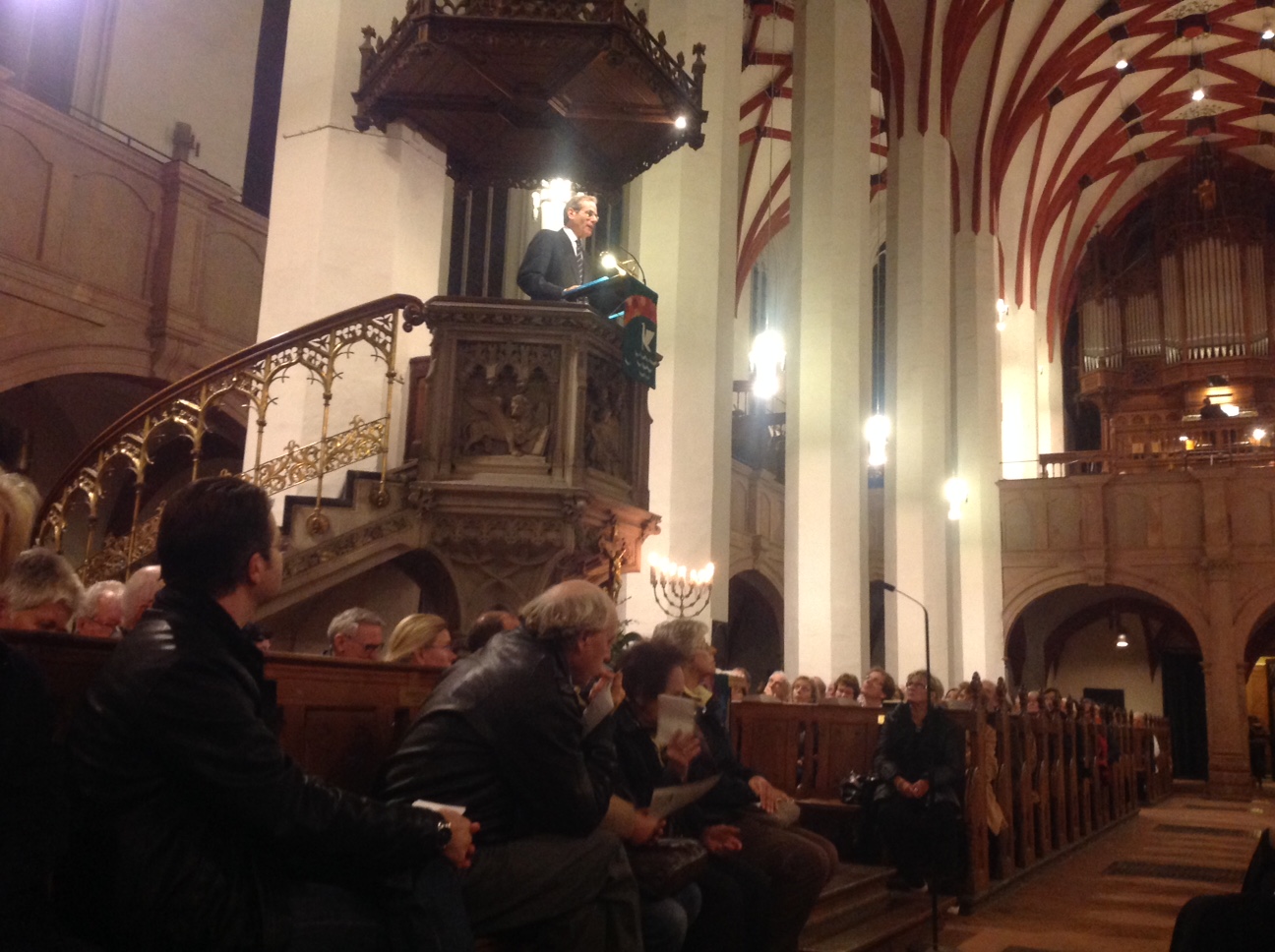
Thomaskirche photo

It is a great honor for me to speak in this historic church to commemorate this horrific night 76 years ago. I am so very grateful to Pastorin Brita Taddiken of the Thomaskirche and to Pastor Timotheus Arndt for the invitation. I also want to express my eternal gratitude to Pastorin Ursula Sieg and Pastor Martin Pommerening for both welcoming Vickie and me into their home and for the endless hours each has put in to make our ten-week stay in Germany so productive and meaningful.

I first found out what happened on this night in 1938 when I began my graduate studies to become a rabbi at the Hebrew Union College in Los Angels. At the opening convocation the then dean and later President of the College, Rabbi Alfred Gottschalk, of blessed memory, told of how as an eight-year old child in the town of Oberwesel, he watched his grandfather wade into the river Rhine to save charred scraps of Torah scrolls thrown by the Nazis from his burning synagogue.

As my train pulled into Leipzig’s huge station, I realized that my first glimpse of the city was probably my father’s last as he traveled on a different kind of train to Dachau after his arrest on Kristallnacht, November 9, 1938.

I picked up a detailed city map at the information center to try to find the street and apartment where my father had grown up. I also sought the location of the city zoo.
Why the zoo? The eyewitness report on Kristallnacht by David H. Buffum, American consul in Leipzig, reveals: “Jewish dwellings were smashed into, and the contents looted… An eighteen year-old boy was hurled from a three-story window to land with both legs broken … three synagogues were fired simultaneously by incendiary bombs, and many Jews were rounded up and thrown into the stream that flows through the city zoo. SS men commanded horrified spectators to spit, jeer, and defile them with mud.”
When I arrived at the entrance to the zoo, it was 6:45 p.m. The gatekeeper said I was too late. “The zoo closes at seven.”
“It is all right,” I answered, as I handed over the entrance fee. “I only need to go in for a few minutes.” The gatekeeper protested, but I persisted until she finally let me pass.
In a few minutes I was standing before the stream. Tears came to my eyes as I heard myself asking out loud, “Is this where they took you, Papa? Did those bastards spit on you… Did they throw mud on you?” Then, as if in retaliation, I spit into the water from a bridge that straddles the stream.

The next morning I found the office of the Leipzig Jewish community. The elderly lady who answered the door explained that the head of the community was out but would be back later. I explained to her that my father grew up in Leipzig. She pulled down a dusty ledger and opened it to the F’s. I quickly found the family listing.
While we were talking, the leader of the community walked in. I explained who I was and why I was there. He was warm, friendly, and clearly pleased that I had come.

I asked him, “How many Jews live in Leipzig?”
“67”, he answered.
“And how many lived here,” I continued, “when the Jewish population was at its peak?”
“In 1935,” he responded, “18,000 Jews lived in Leipzig.”
“How many perished during the Holocaust?” I asked.
“14,000,” he replied.

The twelve-hour train ride to Amsterdam gave me plenty of time to digest my experiences in Leipzig. I thought, of course, of my father. After Kristallnacht, the Nazis took him to Dachau where they shaved his head, interrogated him, and abused him.
But Leo Fuchs was one of the lucky ones. Because he had relatives already in the United States, and because his visas were complete and in order, the American consulate secured his release after only a few days.

He never spoke of any of this to me, but I know the trauma’s effect never left him. In the spring of 1969 my father fell gravely ill. I flew home to New Jersey from my rabbinical studies in Los Angeles to be with him. I shall never forget my feelings of helplessness when I entered the hospital room, and my father in a semi-comatose state did not recognize me.
I stood there and shuddered as he began shouting in German –which he never spoke at home– that the guards should stop beating him! He had repressed those memories for more than 30 years.

And they were –by and large—good years! In this country my father found love and raised a family. But I –perhaps irrationally—blame the Nazis for shortening his life and depriving me of sharing my greatest joys with him: My ordination as a rabbi, my marriage to Vickie, and our children and our grandchildren.

Why do I say this? My father died at age 57. His older brothers who left Germany before Kristallnacht lived well into their 80’s.

Our children! They are our people’s answer to Hitler’s madness. For us Jews each new life represents a young sapling planted not only to bring joy to a family but also to revitalize a once verdant forest ravaged by fire, by smoke, and by gas.

The word, “genocide,” which we throw around so loosely today, came into our vocabulary so that we could attempt to define what Hitler tried to do: to extirpate the gene pool of our people.
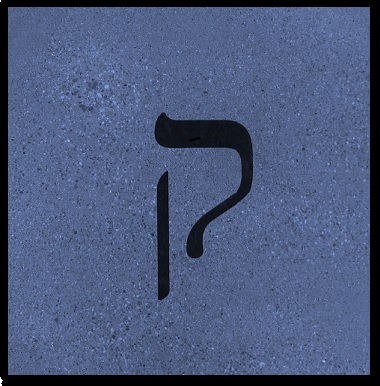
And so we command ourselves: זכור Remember! But if we only remember to wallow in our sorrow, then we waste our time and our tears. We must remember what was so that we can make what will be better.

People ask me all the time. “How could God allow the Holocaust?” I answer that God gave human beings free will and placed us in charge of and responsible for this world. Without free will life would have no meaning. We human beings would be mere puppets on a string or actors following a script from which we could not deviate.

God yearns for us to create a world of justice and compassion, but God does not do it for us. When we fail, it is our failure, not God’s. When we fail, I believe God weeps with us and for us.

As I walked away from the stream that flows through the Leipzig zoo, I wandered past a den of timber wolves in a natural enclosure and beheld a truly wondrous site. A mother wolf stood stark still, while two suckling cubs nursed blissfully at her breasts.

At first, I thought it so incongruous to see such an exquisite glimpse of nature’s harmony in a place that represented to me only discord and destruction. Yet, that is the image that lingered in my mind during the long train ride back to Amsterdam. My mind’s eye kept returning from the vision of violence, hatred, and pain to the peaceful, pastoral scene of wolf cubs drawing sustenance and strength from their mother.

I know that the Nazis’ and neo-Nazi’s use the wolf as a symbol. That is a perversion! Wolves don’t kill because of ideology or cruelty—only to survive.

The Leipzig zoo will always represent for me the horrible evil of which humanity is capable. The wolves, though, will always represent harmony God wants us to create in this world.

On Yom Kippur we read in our synagogues one of the Torah’s most important texts: “See I have set before you life and goodness, death and evil.” (Dt. 30:15). The choice is ours, but God exhorts us: “Choose life that you and your offspring may live (Dt. 30:19).

No, the question is not where was God during the Holocaust. The question is where was humanity?
We cannot change the past, but we can learn from it. We know too well that we can choose death, but God hopes our past will strengthen us as we face the future.

Yes, we can choose death, but God hopes
That the pain we relive this night will give us the courage
To clothe the naked,
Feed the hungry,
Teach the unlettered,
Foster understanding among all people,
And use the vast talents—with which God has blessed us—
To choose life, and
To forge a world of justice, caring, compassion and peace!

And then, at last, we will have the world of which the prophets dreamed when they said (Isaiah 11:9 and Micah 4:4)
They shall not hurt nor destroy in all My holy mountain, for the earth will be filled with the knowledge of the Eternal One as the sea bed is covered by water … and all shall sit under their vines and under their fig trees and none shall make them afraid!
Amen
Warum ich nach Leipzig gekommen bin, 9 November 2014

img_4013

Dies ist meine dritte Reise in die Geburtsstadt meines Vaters. Hier wuchs er auf und – drei Silberteller, die mir sehr wertvoll sind, belegen das – gewann das Tischtennis-Doppel Championat der Stadt Leipzig in den Jahren 1929 (neunzehnhundertneunundzwanzig), 1930 (neunzehnhundertdreißig) und 1933 (neunzehnhundertdreiundreißig), in dem Jahr als Hitler an die Macht kam.

1982 (neunzehnhundertzweiundachtzig), bei meinem ersten Besuch, wurde ich am ostdeutschen Grenzübergang Ölbesfelde abgewiesen, als ich so naiv war, dem Grenzbeamten zu erzählten, dass ich ein Rabbiner bin auf dem Weg nach Leipzig, wo mein Vater seine Jugend verbracht hat. Erst nach einem eintägigen Umweg über Berlin, wo ich mich als Kunstlehrer vorstellte begierig die berühmten Museen Leipzigs zu besuchen, bekam ich ein Visum.

Während der ganzen Reise betete ich, dass niemand mir Fragen über Kunst stellt.
Zu der Zeit war die örtliche jüdische Gemeindezentrale eine kleine, staubige, schwer zu findende Ansammlung von Büros, die ich über eine enge, knirschende Treppe erreichte.

Von dem Vorsitenden der Gemeinde erfuhr ich damals, dass 67 (siebenundsechzig) Juden in Leipzig lebten. Diese Zahl ließ mir das Herz erstarren. 1935 (neunzehnhundertfünfunddreißig) gab es 18.000 (achtzehntausend) Juden in Leipzig. 14.000 (vierzehntausend) starben in der Shoa.

Im Gegensatz dazu fand ich im Jahre 2011 (zweitausendelf) eine liebevoll renovierte Synagoge und geräumige Büros vor. Die Leipziger jüdischen Gemeinde war durch hunderte russische Immigranten neu belebt worden. Ihr Rabbiner Zsolt Balla persönlich zeigte mir die Orte, wo meine Vorfahren gelebt hatten.

Im letzten Winter, als Pastorin Ursula Sieg zum ersten Mal vorschlug nach Deutschland zu kommen, um in Synagogen, Schulen, Kirchen und an der Universität Potsdam und dem Abraham Geiger Kolleg zu sprechen, schien es ein folgerichtiger nächster Schritt auf dem bemerkenswerten Weg, den Deutschland gegangen ist, um die Schrecken des Hitler-Regime wieder gut zu machen.

Ja wirklich, denn in den Jahren 2011 (zweitausendelf) und 2012 (zweitausendzwölf) hatte ich in meiner Funktion als Präsident der Weltunion für Progressives Judentum die Ehre, die Verträge zur Errichtung einer Jüdischen Fakultāt in der Universität von Potsdam zu unterzeichnen. Das bereitete den Weg zu einem Staatsvertrag, der auch beinhaltet, deutschen Studenten das Studium des Judentums und die Rabbinerausbildung zu finanzieren.

In den letzten Monaten allerdings, hat sich der Antisemitismus an vielen Orten Europas wieder kraftvoll erhoben. Sogar hier in Deutschland, wo Gesetze antisemitische Äußerungen in der Öffentlichkeit verbieten, konnten wir erneut die Glut unverhohlenen Hasses gegen Juden auflodern sehen.

Mit diesen Entwicklungen veränderte sich der gesamte Charakter des Besuches.
Als Israel die Angriffe der Hamas auf Israels Zivilbevölkerung kraftvoll beantwortete, hat ein Großteil der Welt Israel verdammt. Dies war eine völlig unangemessene Reaktion auf Israels glücklicherweise erfolgreiche Anstrengung seine Bürger vor dem Terror derer zu schützen, die sich seiner Vernichtung verschrieben haben.

Sie bewahrheitet einmal mehr die uralte Aussage des moabitischen Propheten Bileam: Israel ist ein Volk, das abgesondert wohnt. (Numeri 23, 9)
Praktisch über Nacht wurde uns klar, dass unsere Generation der Juden nicht von der Prophezeiung des Bileam ausgenommen ist.
Als der Tag unserer Abreise aus den USA näher kam, äußerten einige Freunde und Familienmitglieder berechtigte Bedenken gegenüber unserem Deutschlandbesuch.

Aber meine Familie ist hier: meine Frau Victoria, meine Cousine Irene, deren Eltern beide in Leipzig geboren und aufgewachsen sind, ihr Partner Joe Azizallahoff und unser Sohn Leo Fuchs, der nach meinem Vaters genannt ist. Mein Vater Leo Fuchs wurde genau heute vor 76 Jahren hier in Leipzig verhaftet und in das Konzentrationslager Dachau gebracht.

Und dennoch freuen wir uns hier sein zu können und sind sehr dankbar für die Einladung. Nach fast zwei Monaten in Deutschland, weiß ich, dass viele Deutsche sehr interessiert sind unseren Glauben, unsere Geschichte und unseren Lebensstil kennen zu lernen. Ich bin hier, weil ich wie Anne Frank glaube, dass die Menschen in ihrem Wesen gut sind.
Ich bin hier, weil wir zwar die Vergangenheit nicht ungeschehen machen können, aber wir können die Zukunft gestalten.

Ich habe einmal die Geschichte gehört, dass während ein Offizier die Juden einer kleine Ortschaft auf dem Dorfplatz zusammentrieb. Er befahl dem Rabbiner vorzutreten. Er hielt seine Hände hinter den Rücken und sagte grinsend: Da du ja so klug bist, kannst du dein Dorf retten, wenn du mir eine Frage richtig beantwortest. In meinen Händen hinter meinem Rücken habe ich einen Vogel. Sag mir, Rabbi, ob er tot oder lebendig ist.

Dem Rabbiner war klar: Wenn ich sage: “Er ist tot”, zeigt der Offizier den Vogel lebend vor. Sage ich aber: “Er lebt”, dann drückt er ihn mit den Händen tot.
Der Rabbi blickte dem Offizier direkt in die Augen und sagte: “Die Antwort ist in deiner Hand”.

Wir können die Vergangenheit nicht ungeschehen machen. Aber die Zukunft zu gestalten, das ist unsere Aufgabe.
Werden wir unseren Kindern eine Welt voller Hass, Terror, Gewalt und Krieg hinterlassen? Oder werden wir eine Welt der Gerechtigkeit, der Fürsorge, der Freundlichkeit und des Mitgefühls schaffen? Werden wir eine Welt des Friedens schaffen? Ich danke Gott dass die Antwort auf diese Fragen in unseren Händen liegt.

Synagogue Site Speech: Why I Have Come to Leipzig, November 9, 2014 (English Translation)

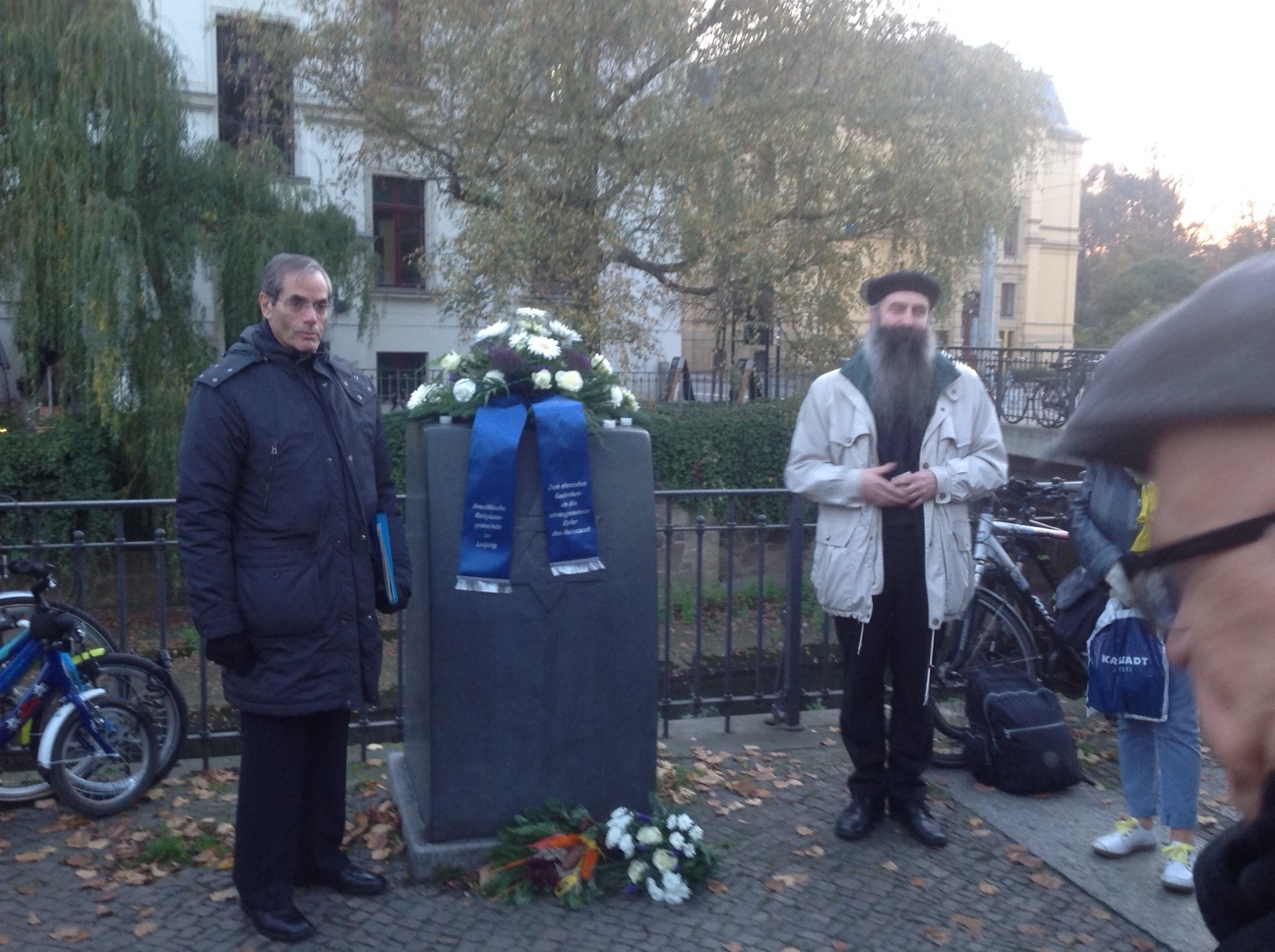
img_4013 November 9, 2014

This is where my my father became Bar Mitzvah in February 1926.

This is my third visit to the city where my father was born, grew up and where (as three sterling dishes that I treasure attest) he won citywide doubles championships in table tennis in 1929, 1930 and 1933, the very year Hitler came to power.

On the occasion of my first visit in 1982 I was turned away at the East German border crossing, Oebesvelde, when I naively told the passport inspector that I was a rabbi on my way to Leipzig to visit the city of my father’s youth. Only after a day-long detour to Berlin–where I reinvented myself as an art teacher eager to visit Leipzig’s famous museums–did I receive a visa. All during my visit I prayed that no one would ask me anything about art!

At that time the Jewish communal headquarters was a tiny, dusty, hard to find and cramped suite of offices that I reached by climbing a creaky, narrow staircase. The head of the community informed me at the time that 67 Jews lived in Leipzig. Learning that number chilled me to my very core. In 1935 there were 18,000 Jews in Leipzig. 14,000 of them perished in the Shoah.

By contrast, my visit in 20ll introduced me to a lovely refurbished synagogue, spacious offices and a guided tour of the places where my relatives had lived. I was accompanied by the young rabbi of Leipzig’s Jewish community, which had been revitalized by the arrival of hundreds of Russian immigrants.

Last winter when Pastorin Ursula Sieg first proposed that Vickie and I come to Germany to speak in synagogues, School, the University of Potsdam and here today, it seemed a natural step in the remarkable progress Germany has made to atone for the horrors of the Hitler era. Indeed, in 20ll and 2012, in my capacity as President of the World Union for Progressive Judaism, I was honored to sign papers that led to the establishment of the School of Jewish Theology at the University of Potsdam. These agreements paved the way for the formal arrangements for the German government to fully fund the German students studying Judaic subject including those studying to be rabbis.
In the last months, though, anti-Semitism has arisen forcefully in many places in Europe. Even here in Germany, where law bars public expressions of anti-Semitism, we have seen the simmering of overt hatred of Jews once again. With these developments, the entire timbre of my visit has changed.
When Israel responded forcefully to Hamas’ attacks on its civilians, much of the world blamed Israel. This totally inappropriate reaction to Israel’s thankfully successful efforts to protect its citizens from the terror of those who dedicate themselves to her destruction—gives credence once again to the notion that we Jews are as the Moabite seer Balaam proclaimed long ago, “a people that dwells alone.” (Numbers 23:9)

Practically overnight, we learned that our generation of Jews is not exempt from Balaam’s prophecy. As the day of our departure from the United States drew near, some friends and family members voiced reasonable concern about our coming to Germany. But my family and I are here: my wife, Victoria, my cousin Irene, whose parents both were born and raised in Leipzig, her partner Joe Azizazoff, and our son, Leo Fuchs, named for my father who was arrested here and sent to Dachau 76 years ago today!

We have come with joy and gratitude for your invitation. After nearly two months in this country, I know that so many Germans are eager to learn about our faith, our history and our way of life. I am here because I believe, as did Anne Frank, in the essential goodness of humankind. I am here because, though we cannot undo the past, the future is ours to shape!
.
Once, the story is told, an officer gathered the Jews of a small village to the town square. He called the rabbi to step forward. He held his hands behind his back, and sneered. “Since you are so smart, Rabbi, You can save your village if you answer my next question correctly. I am holding a bird in my hands behind my back. Tell me, Rabbi, is it dead or alive?”
The rabbi knew that if he said the bird is dead, the officer would produce it alive. If he said the bird was alive, he would crush it to death in his hands.
And so the rabbi looked the officer straight in the eye and replied: “The answer is in your hands.”
No, We cannot undo the past, but the future is ours to shape!
Will we leave our children a world filled with more hatred, terror, violence, and war? Or will we create a world of justice, caring, kindness, compassion and peace?
I thank Almighty God that the answer to these questions is in our hands!

A Letter to the Memory of My Father as I Stand in the Leipzig Zoo on Kristallnacht 2014

Leipzig zoo

Is this the place?
Is this where they took you, my precious father, on that horrible night?
Is this the place where they spit on you, cursed you, threw mud on you and reviled you for the crime of being a Jew?
I am so thankful, my father, that you made it out alive.

I am thankful that you met my mother and that my sister and I could be born.
I am thankful that you raised us as proud Jews, and I hope you are proud that I am standing here today!
But I cannot be sure!
I cannot be sure because you never, ever spoke to me of the night I have come to this place to commemorate.
You spared me the trauma that—as I now know—scarred you.

But I thank you!
For though you were scarred, you persevered.
You and Mother created a warm, loving Jewish home for Rochelle and me.
You taught me of our ancestor, Rabbi Zvi Hirsch Kalischer,
The first Orthodox rabbi to encourage Jews to settle in the Land of Israel in fulfillment of their sacred Covenant with God.

You taught me of your father Hirsch Wolf Fuchs, who was murdered
At the beginning of World War I leaving you as a baby to grow up without a father to teach you the things only a father can teach.
But I was blessed to have you!
We stand in this place, and in truth, I fight back tears.

But I did not come here only to weep!
I am here with my wife, Victoria, whom you would have adored! I am here with your niece, Irene, who you did indeed adore.
Dad, our son carries your name
With great pride!

You did tell me one story that I share now:
When you were born
Your parents named you
Leo Eliezer Fuchs!
Eliezer means “God is my help.”
But the German government—even in 1913—informed your parents that Eliezer was not an acceptable name for a German boy. And so you became
Leo Elias Fuchs.
Your silent protest was to never—ever —
Use your middle name!
It was a subtle protest, but it was not lost on me!
And so when your grandson, who stands here with us today
Came into the world,
Vickie and I proudly named him
Leo Eliezer Fuchs
In your memory!

Today, my precious father,
We have come to a different Germany than the one you left
(In the words of the Prophet Zechariah)
Like, “a brand plucked from the fire!” (Zechariah 3:2)

Because Uncle Allie and Uncle Morris, who spent the best years of their lives in this city
Could get you out and bring you to New York.

Yes, Daddy, Vickie and I have come to a Germany that is very different!
We have come to Germany as welcome guests in the home of German Pastors who have planned for months to make our visit comfortable and productive!

We have come to a Germany where anti-Semitic speech and actions are forbidden!
We have come to a Germany where rabbis, Cantors and Jewish professionals from all Europe learn and train at government expense.
We have come to a Germany that has paid billions in reparations to Israel
And to families like ours whose members suffered the ravages of the Shoah.

To this land of that perpetrated the greatest horror that I can imagine.
I come to say:
Remember! And indeed I shall remember!
I shall remember the horror as long as there is breath in my body!
And my children and, I pray that my grandchildren and those who come after will remember as well!

But I also forgive!
I forgive because Germany has asked for forgiveness so many times and so many ways
Because of all that Germany has done
To repent the horror of the Nazi Era
I forgive!
Speaking for myself and my family alone, for that is as far as my influence extends,
I feel called to say as God said
to the children of Israel long ago:
“I forgive as you have asked!” (Numbers 14:20)


I accept your Teshuvah, your repentance, and–
I forgive.
And I join hands with all who stand with us here and with all of those around the world
Who commemorate this day seared into memory,
And I pledge, and I ask all of you to pledge with me
To use whatever talents God has given us
To bring nearer the time
When the world will become
The just, caring and compassionate society that You have desired we create since the time of Creation!

German of Thomaskirche Kristallnacht Speech: A Trip I had to Make

Eine unumgängliche Reise
Rabbiner Stephen Fuchs

Ich wusste nicht, was in dieser Nacht 1938 passiert war, bis ich im Alter von 22 Jahren mein Graduiertenstudium am Hebrew Union College in Los Angeles begann, um Rabbiner zu werden. Bei der Semestereröffnung berichtete der Dekan und spätere Präsident des Kollegs, Rabbi Alfred Gottschalk, wie er als achtjähriges Kind in der kleinen Stadt Oberwesel seinen Großvater in den Rhein waten sah, um verkohlte Fetzen der Tora-Rolle zu retten, die Nazis aus der brennenden Synagoge geworfen hatte.

Als ich Rabbiner Gottschalks Kindheitsbericht von der Kristallnacht hörte, wusste ich noch nicht, dass mein eigener Vater hier in Leipzig genau in der Nacht verhaftet wurde. Als ich das erfuhr, beschloss ich, diesen Ort eines Tages aufzusuchen. Die Möglichkeit eröffnete sich im Sommer 1982.

Als mein Zug in Leipzig’s riesigen Bahnhof einrollte, wurde mir bewusst, dass mein erster Blick auf die Stadt der letzte meines Vaters gewesen sein könnte, als er in einem ganz anderen Zug als Häftling nach Dachau fuhr.

Mit einem genauen Stadtplan von der Tourist Information versuchte ich Straße und Wohnung zu finden, wo mein Vater aufwuchs. Auch den Zoo suchte ich. Warum den Zoo? Der Augenzeuge der Kristallnacht David H. Buffum, damals amerikanischer Konsul in Leipzig, berichtet: ” Jüdische Wohnungen wurden gestürmt und geplündert… Ein achtzehnjähriger Junge wurde vom dritten Stock aus dem Fenster geschmissen. Er brach sich beide Beine… Drei Synagogen gleichzeitig wurden mit Brandbomben beworfen und viele Juden wurden im Zoo zusammengetrieben und dort in den Bach gestoßen. SS-Männer befahlen den schockierten Zuschauern sie zu bespucken, zu verspotten und mit Schlamm zu bewerfen.“

Als ich am Eingang zum Zoo ankam, war es viertel vor sieben. Die Ticketverkäuferin sagte, ich wäre zu spät: „Der Zoo schließt um sieben.“ „Das ist in Ordnung“, antwortete ich und reichte das Eintrittsgeld hinüber, „ich brauche nur ein paar Minuten.“
Sie protestierte, doch ich blieb hartnäckig, bis sie mich schließlich passieren ließ. Nach wenigen Minuten stand ich an dem Bach. Tränen stiegen mir in die Augen und ich hörte mich selbst laut sagen: „Ist dies der Ort? Haben sie dich hier hergebracht haben, Papa? Haben diese Bastarde dich bespuckt… haben sie dich mit Dreck beworfen?“ Dann, wie als Vergeltung, spuckte ich von einer Brücke aus in den Bach.
Am nächsten Morgen fand ich das Büro der Jüdischen Gemeinde Leipzig. Eine ältere Dame öffnete die Tür und erklärte mir, dass der Gemeindeleiter nicht da sei, aber bald wiederkommen würde. Ich erzählte ihr, dass mein Vater in Leipzig aufgewachsen sei. Sie zog ein staubiges Familienregister aus dem Regal und öffnete es bei „f“. Sehr schnell fand ich die Eintragungen über meine Familie. Währenddessen kam der Gemeindeleiter herein. Ich sagte ihm wer ich sei und was ich wollte. Er war herzlich, freundlich und offensichtlich erfreut, dass ich da war.
Ich fragte ihn: „Wie viele Juden gibt es in Leipzig?“ „67“, antwortete er. „Und wann gab es hier die größte Zahl jüdischer Einwohner?“ „1935“ , antwortete er, „18000 Juden lebten damals in Leipzig.“ „Und wie viele sind im Holocaust umgekommen?“ fragte ich. „14000“, antwortete er.

Die zwölfstündige Bahnfahrt nach Amsterdam gab mir reichliche Zeit, meine Erfahrungen in Leipzig zu verdauen. Natürlich dachte ich an meinen Vater. Nach der Verhaftung in der Kristallnacht brachten die Nazis ihn nach Dachau, wo sie ihm den Kopf schoren, ihn verhörten und misshandelten.
Aber Leo Fuchs gehörte zu den glücklichen. Da er Verwandte in den USA hatte und sein Visum bereits genehmigt war, erwirkte das US-Konsulat nach wenigen Tagen seine Freilassung.
Er hat mit mir nie darüber gesprochen. Aber ich weiß, dass das Trauma ihn immer gequält hat. Im Frühjahr 1969 wurde mein Vater schwer krank. Ich flog von Los Angeles, aus meinem Rabbinatsstudium, nach Hause in New Jersey, um bei ihm zu sein. Ich werde nie das Gefühl der Hilflosigkeit vergessen, als ich das Krankenhauszimmer betrat und mein Vater mich im nur halb bewussten Zustand nicht erkannte.
Ich stand da und es schüttelte mich, als er anfing auf Deutsch – was er Zuhause nie gesprochen hatte – zu schreien. Ich fragte meinen Onkel: Was hat er gesagt? Mein Onkel antwortete: Er durchlebt die Erinnerungen an die Kristallnacht. Er schreit, die Wärter sollten aufhören ihn zu schlagen. Mein Vater hatte diese Erinnerung über dreißig Jahre unterdrückt.
Im Großen und Ganzen waren das gute Jahre gewesen. In den USA hatte er seine große Liebe gefunden und eine Familie gegründet. Ich aber – und das mag irrational sein – beschuldige die Nazis sein Leben verkürzt und mir geraubt zu haben, meine größten Freuden mit ihm zu teilen: meine Ordination zum Rabbiner, meine Heirat mit Vickie, unsere Kinder und Enkel.
Mein Vater wurde 57 Jahre alt. Seine älteren Brüder, die Deutschland vor der Kristallnacht verlassen hatten, aber lebten gesund bis in ihre achtziger Jahre hinein.
Unsere Kinder! Sie sind die Antwort unseres Volkes auf Hitlers Wahnsinn. Für uns Juden ist jedes neue Leben wie ein junger Baum – gepflanzt nicht nur zur Freude seiner Familie, sondern auch um einen einst üppigen Wald neu zu beleben, der von Feuer, Rauch und Gas verwüstet wurde.

In Europa sind von drei Juden zwei umgekommen.. In Leipzig von neun Juden, sieben.
Wir lernten den Begriff “Genozid”, mit dem wir zu definieren versuchen, was Hitlers Absicht war: Den Genpool unseres Volkes ausrotten.
Deshalb befehlen wir uns selbst: Zachor! Erinnere! Aber wenn wir uns nur erinnern, um im eigenen Leid zu baden. verschwenden wir unsere Zeit und unsere Tränen. Wir müssen uns daran erinnern, was war, damit wir schaffen können, was besser ist.

Die Leute fragen mich beständig: “Wie konnte Gott den Holocaust zulassen?” Ich antworte, dass Gott den Menschen einen freien Willen gab und uns Auftrag und Verantwortung für die Welt übertrug. Ohne freien Willen hätte das Leben keinen Sinn. Wir Menschen wären nichts als Marionetten oder Schauspieler, die nicht vom Drehbuch abweichen könnten.
Gott sehnt sich danach, dass wir eine Welt der Gerechtigkeit und des Mitgefühls schaffen. Aber Gott tut es nicht für uns. Wenn wir versagen ist es unser Versagen, nicht Gottes. Ich glaube, Gott weint mit uns und um uns, wenn wir versagen.

Ich wandte mich von dem Bach, der durch den Leipziger Zoo fließt, ab und kam an einem Bau mit Timberwölfen vorbei. Es war ein natürliches Gehege und wirklich ein schöner Anblick. Eine Wolfsmutter stand ganz still, während zwei Welpen glücklich an ihrer Brust nuckelten.
Zuerst fühlte es sich sehr unpassend an, solch einen wunderbaren Moment natürlicher Harmonie and einem Ort zu sehen, der für mich Unfrieden und Zerstörung repräsentiert. Doch auf der langen Bahnfahrt nach Amsterdam blieben meine Gedanken an diesem Bild hängen. Meine inneren Augen wanderten immer wieder vom Bild der Gewalt, des Hasses und des Leides zu der friedlichen, idyllischen Szene wie die Wolfswelpen aus ihrer Mutter Nahrung und Kraft saugten.
Welche Ironie! Ich weiß, dass Nazis und Neo Nazis den Wolf als Symbol verwenden. Das ist ein Missbrauch. Wölfe töten nicht aufgrund von Vorurteilen, Hass oder Ideologie. Sie töten um sich zu ernähren und sind damit Teil der natürlichen Balance. Wie bewegend, dass an dem Ort, wo ich meines Vaters schreckliche Erfahrung durchlebte, Wölfe mich getröstet haben als Zeichen, dass die Liebe und das Gute stärker sind als der Hass und das Böse.

Der Leipziger Zoo wird für mich für immer das schreckliche Böse repräsentieren, das Menschen zu tun im Stande sind. Die Wölfe aber werden immer Harmonie symbolisieren, die wir nach Gottes willen in dieser Welt schaffen sollen.

Am Morgen des Jom Kippur lesen wir Reform Juden einen der wichtigsten Texte der Tora (Dt.: 30,15): „Siehe, ich habe dir heute vorgelegt das Leben und das Gute, den Tod und das Böse.“ Wir haben die Wahl, aber Gott ermahnt uns: Wähle das Leben, damit du am Leben bleibst, du und deine Nachkommen (Dt 30.19)
Nein, die Frage ist nicht: Wo war Gott während des Holocaust? Die Frage ist: wo war die Menschlichkeit?
Wir können die Vergangenheit nicht ändern, aber wir können davon lernen. Wir wissen all zu gut, dass wir den Tod wählen können. Doch Gott hofft, dass unsere Vergangenheit uns für die Zukunft stärkt, dass wir durch den Schmerz, den wir heute erneut durchleben mutig werden:
Die Nackten zu kleiden,
Hungernden Essen zu geben,
Ungebildete zu lehren,
gegenseitiges Verständnis unter den Menschen zu fördern.
Und die großartigen Begabungen, mit denen Gott uns gesegnet hat, zu nutzen, um das Leben zu wählen, und eine Welt der Gerechtigkeit, der Fürsorge, des Mitgefühls und des Friedens zu schaffen. Dann verwirklichen wir die Welt, von der die Propheten träumten, indem sie sagten:
“They shall not hurt nor destroy in all of My holy mountain for the earth will be filled with the knowledge of the Lord as the sea bed is covered by water
And all shall sit under their vines and under their fig trees and none shall make them afraid! (Isaiah 11:9, and Micah 4:4)”
Man wird nirgends Sünde tun noch freveln auf meinem ganzen heiligen Berge; denn das Land wird voll Erkenntnis des Herrn sein, wie Wasser das Meer bedeckt (Isaiah 11:9)
Ein jeder wird unter seinem Weinstock und Feigenbaum wohnen und niemand wird sie schrecken. (Micah 4:4)

Amen

Übersetzung Ursula Sieg, Oktober 2014

Choosing to Be Chosen

“So,” I have heard people say. “You Jews are ‘the Chosen People.’ Does that mean you think you are better than everybody else?”

No, not at all!

This week, we read in the Torah that God chose Abraham, Sarah and their descendants to start a new way of life to create a just caring and compassionate society.

Yes, I believe God chooses specific individuals for specific tasks. I believe God chose Abraham to begin the journey that created the Jewish people. I believe God chose Moses to lead us out of Egypt. I believe God chose William Harvey to teach humanity about the circulation of blood, and I believe God chose the Wright brothers to inaugurate the era of aviation.   I believe God chose Abraham Lincoln to end slavery in this country, and I believe God chose Martin Luther King to make the dream of racial equality more of a reality in our society.

If individuals can have destinies, why not peoples as a whole? Just as God chooses individuals for certain tasks, so too does God choose peoples for certain tasks. As I look at history, I agree with the late Professor of Labor Relations at Cornell, Milton R. Konvitz who wrote, “Many are Called And Many are Chosen.”   He noted that God chose the ancient Greeks to bring the world an unprecedented sense of beauty, and God chose the Romans to teach the world new ideas about order.

God chose us Jews too. God chose us, as Thomas Cahill teaches in his best selling The Gifts of the Jews, to give the world a sense of the sanctity of time. Before we came along, Cahill notes, people perceived life as a series of repeating cyclical events.

“The Jews were the first people to break out of this circle, to find a new way of thinking and experiencing, a new way of understanding and feeling the world…” Cahill’s book is a defense of the concept of chosenness.

Nearly three thousand years ago the Prophet Amos taught that we are not better than others, but that we have particular responsibilities. “Amos wrote: “I have known you uniquely among the peoples of the earth. Therefore I will hold you accountable for every one of your transgressions.”

No, to be chosen does not mean we consider ourselves better than anyone else.   Still, many Jews, both famous and ordinary, shy away from the concept of chosenness because they fear anti-Semitic reactions. Do we really think we will mollify anti-Semites by disavowing our destiny as a people?

Think again. Anti-Semitism is the responsibility of anti Semites, not the responsibility of us Jews.   Abandoning the idea that God has chosen us for the task of bringing the ideals based on Torah to the world will not stop either anti-Semites or anti-Semitism.

Jews do not hold exclusive rights to acts of goodness. God revealed Torah to us, the Midrash teaches, in the desert, so we would know that its ideals are open to everyone who wishes to embrace them. They are not the exclusive property of any one faith or people.

It is well and good that other peoples have adopted those ideals. Let them pursue them in their own ways. Their ways often inspire those who follow them to remarkable acts of caring and compassion that we do well to emulate.

Still, Judaism has done so much to civilize this world. It is no accident that Jews who represent less than ½ of one per cent of the worlds’ population have won more than 30% of the world’s Nobel Prizes. It is the product of a religious and cultural system that has stressed learning and literacy as ways of serving God. It is the product of a religious and cultural system, which teaches us, Lo Toochal liheetalaym. You must not remain indifferent to the suffering of another even if the other is our enemy. It is the product of a religious system that calls on us to be “L’or Goyim, a light to the nations.” (Isaiah 49:6)

Look at the values and culture of the world around us. Look at the violence that stalks our schools, our cities and our towns. Is it really time for us to turn away from a way of life that has done so much for humanity over the centuries? Can we really afford to be less particular in our Jewish practices and studies? Should we trade Jewish worship and practice for a generalized civil religion, which says, “just be a good person?”

No, let us cherish the belief that God chose us out to bring the ideas of Torah to the whole world. Chosenness does not mean privilege, and chosenness does not mean exclusiveness. Still, there are people who want no part of it.   We have often been the targets of enemies, and many have looked at our history and our suffering and said with Tevye the Dairyman, “God if this is what it means to be chosen, please, choose someone else.”

And yet, we continue to persist and exist, and with God’s help we shall continue to do so.

Chosenness is a choice, a challenge and an achievement. The choice to be chosen is ours to make or reject. Choosing to be chosen, I believe, is to believe that God cares deeply about the choices we make— not only as individuals but also as a people whom God chose to bring the ideals of Torah to the constant attention of the world.

Remembering Dr. Joel Deutsch

This week in synagogues around the world we begin the story of God’s Covenant with Abram,Sarai and all of us. That Covenant is the basis of everything we do as Jews. In it God promised to protect us, give us children, makes a permanent people and give us the land of Israel. But we don’t get those things for nothing: In return God charges us: 

1. Be a blessing (Genesis 12:2)

2. Walk in My ways and be worthy (Genesis 17:1

3. Fill the world and teach your children to fill the world with צדקה ומשפט “righteousness and justice.” (Genesis 18:19)

Over the years of my rabbinate few individuals have come closer to living up to the Covenant’s ideals than Joel Deutsch, M. D. It is more than seven years since Joel left us, but in tribute to his memory and as a reminder to us all of the Covenant’s ideals, I wish to share his eulogy with you.

Joel Deutsch loved Congregation Beth Israel with a prophet’s love. He eloquently and sometimes stridently demanded that we live up to the highest values of our tradition. He called us to account for not caring enough about the new Americans in our midst, for not showing sufficient deference and ceding sufficient power to the seniors of our community, and for a lack of fiscal transparency and accountability.

He would have been, quite honestly, a pain in the neck except for the fact that Joel backed up his complaints with tireless efforts in every realm of our community’s life. Rare was the Shabbat when he and Harriet did not worship with the congregation. Rarer still was the Shabbat morning when he and Harriet did not bring their minds and their hearts to the serious study of Torah at 9:30 a.m.

Joel’s passion for Jewish learning did not end with Torah study. When I taught my first graduate course at Hartford Seminary on Reading Scripture through Jewish eyes, I discovered to my delighted surprise Joel and Harriet among the students enrolled.

Joel was a sponge for Jewish knowledge. I can hardly recall an adult learning opportunity in which he did not participate. Learning for Joel – secular, scientific and religious – was a consuming passion. But knowledge was not an end in itself. Knowledge for Joel Deutsch was the means to use his vast talents and abilities to make the world a better place.

As Joel’s favorite Jewish thinker, Abraham Joshua Heschel wrote: “The God of nature is the God of history, and the way to know Him is to do His will.” I have never met a person more eager to do God’s will than Joel Deutsch.

He was born in Brooklyn, New York on August 15, 1926. He graduated from NYU and Hahnemann Medical College in Philadelphia. At Hahnemann he caught the eye of Harriet Miller, a young research assistant who worked at the medical school. “He was quiet, respectful, and very loving,” Harriet recalled. “He enjoyed talking about philosophy.” They married on June 26, 1949 after Joel’s graduation from medical school, and they shared 58 loving years together. They had two children, Bob and Dick.

When Bob brought Laura into the family, she became like a daughter to Joel. He also became the devoted grandfather of Jessica, Ross, Dan and Jay.

“Dad encouraged us to do our best,” his sons remembered, but he never pressured us. He always told our mom that her job of raising children was much more important than his job as a doctor, and he meant it. The most important things he taught us were that true riches have nothing to do with money and to respect people from all walks of life.”

Anyone who knew Joel even slightly knows that respect and concern for the Divine image in which God created all people was the hallmark of his philosophy. As a young army physician in the early 1950’s Joel was assigned to care for patients in a military prison. He found the living conditions there to be unacceptable, and he protested to his superiors. When his complaints fell upon deaf ears, he journeyed to Washington D. C. to consult higher authorities. Even their threats to ship him off to a war zone in Korea did not deter Joel from speaking out against the injustice he saw.

In 1974 Joel and Harriet moved to this area when he accepted the position of Chief of Surgery at Mount Sinai Hospital. He took great pride in his role as a physician and a teacher and was equally devoted to his patients and his students. The experience of actually holding a human heart in his hands filled Joel with a feeling of awe and responsibility to use his talents to improve life for others.

He was very proud of his role in developing one of the first Physician’s Assistants programs at Mount Sinai Hospital. As President of the Hartford division of the Connecticut American Cancer Society Joel was instrumental in setting up over I-84 the powerfully impactful billboard that depicted a skeleton smoking a cigarette.

Although surgery was Joel’s medical specialty, he was truly a renaissance physician devoted to compassionate care of the entire human being. His never ending thirst for knowledge and his passion to share that knowledge extended to the fields of oncology, psychology, cardiology, orthopedics and just about every medical field.

In his retirement he became the medical consultant to every member of Beth Israel’s SAGE program. Countless individuals have regaled me with stories of how Joel took a personal interest in their case, did extensive research about their disease and told them just what questions to ask their doctors and how to navigate the often confusing world of Medicare, prescription drugs, hospital visits and so many other things.

Amazingly, Medicine and Jewish learning were only two of Joel’s interests. He was a computer maven who was a “walking search engine” on almost any subject. He loved telescopes and gadgetry. He was a gifted photographer and an inveterate fan and user of all the latest photographic equipment.

He particularly loved photographing flowers. He was always proud that the Mount Sinai Hospital oncology unit commissioned him to decorate its walls with his floral photographs.

Joel also loved music, cartoons from the New Yorker, and sharing the wisdom of his years with his grandchildren. At significant family occasions he would say, “I am not going to wait until I die to tell you what I have learned in life.” He would then proceed with an “ethical will” which encapsulated his values and ideals.

Yesterday (August 7, 2007), I made my monthly presentation to our congregation’s SAGE group. I always look forward to being with this wonderful group of congregants and find the experience very gratifying. But yesterday, something palpable was missing. And it has been missing ever since.

It was Joel. Joel’s probing questions, his challenge against doing things the way they’ve always been done, his advocacy for the seniors in our community, his love of Judaism, Israel and Jewish values; his reminders to support the Wiesenthal Center, the ADL and the Southern Poverty Law Center – all of these were missing, and it will never be the same. In fact, nothing at Beth Israel will be the same—not Torah study, not worship, not our social justice initiatives, not even our Ongai Shabbat where Joel would often take me aside to remind me of another important matter that needed my attention.

He has gone now to another realm, and heaven better be ready to make some changes. Here on earth, though, we will think of him often. We will remember things that he taught us and that he did for us. His values and his passion will inspire us. Yes, Joel has gone to another realm, but his memory will remain with his family, his colleagues, his patients and so many–-in this sacred community and beyond-–whose lives he touched for a blessing.

Amen

Today’s Agenda

Today, I have been invited to preach at the Michaelis-Kirche in Kaltenkirchen.The church is very close to a former concentration camp. The Pastor of the church during the nazi era, Ernst Biberstein, was an ardent Hitler supporter, a Lt. Colonel in the SS and commanding officer of Einsatzkommando 6. He was found guilty of crimes against humanity at the Nuremberg trials for having overseen at least two mass murders and was sentenced to death. His sentence was commuted to life, but he was released due to church pressure in 1958 and lived until 1986.
The Michaelis-Kirche displays a broken cross as a symbol of its atonement. The current Pastorin Martina Dittkrist and the congregation see my visit as part of that process. I am humbled and excited by this opportunity.

I will have more to say after I process this experience.

Why Can’t We have Just One Religion? Here’s Why!

 I am moved by the story of the Tower of Babel because it answers the question non-Jews ask me most frequently (second only to “Why do Jews not believe in Jesus?”). That question is: “Why do we have to have all these different religions? Wouldn’t the world be better if there was one religion instead of all the problems caused by religious differences?”

My response to the question if the asker is a Christian is, “Whose religion would it be? Would it be yours, where the life, death on the cross, resurrection, and ascension to heaven of Jesus are the guiding beliefs and set of religious principles? Or would it be mine, in which the life and death of Jesus plays no role whatsoever?”

I am very proud to be a Reform Jew. I wold never want to be anything else. But that does not mean for a moment that I think everyone should be like me or believe as I do. Our world is enriched, not diminished, by religious diversity. The problems come when people are not able to accept that thinking people can differ on how God wants them to believe. The Tower of Babel story teaches that God is the force that created religious and cultural diversity. If diversity is God’s creation, then it is blasphemy to try to proclaim that one and only one religion is right!

No. Religious unity should not be our goal. Rather, respect for, and appreciation of honest religious differences is what will lead us to a better world.