The Future of American Jewish Life?

When the German-Amerika Society in Bad Segeberg asked me to address them on the History of American Jewish Life and prospects for the future, I responded:

I can do a credible job of reviewing the history of Jewish life in America, but the future comes with a question mark.

The official outlook—as the widely publicized two-year-old Pew Study makes clear—is bleak.

While Orthodoxy is growing, and while Orthodox families are producing lots of babies to fuel that growth, non-Orthodox movements—with birthrates at or barely above replacement are shrinking.

The fastest growing “movement” among Americans born Jewish is the “nones,” those who claim no specific religious affiliation.

Change has marked Jewish life since biblical times. I would argue that our ability to change is what has allowed us to survive.

Rabbinic Judaism looked very different from biblical “Judaism” (if that word were even appropriate to describe biblical Israelite religion), Medieval Judaism was different than in the rabbinic period, and the modern period has seen sea changes in the ways Jews live and practice.

The Reform Jewish services that I have witnessed in the past four years in my visits to more than 70 communities in the United States and around the world bears very little resemblance to the Reform Jewish services I attended as a boy in New Jersey.

There is also no doubt that the pace of change is accelerating at comparative warp speed due to the Internet speed at which people can exchange ideas and adapt innovations.

The sociological changes in recent years in non-Orthodox Jewish movements have been huge as well.

The first female rabbi in the American Reform movement, Sally Priesand, was ordained in 1972. I remember not long thereafter a very prominent member of the Hebrew Union college faculty said to me, “No one will ever allow a female rabbi to conduct a funeral.” Now it will not be long before half of our spiritual leaders are female, and they occupy top positions of leadership in non-Orthodox movements and congregations.

The open embrace of gay, lesbian, bi-sexual and transgender Jews into the community has been for me a very welcome development. The head of the Reconstructionist movement and the President of the (Reform) Central Conference of American Rabbis are both lesbians. At last we have proclaimed our understanding and acceptance of the fundamental principle on which all of Jewish life stands:

All of us are created ”in the image of God,” and that only our ability should determine our suitability for leadership roles.

Today most Reform Jews in the United States who marry, marry someone who was not born Jewish. In general people are marrying much later (My average first time bride over the last twenty years has been 31 years old) and having fewer children.

Outreach to attract and welcome non-Jewish partners to our synagogues has been very successful.

Still it is hard to deny (though some try) that the likelihood of raising a Jewish family is far less for a Jew and a non-Jew than it is for two Jews.

Recently the Reconstructionist movement opened its rabbinical school to Jews partnered with non-Jews. The Reform movement also considered this idea, but it has rejected it, at least for the time being. Only ten years ago, such a notion would have been unthinkable.

For the present, one thing is clear, non-Orthodox Jews are staying away from their synagogues.

High Holy Day attendance—once an almost universal given for American Jews—is down markedly nationwide.

Rabbis, Cantors, Educators and Program Directors are striving energetically to create enticing programs and activities. Despite the occasional “special event” that draws a crowd, attendance at “regular” services is far lower than it used to be. As a result many predict—some gleefully—that non-Orthodox Judaism is doomed.

I believe they are wrong.

Surely had their been a “Pew Study” at the time the Romans destroyed the Second Temple or at many junctures in Jewish history our future has looked very bleak.

As recently as the ‘60s LOOK Magazine predicted our demise. As many have noted LOOK is gone, but we have endured. True, the challenges we have overcome in the past are the challenges of oppression. The challenge we face today is one of assimilation and apathy. Everyone prays that it will not take a serious dose of anti-Semitism for us to shake off our lethargy.

What of the future? I have two predictions:

  • The practice of Judaism 50 years from now will be very different than it is today for the reasons I have cited above. It may not be the Judaism that nurtured my peers, and me but we will no longer matter.
  • Non-Orthodox Judaism will survive and thrive. I   believe that the creative minds so hard at work to find the direction for Jewish life that will attract the younger generation will eventually find formulae that work. The younger generation of Jewish leaders is too smart, too committed and too creative for Judaism to ultimately fail.

History is on our side.

On a fundamental level, I believe that the Eternal One still wants us around. The Covenant that launched the way of life that developed into what we now know as Judaism is 4000 years old. If we continue to do all we can to uphold our part, God will not let us down.
Retranslating “ … and he shall rule over you.” (Quick Comment Parashat Bereshit)

The verse is familiar: “And your sexual desire shall be for your husband, and he shall rule over you!” (Genesis 3:16) I would like to put this translation aside because for millennia it has supported female subservience.

The Hebrew root משל mashal does mean “rule.” But it can also connote similarity. A mashal in rabbinic literature is a parable. It is often preceded by the question, “What does the matter resemble?” Literally, “To what is it like?”

Using this interpretation, I translate our verse this way: “Your sexual desire shall be for your husband, and (in that regard) he will be like you!”

An obstacle to this translation confronts us in the next chapter where the word תשוקה “sexual desire” appears with the root משל. (Genesis 4:7) Here God compares the strong urge to sin to sexual desire and declares to Cain that we have the power to “rule over it”.

Our Sages teach that sexual desire is an innate human feature. Without it, we would never marry or have children. (Genesis Rabbah 9:7) Like fire the sexual urge can add great meaning to our lives but unchecked it can cause great harm.

So we can say the inclination to evil is “like us” in that it is innate to our nature, and God wants us to embrace and harness it for positive purposes.

Real support for my translation of משל as “to be like” comes from the another use of תשוקה in Tanach. That is in Song of Songs (7:11) where the woman states that her lover’s sexual desire is towards her, a counterbalance to the Eden passage.**

All evidence considered, I think there is very good reason to scrap, “he shall rule over you,” in Genesis 3:16 in favor of, “he shall be like you.”

** In addition to its use in the two passages reference here, the only other time the Hebrew word תשוקה appears in the Bible is in the Story of Cain and Abel (Genesis 4:7)

Is The Creation Story in the Torah True?

As we turn again to the beginning of our Torah, I want to address the question of, “Is it true?”

For me the stories in the Torah represent a religious or poetic truth–not necessarily historical or scientific truth.  That type of truth is why I cherish the Torah, place it lovingly in a special ark and even hold it up proudly after I read it to proclaim in Hebrew and English:  “This is the Torah which Moses gave to the children of Israel at the command of God.”

For example, if I am walking through a meadow, and I say with a sigh as I gaze at my beloved, “Your eyes are like two beautiful pools,” I do not mean that I may dive in to take a swim.  Neither, though, am I lying.  I am expressing a profound type of truth that wells up from the depths of my soul. (This example is found in Leonard Gardner, et.al., Genesis: The Teacher’s Guide, published in 1966 by the United Synagogue Commission on Jewish Education, on pages 18-19.)

As an example, let us consider the story of Creation. When the rabbis studied the story they did not ask scientific or historical questions like, “Did this really happen this way?”  Rather they asked questions like “Why did God choose to begin the account of creation (I.e. why does the first word of the Torah begin) with the letter Bet (ב,the second letter of the alphabet rather than Aleph, א, the first)?

They answered that just as the top and bottom of the letter are closed, so too are secrets of the essence of God above and of what happens when a person is laid to rest in the ground below.  Just as the back of the letter is closed, so are God’s actions before the world was created closed to our knowledge.  But the front of the letter is open!  That teaches us that we should concentrate our efforts and our energies on that which is open to us–this world and its mysteries.

In other words, one truth the rabbis derived from the story of creation is that the mysteries of what happened before the world was created, what happens after we die, and a complete knowledge of God’s ways are beyond us and should not be our main concerns.  Living lives of purpose and meaning and making this world as good as we can while we are here—these, the rabbis urged, should be the object of our efforts. (See Midrash Bereshit Rabbah 1:10 and/or Eugene Mihaly’s book A Song to Creation, published by Hebrew Union College press in 1975, pages 38-41)

Going a bit further, then the truth of the Story of Creation lies not in the contention that it happened as written.  Rather the truth to be gleaned is that Creation was not an accident, that God is the initiator of Creation, that Creation is meaningful and purposeful and therefore our lives can have meaning and purpose.  Furthermore as creatures created in God’s image–we human beings–not the tiger or the Rhinoceros– are in charge of and responsible for this world and what happens to it.  It is an awesome responsibility. The final element of truth to the story for Jewish thought is that it includes the idea of Shabbat.  If God can rest, we too can rest and reflect on the meaning and purpose of our lives.

“Sea Cruise” Reaches Its Final Port


Frankie Ford, who died last week at 76, sure got a lot of mileage out of a one-million selling record. He was only 19 when—at a time when black artists got little air play on mainstream stations—he covered Huey (Piano) Smith’s  composition, Sea Cruise.

It is one of those songs that has found its way into the repertoires of many artists and countless performances over the years. Sea Cruise laid the foundation for Mr. Ford’s successful show business career that spanned more than half a century. Those who remember the movie American Hot Wax will recall Mr. Ford’s performance as a highlight.

Sea Cruise peaked at number 11, but its legacy is far greater than most number 1’s.

Yes, he had only one huge hit, but he was a fine singer, a fantastic piano player and a marvellous entertainer. He  considered his flamboyance “a marriage” of sorts between the styles of Liberace and Little Richard.

I feel privileged that I saw him just a couple of years ago at the Warner Theatre in Torrington, Connecticut. It was apparent that he was quite ill, and he could hardly walk. When he was announced, I was not alone when I feared he would tumble over before he reached his piano. He sat down slowly—very slowly— and settled himself.

But when he played the opening riff of Sea Cruise applause rocked the building, and the years and the infirmity disappeared. It was unforgettable.

Now Sea Cruise has reached its final port, but I remain grateful to Frankie Ford for sharing his talent and his incredible flair with so many for so many years. Watch the clip above, and you will see what I mean. Mr. Ford had quite a journey, but now he is safe at home.

Honoring Torah in German and Russian

One of my fondest childhood memories is of my mother’s father being in synagogue with me on Simchat Torah. The rabbi always called the hakafot (processions around the synagogue with people carrying Torah scrolls) by age and my grandfather, Benjamin Goldstein, who was born in Russia, was in the first one. I don’t remember him as a particularly religious man (he died when I was 10), but I will never forget the joy on his face when he carried the Torah around the synagogue.

Simchat Torah was (as it still is in many places) the occasion for the Consecration ceremony for students beginning their religious school studies. We were all called up to the bimah for a blessing, and then we each received a miniature Torah. The small gold or blue boxes containing the small scrolls were piled up on the steps to the bimah.

When I was six, I must confess, I came back into the empty sanctuary after the service was over and helped myself to as many of the remaining miniature Torahs as I could carry. I cannot remember how I hid this larcenous deed from my parents, but I stashed the contraband in the bottom draw of my bedroom night table where they remained for many years.

When I pilfered those scrolls, Torah study was not what I had in mind as a professional pursuit (I planned to be the Catcher for the New York Yankees), but I hope the Almighty will consider my rabbinical career to be suitable penance.

The scrolls certainly came in handy in later years.

During the meal at the first communal Seder I conducted at my congregation in Columbia, MD, I remembered to my horror that I had forgotten (and no one on the committee had thought of it either) to buy a prize for the young person who found the afikomen (the piece of matzah hidden and looked for after the meal by the children present). While everyone ate, I quickly drove the mile to our house and grabbed a miniature scroll to give to the winner. I don’t think I have ever revealed that I was making a young boy or girl party to my trafficking in stolen goods.

On Simchat Torah we read the last verses of the book of Deuteronomy and then immediately begin again to read the opening lines of Genesis. Even when I was six the message came through: the study of Torah never ends.

As years have gone by I consider it increasingly remarkable that we have a special celebration just to honour study and learning!

While meeting to prepare for our celebration here in Bad Segeberg this year, the make up of the planning committee necessitated translating our respective ideas into German, Russian and English!

Much of our discussion revolved around how to honor members of the local Christian community who raised funds to purchase the Torah scroll from which we shall read and did so much in other ways to help the Bad Segeberg Reform congregation re-establish itself.

As we worship in freedom in the beautiful synagogue that sits proudly not far from the center of town, I will give thanks for the opportunity to help to replant the love and learning of Torah in the land of my father’s birth where evil forces sought to uproot our precious heritage.

I will also rejoice that a sizeable number of Russian Jews have found freedom here in Germany to practice our faith that the communists tried to stamp out.

Yes, a celebration conducted in Hebrew, English, German and Russian seems such a wonderful way to honor the Torah and all of the ideals for which it stands!

Die Tora abschließen nur um neu zub Kurzkommentar zum Wochenabschnitt V’Zot Ha-B’racha, Deuteronomium 33,1- 34,12

Oft fragen mich Leute: Warum erlaubt Gott Mose nicht, in das verheißene Land einzuziehen?

Tatsächlich betritt niemand von uns das verheißene Land. Wir alle sterben mit nicht verwirklichten Träumen und unerfüllten Hoffnungen.

Aber Mose braucht uns nicht Leid zu tun. Er starb in hohem Alter, aber in voller Kraft. Er konnte das verheißene Land von ferne sehen und hatte die Ehre vom EwigEinen selbst beerdigt zu werden. Und darüberinaus lesen wir: Nie wieder wird sich ein Prophet erheben, dem der EwigEine פנים אל פנים begegnet, wörtlich “von Angesicht zu Angesicht” (Deuteronomium 34,10).

Von Angesicht zu Angesicht lässt sich verstehen als: direkter als jemals jemand bevor.

Aber bei all seiner Größe offenbart Mose menschliche Schwächen. Sein Temperament konnte explodieren, und seine Geduld schwinden.

Spätere jüdische Traidtionen kritisieren ihn, weil er die ersten beiden Bundes-Tafeln zerbrochen hat, und weil er Wasser für die durstigen Menschen hervorbrachte, indem er mit dem Stab gegen einen Felsen schlug anstatt ihn anzusprechen, wie Gott es gesagt hatte.

Aber ich stimme überein mit denen, die meinen, dass, wie ernst diese Eigenwilligkeiten auch waren, sie nicht ausreichenten um ihn davon abzuhalten, den Jordan zu überqueren. Vielmehr erinnert uns der Tod des Mose daran, dass das Leben auch ohne uns weitergeht, egal wie wichtig wir sind. Darum ist es unsere Aufgabe so viel Gutes zu tun, wie wir können, im begrenzten Zeitraum, der uns zugedacht ist. Welch wunderbare Einsicht am Ende der Tora.

Aber wir schließen nur um sofort die Schöpfungsgeschichte der Genesis zu bedenken und die Verantwortung, die uns verliehen ist als Geschöpfe geschaffen im אלהים בצלם in Gottes Bild.

Translationn: with thanks to Pastor Ursula Sieg

Das zu tun mit dem Bild des Mose in unserem Rückspiegel befeuert unsere Leidenschaft zu werden,waser r wa עבד ה׳, “Diener des EwigEinen”, der seine Gaben nutz eine gerechtere, solidarischere und mitfühlendere Gesellschaft zu schaffen.

Closing the Torah Only to Begin Again (Quick Commentary, Parashat V’Zot Ha-B’racha, Deuteronomy 33:1-34:12)

Often people ask, why did God not allow Moses to enter the Promised Land?

In reality none of us enter the Promised Land. We all die with dreams unfulfilled and hopes unrealized.

But we need not feel sorry for Moses. He dies at a ripe old age in full vigor. He has the privilege of viewing the land from afar and has the honor of burial by the Eternal One. Moreover, we read: “Never again has there arisen a prophet whom the Eternal One encountered פנים אל פנים, literally ‘face to face.'” (Deuteronomy 34:10)

We understand “face to face” to mean more directly than anyone before or since.

 But for all his greatness Moses displayed human foibles. His temper could explode, and his patience could wear thin.

Later Jewish tradition criticizes him for breaking the first set of Tablets of the Covenant and bringing forth water for the thirsty people by banging his staff against the rock instead of addressing it as God had instructed.

But I agree with those who claim that, serious though they were these transgressions were not sufficient to keep him from crossing the Jordan. Rather, Moses death reminds us that no matter how important we are, life will go on without us. Therefore our task is to do the most good that we can in the finite amount of time allotted to us.

What a wonderful lesson to close the Torah!

But we conclude only to immediately ponder Genesis’ creation story and the responsibilities imposed upon us as creatures created אלהים בצלם in the image of God. As we do Moses’ reflection in our rear view mirror fuels our passion to become, as he was ה׳ עבד, “servants of the Eternal One,” who use our talents to create a more just, caring and compassionate society.

A Plea to Israel to Heed the Sukkah’s Message

When we sit in the sukkah, we have no protection from the sun, the wind, the heat or the cold. Our Sages encourage us to leave the sukkah to escape a driving rain, and we are wise to do so. But far too many people in our world do not have dry warm-in-winter, cool-in-summer homes to which they can retreat.

The sukkah teaches us to feel the pain of these people and care for them.

Today, untold thousands are fleeing Syria in fear of their lives. Germany is opening its doors.  Israel is not.

Yes, I know the dangers and the problems, but Israel should be up to the challenge especially when the reward is the saving of many lives.

What  a powerful message to the world Israel could send  about its values an ideals by taking in—after appropriate vetting—a number of those fleeing for their lives from an enemy country.

More than any other commandment, the Torah emphasises our obligation to care for and protect the stranger. I am sad that Israel seems to be forgetting this cardinal principle of its heritage.

ופרוס עלינו סוכת שלומיך — Spread over us the sukkah of Your Peace!

GIRL TALK: The Lessons of the Sukkah (A Short Story)

Julie Goldstein looked forward each year to the time she and her family built the sukkah.

“Can I invite Sharon to help us,” she asked her mother. “Her family never builds a sukkah, and I know she would love it.”

“Of course,” her mother said.

Sharon and Julie worked hard to build the sukkah with Mr. And Mrs. Goldstein. They carried the boards from the garage, helped hammer the nails. They drove into the country where Julie’s mother had arranged with Mr. and Mrs. O‘Brien to pick some of their corn left standing. They cut down sheaves of corn and loaded them into the trunk of the family car. They drove back and used the stalks for the roof of the sukkah and to help decorate the sides. Then they decorated the sukkah with pumpkins, gourds and all sort of other vegetables. They set up a table in the sukkah, and they sat down.

Mr. Goldstein brought out a plate of cookies and juice. “You girls worked so hard to build the sukkah,” he said. “You deserve some refreshments.” He left he cookies and juice on the table and went inside.

The two girls sat in the newly built sukkah and enjoyed the warm breeze that flowed through it.

“That was fun,” Sharon said, “but why do you build the sukkah in the first place?”

”Well,” said Julie, “lots of reasons. First of all it says in the Torah that God wants us to build it to remind us of the temporary huts our people lived in when we left slavery in Egypt and wandered in the Promised Land.”

“But don’t we celebrate that at Passover,” Sharon asked?

“Yes, but then we think about what it is like to be slaves. On Sukkot we think about how hard it is to move from place to place and have very little. There are lots of people who live like that, and Sukkot reminds us how we can help them.”

“Last week,” Sharon said, “my family and I helped build a house for people who don’t have one. That sounds like one of the reasons we build the sukkah.”

“It sure does,” Julie agreed. “You must have felt great when you finished.”

“It was wonderful,” Sharon answered. “The family was so happy when they moved in. I can still see the expression on the children’s faces. Are there any other reasons to build the sukkah?”

“Many,” said Julie. “Sukkot celebrates the harvest. It reminds us that there are so many people who do not have a harvest—who do not have enough to eat.”

“Didn’t we think of them at our food drive at Yom Kippur?”

“Sure,” answered Julie, “but we could have a food drive everyday, and people would still be hungry. Sukkot reminds us how lucky we are.”

As the day gave way to night Julie and Sharon noticed how beautiful the almost full moon looked. “The moon will be completely full on the first night of Sukkot tomorrow,” Julie said.

“When I sit in the sukkah,” she continued, “and look up at the stars I feel closer to God. It makes me feel like a partner with God in trying to make the world a better place. At Temple the rabbi taught us that God wants us all to use our talents to make a better world. Sukkot makes me think about that.”

“Maybe,” Sharon answered, “that’s the best reason of all to build the sukkah,” as the two girls looked at the stars together.

The Parsonage Has A Sukkah!

The Jewish harvest festival of Sukkot begins tonight, five days after Yom Kippur. We celebrate by building a sukkah, a small hut outside our homes to symbolize the temporary homes of our ancestors while they traveled through the desert after being freed from slavery in Egypt.

“A child who has the experience of building a sukkah,” my Theology/Liturgy Professor, Jakob J. Petuchowski, of blessed memory, used to tell us, “has a Jewish experience worth six months of Sunday school.”

The outstanding American writer, Noah Gordon, in his 1964 best-selling novel The Rabbi, captured the essence of just how important a sukkah can be for a child: “The bond between Michael and his zaydeh (grandfathergrew stronger during the early fall, when the days began to shorten and the autumn feast of Sukkot drew near. Each autumn during his four-year stay with the Rivkins Zaydeh built in their postage-stamp back yard a sukkah, or ceremonial hut. The sukkah was a small house of wooden planks covered with boughs and sheaves. It was hard work for an old man to build it, especially since hayfields, corn shocks and trees were not plentiful in Brooklyn. Sometimes he had to go deep into Jersey for raw materials, and he badgered Abe for weeks until he was driven to the country in the family Chevrolet.

‘Why do you bother?’ Dorothy asked him once when she brought a glass of tea to where he strained and perspired to raise the hut. ‘Why do you work so hard?’

‘To celebrate the harvest.’

‘What harvest, for God’s sake? We’re not farmers. You sell canned goods. Your son makes corsets for ladies with big behinds. Who has a harvest?’

He looked pityingly at this female his son had made his daughter. ‘For thousands of years, since the Jews emerged from the Wilderness, in ghettos and in palaces they have observed Sukkot. You don’t have to raise cabbages to have a harvest.’ His big hand grasped Michael behind the neck and pushed him toward his mother. ‘Here is your harvest.’ She didn’t understand, and by then Zaydeh had been living with them long enough not to expect understanding from her.”

Our family sukkah to which we invited congregants every year was a very precious part of our family’s Jewish identity over the years. Our children were fascinated by it as babies, loved decorating it as children, and helped set it up when they were older. They loved inviting their non-Jewish friends over to help decorate. Now they have children of their own, and celebrate Sukkot with them.

Each year we looked forward to having our congregants join us for a reception in the sukkah. As much as our sukkah meant to our children, it meant at least as much to us.

In addition to the huts our ancestors lived in when they wandered through the desert for 40 years, the sukkah today symbolizes that too many have homes to live in all year around that offer no more protection against the elements than these fragile huts. The Sukkah teaches us that the less fortunate are our responsibility. We cannot in good conscience turn away.

Yes, Rabbi Petuchowski was right about the sukkah and six months of Sunday school. In fact I think he might have  understated the case.

In Bad Segeberg, Germany, our hosts Pastorin Ursula Sieg and Pastor Martin Pommerening got wind of how important the custom was to us back home and took it on themselves to erect a sukkah in their backyard.

This gesture means so much to us. This sukkah more than any other we have ever enjoyed symbolizes our hope for inter religious cooperation and reconciliation that inspired us to spend these ten weeks in Germany.

Eternal God, spread סוכת שלום “the Sukkah of Peace” over us, over all Israel and over all humanity! May we may dwell in it together in harmony!

Amen

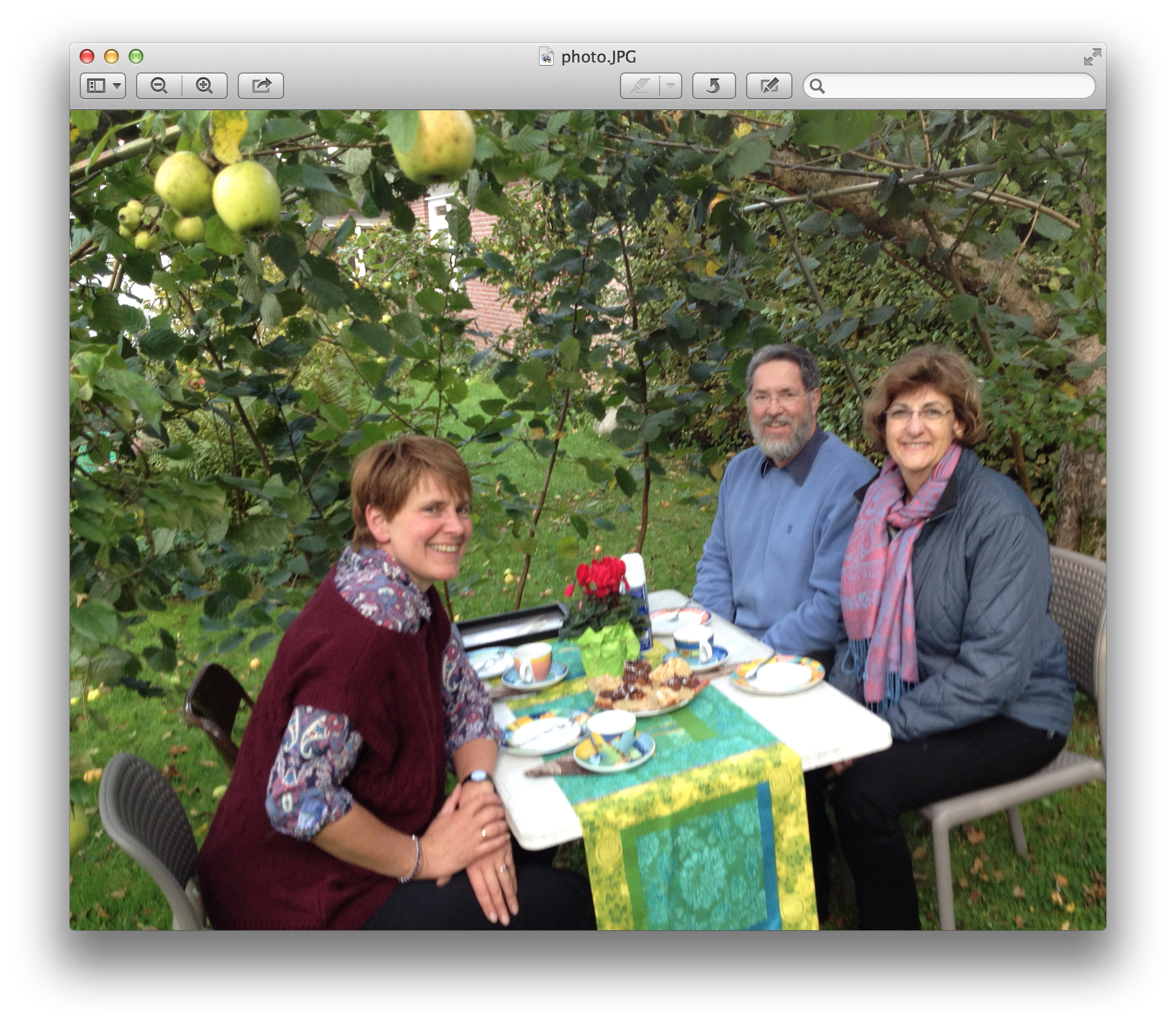
Sukkah photo

Pastorin Ursula Sieg (l) Pastor Martin Pommerening and my wife Vickie sitting in the magnificent sukkah Martin and Ursula erected for us to honor the festival of sukkot in their backyard.