
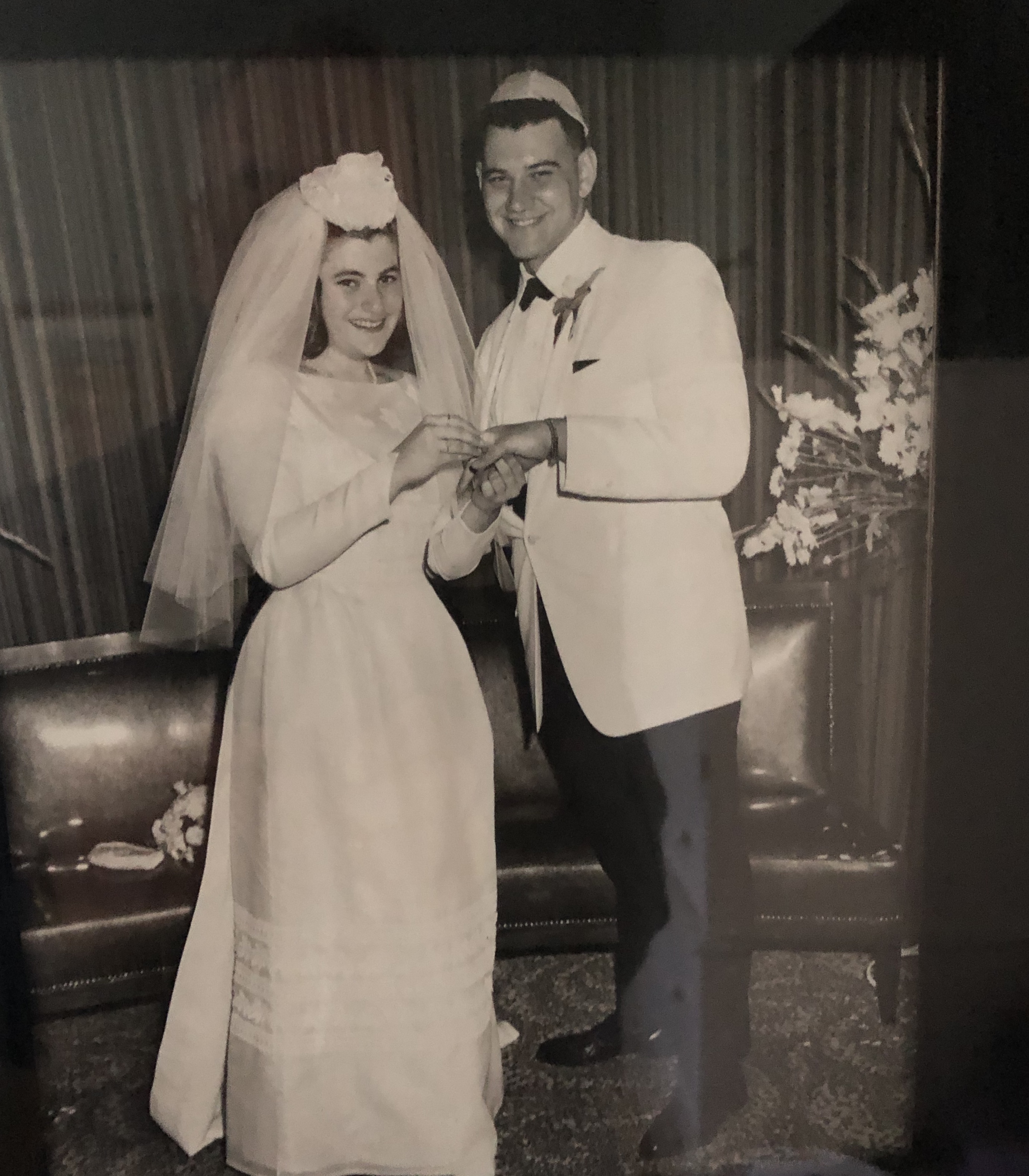
Happy Anniversary Rochelle and Jack

fullsizeoutput_2c3aJune 7, 2020 –

Today marks the 56th wedding anniversary of my sister Rochelle and her husband Jack!

At 18-years-old, I was the head Usher at their wedding!

Together they have raised four wonderful and highly successful daughters who blessed them with wonderful husbands and seven bright and beautiful grandchildren.

Their home in Old Bridge, New Jersey, was for many years the headquarters for countless joyful family occasions and several sad ones as well. Now they kvell, as the family celebrates happy times and mourns our losses in their daughters’ homes.

When we were growing up, I made it difficult for ‘Chelle to be a loving big sister by making a pest of myself whenever her friends would come over. Looking back it is easy for me to see why a 12- year-old girl would not want her 8-year-old brother hanging around when she was in her room with her friends.

But if I made it hard for Rochelle to love me she did anyway.

When I was 7 and in the hospital for my hernia operation (a six-day hospital stay back then), my sister walked 4 miles home from her swimming lesson instead of taking the bus so she could use the money to buy me a present.

When she celebrated her Bat Mitzvah, she used some of her gift money to buy me the coolest present my nine-year-old mind could imagine: a gun with rubber darts that shot ducks off a stand that went round and round.

Speaking of Rochelle’s Bat Mitzvah, it was a pivotal event in my life as well as hers. She became only the second Bat Mitzvah in the 80-year history of Temple Sharey Tefilo in East Orange, NJ. My Dad was against it saying, ”It’s not necessary for a girl,” but Rochelle in alliance with our mother, stood her ground.

I absorbed the message.

If Judaism was important enough for her to stand up to my Dad for the privilege of reading from the Torah, then maybe I needed to look deeper into my religion to find “what’s in it for me?”

When ‘Chelle met Jack, I immediately sensed something different about her.  I liked him right away too.  He was so cool.

I loved listening to his stories about working at Robert Hall Clothes and selling Good Humor Ice Cream on the beach in Far Rockaway. He drove me to and sat through the band concert of a girl I liked in a different town because I didn’t have a license.

Looking back, they were so young, 21 and 20, when they married, but they seemed so ready and so sure and so wise beyond their years.

One of the worst days in my life was when Mom called me when I was studying in Israel (If you got a call from the states in Israel in 1971, you knew it was either a very special occasion or something was very wrong) to tell me that Dad had died. The flight home was beyond painful, but as soon as I saw Jackie, who picked me up at the airport, I began to feel a little better.

Before my wedding, Jack gave me lessons in how to break the glass, so I would do it just right.

And now the years have run by, 56 of them. 

They have seen all four daughters graduate college and shared the joy of each of their seven grandchildren’s B’nai Mitzvah. This fall, a fourth grandchild begins her college journey

 All through those years they have worked side by side as Rochelle played an integral role in Jack’s thriving solo CPA practice. All through those years they have nurtured in their children and grandchildren the same love for Judaism Rochelle nurtured in me long ago.

Happy anniversary, ‘Chelle and Jack! I love you both!
We Are Not at the Beginning

The anguish over recent events—wanton murders, peaceful protests sometimes turned violent – has bought cries of despair from several quarters. Voices proclaim, “We are back at the beginning. It is as though all the progress we made in the 60’s and 70’s was for naught.”

Make no mistake: We are not back at the beginning. 

  • At the beginning the Minneapolis police officers who murdered George Floyd would not be facing murder and manslaughter charges.
  • At the beginning they would not have even been fired.
  • At the beginning no one would have recorded the knee on the neck of George Floyd.
  • At the beginning it would not have been broadcast worldwide.
  • At the beginning the world would not have risen up in outraged protest.

When I was a kindergarten student in East Orange, New Jersey, in 1951, my recess play partner was usually an African-American named Dickie Harvest. We had a great time throwing an orange, volleyball size ball back and forth in the Ashland School playground. We went to each other’s birthday parties, and we played in each other’s homes.

But even then I was aware that most of the other White kids and Black kids kept to themselves. I was also aware that schools in the south were segregated, and people of color there were forced to stay in separate hotels, eat in different restaurants, drink from separate water fountains and ride in the back of the bus.

In my kindergarten naiveté I asked my Dad, “Why don’t they just make a law that all people everywhere must be treated the same in all things?”

My Dad responded, “That would be a wonderful thing, my son, but that day will never come.”

I don’t remember when Jackie Robinson broke baseball’s color line, but I do remember when Elston Howard became the first African American player on the New York Yankees.  Back then when all players had roommates at hotels on road trips, Elston Howard had a room by himself. 

Those days are distant memories. We are quantum leaps forward from “back at the beginning.”

Times have changed enough so that we can envision the day I asked my Dad about as a child. Our profound rage and sorrow over events of recent weeks should not lead us to despair. The perpetrators will answer for their crimes. Their cases will come to justice.

Of course these things should never have happened, and we as a nation must live with the reality. That reality is not that we are back at the beginning. That reality is that we still have such a long, long way to go. 

Where should we start?

Recently we read from the Torah about the vows taken by Nazirites. The restrictions seem strange:

  • No haircuts
  • No wine
  • No contact with the dead.

As strange as they seem these outside the box activities enabled the two known life-long biblical Nazirites, Samson and Samuel, to better fight the Philistines and lead the Israelites respectively.

Maybe we need to think outside the box as well in the fight for racial justice.

Our rabbinical student son, Leo Fuchs directed me to the Twentieth century philosopher Emmanuel Levinas who taught: “God’s face is found in the face of the Other – the face of the one who disturbs us and make us feel that we should do something.”

When asked recently why he joined a protest march, Rabbi Adam Schaffer of Woodland Hills California, responded, “Just trying to do my small part to bend the proverbial arc of history just a little.”

If we all do just a little, we could end up doing a lot.

Many of us have long thought of ourselves as allies and partners in the struggle of People of Color for equal justice, equal access and equal opportunity. No doubt we have been. But these times call for more.

To be sure we are not at the beginning, but we are at a fork in the road.

Perhaps if we look deeply into the “face of the other” and listen closely to their words, we shall see the path God would have us follow as we continue the sacred march toward liberty and justice for all.

In the Face of Injustice

The day before he was indicted I tweeted that Derek Chauvin should be charged with murder in the death of George Floyd.

A friend of 56 years tweeted angrily in reaction: “It is unbecoming for a religious leader to interfere in a matter in the temporal world …you are not the prosecutor, and you don’t know all of the facts…Judaism has absolutely nothing to do with what happened in Minneapolis.”

I responded:

“Judaism has EVERYTHING to do with what happened in Minneapolis … and as for the facts: Three cops looked on while one of their number pressed his knee into the neck of a handcuffed man until he died. If Mr. Floyd did anything to mandate his arrest, the manpower was clearly there to do it without killing him. This is murder.”

In the days following Mr. Floyd’s murder, Jews around the world celebrated the Festival of Shavuot, which marks the anniversary of when God transmitted the Torah to our people on Mt. Sinai.

Our tradition teaches that all Jews everywhere and all future generations miraculously were there to take part in that singly important moment in our religious journey.

To stand at Sinai does not mean simply to worship, give charity and to study.

To stand at Sinai means to pledge our utmost to fill the world, as God charged Abraham,   “with righteousness and justice.” (Genesis 18:19)

To stand at Sinai means among many other things:

To worship no other gods, not to swear falsely, not to bear false witness, to treat the stranger with dignity and respect, to care for the widowed and the orphaned and not to follow the crowd to do what is wrong.

To stand at Sinai means to have special consideration for the minorities and the disadvantaged.

On Yom Kippur, our Day of Atonement, one of the sins we ask forgiveness for is “abuse of power.” There is no more intimidating symbol of power than a uniformed officer of the law. And there is no group of people abused by that power more frequently in our country than those who are Black .

Unless we protest injustice especially when perpetrated against minorities and the disadvantaged, then we Jews today deserve the indictment hurled by the prophet Amos at the Jews of Samaria in the name of God almost 3000 years ago:

“I hate, I despise your feasts, and I will take no delight in your solemn assemblies.” (Amos 5:21)

Unless we raise our voices to protest the murders of people like George Floyd, Breonna Taylor, Ahmaud Arberry, Eric Garner, and Trayvon Martin and countless other Black men and women murdered for the “crime of being black” then all of our Sabbath, Holy Day and Festival observances are abominations in the sight of God.

Make no mistake. I do not condone violent protests that burn buildings, damage property and inflict bodily harm.  But I am violently opposed to the callousness of a system that allows the abuse of minorities to continue unchecked until anger and frustration boil over.

Though none of us can bring this scourge to an end singlehandedly, each of us can raise our voices in protest. Each of us can reach out to those we know in the African American community to acknowledge the pain they feel and express our support.

No, none of us can end oppression by ourselves, but with understanding and compassion we can move the world just a bit closer to another time of which the prophet Amos dreamed: “When justice will well up as waters and righteousness as a mighty stream.” (Amos 5:24)

Hopefully, Next Year

Today would have been the day.

Today was the day Vickie and I were to begin six exciting weeks of teaching in German High Schools about the Shoah, and when I would be speaking in churches and synagogues.

I was also particularly looking forward to celebrating our 46th anniversary on June 9 with our hosts Pastors Ursula Sieg and Martin Pommerening at the exquisite Fuchsbau (Fox Den) Restaurant. We loved the idea of celebrating our anniversary in a restaurant we could imagine was named after us.

The next day we were to travel to Berlin where I had been invited to participate in the ordination ceremony at the Abraham Geiger College, I was also to teach a three-hour seminar there and lead the service and deliver the sermon at Friday night worship.

From there our schedule called for us to travel to Leipzig, the city where my father was arrested on Kristallnacht to take part in a week long series of events for descendants of Leipzig’s once thriving Jewish community.

My bittersweet birthday present to myself on March 16 was to cancel our entire trip.  At that time I wondered if I was being prudently proactive or presumptuously premature. After two more weeks went by it was clear that cancelling was the only decision to make.

It feels strange to be staying in Sanibel now, as our time in Germany has become so important to Vickie and me as part of our quest to do our small part to try to make the world a better place.

For the past five years we spent between five and ten weeks there doing the things I described above.  Before coming to Sanibel in 2017 we were there for ten weeks in the fall. There I had the privilege of conducting services for the High holy Days in Kiel, Bad Segeberg and Freiburg. When we accepted the invitation to serve Bat Yam Temple of the Islands here in Sanibel, the expectation, of course, was that we would be here for Rosh Hashanah and Yom Kippur.  So we switched our program to the late spring and shortened it considerably.

This would have been the first year our hosts, Pastors Ursula Sieg and Martin Pommerening would have hosted us in their new home in Bad Oldesloe and the first we did not spend in their previous home in Bad Segeberg.  We looked forward to experiencing their new surroundings and to exploring a new town in picturesque Schleswig-Holstein, the northernmost of Germany’s 16 states.

A few weeks after cancelling the trip I stopped playing tennis even though I know the warm sunshine and vigorous exercise did me a world of good. That was another bittersweet present I gave to myself.

Just today, Vickie and went to the courts for the first time in a month and hit for about half an hour.

We came in contact with no one and wiped our rackets down when we finished. It is nice to be back on the courts, and I will follow the United States Tennis Association guidelines to play prudently.

Playing tennis again will be a small consolation for missing our time and the people we have come to enjoy so much in Germany! Hopefully we will be able to go back next year.

Rabbi Kenneth D. Roseman

Rabbi Kenneth D. Roseman, PhD, died last week.  He served for a few years as Director of Admissions and then for several years as Dean of the Cincinnati campus of the Hebrew Union College -Jewish Institute of Religion.  With his passing, a true “Light of Israel” has gone out.

As Director of Admissions at the time, Rabbi Roseman interviewed me when I applied to the rabbinical program at HUC-JIR in the winter of 1968.

I approached the interview with trepidation because on paper I was hardly an outstanding candidate. I was no Phi Beta Kappa. In fact I considered my self more of a “Lambda Tau Gamma” as in “Lucky to Graduate” of Hamilton College. On top of that I had the Hebrew background of a Bar Mitzvah student, who had not seriously looked at a Hebrew text since his Bar Mitzvah nine years before.

But Rabbi Roseman must have seen something worthwhile in me, and I could feel the interview was going well. It was going so well that I had the temerity to ask; “Do you think it would be possible for me to spend my first two years of the five year graduate program in Los Angeles?”

While it is now a full-fledged branch of the Hebrew Union College – Jewish Institute of Religion offering the full program leading to ordination, in those days the LA campus was a very small school at which west coast students could take the first two years of the program before transferring to Cincinnati for the last three. It was located in an old estate high up in the Hollywood Hills.

Rabbi Roseman seemed taken aback by my request, and he answered, “Hmm, this is very unusual. Why would you want to do that?”

Well, sir,” I answered, “I am 22-years-old and today in Cincinnati is as far west as I have ever been. I think it would be wonderfully broadening for me to experience life on the west coast.”

For a second I thought I had blown the whole deal, but he responded empathetically. “I tell you what. I will consult with Rabbi Gottschalk (Alfred Gottschalk was then the Dean of the Los Angeles Campus. He would later become President of the entire College-Institute upon the death of Rabbi Nelson Glueck in 1971.) If he says yes, it is OK with me.”

Spending my first two graduate years in LA was one of the best academic decisions I have ever made. To this day I am grateful to Rabbi Roseman for making it possible.

After two years in LA, I spent a leave of absence year studying in Israel** before returning to Cincinnati. So it was at the end of five graduate years that I had completed all necessary course work but had not written my rabbinical thesis.

Because I had no need to be physically on campus Rabbi Roseman helped arrange an internship for me to serve the 58-family congregation, Temple Isaiah, in Columbia, Maryland. Rabbi Roseman offered that it was a great opportunity. I could write my thesis, serve the small congregation’s needs and also teach in the education programs of the largest synagogue’s in both Baltimore and Washington. When I interviewed for a real job for the following year, I would have real congregational experience on my resume.

As my internship year progressed, the congregation began to grow, and in the early spring the leaders of Temple Isaiah asked if I would like to become the congregation’s first full-time rabbi.  I jumped at the chance. The next year when the congregation held a formal ceremony of installation, I invited Rabbi Roseman to be our guest speaker.

Time went by. Rabbi Roseman left HUC –JIR to serve a sizeable congregation in the Dallas area. There he wrote several interesting books that changed the way many congregations taught American Jewish History in their Religious Education programs.

A few years ago at the National Association of Retired Reform Rabbis Convention in Phoenix, I was invited to teach a seminar based on my book, What’s in It for Me? Finding Ourselves in Biblical Narratives.  Teaching one’s colleagues is always daunting, but the nervousness factor ratcheted up several degrees when I saw Rabbi Roseman sitting among those attending my session. I came up to him before I was to start and said, “Rabbi Roseman, I am so very honored that you …”

“It’s Ken, Steve,” He interrupted me with a smile, “and I am very excited to be here.”  He could not have been more attentive or complimentary, and soon I could forget that the person who shepherded my entrance into rabbinical school and helped me launch my career was sitting in my class.

His death caused by the Coronavirus was a shock. He was 80 years old, had a profound influence on my life, and his memory will be to me — as it will be to so many — others a very special blessing.

**Now all entering Rabbinical and Cantorial students spend a mandatory first year studying in Israel. In my day it was optional.


השיבנו Take Us Back

השיבנו

Take us back, Eternal One!

Take us back to when we could absorb

The impact of each death

Before having to deal with the next,

And the next and the next …

Take us back , Eternal One,

Take us back to when we could visit

Our loved ones in the hospital

Our friends in their homes,

Our favorite stores and restaurants.

Take us back, Eternal One,

Take us back to a time we could embrace

Those we wish to embrace

And refrain from embracing

Out of choice, not necessity.

Take us back, Eternal One,

Take us back to when Food Banks were full

And the lines of those in need

Did not extend for miles.

Take us back to a time when connecting by computer

Was a supplement to

Not a substitute for

Connecting in person.

השיבנו ה׳ ונשובה.

חדש ימנו כקדם

Take us back, Eternal one,

And we shall return.

Renew our days as of old.

(Lamentations 5:21)

Especially Now, People Are Asking:

img_3207

“Now it happens to be the way of all men to take sides … About God you don’t know and I don’t know. But I have made a decision in favor of God …”   Rabbi Max Gross to Michael Kind in Noah Gordon’s novel The Rabbi, (New York, McGraw Hill, 1965) p. 139


During these precariously uncertain days of the Corona Virus pandemic, I have received, not surprisingly several questions about God.

I have been curious about God all my life, and at age 18, when I first read Noah Gordon’s The Rabbi my interest intensified and has grown over the years to be a driving force in my life.

After more than half a century of inquiry, I can make no more profound theological statement, nor one that better reflect my thinking than the one Mr. Gordon puts in the mouth of Rabbi Max Gross above.

To be a believing Jew, I have learned, does not mean to BELIEVE in God, it means to struggle with God.

In Genesis (ch. 33, verse 25 ff) after a titanic struggle God changes Jacob’s name to the one by which our people identify ourselves to this day: Yisrael, Israel, “One who struggles with God.”

More than half a century after Gordon’s novel intensified my own struggle with the Eternal One, I produced a volume of essays that I humbly recommend to those – Jews and non-Jews alike – who might find some of the steps of my struggle instructive.

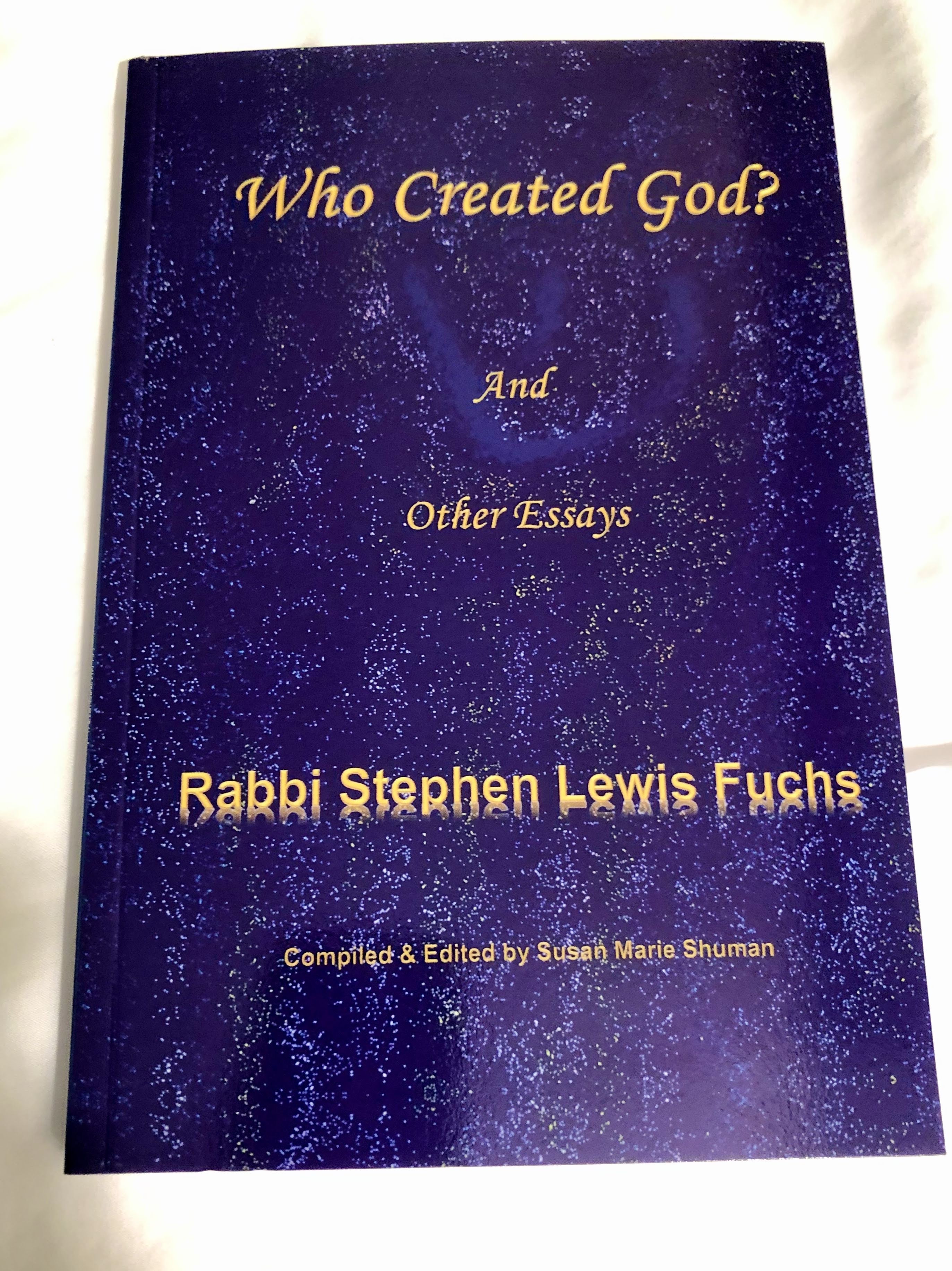
It is called, Who Created God?

 It is available on AMAZON.com both in paperback and very inexpensively in a Kindle edition.

If the book answers some of your questions about God or even helps refine the parameters of your struggle of your connection – or lack thereof – to God, I would be very gratified indeed.


(If you do read the book, please consider leaving a review of it on AMAZON.COM that will hopefully encourage others to read it as well.)

In Honor of Earth Day

img_0010We are in charge of and responsible for this earth. We must do a better job of caring for it.
 

In the late 80’s when then Tennessee Senator Albert Gore, Jr. began his campaign of environmental awareness (which led to his receiving the Nobel Prize for Peace in 2007), he asked me to prepare “a closing homily” for the first meeting of the initiative held in Nashville, the city where I then served as rabbi of the Reform temple. On that occasion, I told a venerable Hasidic story – told in many different ways – about a magnificent goat that lived long ago. The goat had horns so long and beautiful that when he lifted his head, he could touch the stars, and they would sing the most beautiful melody that anyone had ever heard.

One day a man was walking through the forest thinking of what he might give his wife for her birthday. He encountered the goat, and a brilliant idea jumped into his head. “I could make my wife a gorgeous jewelry box from a piece of one of the goat’s horns,” he thought.

The man approached the goat, which was very tame and friendly, and explained, “I want to make a jewelry box from just a small piece of one of your horns. It won’t hurt when I cut it off, and I’ll just take a small piece. You won’t even miss it!” The goat lowered his head to accommodate the man’s request.

The jewelry box that the man fashioned was indeed beautiful, and his wife adored it. Proudly, she showed it to all of her friends who soon wanted one just like it. You can see where this is going. Soon the goat was inundated with requests to “cut off just a small piece” of one of his horns. Of course, soon his horns were much shorter. The goat could no longer reach the stars, and that most beautiful melody was forever silenced.

This wonderful tale teaches one of the vital lessons of Genesis’ creation story. We, human beings – not the crocodile, the elephant nor the lion, though they are stronger, faster, and fiercer – are in charge of, and responsible for, this world. Ergo, if we are to pass-on a beautiful and healthful environment to our children and grandchildren, we must do a much better job than we are doing now of taking care of it!

From: What’s in It for Me? Finding Ourselves in Biblical Narratives, pp. 2-3.


The Darkest Hour is Just Before Dawn

fullsizeoutput_2575Dawn breaking over Husum, Germany

Today is Yom Ha-Shoah, Holocaust Remembrance Day. When I was a young Rabbi, a Catholic priest asked me,  “What is this obsession you have with remembering?  Why can’t you just focus on the present and the future?”

The best answer I can give comes from a Non Sequitur cartoon of a survivor and a small girl, Danae, sitting on a park bench. She notices the numbers tattooed on his arm, and asks about his, “boring tattoo… It’s just a line of numbers.”

“Well,” he answers, I was about your age when I got it, and I keep it as a reminder.”

“Oh,” Danae asks, “a reminder of happier days?”

“No,” he replies, “of a time when the world went mad.” And then he explains about the horror, as Danae imagines herself in a concentration camp.

She responds, with a tear rolling down her cheek, “So you keep it to remind yourself?”

“No, my darling,” he answers, “to remind you.”

Vickie and I do not have tattoos, but those we have seen on the arms of many of our parents’ friends are etched into our hearts. For the past five years we have spent between five and ten weeks per year in Germany where we teach about the Holocaust in German High Schools. We speak about her soon to be (God willing) 99-year old mother and my late father as among “the lucky ones.” They escaped the worst of the horror and came to this country and built meaningful lives here.

No, Vickie’s parents and my father were not, thank God, among the six million who perished, but they are among the many millions more whose lives and whose children’s lives carry the internal tattoo of memory.

So, I would answer the priest who inquired about our need to remember, “Memory is part of our DNA.”

The important question is: will we allow the memory to harbor hatred and resentment, or will we share our memories to work for reconciliation and harmony? Vickie and I choose to push back the darkness of our memories. We do so not to keep reminding ourselves, but to remind this and the next generation of Germans about the depths of brutality to which humans can descend.

I first heard the phrase, “The darkest hour is just before dawn,” in a hit song, Dedicated to the One I Love from the early sixties by the Shirelles. A few years later the Mamas and the Papas also had a hit with that number.

Language historians trace the origin of the phrase to a 1651 travelogue chronicling the visit to Palestine of the English theologian, Thomas Fuller. He wrote: “It is always darkest just before the day dawneth.”

Since I first heard it as a teen, “The darkest hour is just before dawn,” has encouraged me to believe that if I keep pushing them away, whatever emotional clouds envelops me will soon lift. In Germany our aim is to help young people to push away their emotional darkness about the Holocaust.

Vickie and I hold dear the young man who came up to her after our presentation to a high school class in Kiel, and with tears in his eyes said, “Mrs. Fuchs I must apologize to you.”

“But you have nothing to apologize for,” she answered.”

“I must apologize because my grandfather was SS,” he answered.

Their embrace brought tears to my eyes.

We are grateful for the opportunities we have had to help people like this young man, push away their darkness.

In Germany we frequently say, “We cannot undo the past but the future is ours to shape.”

Holocaust Remembrance Day is more than a reminder of the past. It is to remind future generations to work to push back the dark clouds of antisemitism, bigotry and hatred and embrace the dawn — that can be just ahead — of harmony, understanding and love.


Weeping May Tarry for the Night, But Joy Comes in the Morning

“Weeping may tarry for the night, but joy comes in the morning (Psalms 30:6),” is one of my favorite verses in the entire Bible.

Robert Alter’s translation, “ At evening one beds down weeping, and in the morning glad song,” (The Book of Psalms, A Translation with Commentary, W.W. Norton and Co., 2007, loc. 2387, Kindle edition) may be more accurate linguistically, but it lacks the majesty of the more familiar King James translation of the verse.

As we move from day to day through the Corona plague, I find no more fitting mantra of aspiration than these immortal words.

Our lives have changed radically. Isolation is the new normal. The country faces a horrific choice. We must weigh the risk of an even greater death toll against the impact of an economic recession that deepens daily. Protesters have taken to the streets as arguments rage about our preparedness as a nation for the reality through which we are now living.

The late Rabbi Leon Klenicki, former Director of Inter-Religious Affairs for the Anti-Defamation League, defined the word “crisis” as, “turning point.”

Without question, however long it endures Covid-19 will mark a turning point in our lives. We not only wonder when the economy will recover but if. Some industries face the possibilities that they never will. 

The cost in human suffering is incalculable, and the economic hardship many face is beyond measure. People who never dreamed they would depend on charity now wait in line for hours just to receive the food they will need to feed their families for the next week.

Through it all, the Psalmist promises: things will get better. “Weeping may tarry for the night, but joy will come in the morning.”

One way or another we will get through this.

We as a nation, and we as a worldwide humanity created in God’s image, will survive this pandemic. Hopefully we will learn from it to be more diligent in our stewardship of the planet entrusted to our care.  Hopefully we will put greater store in the relationships we used to take for granted. Hopefully we will hold more precious every breath of life that we have the privilege to take.

Today is Yom Ha-Shoah, Holocaust Remembrance Day. We have learned that those who survived the camps shared a common characteristic: they clung to the hope that they would make it.

There is a lesson there for us. Though the toll of lives lost and economic devastation is staggering, we must not despair. Our night of weeping will end, and joy will come in the morning.