
| In its account of the completion of the desert tabernacle, the Torah includes a startling detail: When the work of the Mishkan (tabernacle) was complete, a cloud of smoke filled the sanctuary. It was so thick that Moses himself could not enter. Only Aaron and his sons had the privilege. (Exodus 40:35) | Professor Ellis Rivkin, z”l, of the Hebrew Union College in his 1971 book, The Shaping of Jewish History wonders: How could it be that Moses who regularly went out to the simple tent of meeting to commune with God and relay God’s instructions to the Children of Israel (Exodus 33:8-9) could not even enter the elaborate Tabernacle whose completion the Torah celebrates?
The answer, Rivkin writes, is that by the time the Torah was actually written, descendants of Aaron had effectively taken control not only of religious life in ancient Israel but political and economic life as well. Moses’ role in our people’s history would never be matched, but it would never be replicated! The cloud in the Mishkan excluding Moses but allowing Aaron and his sons to enter represented this starling takeover. The Clouds Are Still There To a significant extent the cloud still fills the sanctuary. There are those who would stifle the Progressive Jewish voice and leave many to regard our precious heritage as a daunting set of rules and regulations which they do not understand. We must push that cloud up off of the tabernacle that represents our sacred tradition! Each of us should encounter and understand God in our own way as Moses did before the cloud filled the sanctuary. Before the cloud descended God made a sacred Covenant with Abraham and with our people forever! In that Covenant God promised to: · Protect us · Give us children · Make us a permanent people – 4000 years certainly strikes me as permanent – · Give us the land of Israel! A Reciprocal Covenant But a covenant is reciprocal; we do not get those wonderful rewards for nothing. In return God charged us to do three essential things: · “ברכה והיה Be a blessing!” (Genesis 12:2) · “תמים והיה לפני התהלך Understand and follow God’s teachings as best we can! (Genesis 17:1),” my translation. Literally: “Walk in My ways and be worthy!” · Fill the world and teach your children and future generations to fill the world with: ומשפט צדקה Righteousness and justice! (Genesis 18:19) To Repair the World When we push the cloud off of the tabernacle, we shall realize that the essential message of Judaism is for each of us to work in our own way and with our own individual talents and interests to uphold our end of our Covenant with God. In so doing our ultimate goal is: העולם את לתקן to repair this broken world, fill it more and more with “righteousness and justice”, and leave for our children and grandchildren a more just, caring and compassionate society than the one in which we now live. ומשפט צדקה–וצדקה משפט Righteousness and justice – justice and righteousness! These are the values the prophets continually exhorted our people to uphold. These are the values that have inspired the world at large! When Dr. Martin Luther King Jr. concluded his most famous speech in August, 1963, on the Mall in Washington DC, he invoked these values in an unattributed quotation from the Prophet Amos (Amos 5:24): “Let (משפט) –justice—roll down like waters and (צדקה) like a mighty stream!” The Cloud over Israel Nowhere, perhaps, will the cloud of entrenched religious authority be harder to lift off the tabernacle than in Israel itself. The work of Progressive communities – which I have seen with my own eyes – in Jerusalem, Tel Aviv, Mivaseret Tzion, Modi’in, Haifa, Rosh Ha-Ayin, Carmiel, and Tivon is inspiring. Our rabbis there have built communities against all odds starting from scratch. In Israel’s largest city, Tel Aviv. Standing on the balcony with Rabbi Meir Azari of Mishkanot Ruth, with a panoramic view in every direction, he told me, “Within our sight range there are more potential Progressive Jews than anywhere in a similar sized area in the world.” The Prophet Isaiah taught us more than 3000 years ago (Isaiah 2:3): “From Zion shall go forth Torah and the word of the Eternal One from Jerusalem!” Israel is the birthplace of our history and the symbol of our ideals. Our love for her – with all her imperfections – is without measure! We Need Israel, but Israel Also Needs Us Yes, From Zion shall go forth Torah, but the reverse is also true: To Zion we must bring Torah and the word of the Eternal One to Jerusalem! Israel needs our visits, our wisdom, our experience, our encouragement and our support. When Israel appears to fall short of the values of “righteousness and justice” we must stand with those within Israel who offer their loyal critique! When I first visited Kehilat Bavat Ayin in Rosh Ha-Ayin six years ago, Rabbi Ayala Miron spoke of the difficulties she encountered as a female Reform rabbi in a heartland city in Israel with a strong Yemenite Orthodox tradition. “You can be sure,” she said, “that the City Fathers did not greet me with flowers.” When I spoke there three years ago, I made it a point to greet her with flowers to let her know: “Jews around the world are with you!” But we have a long way to go! As Vickie and I sat with the professional staff of Bet Daniel in Tel Aviv they shocked us when they said: “The biggest problem in Israel is assimilation! If we begin our most important prayer: “שראלי שמע, Hear O Israel“ they continued, “an alarming percentage of Israelis would not be able to complete the sentence from Deuteronomy with, “”The Eternal One is our God, the Eternal One alone (Deuteronomy 6:4)!” We must push the cloud of the Tabernacle and replace it with knowledge and spiritual meaning. We must restore our houses of worship to their original purpose: a place where God’s spirit can dwell (Exodus 25:8) If we wish to meet that formidable challenge, we must offer our people serious study of Torah and an understanding of the meaning of our prayers. We must make our mishkanot worthy of the description of the word we often sing on entering the synagogue: “How lovely are your tents, O Jacob, your mishkanot –your tabernacles – O Israel (Numbers 24:5)!” If we are to push the cloud away we cannot simply intone our prayers mindlessly! We must know and teach what they mean, what their historical context is, and how can they help us live more meaningful Jewish lives! No outside force can destroy us! As the children of Israel were on their 40-year journey from slavery in Egypt toward the Promised Land, Balak, King of Moab was afraid that we would overrun his land.So he hired Balaam, a world famous sorcerer, to put a curse on us so that his forces could defeat us! Despite all the riches Balak could offer, Balaam – try as he might – could only bless us with the words: “Mah Tovu! How lovely are your tents…” When we understand its biblical context, the ancient prayer teaches us a vital modern lesson: No outside force – no Balak, King of Moab, no Pharaoh, no Haman, no Torquemada, no Tsar, and no Hitler – can ever destroy us! But Will We Destroy Ourselves? Only we can destroy ourselves. We can destroy ourselves by turning away from our sacred Covenant! No! No outside force can destroy us, but we can destroy ourselves by failing to keep pushing the clouds that block understanding, purpose and meaning from our lives as Jews! We must always strive to push the cloud off the tabernacle and make real the world of which the prophets Isaiah and Micah dreamed when they said: “They shall not hurt or destroy in all my holy mountain for the earth shall be filled with the knowledge of the Eternal On as the seabed is covered by waters (Isaiah 11:9).” And all humankind shall sit under their vines and under their fig trees with none to make them afraid (Micah 4:4).” |
Month: March 2015
We Can’t Let This Happen! (Quick Comment on Torah portion (Va-yakhel-Pekude)
Earlier in Exodus we read that Moses would go into to the Tent of Meeting where God would talk to him (Exodus 33:9). By the end of Exodus, though, we read: “Moses could not to enter into the Tent of Meeting because the cloud settled upon it… (Exodus 40:35).”
As Professor Ellis Rivkin pointed out in The Shaping of Jewish History this radical shift represents a takeover of Jewish life by the descendants of Aaron who became a hereditary ruling class and usurped complete control of Jewish life. “Any outsider who encroaches shall be put to death (Numbers 3:10).”
What does this teach us?
We must push the cloud off the tent and see God’s instruction as accessible to us as it was to Moses. We dare not cede ultimate authority to priests ministers, rabbis or Imams. Yes, we should respect and study their teachings. But our own conscience and desire, as God charged Abraham, “To do what is just and right (Genesis 18:19)” should determine our actions.
How often in history have people done atrocious things simply because the ruling authorities told them to. The Nazi era was able to wreak its horrors not just because of evil leaders, but because good people unquestionably obeyed an authority that led them down a horrible path.
God’s greatest gift to humanity is a mind we can use to make considered decisions as to how we will act. When we allow “a cloud” to block us from God’s teaching, we impoverish our spirit. If instead we push the cloud off the tabernacle by studying and earnestly seeking the contemporary message of Biblical teachings we can draw closer to the Divine Image in which we were created and make a better world for our children, grandchildren and future generations.
Kalb-Kontrolle! – Ein Kurzkommentar zum Tora-Abschnitt “Ki Tisa”
Vertu dich nicht! Das Goldene Kalb lebt. Inmitten deiner Gemeinschaft ist es gesund und munter. In meiner auch!
Wir dienen dem Golden Kalb jedes Mal, wenn wir uns für das Leichte und Eigennützige entscheiden anstatt für Recht und Gerechtigkeit.
Diese Jahr, wie oftmals, lesen wir die Geschichte vom Kalb am Schabbat nach dem Purimfest. Die Geschichten lehren ähnliche Lektionen:
Im Buch Esther war Vasti Königin von Persien, dem mächtigsten Land der Welt. Doch als ihr Ehemann ihr befahl vor seinen betrunkenen Freunden aufzutreten, waren ihr ihre Würde und Selbstrespekt wichtiger als Bequemlichkeit und Luxus.
Translation: Pastor Ursula Sieg
Esther hat sich genauso entschieden, als Sie sich mit ihrem Leben für die Rettung ihres Volkes einsetzte. Das Goldene Kalb belauerte auch diese beiden mutigen Frauen, aber sie waren – als ruhmreiche Beispiele für uns – fähig ihm zu widerstehen.
Weisheit der Cherokee
In einer Legende der Cherokee erklärt ein Großvater seinem Enkel: “In jeder Person kämpfen zwei Wölfe. Einer ist egoistisch und habgierig, der andere fürsorglich und freundlich.”
“Welcher Wolf gewinnt?” fragt das Kind.
“Der, den du fütterst”, antwortet der Großvater.
In Deutschland symbolisiert ein wütender Wolf die Schrecken der Nazi-Zeit. Aber Wölfe können auch freundlich, großzügig und fürsorglich sein.
Indem wir einmal mehr die Purim-Geschichte bedenken und den Bericht über das Goldene Kalb, müssen wir uns – wie Vasti und Esther – entscheiden zwischen dem, was real und beständig ist, und dem, was vergänglich und sinnlos. Wir können Gottes Weg folgen oder dem des Goldenen Kalbes. Oder – mit der Cherokee Geschichte – wir müssen entscheiden, welchen Wolf wir füttern wollen.
A Call for Calf Control (quick comment on Torah Portion “Ki Tisa”)
Make no mistake! The Golden Calf is alive and well and living in your community. And in mine!
We worship the Golden Calf each time we opt for what is easy and selfish over what is just and right.
This year, as we often do, we read the story of the Calf on the Shabbat following Purim. The stories teach similar lessons. In the Book of Esther Vashti was Queen of Persia, the most powerful country in the world. Yet when her husband ordered her to appear before his drunken friends, she chose dignity and self-respect over ease and luxury.
Esther made a similar choice when she put her life on the line to save our people. The Golden Calf lured both of these courageous women, but—in glorious examples for us today–they were able to resist.
Cherokee Wisdom
In a Cherokee legend a grandfather explains to his grandchild: “Two wolves fight within each person. One is selfish and greedy and the other is caring and kind.”
“Which one wins?” the child asked.
“The one that you feed,” his grandfather answered.
In Germany, of course, a ferocious wolf is the symbol of the horrors of the Nazi era. But wolves can also be kind, gentle and nurturing.
As once again we ponder the lessons of the Purim story and the account of the Golden Calf we, like Vashti and Esther, must choose between that which is real and enduring over that which is fleeting and vain. We can follow God’s path or that of the Golden Calf. Or as the Cherokee teach, we must decide which wolf we wish to feed.
Skip & Debbi
Sometimes like manna from heaven undeserved gifts come our way. For me Skip and Debbi are such a gift.
Skip Conover and I were fraternity brothers at Hamilton College long ago, but we never were close. His remarkable career has taken him around the world many times over, and he has become a prolific author and blogger. He discovered my book and felt that he wanted to promote it on his website which focuses on the ideas of the world renowned psychiatrist Carl Jung.
Wait, there’s more!
But that’s just the beginning! He invited me to his home in Annapolis to make an audio edition of What’s in It for Me? Finding Ourselves in Biblical Narratives.” “But Skip,” I warned him, “I am about as computer ignorant as they come.”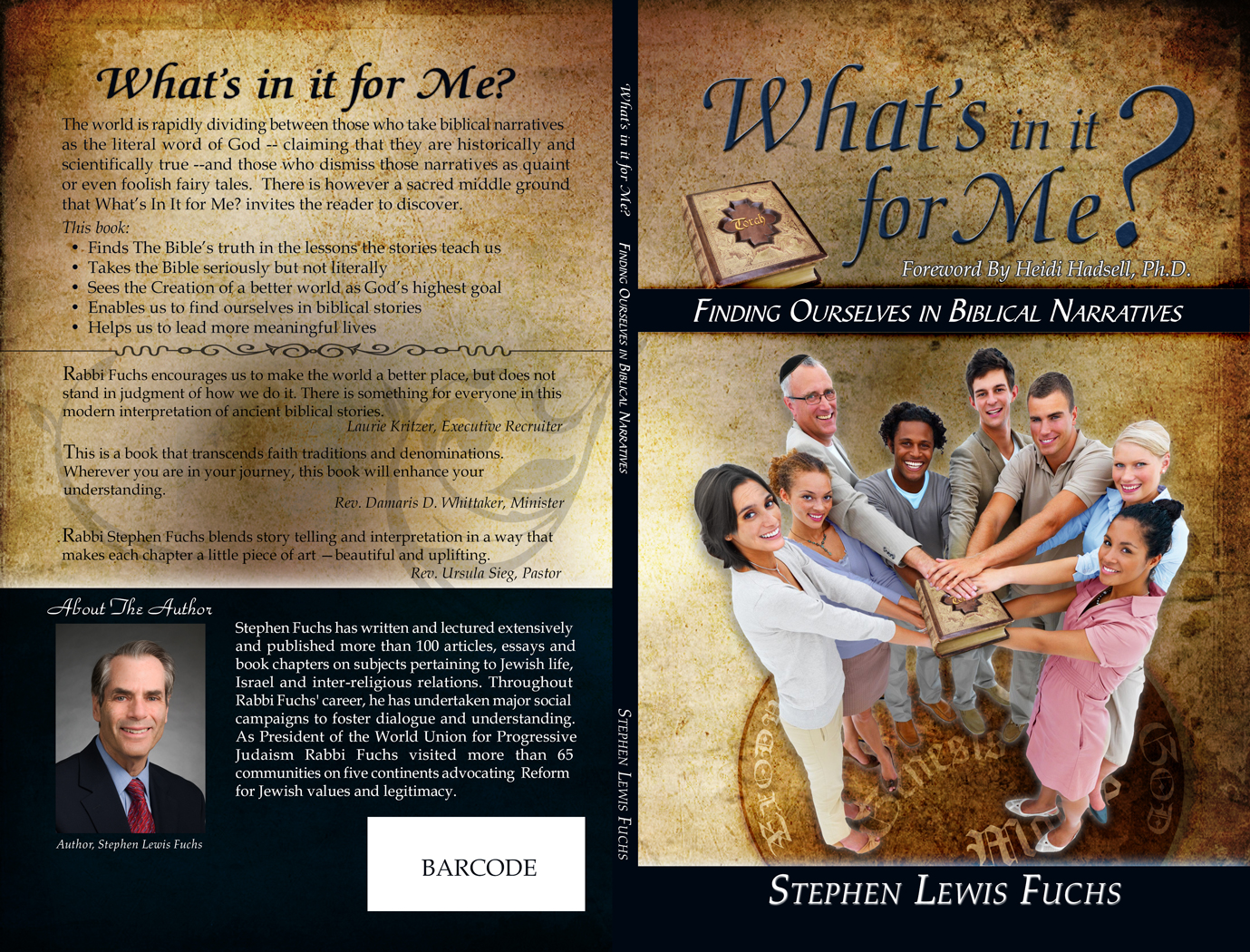
“Don’t worry” he answered.” I’ll walk you through in a day the process it took me three months to learn.”
He was better than his word. Not only did he walk me through the (for me) complex process of laying down the tracks, he vowed to get the time consuming sound-editing process finished before he leaves for his daughter’s wedding in Ireland next week.
“I am doing this,” he explained, “because I believe your book can be an important influence for good. It stems from Jung’s idea of the “collective unconscious.” Somebody might read it on the other side of the world—maybe an Islamic fundamentalist or an atheist—thinking he/she disagrees completely. But one of the things Jung taught is that when we read something, we subconsciously begin to think about it. Slowly, imperceptibly our thoughts begin to change.”
For me it happened quickly
I had to think about that one until his wife Debbi McGlauflin proved his words true. Only the process was not “Slowly imperceptibly” but rapid indeed. Debbi is an avid Buddhist who thinks deeply and writes beautifully. She gifted me with two of her poetry collections which I read on the plane home. One of the main ideas is that we take a huge step toward enlightenment by valuing others above ourselves and truly suppressing our ego.
“Are you kidding me,” I said to myself. A healthy ego is a vital component of a healthy person. We don’t need ego suppression, we need good balance. I try to value people as myself but above myself? I don’t think so. “As Hillel famously said, “If I am not for myself, who will be for me, but if I am for myself alone, what am I … ?”
But by the time I reached home that evening, Debbi’s gift had taken on real value. Yes, I still believe in Hillel’s balance, but I had to acknowledge how frequently the “If I am not for myself, who will be for me” part of the formula weighed down my teeter totter. I began to see how a dash of Buddhist wisdom could be a very good thing indeed.
A week ago, I hardly knew Skip and had never heard of Debbi. Now like a gift from heaven their generosity and wisdom are making difference in the quality of my life.
 Finding Ourselves In The Bible