
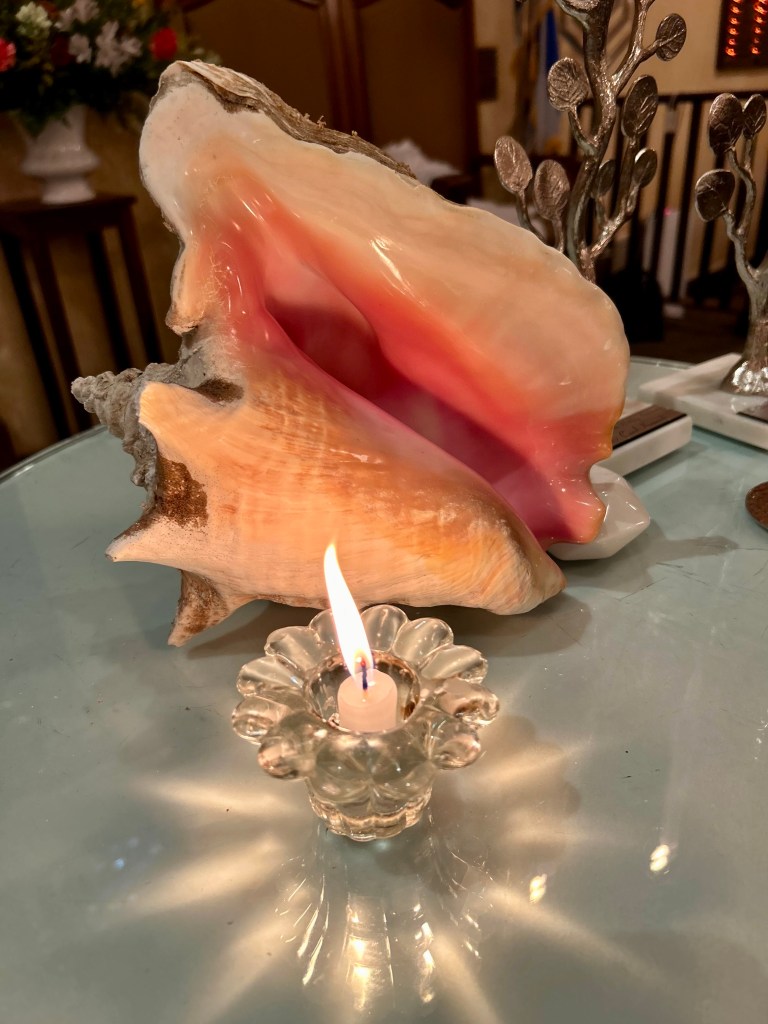
The Torah of the Conch

My Conch on the pulpit of Temple Beth Shalom, Vero Beach, on Rosh Hashanah

One of my always on file petitions to the Eternal One is, “Please, God, no deaths in the days before Rosh Hashanah because I am too busy preparing for the Days of Awe, Amen.” 


As has happened several times over the years, God recently gave this prayer a, “No.” It saddened me to learn Gary Hodgkin’s, a congregant at Temple Beth Shalom in Vero Beach, FL, which I am serving this year as Interim Rabbi, had died. 


I met with his widow Megan who shared they were both marine biologists and that they had met and gotten to know one another through their work. I had never met a marine biologist, so I asked, “What specifically do you focus on?”


“Conch,” she answered, a subject about which I knew nothing.


“And what do you do with these ‘conches,’” I asked?


“I grow them,” she answered modestly.


As we continued to talk, I learned that these magnificent shells with the eerily beautiful pink interior are pronounced, “Conk” and the plural is pronounced the same way, “like sheep,” she added. 


A bit of research after I returned home revealed that professionally, Megan Hodgkins was Dr. Megan Davis, the world’s foremost expert on Conch. She is a research Professor at Florida Atlantic University and Principal Investigator at their Queen Conch Lab. She sets up conch aqua farms at several places along the Florida Keys and the Caribbean Islands. In these laboratory farms she and the many scientists she trained cultivate and grow conch embryos.

  When they are sufficiently mature, she introduces them back into the ocean. There they continue to mature and feed on plankton which cleans up the seagrass and helps reverse some of the horrible ways we humans have polluted the ocean waters and grossly overfished Queen Conch for their meat and their beauty.
 
Dr. Davis’s work intrigued me, and I asked if might include some of what she had taught me in the Rosh Hashanah sermon I planned to deliver on how we humans have done a terrible job of fulfilling God’s charge in Genesis’ Creation Story to oversee and exercise prudent responsibility in caring for this planet God has entrusted to our care.


In agreeing, Dr. Davis helped re-steer my sermon from a lament of our failure to a hopeful concrete example of how we can reverse the ravages to the environment we humans have perpetrated.


When we met a second time in my office, Dr. Davis presented me with a gift I shall always cherish: A magnificent Queen Conch shell of my own. I placed it on the Bima in front of the congregation on Rosh Hashanah, and now it sits proudly on display in my office at the Temple. It will always symbolize for me that each of us can do something to make our world a better and more beautiful place.


Of course, I am very sorry for the reason I met Dr. Davis, but I hope it comforts her to know how her sacred life’s work of repairing the oceans eco system inspired the congregation on Rosh Hashanah


Personally speaking, it will always inspire me to try to fulfill the essential message of this Holy Day season: to continually strive to do more to improve the world around me.
 

This I Believe About God

http://http://www.last.fm/music/Garth+Brooks/_/Unanswered+Prayers

My Unanswered Prayer

God and I have always had a very personal relationship. So it seemed natural to me that when I was 18 years old and stepped onto the ice for my first hockey practice at Hamilton College I offered God a deal: “God, if you make me an all-American hockey player, then, I’ll become a rabbi.” As any witness to my Hamilton hockey career can attest, God categorically rejected that proposal.

Now, a half-century later, I think God must have laughed at my offer and said. “Miracles I can perform, didn’t I part the Red Sea? But, Steve, you are asking too much. No, I have given you just enough athletic talent so that if you work really hard, you may achieve some limited success but you will learn important lessons that will help you for the rest of your life. As far as becoming a rabbi goes, I now perceive that God’s response was: “Don’t do me any favors! But, if that is what you really want, and –again—if you really work hard, I’ll grant you a meaningful pulpit career, opportunities to travel beyond your dreams, and the privilege of making a difference at times in people’s lives.”

If I could have discerned these answers when I was 18, I might have thought the Almighty was rejecting me, but today I bow my head in gratitude for the many ways God has blessed me.

I find great wisdom in Garth Brooks’ song: Unanswered Prayers (Link above). It is about a youth who fervently prayed that the girl he loved more than life itself would return his love and marry him. It did not happen. Many years later, when he met that girl by chance at a football game, he realized that his life was much happier with the woman he did marry, than he would have been with his high school love. “Sometimes,” he concludes, “God’s greatest gift is unanswered prayers.”

God Is a Mystery

Even after all of my years of religious study, most of what God does remains a mystery to me. That sense of mystery and wonder move me to say: “There is a reason that we come to worship God and do not expect God to come and worship us.”

For many, though, questions they cannot answer about God squelch their belief. If there were a good God, they say, there could not have been a Holocaust. If there were a good God, there would be no hunger and poverty in the world, and there would be no floods, famines or natural disasters. If a good God were in control of the world, innocent children would not die. God would protect us from harm and disease.

In 1981, Rabbi Harold Kushner wrote one of the most influential books ever about God: When Bad Things Happen to Good People. After the death of his son Aaron from a rare disease, progeria, that caused him to age prematurely and die at 14, Kushner decided he could no longer accept the idea of God who is both all good and all-powerful. And so he postulated that God’s goodness is infinite but that God’s power is not. There is, Kushner claimed, a realm of nature beyond God’s control. His book performed a great service by enabling many who once could not believe to believe once again.

Was Rabbi Kushner right? I am not sure.

But was he right? I am not sure. Rather than claim that God’s power is limited, I believe our knowledge is limited. We can understand some of what God does, but there is so much about God that we do not know and can never know.

Too often, though, we create God in our image instead of the other way around. We think our fine minds should apprehend everything there is to know about God. In our arrogance we think that if something happens that does not comport with our view of the way we believe God should act, then clearly there is no God.

We have all seen good people suffer. We have all watched helplessly while a righteous person writhed in pain or died young while a person with seemingly no regard for anything but his or her own selfish needs lived a long life in robust good health. There is much about God that we do not understand. And maybe there is nothing about God we can say backed by scientific proof!
Jewish thinking does not rest on a proof of God’s existence but on an assumption of God’s existence. That assumption proclaims itself in the very first words of the Torah: “In the beginning, God…

The Goal: A Better World

Why should we make that assumption? For me it comes down to one simple reason!
If we assume God exists and assume that God wants all of us to use our diverse talents to do good, then we shall create a better world for ourselves, our children and our grandchildren. Though so much about God is way beyond my comprehension, this I believe with all my heart, with all my soul and with all my might!