Adhesive Tape

Followers of my page know that I recently celebrated the 55th anniversary of my Bar Mitzvah—the most important day of my life.

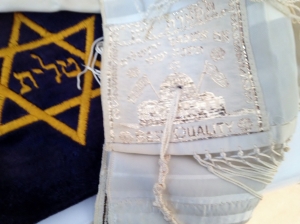
On that day, I walked up the steps to the bema on shaky legs. There, my father waited to enwrap me in the Tallit my grandmother had bought me . I still remember the pride on her face when she showed me the embroidered words in the corners near the fringes, “Best Quality.”

My father said the blessing in Ashkenazic Hebrew . The key words in Sephardic Hebrew are
לחתעטף בציצית (l’heet-ah-tafe bah tzitizit). But when my dad said it in Ashkenazic pronouncing the first “t” as an “s” it sounded to me like “adhesive tape.”

The word to enwrap is a reflexive verb but the plain meaning of its three letter root, ayin, tet, fay, is “to faint” or to falter.
I was certainly ready to faint or falter that day, but my father’s application of “adhesive tape” helped me to stand upright.
As time went on that adhesive tape had me somehow connected to Torah in a way that — though it seemed tenuous to me as a 13- year old boy — has attached me to Torah through all of these years..and my connection continues to grow stronger.

As a rabbi I have collected a good number of  tallesim over the years, but I wore my grandmother’s “best quality” one when I read the Torah for my 55th Bar Mitzvah anniversary. On that occasion, I noticed for the very first time that in the same little patch where it says, “Best Quality” there is a quotation in Hebrew from Psalm 137, “If I forget you, O Jerusalem, let my right hand forget its cunning.”

What a powerful symbol my first — and now seldom worn — tallit remains. It reminds me of my grandmother’s love, my father’s support, and my connection to, and love for, the land of Israel. But most of all, it is the adhesive tape that binds me with love to Torah and its teachings.

Rabbi Stephen Fuchs

“A Sneak Peek: Chapter Summaries of What’s in it for Me? Finding Ourselves in Biblical Narratives”

Rabbi Stephen Fuchs
Below you will find descriptions of the chapters in my forthcoming book. Of course I hope these description will make you eager to read the entire work   As I am finishing up my writing, I want to also ask my readers:  Is there anything missing; anything you think should be included in this book that I may have left out. I consider your feedback very important and will carefully consider any suggestions.
*********
Creation – Neither science nor fairy tale, the Story of Creation in Genesis reveals the overarching hope of biblical thought:  That life has purpose and meaning, and for better or worse, we human beings are in charge of, and responsible for, this earth.  Each of us participates in creation when we use our talents to help in some way create a more just, caring and compassionate society.

Eden – Many think of the Story of Eden as “The Fall of Man.”  We might better think of it as the “Elevation of Humanity.”  Eve, rather than being the villain that much of religious history has made of her, is the true hero of the story because she chooses a limited life of purpose and meaning in the real world over an endless existence of indolence in the Garden.

Cain and Abel — Nobel laureate John Steinbeck considers Cain and Abel, “the symbol story of the human soul” because it is the story of every one of us. It is about rejection – which all of us have faced – and how we deal with it.  And Yes!  If this world is ever going to work, we must be our brothers and sisters’ keeper.

Noah and The Flood — Many accounts of a deluge emerge from various cultures of the ancient near east.  The biblical flood story is unique in two important ways:  Only in the Bible does the flood occur because of humanity’s moral failure. Only in the Bible is the hero chosen not for capriciousness, but for his righteousness.

Babel – The brief account of the Tower of Babel is analogous to “the last straw” in God’s attempt to persuade humanity as a whole, to create a just, caring and compassionate society. Also, I am often asked: “Wouldn’t it be great if there were just one religious outlook?”  No!  The Tower of Babel teaches us that God created diversity, and the world is better off because of it.

Abraham – After three attempts at persuading humanity to create a just, caring and compassionate society (in Eden; pre- and post-flood Eden), the Eternal One chooses Abram as a Covenantal Partner. He then launches a new vehicle for humanity to understand God’s desires.  Now, one family and its descendants will become an instrument to teach the world the ideals and values we all hold dear.

Jacob – A punk kid who extorts the precious birthright from his brother and misrepresents himself before his blind father grows through many trials to emerge as a responsible partner in God’s Covenant. If we understand the relationship between the crimes of Jacob’s youth and the tribulations he endured because of them, his journey can transform our lives, as well.

Joseph – Like his father, Joseph transforms from a spoiled, selfish brat into a leader whose bold policies saved the biblical world from famine.  His story and the parallel story of his brother Judah, are stories of suffering, growth and forgiveness.  The lessons they learn through bitter experience can inspire us as we seek meaning and purpose in our lives.

Slavery – “A new king arose who knew not Joseph” (Exodus 1:8).  In this verse, we have the paradigm of all Jewish history.  A pattern has repeated itself in almost every country where Jews have lived.  It is a fitting starting point for our people’s journey from the degradation of bondage to the dignity of a free people, and it has a universal message.

Six Women Heroes – Moses is the hero of the Exodus and hands-down the most important figure in the Bible and all Jewish thought.  Nevertheless, Moses would not have gotten as far as uttering, “Let my people go…” (Exodus 7:16) before Pharaoh were it not for six women.  If we look closely, we find many biblical examples in which women play pivotal roles in biblical narratives, while the male protagonist is often clueless by comparison. The recurring biblical theme of the woman who “gets it,” while the man does not, was initiated by Adam and Eve.  This theme offers strong testimony that the Bible affirms and exalts the power and role of women.

Moses and the Call to Leadership – Why God Chose Moses.  The Bible gives us hints, but for the rabbis, the partnership was based on a careful examination by God of Moses’ character.  This chapter explores the rabbinic view of why God chose Moses, and the implications of that choice for our lives today.  Like Moses, we each have a destiny, if we choose, as Moses eventually did, to embrace it.

God’s Role in the Exodus — If God represents goodness and kindness, why does God “harden Pharaoh’s heart?”   To understand the story of the Exodus, we must see it as a war between God and the pagan deity, Pharaoh.  Pharaoh, on the one hand, represented the prevailing pagan value system. One worshipped him by building bigger and bigger monuments to his glory in the hope that he would use his perceived powers to protect his followers.  God represented the values of the Covenant made with Abraham: the values of justice caring and compassion.  These divergent value systems cannot coexist, and the Exodus represents a struggle to the finish between them.  The story and the Passover celebrations based on that, bid us to ask which set of values we choose for ourselves: a life of self-centered greed, or a life of caring, concern and service to others.

Crossing the Sea – In the Hebrew Bible’s most dramatic miracle, God splits the Red Sea allowing the children of Israel to cross on dry ground.  The Egyptians follow and are drowned when the Almighty orders the seawaters to cover them.  The Children of Israel are now free, but not free to be like everyone else.  The ancient Hebrews were set free in order to march on to Sinai to renew the Covenant God made with Abraham. It is a Covenant whose basic values are accessible to everyone, whether he or she is Jewish, or not. One of the issues the drowning of the Egyptians addresses is how we should react to the downfall of our enemy.

A Visit from Jethro –Jethro’s visit to Moses and the Israelites marks, perhaps, the first management tutorial in recorded literature.  Moses, Jethro warns, risks burnout unless he develops a plan to delegate authority.  Moses heeds Jethro’s advice, and we can benefit from it at well.

Standing at Sinai – This chapter examines different perspectives of God’s revelation at Sinai.  What might have happened during the encounter that transformed God’s people from a band of refugees from slavery into a people covenanted for all time to the service of the Almighty?  We shall look at a number of Midrashim that offer contradictory viewpoints on what might have occurred at Sinai and ask the more important question: what do these different points of view teach us today?

The Golden Calf – Almost as soon as Israel agrees to the Covenant with God, they break faith in the worst way imaginable by worshipping a golden calf.  Certainly, we do not build idols and bow down to them today, yet the story of the golden calf still speaks to our human condition.  Do we choose the path of generosity, kindness and the quest to make a better world, or to find our own security and satisfaction at the expense of others?

The Spies — In the second year of the Israelites desert journey Moses sends out twelve spies to report on the land God has promised them.  Ten of the spies come back and say the land is unconquerable.  Two, though, Joshua and Caleb demur and say we need to have faith and confidence in God’s promise.  The chapter explores what we can learn from this story.

The Waters’ of Meribah — For nearly forty years Moses has been God’s faithful servant.  He slips up once – in what seems like a minor way—by hitting a rock to give drink to the thirsty people instead of asking the rock to brings forth water in God’s name.  God punishes Moses by not allowing him to enter the Promised Land.  Is this fair?  Perhaps not, but the lesson of the story is vital to each one of us.

What If I Don’t Believe in God? — As discussed throughout the book, the Hebrew Bible assumes the existence of God, who wants human beings to establish a just, caring and compassionate society.  The simple fact is not everyone believes in such a God.  This chapter discusses how the ideals and values of the Journey can speak effectively and meaningfully even to those who do not believe in God.

Conclusion— This summary of the journey and its meanings reviews and elaborate on the vital lessons we learn from the Genesis’ story of creation to the edge of the Promised Land where Moses’ dies on Mount Nebo.  Moses is the Hebrew Bible’s pre-eminent figure, but he dies with his dreams unfulfilled.  Like Moses, most of us leave this earth with –despite our accomplishments – dreams unfulfilled.  The lesson we learn is that each of us should do the best we can for as long as we can, to make the world in some way, better.  Part of our task is to inspire and mentor others to continue the work.
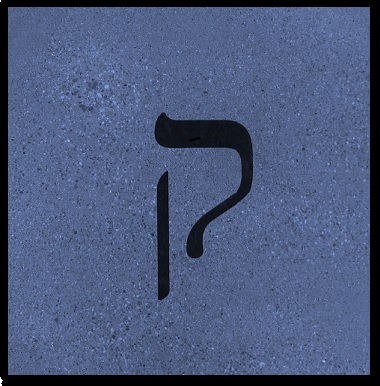


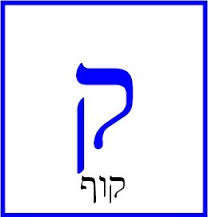
Why the letter Kof?

The Hebrew letter Kof stands as a symbol of my web page.  I chose it because it is the first letter of the Hebrew word “Kadosh” which means holy.

One of the most famous lines of the Torah teaches (Lev. 19:1) “You shall be holy for I the Lord your God am holy.”

“Holy” really means set apart or different from the ordinary.  Torah came into the world because the ordinary values of the ancient world were not good enough for our people. Our tradition calls on us to be different: to strive for an ever higher standard of justice, righteousness, kindness and compassion than those which prevailing societal norms uphold.

In terms of time we are taught to make a distinction between ordinary time — the time to do the work of living — and time that is Kadosh, holy.  In Kadosh time we step back and ponder why we do the things we do.  We ask ourselves: How can we infuse more kindness, caring and compassion into our daily living?  In his best seller THE GIFTS OF THE JEWS (ANCHOR BOOKS, 1999), Thomas Cahill calls the division between sacred and ordinary time the greatest gift of the Jewish people to humanity.

When I was a child, my parents gave me a copy of THE ALEPH-BET STORY BOOK by Deborah Pessin.  It contains children’s stories about each of the 22 letters of the Hebrew alphabet.  My favorite among the stories was then and is now, “Kof and the Woodcutter’s Prayer.”  In it, a poor woodcutter and a rabbi who visits him by chance both learn and teach a vital lesson about humility and priorities. I have retold that story many times in my career because of the lessons it teaches.

My favorite Shabbat Prayer asks God to, “Help us to distinguish between that which is real and enduring (my favorite definition of Kadosh) and that which is fleeting and vain.” In writing my book I have searched the Torah for those values which are real and enduring. In my blog as well I hope my thoughts help my readers and me to infuse a greater sense of Kedushah, (holiness, that begins with the letter Kof) into our lives.

Rabbi Stephen Fuchs
writerfox.hubpages.com

Another Bar Mitzvah Memory and Its Legacy

55 years ago this coming Shabbat I was called to the Torah as a Bar Mitzvah.  Although compared to most B’nai Mitzvah today, I did little in the service, I feel my knowledge of my portions was pretty deep for a thirteen-year-old.

I remember my rabbi, Avraham Soltes, of very blessed memory, standing next to me with his strong left arm around my shoulder!  It was so reassuring because I remember as I described in an earlier post (How I Came to Love Torah) being very nervous.  But what I remember most appreciatively, and what I incorporated in almost every Bar/Bat mitzvah service I conducted over 40 years (except in a very few cases when parents insisted that I do not) were the questions.

In our synagogue back then, students did not give the speeches or Divrei Torah that have become de rigueur  today.  Rather, after I had finished my readings Rabbi Soltes asked me questions.  He asked about my portion, he asked me to recite the ten commandments, and he asked me what my favorite Psalm was and to quote a bit of it.  I quoted Psalm 61, still a favorite, “Hear my cry, O God.  Attend unto my prayer.  From the ends of the earth I cry out to you when my heart is overwhelmed.  Lead me to the Rock that is higher than I.”  Without doubt, it was the questions and my ability to answer them that made my Bar Mitzvah day the most important day in my life.

Today, few rabbis ask questions.  Only one of my colleagues with whom I worked together in years past, Rabbi Beth Davidson, continues the practice in her own congregation.

Today as well, most Bat Mitzvah kids will not even know what a Psalm is.  Rather they have spent hours memorizing the chant of long sections of the Torah.  Few, though, learn Hebrew vocabulary words that the rabbi can ask them on the bema and invite the student to explain how they fit into his or her Torah or Haftarah portion.   I think our students are the losers.

The skillful rabbi knows that with a gifted student the material he/she expects the student to know can range far and wide.    With a slower student, the rabbi and the student deal with a much smaller vocabulary list and other potential questions.  In the service then, the difference between a gifted and slower student is not the AMOUNT of Hebrew that they chant, rendering the difference between them crystal clear to everyone who attends.  The difference when questions are asked is more subtle, how much material have the student and rabbi covered when they studied together.

Yes, it can happen that a student will not know an answer, but if the rabbi has done her/his homework it should be  very seldom. In life, there is always a chance that something goes wrong.  A skillful rabbi who has studied with his or her students will know what they know greatly minimizing the chance that the student will (in common parlance) “mess up.”  A skillful rabbi also knows how to cover for the student in the rare cases that it happens.  Once — only once — in the 100’s of services I conducted a student missed a question, and I did not cover properly.  I regret my lapse –30 years ago– and I will continue to regret it.  But I don’t see that one slip as reason to deny a student the opportunity to remember what he or she learns — not how well or how much he or she can chant — as the focal point of the experience.


The Adult Issues of Purim

Many think of Purim as simply a time for groggers, costumes noise and merriment.  With all the frivolity and fun that we shall hopefully experience, it is easy to dismiss Purim as merely a fun holiday for the young and the young at heart, but Purim is much more.

The Purim story confronts the mature reader with vital philosophical questions about the place of women in society, the phenomenon of prejudice, and the very meaning of life itself.

Too seldom do we ponder the courage of Vashti, King Ahasueras‘ first wife. In the story, the world’s most powerful man commands her to display her beauty for his drunken friends, but she refuses. She is a worthy role model for our daughters. She is also a good jumping off point for a discussion about the value of women as complete human beings. Vashti refused to simply be a sex object even if that refusal cost her throne. Hopefully all of us can learn from her courage

A vital lesson about prejudice presents itself when Mordecai refuses to bow down before Haman.  Haman is angry, but as the Bible records: “…it was not enough for him to punish Mordecai alone, for they had told him the people of

Mordecai” (Esther 3:5). No, because of his anger at one man, Haman sought to destroy all the Jews.

Sadly, the prejudice presented against in the book of Esther has confronted our people many times throughout history. The Purim story provides a vivid example of this phenomenon that we can profitably discuss with young people.

The third vital lesson instructs us in the meaning of life itself. When Mordecai read Haman’s decree condemning the Jews of Persia to death, he sent a message to Esther to intercede for her people. Esther’s response was that she dared not enter the presence of the king because he had not summoned her, and the penalty is death for anyone even the queen who appears unbidden before the king unless he holds out his scepter as a sign of acceptance.

Mordecai, through the servant Hatach, asks Esther a question we should all frequently ask ourselves: “Who knows if you have not become queen for just such a time as this?” (Esther 4:14). In other words, who knows if we are where we are at any given moment for the opportunity  to make a difference.

Mordecai really asks: Are we on this earth just to enjoy life? Is our own pleasure the primary purpose of our existence?

Jewish tradition and the Book of Esther say, “No.”

Esther could have lived out her life in selfish luxury. She could have ignored the plight of our people. But Mordecai’s question pricked her conscience enough so that she risked everything to save in an effort to save our people.

Mordecai’s question addresses us as well. What are we willing to risk to keep our people vibrant and strong?

In our day-to-day lives, we, like Esther have moments when our action or inaction, our willingness or unwillingness to risk it all can make a vital difference in someone’s life. We can seize these moments or turn away from them. Esther swallowed her fear and seized her moment. Her example and her courage commend themselves to all of us when the times come for us to step up and make a difference.

As Purim approaches, let us prepare for more than fun and games. If we truly study the Story of Esther, what we learn about the dignity of women, the phenomenon of prejudice and the very meaning of life itself can enrich our Jewish souls long after the celebration is over.

The Premise of My Book in Brief

Rabbi Stephen FuchsWHAT’S IN IT FOR ME walks an important line between fundamentalism and fairy tale and fills an important niche in Torah commentary.  Fundamentalist perspectives on Scripture abound and so do commentaries denigrating Scripture as unscientific and unhistorical.

WHAT’S IN IT FOR ME cares nothing about science because the Bible is not a science book.  It cares little about history as well. The premise of the book is that its stories were carefully selected for what they can teach us about living more meaningful lives and becoming better people.

Torah presents to the world a deity unlike any others that people worshipped.  In the pagan world into which Torah emerged gods and goddesses were force that people worshipped because they presumed these deities had power.  The only purpose of worship was to bribe these gods with offerings so that they would not use that power to hurt or to induce the deity to use their power to help those who worshipped them.  Ethics, morals and human interaction were of no concern to these gods.

God in the Torah is entirely different.   Of course we only worship one God and our God is invisible.  But as crucial as these differences are they are NOT the most important.

The most important difference is the agenda of Torah’s God.  From the story of Creation on God’s desire is that human beings – we creatures who are in charge of and responsible for the quality of life on earth – use our power to create a just, caring ad compassionate society.  All of our religious behavior as Jews – Holy Days, festivals, and life cycle celebrations – is designed to inspire us to work toward God’s ultimate goal.

There is no overstating the importance of this difference.  Yes, there are sacrifices in the Bible, but their purpose is to inspire ethical and moral behavior not assuage God’s anger.  Over and over again the prophets particularly those of the eighth pre-Christian century, Amos Hosea Isaiah and Micah, instruct the people of Judah and Israel that sacrificial observance unaccompanied by ethical and moral behavior is an abomination.

How desperately we need that message today!  Our religious observances only have meaning in so far as they inspire us to care for those less fortunate than we are, to seek housing for the homeless and food for the hungry.  In Jewish thought there is no place for an innocent bystander in the face of poverty and injustice. This is the Torah’s timeless message .  That is the message I hope my book will help its readers make their own.

How I Came to Love Torah

At my retirement party as Sr. Rabbi of Congregation Beth Israel in West Hartford, I was spoofed for the number of times I made reference over the years to the importance of my Bar Mitzvah!

In truth I consider that day, March 21, 1959, the most important day of my life.! I don’t say the best day of my life.  Those were the day I got married, the days my children and grandchildren were born, and the day I was ordained as a rabbi.  But as for importance my Bar Mitzvah Day tops the list.

Why?  I never thought I could do it.  That’s why.  I mean, me read from the Torah with NO VOWELS (The Hebrew texts of Torah scrolls contain neither vowels nor punctuation)?  There is NO way! I was so scared of my impending Bar Mitzvah that I thought I would die before I could get up there and read with no vowels.

Rabbi Stephen Fuchs

But then I went through my first ever exercise – as I realized years later – in deductive reasoning.  The process went like this.

  1. There are others in my Bar Mitzvah class
  2. Some of them have already had their B’nai Mitzvah services
  3. None of them died.
  4. Some of them are dumber than I am
  5. Based on 1-4 I might survive.

And I did!  And every time I have faced a challenge since then that I didn’t think I could conquer, I think back to my Bar Mitzvah and I say, “I didn’t think I could do that either.  Maybe if I just keep trying the best I can, I can do it.  It worked when I entered rabbinical school knowing no more than my Bar Mitzvah prep Hebrew and felt like a complete dummy!  Though I can’t say it has worked every single time, that mantra has helped me more often than not.

But there is another reason my Bar Mitzvah is so important.  It made me take Torah seriously!  My portion, Va-yikrah, the first in the book of Leviticus is among the most esoteric in all of scripture.  And yet there are two lessons in what I read that are as modern as today:

  1. Ignorance of the law is no excuse for violating it (Lev. 5:17)
  2. Victim compensation should be the major form of redress for financial crimes. (Lev. 5:24)

These discoveries occasioned a major WOW for me!  If such treasures were gleanable for my dry as dust portion, what insights relevant to life today are waiting for me to discover in the narrative portions of the Torah.  Fifty-four years later, my book,  WHAT’S IN IT FOR ME: Finding Ourselves Biblical Narratives is the result.  I hope you find it meaningful reading!