A Stark Covenantal Reminder! Quick comment: Parashat Ha’azinu (Deuteronomy 32: 1-52)

What powerful words begin the poem that comprises this week’s Torah portion: “Give ear O heavens … listen well, O earth. Let God’s words fall like the dew and rain that nourish the grass.”

We quote part of this poem when we accompany one who has died to his or her final place of rest:

“God is the rock whose works are worthy, and all God’s paths are just … and right”

Sadly the significance of that line at such an emotional moment has been all but lost. The words it contains, תמים, משפט and צדיק take us back to the foundational Covenant that God first made with Abraham.

God charged Abraham with these three trigger words, and they underlie our faith to this day: To be תמים (worthy) and to live a life–and teach his offspring to live lives–marked by צדקה (same root as צדיק) and משפט (justice and righteousness).

When we accompany the dead to his or her grave these words should challenge us:

Just as the person whose life has ended lived up (and here we are happy to give the individual the benefit of any doubt) to his or her Covenantal obligations, so must we.

As far as God’s other charge to Abraham, “Be a Blessing” (Genesis 12:2), our poem references it by mentioning the blessing of God’s rain and dew. We shall only merit these necessities to sustain life on earth if we do a better job than we are now of taking care of it.

Put differently: we only deserve God’s blessing of life and sustenance (See Leviticus 26:3 ff) if we through our acts of justice, caring and compassion make our lives blessings to the lives others.

Michael Holzman

Yom Kippur bids us to imagine how we would like people to remember us after we die. As I face that stark question this year, I can think of no more meaningful way to be remembered than the way so many of us remember Michael Holzman who died this past summer at the age of 52.


When he knew that he was dying, Michael’s last major goal was to make it to his daughter Emily’s graduation from Colgate. He not only made it, he was able to enjoy it thoroughly and record the events surrounding this great milestone with one of his signature photograph albums. What a wonderful achievement! What a wonderful gift to his family!

Carmen and Emily were the foci of Michael’s universe. You could see the love he had for them in his eyes. You could feel it in the spirit that emanated from his soul.

I can still see the glow he radiated at Emily’s Bat Mitzvah and Confirmation. I can easily imagine how proud he was at Colgate this past May.

When we travelled to Israel, ten years ago except for the gazelle-like Gail Mangs, Michael was the first one to reach the peak of Masada with Emily close behind. The climb that left the rest of us huffing was not even a challenge for someone as fit and strong as he.

With his keen eye and wonderful skill he took amazing pictures throughout the trip, and I still treasure the framed photograph he gave me that I displayed in my office. I have had the joy of seeing several albums Michael has created. It is as though he painted with his camera.

For years at the synagogue, we had a portable ark for use during our services in Haas or Feldman Hall. Opening the doors during a service was a major challenge. I had to push with all my strength to get them open hoping all the time that the whole thing would not topple over.

It is a challenge we have to face no longer because of the beautiful new portable ark that Michael crafted for the congregation.

As a rabbi I have never had a theological problem with the Holocaust. I believe God gives us free will, and that society, not God, is to blame for the horrors that humans perpetrate against one another.

But as a rabbi I have a great theological problem—and no good responses–for why someone like Michael Holzman has the body that he kept so incredibly fit and strong ravaged and destroyed by cancer at such a young age.

Michael and I discussed these matters candidly together. I wish I could have given him—just as I wish I could give you and myself—more comforting answers.

As I told Michael, there is a reason we come to worship God and do not expect God to worship us. Though we continue to unravel many mysteries of life, there are some things we just cannot understand.

I consider it a miracle that despite everything he endured, Michael still believed in God.

He believed strongly—and he lived that belief—in the imperative of our tradition to make this world a more just, caring and compassionate place.

He also believed in the possibility of an existence beyond the grave. During one of our visits he told me with his scientist’s curiosity, “I am interested to see what it is.”

Michael, if it is what you deserve for the way you lived on earth, it is a paradise beyond description.

As for those of us you leave behind,

—Your parents, who endure today what no parents should ever have to endure,

— Your brothers and their families,

—All of us who admire you so,

—And particularly, Carmen and Emily,

You will live on each time we make a conscious effort to live the way you lived.

You were kind, generous and loving! You diligently developed your vast talents and abilities and gave freely of them to help others. You have made the world a better place, and your memory will always be a blessing!

A Yom Kippur Carol—Charles Dickens’ High Holy Day Sermon

Whether you prefer the 1951 version starring Alastair Sim or the 1938 version starring Reginald Owen—or whether you are a fan of any of the many more modern incarnations and adaptations–or even perhaps if you like the book first published in 1843 best of all, there is no question that Charles Dickens’ A Christmas Carol is a classic.

Now, A Christmas Carol is a Yom Kippur story if there ever was one. And it matters not that when Dickens wrote it, he had in mind another season and another holiday. It is a Yom Kippur story.

As a small child, I couldn’t resist it. That is to say, I couldn’t resist the first act. I lived to hear Scrooge say, “Bah! Humbug!” It wasn’t until I was older that I began to appreciate the drama that unfolds after the first commercial.

Scrooge spends a restless night marked by four fateful encounters. The first is with the ghost of his dead partner Jacob Marley. In life, Marley was Scrooge’s tight-fisted clone. In death, he walks about chained to his account books, wailing in misery.

The frightened Scrooge cries out to his partner: “But you were always a good man of business, Jacob!”

“Business!” answers Marley. “Mankind was my business. The common welfare was my business; charity, mercy, benevolence, forbearance. These were all my business. The dealings of my trade were but a drop of water in the comprehensive ocean of my business!”

The Hassidic Rabbi Levi Yitzhak of Berditchev, who died in 1810, two years before Charles Dickens was born, expressed Marley’s admonition to Scrooge in another way. Once, he saw a man hurrying down the street looking neither to the right or the left.

“Why are you hurrying so,” the Rabbi inquired?

“I am pursuing my livelihood,” the man answered.

“And how do you know,” the Rabbi continued, “that your livelihood is in front of you? Perhaps it is behind you, and you are running away from it.”

Such was Marley’s message to Scrooge:

You are running away from your livelihood, but “I am here tonight to warn you that you have yet a chance and hope of escaping my fate.” As Marley leaves, he promises Scrooge that the spirits of his past, present and future will visit him.

The ghost of his past allows Scrooge to see the hurt people inflicted on him that turned his life in its miserable direction. He sees himself as a boy in school, sitting alone during the winter recess, in his words, “a solitary child … neglected by his friends.”

But then Scrooge sees another side of humanity: He sees himself as a young apprentice to kindly Mr. Fezziwig. And Scrooge apprehends a truth, which escaped him for many years: “He has the power to render us happy or unhappy; to make our service light or burdensome; a pleasure or a toil.”

Moving from his past to his present, Scrooge encounters his nephew, Fred, and his clerk, Bob Cratchitt. They teach him that vast riches do not provide happiness, nor does their absence preclude it. In Bob Cratchitt’s ailing son, tiny Tim, Scrooge sees opportunities to act righteously that he has spurned for so long.

Scrooge’s final lesson allows him to look into the future, to see how people scorn him after he is gone. With terror he sees his chambermaid stealing the very sheets from his deathbed and the curtains from his bedroom and chortling over his death.

Yom Kippur asks us to experience what Scrooge experienced: to imagine we are dead and ask, what is the impact of our actions on those around us?

Yes, once a year we need to spend a night like Scrooge.

We need to hear and heed the lesson: Mankind is my business…charity, forbearance, mercy, and benevolence. These are all my business. We need to remember those who treat us kindly. We also need to ponder: Will our death cause sadness or occasion relief?

“Spirit,” cried Scrooge, clutching the robe of Christmas Future, “Why show me this if I am past all hope?”

Scrooge, of course, was not past all hope. And neither are we.

A famous Polish preacher, Jacob Krantz, who was known as “the Dubner Maggid,” wrote many wonderful stories and parables. My favorite is about a king who had a precious diamond that he guarded carefully.

Despite all his efforts, he awoke one morning to see a scratch on one of the facets of the gem.

Overwrought, the king sent word around the world offering a great reward to any jeweler who could remove the scratch from the gem, but none of them could remove the unsightly blemish.

At last a local lapidary sent word that he would like to try. The king’s courtiers scoffed: “You! What can you do when the world’s greatest jewelers have been unsuccessful?”

“Certainly,” he replied, “I cannot do any worse than they.”

So they gave him a chance. Instead of trying to remove the scratch from the diamond, the jeweller used it as a stem around which he etched a most beautiful flower. When he had finished, the king and all of his courtiers agreed that the gem was more beautiful than it was before.

Like Ebenezer Scrooge we are flawed diamonds with the opportunity to etch lives of beauty and meaning around our shortcomings.

Every year, the Yom Kippur Carol urges us to build lives of “charity, mercy, benevolence, and forbearance” around our flaws.

It is not an easy thing to do, but if our efforts are sincere, infinite rewards await us at the end of the day.

Elijah’s Role on Yom Kippur

It is for good reason that Jews close Yom Kippur — just before the blowing of the shofar with the triumphant cry from the wonderful passage (First Kings,chapter 19) in which Elijah vanquishes the prophets of Ba’al on Mt. Carmel:  “Adonai Hoo Ha Elohim!  The Eternal One (alone) is God!”  We chant it seven times before we hear the shofar (the ONLY time all day we hear the shofar on Yom Kippur) to signify the end of the most solemn holy day in our calendar.

Sadly, most Jews have no idea of this connection, but it is crucial!   King Ahab and (even more so) Queen Jezebel (a name known as a synonym for wickedness even for people who never read the Bible) had corrupted Israelite worship by setting up Ba’al and its prophets as their favored cultic practice.  They vowed to kill Elijah who was the champion of the one true God.

So Elijah challenges the prophets of Ba’al on Mt Carmel. He says we will each prepare our offering, and the god who consumes the offering without a fire being kindled is the real deity. The prophets of Ba’al go first, and though they cry out and gash themselves, nothing happens. Then Elijah pours water all over his offering, so much water that it fills the trench around the makeshift altar erected for the showdown. Then Elijah cries, “Answer me, O Eternal One, Answer me, and POOF! The offering, the altar beneath it and even the trench filled with water go up in smoke.

Who is God? Elijah essentially asks?  Is it your idol that you worship by gashing yourselves and with other abominations that make a mockery of human dignity? Is it Ba’al who—you hope—will greedily eat your offering?  Or is it the one true God who wants us to create a world of justice, kindness, caring and compassion?

And then in most dramatic fashion God vanquishes Ba’al on Mt Carmel and everyone must acknowledge God’s sovereignty.  It is a replay in miniature of the ten plagues and the Exodus from Egypt where God defeats Pharaoh, the pagan god in human form.

So what should Jews take away when the liturgy references this amazing scene at what is arguably the holiest moment of the year?  What should we all learn from this passage that can help us to live better lives?

Even though many in power debase the ideals and values that the Eternal One wants us to uphold—and even though God does not assert the reality of the Divine presence as dramatically to us as we see on Mt. Carmel (or in the parting of the sea)–it is our job to hold fast to God’s desires for us.  True worship is not found in mouthing empty words, but in making our faith the driving force in our lives.  We glorify God and demonstrate our faith when we use the talents that God has given us—whatever they may be—to help repair this broken world.

http://www.rabbifuchs.com

My Three Covers

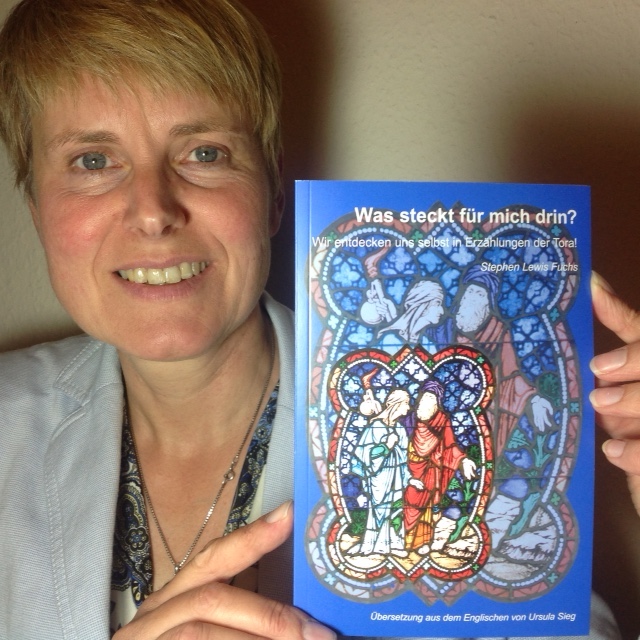
Fuchs-Cover photoPastor Ursual Sieg holding newly published German edition of What's in It for Me? Finding Ourselves in Biblical Narratives

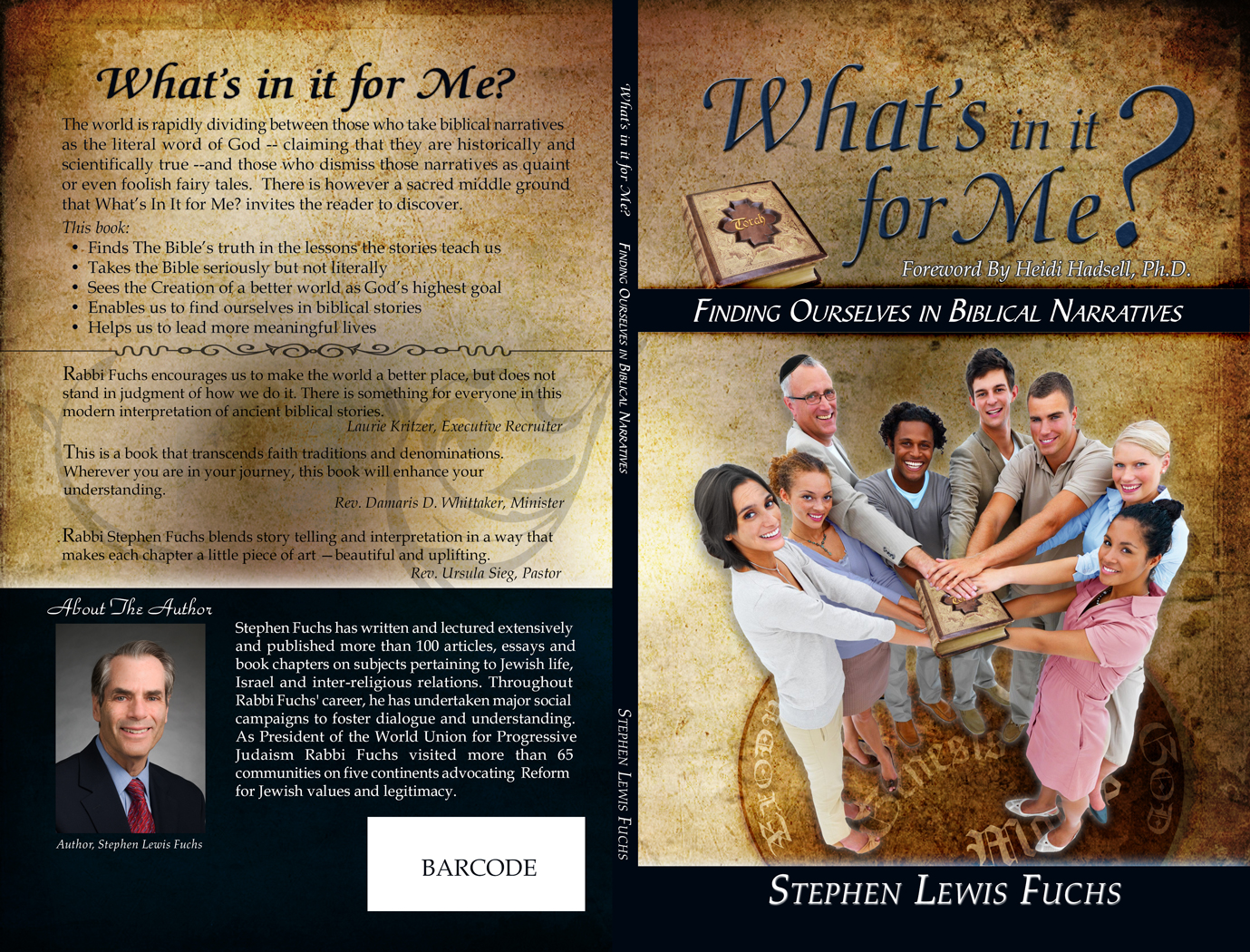
It is hard for me to believe —but exciting to contemplate—that What’s in It for Me? Finding Ourselves in Biblical Narratives is now available in three editions. There is the original book in English published last year, a just released German edition, and an even more recently released audio book edition (www.audible.com).

Due to production issues the three books have three different covers, and as I look at each one, I am glad that they do.

The original has a nice photo of a number of individuals from different ethnic and religious backgrounds all leaning in to grasp a copy of the Torah, the first five books of the Hebrew Bible. The message is that people of all backgrounds and religious beliefs (or no religious beliefs) can gain valuable insight and understanding from biblical stories. I am grateful for the many who have told me—including the 28 five-star AMAZON reviewers (http://www.amazon.com/Whats-Finding-Ourselves-Biblical-Narratives/dp/1427655014/ref=tmm_pap_title_0) that they have.

The audio edition has an artistic depiction of Abraham, selected from the net by Skip Conover, who encouraged me to record the book and helped me jump through all the technical hoops (and at times they were daunting) that stood between the recording and the release of the finished product.

Abraham was the perfect choice for the cover photo because Christians, Muslims as well as Jews consider him our spiritual patriarch, and my goal is that the book appeal to all people.

The cover of the German edition also depicts Abraham, but (I know you will understand) this cover holds the most personal meaning for me of the three.

Why?

First, it depicts Abraham and his wife Sarah beginning together their journey to the Promised Land. Together they answered God’s call to start a new way of life with the aim of teaching humanity to build a just, caring and compassionate society. Sarah is such an integral part of the story and so beloved to Abraham that the midrash points out: Abraham endured ten difficult trials, but the only time the Torah tells us that Abraham wept is when his beloved Sarah dies.(Bereshit Rabbah 58:1).

Second the cover photo was painstakingly shot by photographer Lena Stein and carefully selected from dozens of snaps by Pastor Ursula Sieg (holding the German edition in the photo above). The photo is from one of the magnificent stained glass windows of Congregation Beth Israel, West Hartford Connecticut, where I served as Spiritual Leader of for fourteen years.

Pastor Sieg not only translated the book into German, but, aided By Dr. Serafine C. Kratzke, oversaw every aspect of its production through the publishing house she established, Mutual Blessing Edition.

Pastor Sieg undertook this project and saw it through to successful completion because of her passion to foster greater understanding and affirmation among all religious groups.

Seen together, my three covers form a mosaic (pun intended) that pays tribute to our roots in the stories of the patriarchs and matriarchs and looks with hope to a future of greater harmony among all of God’s children.

Whether you choose the original—in either eBook or hard copy format— the audio book, or the German translation, may you find meaning in the ideas you encounter. Indeed, I hope that as the President of Hartford Seminary, Dr. Heidi Hadsell, wrote in her Foreword, ” …you will be informed, comforted, challenged and encouraged … you may also find in the process you have changed in important ways.

http://www.rabbifuchs.com

Wie am besten die Karriere beenden? Kurzkommentar zum Wochenabschnitt Va-yelech, Deuteronomium 31:1-30


Beim Blick in den Spiegel sehe ich – jetzt 69 Jahre alt – nicht mehr den jungen Mann, der ich zu sein glaube. Diese Realität zu akzeptieren, fällt mir nicht leicht.

Ich stelle mir vor, dass Mose ähnlich fühlte, als er zu den Kindern Israels sagte: “Ich bin jetzt 120 Jahre alt. Ich kann nicht mehr tun, was ich sonst tat.” (Deuteronomium 31, 2)

Gott ruft daraufhin ihn und seinen Nachfolger Josua zum Zelt der Begegnung um Gottes Auftrag zu empfangen und die Leitung zu übergeben.

Nach anfänglichem Widerstand (Deuteronomium 3:24-26) kann Mose jetzt loslassen. Er ermahnt Josua, stark und gutem Mutes zu sein (Deuteronomium 31:6), und überlässt ihm dann die Führung des Volkes ohne sich noch einzumischen.

Im Gegensatz dazu tat Samuel das nicht. Seine Unfähigkeit loszulassen ruinierte die Regierung des Mannes, den Samuel im Auftrag Gottes zum König gesalbt hatte: Saul (1, Samuel 9 – 15). Indem er jede seiner Entscheidungen infrage stellte, verdammte Samuel Saul zu einer gescheiterten Regentschaft und zu einem tragischen Ende,

Wer von uns Leitungsverantwortung trägt, sollte diese beiden Beispiele studieren.

Als Rabbiner kenne ich Gemeindeleiter, die geplagt werden von beständigen Einmischungen ihrer Vorgänger. Wie traurig ist es zu sehen, wie pensionierte Rabbiner, die sich nicht würdevoll zurückziehen können, ihr Erbe zerstören und Verbitterung sähen in ihren Nachfolgern und deren Gemeinde. Persönlich war ich mit zwei pensionierten Kollegen gesegnet, die mir Gutes wünschten und mir großzügig die Zügel überließen. Ich bin für immer dankbar. Wo wir auch arbeiten, sollten wir und fragen: “Wenn ich pensioniert werde, will ich dann dem Beispiel Samuels folgen oder dem lobenswerten Beispiel des Mose?” Die richtige Entscheidung wird das Erbe unserer Amtszeit mehren und ein Segen sein für unseren Nachfolger.Als Rabbiner kenne ich Gemeindeleiter, die geplagt werden von beständigen Einmischungen ihrer Vorgänger. Wie traurig ist es zu sehen, wie pensionierte Rabbiner, die sich nicht würdevoll zurückziehen können, ihr Erbe zerstören und Verbitterung sähen in ihren Nachfolgern und deren Gemeinde.

Persönlich war ich mit zwei pensionierten Kollegen gesegnet, die mir Gutes wünschten und mir großzügig die Zügel überließen. Ich bin für immer dankbar.

Wo wir auch arbeiten, sollten wir und fragen: “Wenn ich pensioniert werde, will ich dann dem Beispiel Samuels folgen oder dem lobenswerten Beispiel des Mose?”

 Die richtige Entscheidung wird das Erbe unserer Amtszeit mehren und ein Segen sein für unseren Nachfolger.

Translation: with thanks to Pastor Ursula Sieg

Die richtige Entscheidung wird das Erbe unserer Amtszeit mehren und ein Segen sein für unseren Nachfolger.

How to Retire and How Not to (Quick Comment, Parashat Va-yelech, Deuteronomy 31:1-30)

Looking in the mirror and—at age 69—I no longer see the young man I still think I am. It is not an easy reality to accept.

I imagine Moses had similar feelings as he says to the children of Israel, “I am now 120 years old. I can no longer do the things I once did.” (Deuteronomy 31:2)

God then calls him and his successor Joshua to the tent of Meeting to receive God’s charge and to turn over the reigns of leadership.

 Moses, after initial reluctance (see Deuteronomy 3:24-26), now knows how to let go. He charged Joshua, “Be strong and of good courage,” (Deuteronomy 31:6) and then left the leadership of the people to him without further interference.

By contrast Samuel did not. His failure to let go ruined the reign of the man God told Samuel to anoint as King, Saul (I Samuel 9 – 15). By second-guessing each of Saul’s decisions Samuel doomed Saul to a failed reign and a tragic end.

Those of us called to lead in any situation should examine both of these examples.

As a rabbi I have learned of new congregational leaders plagued by the constant interference of their retiring predecessors. How sad to see retiring rabbis destroy their legacy and foster bitterness in their successors and in their communities by their failure to retire gracefully!

Personally I had the blessing of two retiring colleagues who wished me well and then graciously relinquished the reins of leadership.I am ever grateful.

Whatever our field of work, we should ask ourselves: “When I retire, will I follow the sorry example of Samuel or the praiseworthy example of Moses?

 The right choice will enrich the legacy of your leadership and be a blessing to the one who follows you!

UNVARNISHED

As Rosh Hashanah ends and Yom Kippur approaches I am reposting this essay which drawn deeper reflections from readers than any of the other 210 essays on http://www.rabbifuchs.com. It still makes me wince when I read it.
Have I made progress in this area during the past year? Maybe a little, but surely not enough. And so I pray as the Day of Atonement draws near: “Help me, O God, to distinguish between that which is real and enduring and that which is fleeting and vain.

slfuchs's avatarFinding Ourselves In The Bible

Yom Kippur is almost here: It is the Day of Awe. It is the culmination of a 40-day period of reflection and repentance, which (if and only if we take it seriously and personally) can leave us feeling cleansed and renewed. But it takes work, hard work.

All year long we puff ourselves up in an attempt to impress our bosses, dates, prospective employers, those with whom we communicate on Facebook, and everyone else. Yom Kippur demands that for one day we strip away this puffery.

And so I look deep into my soul and ask: Why did I do the things I did? What was I really hoping to accomplish? Did I want to help others? Or did I want to aggrandize myself? Can the two desires be congruent?  God commands me to struggle with tough questions. There is no place for pretense on Yom Kippur.

And so, I…

View original post 517 more words

Jake, Hank, Sandy and Me

This essay was originally published in, Judith Zabarenko Abrams, z’l, and Marc Lee Raphael, eds., What is Jewish about America’s Favorite Pastime? (The College of William and Mary, Williamsburg, VA), 2006.

Jake Pitler

For me, my consciousness of my special identity as a Jew as it relates to athletics began back in the 1950s, when, on a Rosh Hashanah afternoon, I heard the mellifluous voice of the great Red Barber say, “The old familiar number 31 of Brooklyn first base coach Jake Pitler will be missing today as he is observing the Jewish New Year and is not in the ball park.”

My consciousness of Jews in American sports developed further during Oneg Shabbat (reception following service) at Sabbath Eve services at my congregation, Temple Sharey Tefilo in East Orange, New Jersey. My parents were regular Sabbath eve attendees, and as I look back on my childhood, I realize that one of the most precious gifts they gave me was to bring me with them. I wanted to be with them although I often counted ahead to see how many pages were left in the service. At the Oneg Shabbat, while they socialized with friends, I drifted into the Temple’s combination museum and library and browsed through the exhibits and the books.

Invariably, as a young boy who loved athletics, my hands picked out The Jew in American Sports, by Harold U. Ribalow. The book was published in 1952 and contained sketches of Jewish athletes most of whom I had never heard of. Their stories fascinated me. I became familiar with such names as Morrie Arnovich, Al Singer, Moe Berg, and, of course, Hank Greenberg. Sandy Koufax came of age as a baseball and Jewish icon as I moved through high school and college.

Greenberg and Koufax were not just Jews who happened to play sports. They were Jews who, through circumstances of time, location, and the game of baseball, became symbols of Jewish pride as our people searched for the elusive balance in their identities as Jews and Americans. They – perhaps unwittingly – helped us in our struggle to gain full acceptance in a gentile world while maintaining (to differing degrees) our identity as Jews.

Hank Greenberg

American antisemitism reached its peak in the 1930s. The Great Depression proved the well-known axiom that the comfort level of Jews is in a direct relationship with the health of the economy. With Henry Ford’s Dearborn Independent still popular and his book, The International Jew, the World’s Foremost Problem, and the rantings of Father Charles Coughlin leading the way, the 30s were not a comfortable decade for American Jews especially in the Detroit area, where Greenberg played.

Hank Greenberg’s story is well-known to us. According to The Baseball Page.com, “Amid the rising antisemitism of the 1930s, Hank Greenberg’s baseball heroics took on symbolic meaning for many Jewish Americans. He was the first baseball star to enter the military in World War II, doing so voluntarily.”1

As a player, Greenberg ranks among the all-time greats. He is the first and only one of only three players in all of history to win Most Valuable Player awards at two different positions (he played first base and left field). He played in four World Series in his war-shortened career, and he led the Detroit Tigers to two world championships in 1935 and 1945.

In 1934, Hank batted .339 with 63 doubles, and he hit .328 with 170 RBIs in 1935. Injuries hampered him in 1936, but in 1937, he drove in 183 runs (one short of Lou Gehrig’s all-time record) with 103 extra-base hits and a batting average of .337. In 1939, he hit 41 home runs and had 150 RBIs, with a batting average of .340.

His greatest year, though, was 1938, when he hit 58 home runs with 146 RBIs. His 119 walks might well have prevented him from eclipsing Babe Ruth’s home run record, and it was frequently heard that he received so many passes because of a reluctance of many in baseball to have a Jew equal or tie Babe Ruth’s record.

The reluctance of Tiger Manager Bucky Harris to play Greenberg regularly as a young player, and the Tiger’s curious sale of a still productive and very popular Greenberg after the 1946 season, suggests to many that antisemitism was still a factor in Major League Baseball decisions during the years of Greenberg’s career.

My interest in Greenberg, though, is as the role model he became for American Jews. He was by no means a religious man – although his parents were Orthodox-–but he did sit out on Yom Kippur and actually consulted a Reform rabbi who gave him (incredulously, to me) his okay to play on Rosh Hashanah during a tight 1934 pennant race. In that Rosh Hashanah contest, Greenberg hit two home runs in a 2-1 victory. When he sat out on Yom Kippur, though, he inspired the following poem by Edgar A. Guest, which appeared in The Detroit Free Press:2

The Irish didn’t like it when they heard of Greenberg’s fame

For they thought a good first baseman should possess an Irish name;

And the Murphy’s and Mulrooney’s said they never dreamed they’d see

A Jewish boy from Bronxville out where Casey used to be.

In the early days of April not a Dugan tipped his hat

Or prayed to see a “double” when Hank Greenberg came to bat.

In July the Irish wondered where he’d ever learned to play.

“He makes me think of Casey!” Old Man Murphy dared to say;

And with fifty-seven doubles and a score of homers made

The respect they had for Greenberg was being openly displayed.

But on the Jewish New Year when Hank Greenberg came to bat

And made two home runs off pitcher Rhodes they cheered like mad for that.

Came Yom Kippur holy fast day world wide over to the Jew

And Hank Greenberg to his teaching and the old tradition true

Spent the day among his people and he didn’t come to play.

Said Murphy to Mulrooney, “We shall lose the game today!

We shall miss him on the infield and shall miss him at the bat,

But he’s true to his religion and I honor him for that!”

Did the antisemitic feelings of the times that were often magnified by slurs and comments from opposing players and fans bother Greenberg? Of course they did. He once noted candidly: “How the hell could you get up to home plate every day and have some son-of-a-bitch call you a Jew bastard and a kike and a sheenie and get on your ass without feeling the pressure? If the ballplayers weren’t doing it, the fans were. I used to get frustrated as hell. Sometimes I wanted to go into the stands and beat the shit out of them.”3

What Henry Benjamin Greenberg did, though, was much more effective and much more satisfying. He provided Jews across the land a symbol of strength, power, and success. He was a fine athlete, a war hero, and a mensch, with a marvelous work ethic that made him one of the greatest ballplayers ever. When he entered the synagogue on Yom Kippur in 1934, he received a standing ovation from the congregation. He made us proud to be Jews.

Sandy Koufax

In the five or so years before arm trouble ended his career at 31, Sandy Koufax may well have been the greatest pitcher who ever lived. Although he last pitched nearly 40 years ago, my memories of him are vivid. My most prominent one is the first inning of his perfect game — when he struck out the side in the first inning on nine pitches. I have never seen anyone do that before or since. I remember saying as he walked off the mound after those nine pitches, “I can’t imagine anyone getting a bat on his pitches today.”

In 1961, when Koufax was in his first outstanding season, the famed Los Angeles Times columnist Jim Murray wrote: “Sandy’s fastball was so fast some batters would start to swing as he was on his way to the mound. His curveball disappeared like a long putt going in a hole.”4

The web page of the National Baseball Hall of Fame sums up Koufax’s career succinctly: “After Sandy Koufax finally tamed his blazing fastball, he enjoyed a five-year stretch as perhaps the most dominating pitcher in the game’s history. He won 25 games three times, won five straight ERA titles, and set a new standard with 382 strikeouts in 1965. His fastball and devastating curve enabled him to pitch no-hitters in four consecutive seasons, culminating with a perfect game in 1965. He posted a 0.95 ERA in four career Word Series, helping the Dodgers to three championships.”5

In addition Koufax was an All-Star six times, the National League MVP in 1963 and the Cy Young Award three times as well. He was also World Series MVP in ’63 and ’65. One of his most memorable games was his three-hit shutout of the Minnesota Twins in Game Seven of the 1965 World Series. He also shut out the Twins in Game Five of that series, on four hits.

Of course, for all his feats on the field, his most memorable act as a Jew was refusing to pitch in the first game of the ’65 Series, on October 6, because that day was Yom Kippur. Like Greenberg, Sandy Koufax was not a religious man, but he demonstrated his pride in his heritage publicly. From that day to this, he has been an inspiration to me.

Me

In 1966 I won the Eastern College Athletic Conference College Division Draw II tennis tournament at Rider College in Trenton, New Jersey. I played five of the best matches of my life at that tournament. I still cherish that victory and seeing my name in the National Tennis Magazines and the New York Times. I was excited at the prospect of returning the next year–-my senior year-–to compete as Hamilton College’s number one player in the Draw I Division.

When I learned, however, that the dates of that tournament coincided with Yom Kippur, I made without hesitation-–but with much trepidation-–the longer-than-it-usually-seemed walk to the gym to tell my coach that I would not compete and why. From that day to this, I still love to play tennis.

On the local level, when I lived in Maryland and Tennessee, I won a number of tournaments of which I am proud and. I even managed to win the Hartford Tennis Club 60 and over Men’s Singles Championship in 2006. But my proudest moment as an athlete is the tournament in which I did not play. It allowed me to realize that compared with others over the centuries, I was paying a piddling price to express my pride in being a Jew. It also allowed me to feel that, in my own small way, I was following in the footsteps of men like Jake Pitler, Hank Greenberg, and Sandy Koufax. I am grateful to be in their company and grateful for the example they set for me and for so many others as Jews in American sports.

Endnotes:

The BaseballPage.com, Hank Greenberg, web page.
Edgar A. Guest, Detroit Free Press, 1934 (date uncertain).
Barry Burston, The Diamond Trade: Baseball and Judaism, web page.
Jim Murray, “Sandy Rare Specimen”, column, August 31, 1961, quoted in, The Great Ones, Los Angeles Times Books, 1999, 27.
National Baseball Hall of Fame, web page, Sandy Koufax.
Posted in Insights & Inspirations
The Pastors’ Convention

It was with some trepidation that I arrived at the regional Lutheran Pastor’s convention in the quaint German town of Preetz. I had been invited by Pastor Anke Wolff-Steger to keynote the convention with a sermon on the Garden of Eden. Because Pastor Wolff-Steger had invited me to preach on this topic at her church a year ago, she knew the gist of what I would say. The pastors in attendance did not, and I knew some would be taken aback.

I reviewed quickly the classical Christian interpretation (surely they did not need me for that) that Eden marked the “Fall of Man.: We had everything we could possibly in the garden, but Eve ruined everything by eating of the Tree of Knowledge, the one tree from which God warned the first couple not to eat and then convincing Adam to eat as well. In so doing they plunged humanity into a state of sinfulness, but belief in the saving power of Jesus’ life, death on the cross, ascension to heaven and resurrection saves us from that degraded state.

It was a surprise to no one there, of course, when I said that Jews do not believe that. For traditional Jews eating from the Tree of Knowledge was a profound act of disobedience, and we live with the consequences, a life of limited duration, pain in childbirth and the need to work for a living. But we do not exist in a state of sinfulness, and therefore we have no need for Jesus to save us.

Then I shared a perspective on Eden that I include in my book, What’s in It for Me? Finding Ourselves in Biblical Narratives, the essence of which I first learned from my beloved Bible professor at HUC, Chanan Brichto, of blessed memory:

Eden was a nice place to visit but not to live. It was a world of no birth, no death and no sexuality. Indeed sexual knowledge is precisely the knowledge the first couple discovered when they ate of the Tree of Knowledge.

Eve is not the villain of the story but the heroine. She is not interested in an endless life of ease without challenge or purpose. Although she did not know what life outside the garden would be like, she was willing to risk that uncertainty for a life filled with meaningful achievement, satisfying relationships, and the ability to bring new life into the world.

I can relate. After a long year of work, I would love to visit Eden, a place where all my needs are provided and I can lie on a pristine beach with fresh ripe fruit hanging over my head.

I would love it for about a week, maybe even ten days. After that I would seek out a challenge that would bring meaning to my life.

That is how I imagine Eve felt when she chose to eat the fruit. We should see Eve as a hero whose bold action enables us all to live lives of meaning and purpose.

However differently we interpret the story of Eden, I concluded, we can agree on one thing. None of us live there any more. We all live in this imperfect world. Therefore God calls on each of us to work as best we can to make the world a better place.

After breakfast we spent an hour studying the texts in small hevruta groups. I truly believe studying Torah or Bible together is one of the most productive and honest ways to experience inter-religious dialogue. As we studied one of the pastors challenged me: “How can you call Eve a hero when she defied a direct command from God.”

I responded that rather than a command I see an admonition in the text. God warned that there would be consequences for eating from the tree, and Eve was willing to take the risk. I added that I don’t believe this is the only reasonable interpretation of the story, but I think it is reasonable for you to give it some thought. Sometimes when we first hear an idea it jars us, but then it begins to make more sense over time.

Her response was a quizzical look, but as I left the gathering I noticed that she had purchased my book and had begun to look through it. I could not ask for more.


Rabbi Fuchs’ book is now available in audio format and has just been released in a German edition.