
13 Years Ago: How I Reacted to 9/11

What follows are thoughts I expressed on Yom Kippur in 2001.

It is hard to imagine that if 9/11/01 was a child, he or she would now be ready for Bar or Bat Mitzvah. Indeed in the years since that day, terror has come of age.

 The connection I made between the events of that day and the Middle East was valid then, and I believe it is all the more valid today. I applaud President Obama’s resolve to fight the ISIS terrorists.There are those in this world whose only mission is death and destruction. Unfortunately, that is the only language they understand.

Why does it take the worst to bring out the best in us?

That is the question I hope we shall ponder intensively throughout this sacred day.

We are just beginning to absorb the enormity and the reality of the tragedy our nation has endured. Thousands and thousand of people whose only crime was that they got up and went to work will never come home.

Through our tears and our revulsion at the evil behind this terror, we have seen awe-inspiring heroism and examples of goodness and leadership that will inspire us as long as we breathe. Let us close our eyes and think of the firefighters, the police, the Emergency Medical Technicians, the doctors, nurses, and the chaplains of all faiths who did so much to comfort so many.

Let us think of the entertainers. They came from every corner of everywhere to donate their talent and time, and they raised 150 million dollars to aid the victims.

Ordinary people, too, rolled up their sleeves to give blood, unrolled their billfolds to give money, collected food, and clothing. The resolve and reaction of the American people to this tragedy is a proud chapter in our history.

 What we suffered in the United States on 9/11 is on a larger scale what Israel has lived with for all its existence. That point becomes even clearer when we realize that just days ago, Israeli security captured two Palestinians that had planned to blow up the Azrieli Towers in Tel Aviv, the tallest building in the Middle East.

If the Palestinians cannot accept the reality of a sovereign Jewish Israel, then the prognosis is war and suffering and more war and more suffering. If the Palestinians cannot renounce terror, then reprisals and the deaths of innocent Palestinians will not end.

Why does it take the worst to bring out the best in us? I wish I knew. I do know, though, that this is the time for us to bring out our best –our best as Americans and our best as Jews; our best in support of the victims of terror in our country, and our best in support of our brothers and sisters in Israel.

They both need our love, our money, our time, and our presence.

Let terror not paralyze us but mobilize us. As Americans let us conquer the fear that gives terror its victory, and let us face the future with courage.

Elul Has Begun!

The last months of the Hebrew year, Elul, has just begun. Elul is a special time of preparation for the hard work of self examination and repentance Jews engage in between Rosh Hashanah and Yom Kippur.

Rabbi Simcha Bunam, an 18th-19 C Hasidic leader in Poland taught that everyone should have two pockets, each inscribed with a different quotation. In one, for when he/she is feeling puffed up and full of pride, let there be the reminder, “I am but dust and ashes!” In the other pocket, when a person feels that his/her efforts are of no consequence, let her/him read: “For my sake the world was created.”

During this month of Elul we Jews dedicate our thoughts to examining our actions and thoughts during the past year with the goal of becoming kinder and more caring in the year ahead. If our self-scrutiny is honest we know that there are many times we have fallen short of both our own ideals and the Almighty’s hopes for us as creatures created in the Divine image. At such times it is easy to fall into despair and see ourselves as without merit, or little more than dust and ashes.

At such a time it is good to remember that our tradition teaches us that this world is no accident and that our lives are not accidents either. They can have purpose and meaning!

We celebrate Rosh Hashanah as the anniversary of the creation of the world. The world was created for us human beings to use our talents to make the world a better place. Few of us will find the cure for cancer or bring about world peace, but that should not stop each of us from dong something. We each can teach a child to read, work for racial equality, cook and serve a meal at homeless shelter, or donate food and paper goods for those in need.The possibilities are endless.

But when we become puffed up in the pride of our accomplishments or even in our acts of kindness, it is good to remind ourselves that as Abraham realized when he addressed the Almighty (Genesis 18:27) we are ”but dust and ashes.”

One


of life’s must difficult challenges is to find the balance between conceit and despair. Henry David Thoreau reminded us: “We are double-edged blades, and every time we whet our virtue the return stroke straps our vice.”

I think that it is no accident that, as Bahia ben Asher of Saragossa (13-14th c.) noted the zodiacal symbol for Tishri (next month, the month which begins with Rosh Hashanah, the Jewish New Year) is a balance scale. As we count down the weeks toward Rosh Hashanah, our tradition enjoins us to think of our good and evil deeds as weighing equally on the scale of merit, and that our next act will tip the scale of judgment for good or for ill.

Think of the power the image can have. If each of us awakens feeling an urgent need to do a good deed, what an amazingly positive impact our collective actions will have on our families, our communities and our world.

Approaching Elul

 On the night of August 26, the Hebrew month of Av ends, and the month of Elul begins. Elul in Jewish thought is a sacred time during which we begin in earnest the process of self-examination and reflection in preparation for Rosh Hashanah (The Jewish New Year) and Yom Kippur (The Day of Atonement) a month hence.

 We need this month to prepare for the grueling period of introspection that the Days of Awe (the period between Rosh Hashanah and Yom Kippur) should be. A sports team does not simply put on their uniforms and show up to play their first game. They prepare and practice for weeks beforehand. So it should be with us and the Days of Awe. We do not just show up and expect to be “ready to play” on Rosh Hashanah. We carefully prepare during the month of Elul by reviewing our thoughts and actions over the past year and asking ourselves, “How can we do better in the year ahead?”

 It is a worthy task that elevates our humanity. If we take it seriously, the Days of Awe themselves will be much more meaningful, and we will enter the new Year better equipped to use the talents with which God has blessed us to make on this earth a more just, caring and compassionate society!

 The moon of Av wanes rapidly,

And soon Elul arrives—

A holy month, our Sages taught,

A chance to examine our lives.

 We prepare ourselves for the Days of Awe

The Holy Days just ahead.

We look at our thoughts, our words, our deeds,

“What might we have done instead?”

 To better live true to the Covenant

The Almighty asks we uphold

To work to create a better world

As our lives unfold.

 Will our world be a kinder realm

Because God planted us here?

Will we strive to make the earth a place

Where no one needs to fear?

 As the moon of Av wanes rapidly

And sacred Elul arrives

May these be the questions we ask ourselves

As we examine our lives!


A Visit to Eden

These are days of great concern for Jews around the world. The rise of anti-Semitism is a real and alarming concern, yet, this past weekend I was able to put those concerns on hold.

In What’s in It for Me? Finding Ourselves in Biblical Narratives, I point out that the carefree world of the Garden of Eden is a world from which we’ve all been expelled. But this weekend as the guest of my dear friends, Elaine and Sheldon Kramer, I came close to an actual visit: Shabbat Eve services and the privilege of leading Torah study at Temple Isaiah in Maryland, the Bar Mitzvah of 79-year old Milt Kline, whose family I have known for 41 years, and yesterday morning cheering at the finish line of the IRON GIRL TRIATHLON for the Kramer’s daughter Missy, at whose Bat Mitzvah, Confirmation and wedding I officiated. This, coupled with the opportunity to discuss, sell and sign some books, has me feeling blessed, indeed!

During his Bar Mitzvah service Milt read a passage from the book of Deuteronomy (7:12-17) reaffirming the centrality of our Covenant with God. That Covenant, as God charged Abraham in the book of Genesis requires us to:

  1. Be a blessing in our lives (Genesis 12:2).
  2. Walk in God’s ways and be worthy of them (Genesis 17:1) meaning, we must embrace and exemplify God’s teachings.
  3.  Fill the world with צדקה ומשפט Tzedakah u’Mishpat, righteousness and justice.”

The rest of the Torah concerns itself with expounding on and elucidating the details of those Covenantal imperatives.

At Milt’s Bar Mitzvah, it was my privilege to address the congregation through him. Milt’s simcha also provided the opportunity to illustrate the parallels between the passage Milt read and the key Covenantal details about which his children, David and Lisa, read during their respective Bar and Bat Mitzvah ceremonies nearly 40 years ago.

David’s Torah portion emphasized one of the most important of all Covenantal principles:   לא תוכל להתעלם Lo too-chal l’heet-ah lame You must not remain indifferent.” You see, in Judaism there is no such thing as an innocent bystander.  When we see injustice, we must acknowledge it, and then take the necessary measures to eradicate it.

At her Bat Mitzvah, Lisa examined the early observance of Yom Kippur (Leviticus 16).  In that passage, the Israelites symbolically transferred their sins onto a scapegoat that carried them into the wilderness. Today, as Lisa taught, we have no scapegoats.  We must take responsibility to examine our lives with the intent of repenting for deeds of which we are not proud, with the resolve to do better going forward.

My late Ulpan (intensive Hebrew language training) teacher in Israel, Sarah Rothbard, taught us that it is not just a credit to the Jewish people to have invented a day like Yom Kippur.  It is a credit and gift to all humanity to take a full day each year to engage in solemn חשבון  הנפש (Heshbon ha-nefesh) introspection. We are commanded to eschew all earthly pleasures (i.e., eating, drinking and sexual activity) to focus entirely on the duty of self-improvement.

I also noted that Lisa’s Haftarah (portion read from the prophets) was an angry rant from the prophet Ezekiel proclaiming that the people of Judah would suffer hardship and exile because they abandoned the covenant. (See Ezekiel 22:29-31).

It was wonderful to observe, then, that Milt’s Haftarah, 36 years later, brought the journey full-circle with a message of forgiveness, return and hope. “For the Eternal One has comforted Zion …and has made her desert like the Garden of Eden … joy and gladness will be found in her, thanksgiving and the voice of joyous song!” (Isaiah 51:3)

Yes, there is a real world of pain and suffering out there that invites pessimism and despair, but our tradition exhorts us—commands us—to look with hope toward the future.  No matter how bleak things appear, we trust in the promise that the wilderness in which we live can be transformed into an Eden, in which joy and gladness negates suffering and pain.  

That is the hope I embrace and cherish as I return to ‘the real world,’ strengthened by my glorious respite in Eden.

At Last

Today I got word that What’s in It for Me! Finding Ourselves in Biblical Narratives was available for sale on KINDLE and NOOK. What a thrill it was for me to see my book’s link!

It will still be some time before it is available in hard copy other than through my web page, http://www.rabbifuchs.com, but no matter!

Now the ideas I have been studying, teaching and developing for more than 40 years have a chance to reach and influence a significant number of people. It is welcome news as Shabbat approaches.

It is especially meaningful that this milestone occurred while I am in Columbia, MD where I will teach some of these ideas at Temple Isaiah. TI is the congregation that welcomed me as it’s first rabbinic intern 41 years ago, and TI is the congregation which installed me as it’s first full-time rabbi a year later.

Temple Isaiah is the congregation that celebrated my marriage to Vickie and rejoiced with us in the birth of our three children, gifting each with a beautifully engraved Sterling Kiddush Cup. Now that my children are adults, those beautiful symbols of Shabbat joy mean so much to them and to Vickie and me!

I served Temple Isaiah for thirteen years in all. The congregation is my first professional love, and the bonds are enduring. So I am back to teach Torah with the same enthusiasm and joy as I had when I arrived 41 years ago. I come with the same hope I cherished then: that my message will have meaning for those who hear it and inspire at least one person to use his or her talents to make on this earth a more just, caring and compassionate society!

I feel very blessed!

Book Excerpt: The Golden Calf: Lowest of the Lows

No sooner does Israel declare her allegiance to God and God’s covenant than she falls off the wagon. Moses is gone forty days and nights, and during that time the Israelites become frightened. They are still very much in a slave mentality. And without the guidance of a visible leader, they lose it. They turn on Aaron and demand, “Give us a god we can see,” because who knows what has become of this Moses.

Aaron, to his discredit, utters not a whimper of protest. He tells the people to bring him their jewelry, and fashions an idol, a golden calf for them to worship.

“Why,” I have often been asked, “is Aaron not punished for his complicity in the peoples’ apostasy?” From a historical perspective, the answer is simple. It was Aaron and his descendants who had taken control of Israelite life at the time the Torah attained its present form. His descendants give us the Torah as we now have it.

The logical follow-up questions then are: Why is the story recorded at all? If Aaron and his descendants had the power, why put something in the biblical narrative, which reflects so negatively on the first high priest of Israel?

The answer is that the memory of the golden calf incident was much too vivid to extirpate. It would be akin to editing the assassination of President John F. Kennedy from the history books of the United States.

Hence, the priestly redactors of the Torah did the next best thing regarding the golden calf episode. They buried it. They did not place in its logical place after the Ten Commandments and the laws, which followed them. Those who edited the final version of the Book of Exodus hid the golden calf incident in the midst of two long, and to some, boring accounts of the intricate details of the building of the desert tabernacle.

The Torah records: God tells Moses to hurry down from the mount as the Children of Israel have run amok. They have forsaken God’s wishes in favor of building an idolatrous calf to worship. God threatens to destroy the entire people, but Moses stays God’s hand, and asks, “How will it look to Egypt?” The Egyptians will think that You destroyed the people because you were not powerful enough to deliver them to the Promised Land. Now God might not have been a bit worried about how it would look to Egypt, but the point is that God and Moses were in partnership; and God heeded Moses entreaty to forgive the people’s great sin.

Then, Moses himself loses it. When he sees the people reveling before the calf in orgiastic fashion, he becomes so enraged that he hurls the tablets of the Covenant to the ground, smashing them to bits.

Eventually, God calms down, and Moses calms down. When it is time to put the incident behind them, God seems to take Moses to task for smashing the tablets. “Hew out two tablets of stone like the first,” God commands (Exodus 34:1).

The implication is that although Moses had a right to be furious, he had no right to smash the tablets. This time, he has to hew them out himself instead of God providing them as (the text seems to suggest) God did the first time. The lesson for us

is that we take much better care of something in which we have invested time and energy to create.

The rabbis take the story and its lesson a step forward in this marvelous Midrash. “Rabbi Judah bar Ilai taught: Two Arks journeyed with Israel in the wilderness in which the Torah was placed, and the other in which the Tablets broken by Moses were placed…” (Palestinian Talmud, Shekalim 1:1).

Wow. The Midrash teaches us that we can learn at least as much from our mistakes and failings as we can from our triumphs. We all make mistakes⎯even big ones. But if we turn our failings into instructive lessons rather than letting them destroy our sense of purpose and self-worth, they can be of enormous benefit.

The golden calf story is a strong warning to all of us not to overvalue material things. One of my favorite prayers is, “Help me, O God, to distinguish between that which is real and enduring and that which is fleeting and vain.”

Ray Stevens makes this prayer concrete for us aptly in a popular song of yesteryear:

“Itemize the things you covet as you squander through your life – bigger cars, bigger houses, term insurance for your wife!…Did you see your children growing up today? Did you hear the music of their laughter as they set about to play? Did you catch the fragrance of those roses in your garden? Did the morning sunlight warm your soul, brighten up your day? Spending counterfeit incentive, wasting precious time and health, placing value on the worthless disregarding priceless wealth.” (Ray Stevens, “Mr. Businessman,” 1968)

In essence, God brought us out of Egypt not just to be free of Pharaoh’s oppression, but also that we would be free to journey to Mount Sinai and accept responsibility for the Covenant God made with Abraham. Accepting responsibility means that we use our talents to create a more just, caring, and compassionate society. It is easy to lose sight of those values in our rush to make a living. During our time off, we rush around with the goal of amassing bigger, better, and shinier material goods.

Indeed, the golden calf is alive and well. It lives in our cities and towns, and if we allow it, the turbo-charged golden calf of today will take over our hearts and minds, as well.

The golden calf narrative is a quintessential illustration of the middle ground of biblical understanding. Who knows if there was a golden calf, and whether God became furious at our worshipping it. I do not take the story literally, but the truth of the Bible is not literal truth. On the other hand, I do not simply dismiss it as an ancient fairy tale. The truth of the story is in its message, a message that can change our lives if we take it to heart.

The Beginning of Desire

I first fell in love when I was seven, with a nurse at East Orange General Hospital when I was there for a hernia operation. In those days a hernia required a five-day hospital stay, more than enough time for me to fall in love with Miss Whitman. Today I don’t remember anything about her except her name, and that she had brown hair and a beautiful smile. But I will never forget my feelings for her.

 Then there was Sylvia. Sylvia etched herself indelibly into my heart in the summer when I was eight. She was a junior counselor at Brook Lake Farms Day camp that I attended that summer The only two things about the experience (other than that I enjoyed it) that I remember were the camp song: “Rah, rah for Brook Lake Farms we love to cheer! Always good campers year after year … “ and Sylvia!

 She must have been about seventeen and drop dead gorgeous. She smiled at me like she would smile at everyone, but that didn’t matter I was in love! Toward the end of that summer, I believe I experienced my first miracle. Our family—Dad, Mom, my sister Rochelle and I—went “down the shore” for a day. The beach was crowded, as you would expect on a hot, sunny, summer Sunday. And suddenly, somehow, out of the mass of people–like magic–Sylvia appeared. Wow! She smiled, gave me a hug, chatted a bit with my parents and then my dad took a photo of the two of us sitting in the sand with her arm around me. I have long since lost the print, but the pose is forever engraved on my brain. Sitting in the sand—if only for a few seconds—with Sylvia’s arm touching my bare skin was my definition of paradise.

 Sometimes I wonder if my first two loves—Miss Whitman (never knew her first name) who must be in her 80’s and Sylvia in her upper 70’s—are still alive. If so I wonder what they are doing now and of course, what they look like.

 Since then I have fallen in and out of love many times! I admit I maintain curiosity about where these women are today and what they are doing. One of the advantages of Facebook is that it has unlocked many of these mysteries.

 Of course, the one true and enduring love of my life has been Vickie with whom I share 40 and counting wonderful (most of the time) years of marriage! Because of her my life has been blessed beyond measure.

 But still, I confess, my mind occasionally transports me back to places like East Orange General Hospital, that sandy beach down the shore, and to other stops along my life’s journey.

 Many of the memories are very pleasant; some not so much, but they are all there. Sometimes I feel a bit guilty about these flights of fantasy. When I do, I remind myself that all of these experiences have made me who I am. I have learned from all of them, so why should I deny them a place in my memory bank or a peek now and then on social media?

Yes, I think that is OK, as long as I know the difference between that which is real and enduring in my life and that which was fleeting and vain.

A Laboratory for Diversity

“Hail to our Alma Mater, Old East Orange High!” These words of our school song brought Goosebumps to my arms when those of us attending spontaneously sang them in unison at our 50th class reunion

What a joyous experience the reunion was! It was good to see people I had not seen in half a century, and I was proud to introduce my wife Vickie, who grew up in San Francisco, to the people I knew back then.

I feel very blessed that I grew up in East Orange, New Jersey. My class was–give or take–half black and half white. We learned in a laboratory for diversity. Our reunion attendees reflected that ratio, and I can say with pride that it was 100% color blind!

I believe the reason is that respect for racial and religious differences was an unspoken agenda of our high school curriculum in those days.

During my formative years I was one of the few Jews in my school environment. Among my classmates all I encountered was interest in and respect for my beliefs. I was the only Jew in my small (seven-member) high school fraternity, and it was not a problem for the others when I asked that we not hold all of our meetings on Friday nights because I wanted to attend services at my synagogue.

I am a rabbi and a proud Reform Jew, but that does not mean for a second that I think everyone should believe as I do.

Diversity is not just something to tolerate; it is something to respect and affirm as a positive good. We are enriched as a society by the different cultures and religious beliefs in our world.

And yet, I cannot count how many times people have asked me, “Why do we have to have so many religions? Why not just one?”

I answer, “Whose religion should it be? Will it be yours in which the belief in Jesus’ life, death on the cross, resurrection, and ascension to heaven are essential for salvation? Or will it be mine where Jesus plays no theological role at all? The bottom line is we will never have just one religion unless people are forced to abandon beliefs they hold precious.”

Also, I often hear of the problems caused by religion as a reason for abandoning it. My response is, “Religion does not cause problems. It is the inability or unwillingness of some to recognize the validity of beliefs different from their own that causes problems.”

There is biblical warrant for diversity in the story of the Tower of Babel (Genesis 11). When people ask me why we have to have all of these different religions, why not just one, I point to that story and say, “Once upon a time it was that way. People talked the same, believed the same and acted the same. God thought so little of all that unity that the Almighty scattered the peoples and confounded their language In short God created diversity.”

When I was about five, my mother gave me one of the greatest presents I ever received. It was a phonograph record called “Little Songs on Big Subjects.” One of my favorites went like this: “I’m proud to be me but I also see you’re just as proud to be you. Its just human nature so why should I hate for being as human as I. We’ll get as we give if we live and let live, and we’ll both get along if we try!”

It was good advice when I was five-years-old, and it is good advice to day for all of us today. The “Laboratory of Diversity” that was East Orange High School 50 years ago is a worthy model for humanity today as we share space and strive to coexist in harmony on this ever-shrinking planet!EOHS


A Reform Jewish Perspective on Tisha B’Av

The Ninth day of the Hebrew month of Av, Tisha B’Av on August 5 this year, is a day when traditional Jews fast in memory of the magnificent Temples of Jerusalem which were each destroyed in their turn first by the Babylonians in 586 BCE and then again by the Romans in 70 CE. The day also is a solemn one in memory of other historical tragedies associated with that date. For example, it is said that the beginning of the first Crusade in 1095, a time of persecution and slaughter of the Jews of Europe and in 1290 the expulsion of Jews from England both took place on that date. Tisha B’Av also coincides with the expulsion of Jews from Spain in 1492 and the outbreak of World War I in 1914.

The meaning of this day of tragedies does not rank high in the consciousness of most Reform Jews, and that raises the question of what might we make of Tisha B’Av today

The destruction of the two Temples and the exile of Jews from our sacred land that followed, were occasions of death and suffering, and sorrow is appropriate. Certainly all the other historical tragedies associated with that date are important to remember too.

On the other hand, the centrality of the Temple in Jewish life ended abruptly with its final destruction and there seems to be little merit in reviving its traditions anew. Much of the Temple’s centrality revolved around its role as a place for animal sacrifice as a sign of repentance, thanksgiving or celebration. After the destruction and dispersion, though, the Jewish people found other ways worship built them around their synagogues and homes. Rabbis rose up from the community instead of priests and much of this has served us well as we wandered through the world. I know of no non-Orthodox Jews who wish to see a reconstructed Temple, a reinstitution of animal sacrifice, and a return of control over Jewish life to a hereditary priestly class.

While a tragedy of the time, the destruction of the Temple liberated Judaism to become what we treasure today, a religion based on the study of Torah, of prayer and of acts of kindness and compassion: a religion and a way of life that reaches deeply into everything we do. The very vibrancy and strength of the Jewish people over the centuries attests to the wisdom on what we have become and not what we once were. It may sound odd, but in that sense Tisha B’Av, in the age of a renewed Jewish Nation in Israel, can be seen as both an occasion of hope and optimism as well as one of remembrance and sorrow.

It is left to us to reconcile the remembrance of genuine tragedy with the possibilities for the growth and development of the Judaism that has been passed down to us. In that context I observe a fast on Tisha B’Av until mid day. During that time I study the traditional text for the day, the biblical book of Lamentations. At one O’clock I partake of a mid day meal grateful for the Judaism that has been bequeathed to us over the years, a Judaism that no longer slaughters animals and sprinkles their blood as a sign of gratitude or as a petition to God. I celebrate the fact that a Judaism without the Temple and its hereditary priestly class has been replaced by a Judaism we can all access and immerse ourselves in while we absorb the lessons our people gleaned over the centuries of wandering and before our return: that each of us should use our individual talents in our own way to make the world a better place.

Tisha B’Av for me is also the day when I begin preparing for the period of introspection culminating in the rituals of Rosh Hashanah and Yom Kippur. Impetus for beginning the process of repentance comes from the middle of the book of Lamentations.

“Let us search and examine our ways and return to he Eternal One!” (Lamentations 3:40)

This year, with war raging in Israel, Tisha B’ Av seems more real. Those who wish to destroy Israel use their women and children as human shields and somehow are convincing much of the world that Israel is not only the aggressor but guilty of heinous crimes. It is hard to imagine, but it is true.

Israel for its part must constantly balance the very legitimate needs of its self-defense with the impact its action have on its place in the world community. At the end of the day, we are as Balaam proclaimed long ago, “a people that dwells alone.” (Numbers 23:9)

For Reform and Progressive Jews, then, Tisha B’Av can be both a day of mourning and a day of joy. We mourn for the destruction of the temple, but we rejoice that we have developed a strong, resilient means of surviving as Jews. We mourn not only for our fallen soldiers and citizens in Israel but also for the innocent people of Gaza sacrificed on their leader’s altar dedicated to Israel’s destruction.

Mourning the tragedies of the past and the present we begin our annual process of intense self-examination. May we have the courage and the strength to search and examine our ways, strive to make our actions consistent with the will of the Almighty, and face the future with hope and courage!

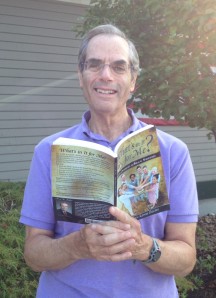
Author Excitedly Holding His First Book

photoThis was an exciting day!

My book is off the presses, and I received the first small shipment today.  I am thrilled beyond words!  I hope and pray that I will be able to get what I believe is the important message of What’s in It for Me? Finding Ourselves in Biblical Narratives to as wide an audience as possible. I wrote this book because I believe in the power of biblical stories–properly interpreted and understood–to transform our lives for the better.

I do not believe the Bible is literal, historical or scientific truth. I believe its truth lies in the lessons the stories can teach us that can make us better people.  I strongly believe in God, but I am convinced Biblical narratives–as I explain in the book–can have meaning for those who do not.

There is a reason more people have read he Bible, translated the Bible and written about the Bible more than any other book. I hope my slender volume will help you understand why and that it will change the way you think about your life and your place in the world.