Rabbi Beth Dina Davidson and I worked together (she was the first female rabbi in the history of Nashville Tennessee) for six years. We shared similar perspectives on almost every important issue, and enjoyed a wonderful partnership.
Our patriarch Jacob was the one subject on which we could never agree.
For me this week’s Torah portion culminates 20 years of change in which Jacob grows from a self centered knave willing to cheat and steal to get what he wants into ישראל (Yis-ra-el) Israel, the one worthy to carry on the Covenant God first made with Abraham.
For Rabbi Davidson, though she acknowledges he did some good things, Jacob never changed. He always remained the selfish manipulator willing to do whatever it took to accomplish his ends.
When Rabbi Davidson invited me to serve as scholar-in-residence in her current congregation, we led Torah study together on Shabbat morning. We decided to consciously model our disagreement about Jacob to an eager group of participants.
We saw the session as an opportunity to show how two individuals who are avid students and lovers of Torah coulddisagree sharply about one of Torah’s most significant figures.
I will always treasure Rabbi Davidson’s comment that, “Your chapter about Jacob in What’s in It for Me? Finding Ourselves in Biblical Narratives makes your case for him as strongly as possible. But I still disagree that his character changed as you contend.”
The word Yis-ra-el means “One who struggles with God.
I know that my book’s chapter on Jacob is much stronger because of the “struggles” Rabbi Davidson and I shared while we worked together. When two people deeply love Torah, our disagreement about Jacob proves for me both the value of “struggle” and the conclusion of our Sages about sincere disagreements: “Both are the words of the living God.” (Babylonian Talmud, Eruvin 13b)
It is hard for me to believe that it has been more than three years since my last visit to Israel.
That is far too long for Israel is constantly in my thoughts.
When I think back to my last visit, this is what comes to mind …
Today, the very upscale Mamilla mall that connects King David Street in Jerusalem to the entrance to the Jaffa Gate of the Old city is one of the most expensive stretches of real estate in the world. When I first came to study in Jerusalem in 1970, though, it was a depressed industrial area with a slum-like look. How Israel has changed!
I wonder if it is still there. I hope so
On my last visit there was at the entrance to the mall is a bronze sculpture of a man playing his violin on a street corner or a promenade. Some of his strings are broken, but he perseveres. His violin case is open before him, and it holds the spare change that passers-by have tossed into it. It is how the man supports himself and his family.
Three years ago the asking price of the sculpture was about $16,000. It is probably more today. That is way beyond my budget, but to me that sculpture is a magnificent symbol of one of Israel’s greatest triumphs.
Israel’s Record on Refugee Absorption
Between 1990 and 2000 Israel absorbed more than one million immigrants from the former Soviet Union. To give perspective on what that means it was a feat akin to the United States absorbing the entire population of France!
As you can imagine, it was not easy . There were logjams in housing, job training, language training and many other necessities of starting a new life in a new country. Doctors in the FSU worked as orderlies; PhD. engineers worked as janitors; and symphony orchestra level musicians stood or sat on street corners and played with their instrument cases open, hoping for a few shekels from those who passed by.
Whenever I visited Israel during those ten years, the sculpture that caught my eye at the entrance to the Mamilla Mall was an all too familiar and all too sad real life scene. I still see their faces, and I still feel the sadness of their sacrifice.
Back home in the FSU they were respected musicians with positions of esteem. But they sacrificed all that as did so many in other walks of life. They sacrificed their present to come home to Israel in order to give their children and grandchildren the future and with that future the freedom and opportunities which the Jewish State would offer.
As we know, Israel triumphed and overcame those hard times! Because Israel successfully absorbed so many highly educated FSU immigrants, her economy has boomed, and it has become one of the leading high tech nations in the world!
Israel, of course, still faces many problems both external and internal, but it has become one of the strongest most economically healthy nations on the planet. So many people from visionary leaders to dedicated factory workers have shaped the Israel of which we are justly proud .
Just as I am proud of Israel’s triumphs, we yearn to see it become an ever more just, caring, compassionate society that offers freedom and equal opportunity to all of its citizens regardless of religion, nationality race or gender. I yearn and hope one day to see a strong Israel and an independent Arab state of Palestine living side by side in harmony and friendship.
For me, the symbol of both that triumph and that hope is the sculpture of an elderly man playing on with broken strings with an open violin case before him.
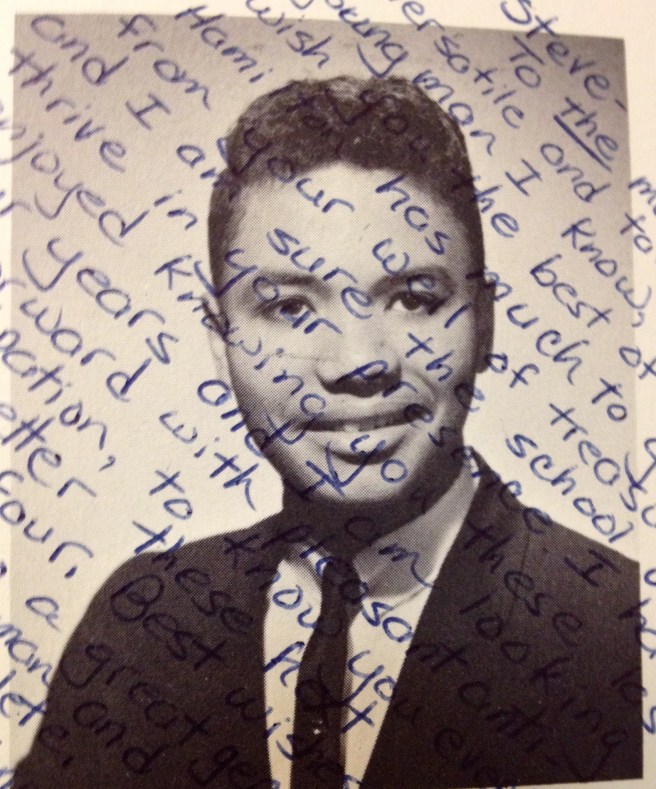
(Photo of Kenyon Field from 1964 East Orange High School Yearbook)
It is hard to believe that it is nearly twelve years since my dear friend Kenyon died
“Field to Star in Our Town” blared the headline from the East OrangeHigh School News. Kenyon Field was the stage manager, the calm all knowing presence that absorbed life’s blows and moved forward with strength and dignity. That is how I first remember Kenyon. That is how I shall always remember him…
“Class, get ready for your time trial.”
I can still see our personal typing teaching Myrla R. Oakley standing before our class, and I can still hear her saying those dreaded words. Kenyon sat in the chair directly in front of me. “Begin,” commanded Mrs. Oakley. Before my struggling fingers typed the first word, I heard the bell and saw the blur of Kenyon’s typewriter carriage as he was already on to the second line and off to the races.
He was on the only African American in our class at Hamilton College.
What courage that took! Yet Kenyon welcomed the challenge. We joined the same fraternity. I am sure he was the first African American to pledge Delta Upsilon at Hamilton. It didn’t faze him. He didn’t think about being a pioneer. He made friends easily. His smile, his warmth, his laughter drew people to him.
We were roommates for almost all of the time he was there. He had crazy sleeping habits–almost never at night—often during the day. He was my friend, my confidante, and through long intimate conversations we shared the laughter and the loneliness that Hamilton foisted upon each of us in different ways.
Then, one day, he felt ill and went to the infirmary. He had a urine test, and the doctor told him he was very sick.
Soon Kenyon left Hamilton, and somehow we lost touch. Years went by.
The next I heard of him he had finished his undergraduate degree at Upsala College in East Orange and was in Medical School studying to be a kidney doctor. He had a new kidney-the precious gift of his loving mother–and wanted to take care of patients who had suffered as he had.
Another blank page … more years elapsed
Then, miraculously we were almost neighbors. He was a physician at Johns Hopkins and I was a rabbi in Maryland. We both had young children. He would come to visit. How great it was to see him!
Those were years when reasonable health allowed Dr. Kenyon Brown Field to accomplish great things, and I marveled at how confident and successful he was and at the respect he had earned.
Then we moved to Tennessee and the n to Connecticut. Years passed again. His sister Beverly to in touch with me to tell me Kenyon was ill. She gave me his phone number
I called. He had suffered a stroke, yet somehow he managed to continue to practice. How in the world he did it, I don’t know, but by then I could never be truly surprised by the indomitable strength and sprit of my friend.
Speech was difficult for him. He searched for words. Could this be Kenyon?
I remember how once in an East Orange High assembly he portrayed a Black preacher with a silver tongue. Words and syllables fell out of his mouth like pearls in a sermon on the story of Noah and the ark. I can still hear his refrain, “’Cause it’s gonna rain.”
There was much rain that fell in Kenyon’s life, but through it all he was the rainbow that lit up the cloudy sky. Now he could speak only with difficulty. And yet his laugh, his laugh was the same.
Only a few weeks ago, I conducted a seminar and preached about the story of Noah at the Geiger College in Berlin. For me Kenyon was like the צהר (Tzo-har), the skylight in the ark that allowed the people to perceive God’s presence.
Can it be nearly twelve years since I spoke at his funeral? His light still shines, and I still pray to be worthy of his friendship.
(Kurzkommentar zum Wochenabschnitt Va-Yetze Genesis 28,10 – 32,3)
Was hat Jakob gedacht in diesen dunklen, kalten Stunden, wenn der „Schlaf von seinen Augen floh“?
Offensichtlich war er ein veränderter Mann, nicht mehr das selbstbezogene und verdorbene Kind, das seinen Bruder zweimal betrogen hat. Als er sein Haus und den Schutz seiner Mutter verließ, erblickt er erstmals den EwigEinen und erkennt: „Sicher ist Gott an diesem Ort, aber ich hab es nicht bemerkt!“ (Genesis 28, 16-17)
Nach den ersten sieben Jahren, die in Liebe zu Rachel im Nu verflogen (Genesis 29,15), war sein Leben mit Laban wie eine Gefängnisstrafe. Aber Jakob lernte die Lektion, die eine Gefängnisstrafe erteilen sollte.
Laban war der perfekte Gefängnisdirektor:
Zuerst trickst Laban Jakob genau so aus, wie Jakob seinen Vater ausgetrickst hatte (Genesis 29, 23-28). Wiederholt nimmt er Jakob weg, genau wie Jakob es von Esau genommen hatte, was Jakob von Recht wegen zusteht (Genesis 31,38ff).
Jakob wusste, dass Esau ihn hasst und geschworen hat, ihn zu töten.
Aber mit jeder neuen kalten, einsamen Wüstennacht wurde sein Wunsch, sein Verhältnis zu seinem Bruder in Ordnung zu bringen, stärker als seine Angst. Trotz Labans Versuchen ihn zu betrügen, wurde er reich an Schafen und Rindern. Darum bereitete er in Gedanken ein Geschenk vor, das er seinem Bruder schicken wollte.
Eines nachts rafft er sich auf. Er geht nach Hause um seinem Bruder zu begegnen. Er vertraut Gottes Versprechen, ihn zu schützen – tatsächlich klammert er sich daran – , aber er weiß, dass er seinen Teil dazu tun muss.
Er spart nicht! Er sendet Herden von Rindern, Schafen und Eseln zu seinem Bruder, mehr als genug um den Wert des Erstgeburtsrecht zu ersetzen, das er gestohlen hatte. Den Segen allerdings wird er behalten. Er bekommt den Namen Israel, mit dem wir uns selbst bis heute rufen.
Nach den 20 Jahren Haftstrafe im Laban-Gefängnis ist Jakob bereit seine Bestimmung zu erfüllen.
Often during my recent ten weeks in Germany I shared in Christian Churches and school classrooms the underlying principle of our religion. It is an ideal of which many Jews are not aware.
So involved do we become in the details of an event– whether it be a Sabbath Eve service, the High Holy Days, a Bar or Bat Mitzvah, food preparations for Chanukah or Passover, or getting the kids dressed for Purim–that we remain unaware of Torah’s revolution in human thought that underlies everything we do as Jews.
In the pagan world, from which Judaism evolved, people thought of gods as super human forces that possessed great power. The purpose of worship was to appease these various deities. Worshippers made their offerings in the hope that the god or goddess would not use its power to hurt them or, conversely, in the hope that the god or goddess would use its power to help the petitioner in some way.
Torah posits an entirely different idea about God. We claim that there is one God, not many and that God is invisible with no shape or bodily form. Most Jews know these things.
What many cannot articulate, though, is that our God has an entirely different agenda than the objects of pagan worship.
In our tradition God’s primary interest is how human beings treat each other.
God’s primary goal is that we create–on the earth that God has entrusted to us —a just, caring and compassionate society.
Almost every religion offers a “Golden Rule” type saying. But our tradition insists that every Jewish act should reinforce that vital principle.
As the Sabbath and festivals of the year, as well as the joyous and sorrowful events of our lives, come and go, we should ask ourselves: How can I best connect this observance with that central ideal for myself, my children and for my grandchildren?
We should strive to make a direct connection between every Jewish event and the idea of God who wants us to use our talents to make a better world.
If we succeed, we can put to rest concerns for the Jewish future.
If we succeed, our people will thrive as “לאור גוים (L’or goi-eem) a light to the nations (Isaiah 42:6)” that will brighten this ever-darkening world.
What was Jacob thinking in those dark cold hours when hours when sleep “fled from his eyes”? (Genesis 31:40)
Clearly he was a changed man from the self centered and venal child who cheated his brother twice. When he left home and the protection of his mother, he beheld the Eternal One for the first time, and realized, “Surely God is in this place, but I had no idea!” (Genesis 28: 16-17)
After the first seven years, which flew by because of his love for Rachel (Genesis 29:15), his time with Laban was like a prison sentence, but Jacob learned the lessons prison is supposed to teach.
Laban was the perfect warden
First he tricked Jacob just the way Jacob tricked his father Genesis 29:23-28). He frequently took from Jacob, just as Jacob took from Esau, what was rightfully his. (Genesis 31:38 ff)
Jacob knew that Esau hated him and vowed to kill him.
But with each succeeding cold, lonely desert night, his desire to make things right with his brother grew even stronger than his fear.
Despite Laban’s attempts to cheat him, Jacob grew wealthy in sheep and cattle. So in his mind he prepared the offering he would send to his brother.
One night, Jacob made up his mind. He is going home to face Esau. He trusts God’s promise of protection—indeed he clings to it—but he knows that he too must do his part.
He does not stint. He sends droves and droves of cattle, sheep and donkeys to his brother, more than enough to make up for the value of the birthright he stole.
The blessing, though, he will keep. He will become Yisrael, the name we call ourselves to this day. After his twenty-year sentence in the Prison of Laban, Jacob is ready to fulfill his destiny.
Dr. Daniel Havemann, The Probst of the Lutheran Church in Segeberg, standing with me in the Marien Cathedral after my sermon on November 15, 2015
The Probst of the Lutheran Churches of Bad Segeberg, Dr. Daniel Havemann, has been incredibly gracious, kind and welcoming to Vickie and me. He invited me to preach the first sermon I delivered in Germany in 2014 in the historic Marien Cathedral in Bad Segeberg. This year he invited me to preach at the end of my visit. It is as though Dr Havemann’s friendship and authority created a protective and comforting bracket around our extended stays in Germany.
Our joy, of course, paled against the anger and sadness caused by the horrific attacks on Paris.
Pundits are telling us to accustom ourselves to this new reality of dozens of people mercilessly murdered by savage forces in the name of religion.
I refuse to do so.
Fittingly the text about which Dr. Havemann requested I preach—long before the Paris event—was the destruction of Sodom and Gomorrah.
No text could have been more fitting.
Our Rabbinic Sages probably could not have imagined the magnitude of the attack on Paris. They had no concept of mass coordinated assaults on innocent civilians in sports stadiums and theaters with sub machine guns and other weapons of mass destruction.
But because the Torah tells us that Sodom and Gomorrah were so wicked that The Eternal One destroyed them, our Sages’ fertile minds gave us graphic pictures of how depraved those societies were.
Three Midrashim
In Sodom visitors had one size bed. If the guest were too tall, they would lop of his legs at the point where he or she would fit. If the person was too short for the bed, they stretched him until he fit. (Babylonian Talmud, Sanhedrin 109B)
Another Midrash tells of one of Lot’s daughters who violated a law of the city against feeding the poor. In Sodom that was a capital crime, and Lot’s daughter cried out to the Eternal One to save her from the punishment of being burned alive for her offense. (Pike d’Rabbi Eliezer 25; Bereshit Rabbah 49:6)
There was also a law in Sodom against welcoming guests into one’s home. Of course, the Torah tells us that Lot violated this law by not only welcoming guests but also protecting them from the assault of an angry mob outside.
Lot’s wife, though, the Midrash teaches, wanted to betray her husband to the authorities of Sodom. She went to neighbors to borrow salt because, she said, her husband wanted to offer a tasty meal to her guests. That is the reason, the Midrash concludes, that Lot’s wife was eventually turned into a pillar of salt. (Bereshit Rabbah, 51:5; 50:4)
Yes, the depravity of Sodom parallels the depravity of those who attacked Paris. Anger and rage are appropriate responses, but despair is not.
Our tradition forbids us to abandon hope that things can be better. It is for that reason that Israel’s national anthem is called, “התקוה, Ha-Tikvah, The Hope.”
Another story (that I first heard from Ambassador David Saperstein when he spoke at the congregation I served, Temple Isaiah in Columbia MD in the late 70’s makes this point:
Once there was a man who travelled to Sodom every day asking the people there to repent their evil ways and to change. The scoffed at him and mocked him. But every day he would return with the same message of repentance.
When he returned home his wife and family chided him, “Why do you go down there day after day? Don’t you know those people will never change and become like you?”
“You may be right,” the man would answer. “Perhaps those people will never change and become like me. But I must go down there—day after day—so that God forbid, I do not become like them.”
And so
Even in the face of wickedness that defies description, we must never abandon hope.
We must continue to dream of and work—each in our own small ways–to bring nearer the day of which the prophets dreamed when:
“They shall not hurt or destroy in all My holy mountain for the earth shall be filled with the knowledge of the Eternal One as the sea bed is covered by water. (Isaiah 11:9)
And all shall sit under their vines and under their fig trees with none to make them afraid.” (Micah 4:4)
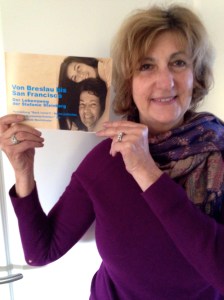
Vickie holding the recently published booklet about her mother’s life and journeys from Breslau in 1921 to Sand Francisco in 2015
When Vickie, Pastor Ursula Sieg and I returned to the Holstenschule in Neumünster on Thursday to revisit the students who studied the exhibit about Vickie’s mother last year, she had a very special gift for them. Each student received a copy, signed by Pastor Sieg, Vickie and me of Von Breslau bis San Francisco. It is the story of the exhibit about Vickie’s mother that they studied in depth last year.
For the students it is a wonderful souvenir of a project they worked on long and hard. These students, taught lovingly and skilfully by Wolfgang Henke, translated Mrs. Steinberg’s biography from English to German. But it is much more.
The beautiful booklet greatly expands the project’s scope.
The five tall panels of the project are beautiful. But they require setting up and taking down. People can only see them in one place at a given time.
The booklet, however, that Pastor Ursula Sieg lovingly and skilfully compiled and produced is portable. It can easily fit into one’s computer case to read while he or she rides on the train. It contains the material of the project in a form that people can review many times. It is also a great advertisement for the exhibition.
Nothing, of course, can match the experience of actually hearing Vickie explain in person the details of her mother’s journey and the personal anecdotes she shares about her mother’s life. The booklet, though, is the next best thing.
And, while Vickie can only be in one place at a given time, the booklet can reach as many people as copies are printed. Pastor Sieg, in her position as Director of Church-School Relations in Northern Germany, is seeing to its publication, printing and distribution. This attractive booklet insures that the lessons of Stefanie Steinberg’s life and travels will reach the hands, eyes and hearts of far more students and adults than the exhibition—wonderful as it is—ever can.
Photo above taken one year ago: Vickie and I (above) are “embedded” in “our” class at the Holstenschule in Neumünster!
After they studied the life and journeys of Vickie’s mother, Stefanie Steinberg, from Breslau, to Barcelona to an orphanage in Switzerland to NYC to LA and ultimately to San Francisco last year, class members sent her voice messages in German saying what the experience meant to them.
They touched my mother-in-law’s heart.
When we first decided to go to Germany, Vickie’s mother was not thrilled, but these messages warmed her heart. In January we had the privilege of presenting her an honorary Abitur (diploma) with a beautiful letter written by the Head of School, thanking Stefanie for contributing so meaningfully to the students’ learning experience. Stefanie’s eyes welled up with tears as she read the letter.
Although she still paints, works on her computer and attends classes and lectures at 94, the Nazis deprived her of the opportunity to complete her high school education. Now she is grateful that the Holstenschule has put a missing piece of her life in its proper place.
We visited this class again this past Thursday.
“Our” students are now ready to graduate HS and move on to the next phase of their lives. It was a joy to see them. They looked more mature than they did a year ago. They were pleased to see us too, and one of them actually invited us to come to their Abitur Ball in July. Although we cannot make it, Vickie and I are so touched that they asked.
As time moves forward I hope these students will always feel gratified that they helped ease a wonderful woman’s pain from the Nazi era. Their enthusiasm for the project also opened the door to the exhibit being on display in eight different schools this year.
In Pirke Avot (Ethics of the Fathers 4:2) Ben Azzai taught: “מצוה גררת מצוה One good deed leads to another.” By embracing the Back Home?! exhibit about the life and journeys of Stefanie Steinberg so enthusiastically, these students set in motion a chain reaction of good deeds.
Not only did they ease the pain of an elderly woman, they enabled many other students to learn a bit about the Shoah in a unique way. Who knows what other doors will open in the future?
Indeed, מצוה גררת מצוה One good deed leads to another!
Wolfgang Henke who adds luster to an already honored profession in Germany: Teacher
In Germany “teacher” (Lehrer) is an honored profession. How refreshing it is to see that!
My wife Vickie taught school for over thirty years. Like too many American educators she was overworked and underpaid. As the years went by the imperative to “teach to the standardized test” robbed her teaching of much of its creativity and joy.
Here in Germany because of the exhibit about Vickie’s mother we have made more than a dozen visits to schools and spoken with more than twenty teachers. Without exception they felt their work was respected, important and appropriately compensated.
The USA could definitely take a lesson from Germany in this regard.
Last year the exhibit stayed in one school, the Holstenschule in Neumünster. For weeks we worked hand in glove with the teacher in charge of the project, Wolfgang Henke. For us Mr. Henke is the epitome of the German teacher. He is modest, soft-spoken, extremely well schooled and supremely competent. He treats the students with respect and caring, and they treat him the same way.
It is easy to see why.
He spent months preparing for the exhibit with Pastorin Ursula Sieg. Together they set us a Jewish Wohnzimmer (Living Room) in a classroom set aside for that purpose in the Holstenschule last year. Students could come there and chat informally with Vickie and me during certain times when we visited.
This year he spent an additional untold number of hours as a volunteer helping coordinate the visits of the exhibit to several other schools in the area. His dedication is inspiring.
Wolfgang Henke presenting me with an official “Tennis Halle Neumünster Tee shirt after we hit a few weeks ago.
Mr. Henke is also an excellent tennis player, and he graciously invited me to hit with him on an off day at the Tennis Halle in Neumünster.
After five summers as a tennis instructor in a private club in New Jersey and at the famous Concord Hotel in the Catskill mountains, I believe I can tell more about a person’s personality by watching him or her for fifteen minutes on the tennis court than I can if I were to interview the individual for half an hour. My observations have nothing to do with how well a person plays but everything to do with his or her demeanor on the court.
In the case of Mr. Henke, all of the qualities I had already observed (and noted above) while working with him were evident when we played. It was a most enjoyable hour that confirmed for me that Wolfgang Henke certainly deserves one of Germany’s most honorable titles: Teacher!


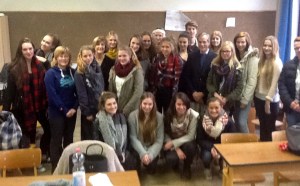
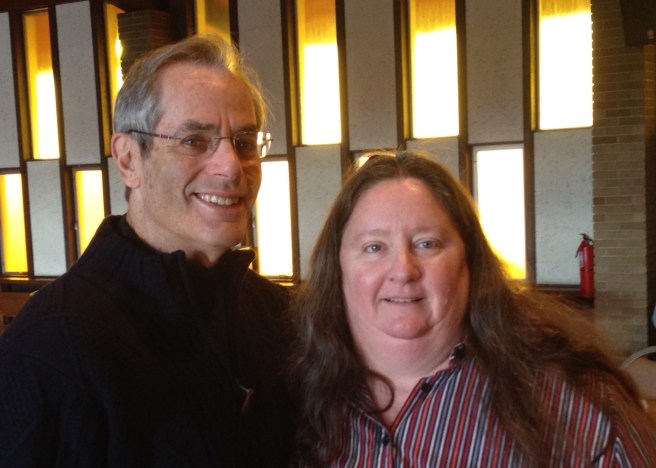 Rabbi Beth Davidson and I
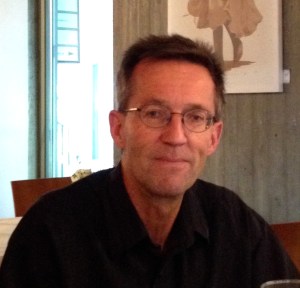
 (Photo of Kenyon Field from 1964 East Orange High School Yearbook)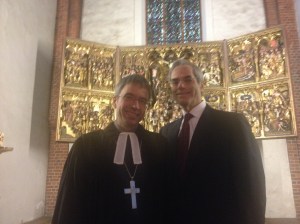

 Finding Ourselves In The Bible