Joseph Reveals Himself

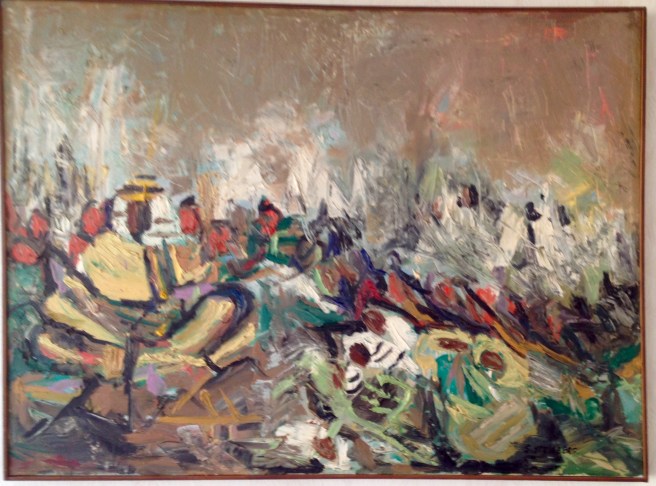
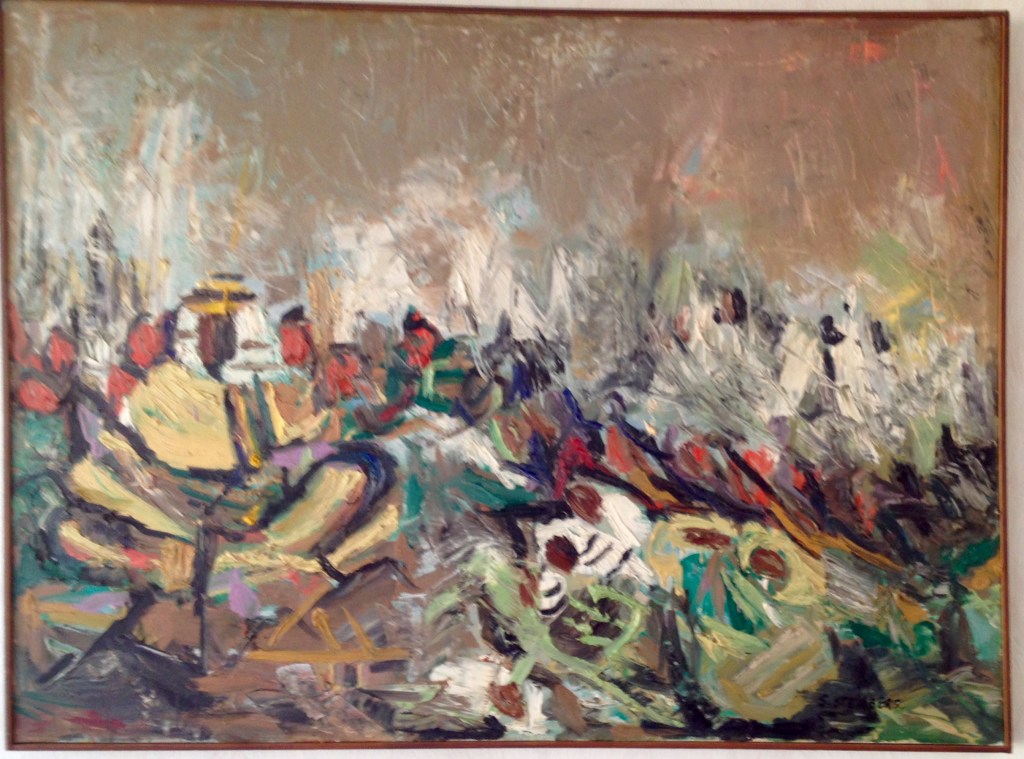
The magnificent oil pointing above of Joseph’s brothers bowing before him is the work of my (no 101-year-old mother-in-law, Stefanie Steinberg.

The entire story of Joseph builds toward the moment when Joseph reveals himself to his brothers in Parashat Va-yigash.

We wonder though, why does Joseph treat his brothers so harshly? Why does he accuse them of being spies? Why does he demand Benjamin’s presence in Egypt, and why does he instruct his steward to put his goblet into Benjamin’s bag?

Many commentators suggest that Joseph’s motive was revenge. The brothers mistreated Joseph and sold him as a slave, and so now Joseph is paying them back.

Even W. Gunther Plaut in his masterful Torah commentary suggests revenge as one of Joseph’s motives. Plaut writes that at first and understandably, Joseph thought of revenge. He still wants revenge more than he wants love. (The Torah, A Modern Commentary, p. 284)

If, however, revenge had been Joseph’s goal, he could have exacted it without disguise, without delay, and without bringing the untold anguish upon his father that Benjamin’s journey to Egypt caused. Joseph acted as he did for only one reason: He wanted to see if his brothers had changed.

Years before, Joseph had been their father’s favorite. As a result, Joseph’s brothers hated him and sold him away into slavery. With Joseph gone, Benjamin became Jacob’s favorite. By putting his cup into Benjamin’s sack, Joseph places Benjamin in a position whereby he would be detained in Egypt as a slave and Jacob would once again suffer the loss of his favorite son.

Judah knows what is at stake. In one of literature’s most stirring speeches (Genesis 44:18-34), he offers himself as a substitute for Benjamin. That is all Joseph-who has already had to leave the room twice in his meetings with his brothers to avoid breaking down and weeping in their presence-needs to hear to end the charade.

Our tradition calls a person who repents for his or her sins a ba’al or ba’alat teshuvah (literally, a “master of repentance”). The Jewish tradition accords even a greater honor to a person who commits a particular transgression but later, when he or she is put in a similar position, turns away from the same kind of wrongdoing. That person is a ba’al teshuvah shelemah (a “master of complete repentance”). This is the lofty designation Judah earns for his actions in Joseph’s presence. [See Nehama Leibowitz, Studies in Sefer Bereshit, pp. 327-328 (Hebrew edition), pp. 460-461 (English edition)].

In Parashat Va-yigash, Judah becomes a true hero. The story discusses his emergence as the progenitor of Israel’s most enduring tribe. We can be proud that the words “Jew” and “Judaism” are derived from his name. More important, Judah’s example of repentance can inspire us to examine our own actions and help us to turn away from transgressions we have committed in the past.

I am deeply grateful for my studies with Professor Leibowitz in Jerusalem during the 1970-1971 academic year, which helped me develop the outlook I have shared in this commentary.
We Never Know

The Platers sing, “You’ll Never Know.”

One of the Platters lesser-known songs, but one of my favorites is: “You’ll Never Know.” What makes this song special to me is the richly melodic repetition of the title by the group’s late bass man Herb Reed.

The song speaks to me because in life we sometimes never know the impact for good or for ill our words and actions have on others.

As a Rabbi, I have spoken in front of many people over the last half century. Sometimes, I confess, I wonder what if any impact my words have. I am sure many of you occasionally ask, as I do, “What’ the point?”  What’s the point of all the time, the blood sweat and tears we put into our work?

It doesn’t matter what line of work you pursue. At times it all seems meaningless, and we harbor thoughts akin to those that begin and permeate the Book of Ecclesiastes:  Vanity of vanities …Vanity of vanities everything is vanity. Of what useful purpose is all the work that we do under the sun.” (Ecclesiastes 1:1)

My thinking on this question has been enriched by an observation our son Leo recently shared with me. After a successful career as an Educator and Principal of an inner-city elementary school that he founded, Leo made the decision to undertake the arduous five-year course of full-time study at Hebrew Union College in Los Angeles to become a Rabbi. It was not an easy decision, and only the love and support of his wife, Liz, and his two sons made it possible. 

Leo and I frequently debate the merits of Abraham, and often we must agree to disagree. But this year Leo shared an insight from the writings of the late Chief Rabbi of the United Kingdom, Lord Jonathan Sacks, that sheds new light for me on the “Vanity of vanities…” question.

Abraham is renowned for his faith in God. But what makes his faith so special is that he had faith even when the outcome of his journey was far from certain.

Specifically, when God instructed Abraham to offer his son Isaac as a sacrifice, he was uncertain of what the outcome would be. And yet he found the courage to go on. In so doing he in partnership with the Eternal One taught the world of the horror of human sacrifice (a lesson, as I have written elsewhere, we still struggle to learn).

Viewing Abraham’ and Isaac’s journey to Mount Moriah this way, comforts me on my journey through life, and I hope it will comfort you.

We “never know” what the outcome of our efforts will ultimately be. But if, despite that uncertainty, we walk the path we believe God wants us to pursue, we have the best chance to fill our lives with purpose and meaning.

The Chanukah Lamp is Full…

TheChanukah lamp is full

The Chanukah lamp will be full tonight as much of the world enjoys their Christmas dinner.

The eighth night of Chanukah has always been special to me. The full Chanukiah gives off its maximum glow and has always conveyed to me a sense of completion. The fully lit chanukiah speaks to me of dreams fulfilled and not the aspiration of the previous days with their latent message, “There’s more.”

And yet the Chanukah candles burn quickly to remind us that the moments of fulfilled visions and dreams are fleeting indeed.

So, it is with life.  We strive and occasionally, if we are fortunate, we achieve a milestone.  It doesn’t matter which milestone It could be a victory in a game or even a championship.  Maybe it is an aced test or an academic degree. Perhaps it is a new job or a big promotion.  It might even be achieving the most important goal to which we can aspire: winning the person of your dreams as a life partner.

It doesn’t matter if it is a big dream or a small one. The feeling of triumph and completion never lasts. Soon we look for a new challenge. No matter what we achieve we continually ask, as Peggy Lee does in her signature song, “Is that all there is?”

Rabbi Simeon ben Zoma asked two thousand years ago: “Who is rich?” And he answered, “Those who are content with what they have.”

Maybe it is human nature that contentment is an ephemeral feeling. 

But as I savor the beauty of the full Chanukah lamp and envision many others at their Christmas dinners, I can’t help but think: Wouldn’t it be nice if people of whatever religion spent more time celebrating and appreciating one another? Wouldn’t it be great if we could savor our joys a bit longer before turning the page and looking for our next challenge?

From Darkness to Light

Joseph with his brothers bowing before him (oil painting by Stefanie Steinberg)

Our Sages firmly believed that it was more than a coincidence that the Torah portion in which Joseph interprets Pharaoh’s dreams is the portion read in synagogues around the world on the Shabbat that falls during Chanukah.

The most common explanation connects the lights of Chanukah which illumine the winter darkness to the emergence of Joseph from the darkness of prison to the light of freedom and the status he achieves as second in command to Pharaoh in Egypt.

For me there is another more personally meaningful explanation. In this portion Joseph emerges from the darkness of his own self-centeredness to the light of humility he has learned during his two years in prison.

At the beginning of the story Joseph flaunts his dreams and their interpretations in the face of his older brothers. Even though he is their father’s favorite son, and even though he and he alone receives the famous, “coat of many colors,” he makes matters worse by tattling to his father about whatever he observes the brothers are doing wrong.  To rub salt in an already chafing relationship he flaunts his grandiose dreams of superiority and dominion in his brothers’ and his father’s faces.

But after two years in prison, he emerges with the light of a different perspective.  When Pharaoh references Joseph’s skill as a dream interpreter, he responds with hard-learned humility: “Not I but God will see to Pharaoh’s welfare.”

This understanding of the connection between Chanukah and this part of the Joseph story makes Chanukah not just a historical remembrance or a time to show pride in our Jewish heritage.  Rather the Festival of Lights becomes a catalyst for our personal journeys from the darkness of self-absorption to the light of selflessness.  

The word. “Chanukah,” means, “Dedication.” The festival becomes so much more meaningful when it inspires us to “dedicate” our efforts less t our own self-interest and more  to the well-being of those around us and the world at large.

Ten Years Later


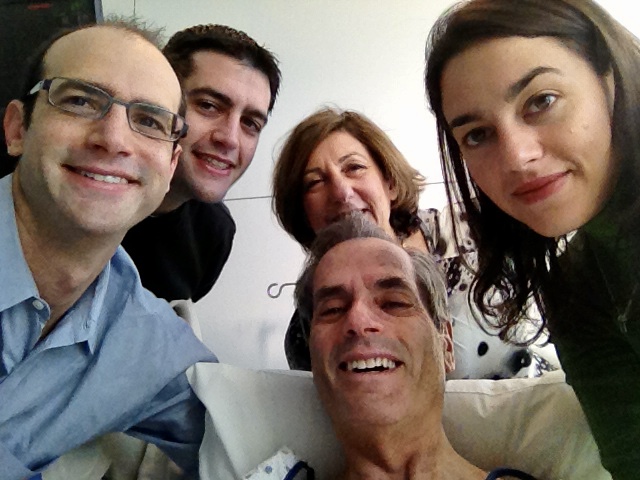
First meeting with Vickie and our children, Leo, Sarah and Ben after my second open heart surgery

As we celebrate Chanukah in the Hebrew year 5783, I find myself looking back ten years to November 29, 2012. After a seemingly endless barrage of examinations and tests, hospital staff pushed a gurney with me on it to an operating room at the Cleveland Clinic for my second open heart surgery.

There, Dr. Lars Svensson and his medical team sawed through my chest bone, replaced an inadequately working mechanical aortic valve and sheathed a potentially fatal ascending aortic aneurysm.

I woke up the next day in the Cardiac ICU with a pump morphine drip dispenser and barely enough strength to push the button.

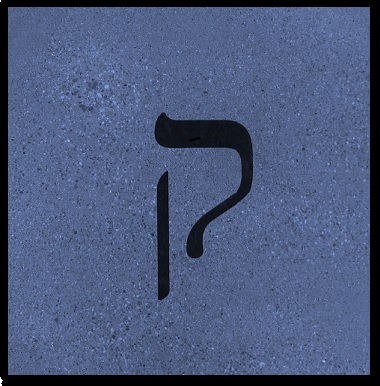
Physically frail and emotionally exhausted after my term as President of the World Union for progressive Judaism had ended only a few weeks earlier, I nevertheless felt strength and connection with the also once fragile State of Israel.  It was on that date, 65 years earlier, that the UN voted for the partition plan that led to the creation of Israel as a Jewish state.  I had often walked on “November 29th Street”, (“Kaf Tet b’November” in Hebrew) in Jerusalem when I studied there. Israel has become strong since that time, and I had faith that I would as well. 

As I began to recover from my heart surgery, and wondered what adventures lay before me, I decided to finally finish the book I had begun to write but never finished, 40 years earlier.  I’ve been writing since and have now published six more!

One of our first post-surgery adventures was being asked to serve as rabbi to congregation Beth Shalom Milano, in Italy from the high holidays through Chanukah, and to help with the Reform Congregation Shir Hadash in Florence, Italy on those Shabbats when Milan could spare me! What warm, welcoming communities they were and are! The President of the congregation there had heard me speak as President of the WUPJ in Amsterdam about the importance of progressive Judaism in Europe, and when I called to inquire about the position, he enthusiastically told me, “I heard you speak in Amsterdam. You’re hired!”

While in Italy, we had a visit from Pastorin Ursula Sieg, whom I had met briefly in West Hartford while she was on sabbatical and studying at the Hartford Seminary. She was determined to bring Vickie and me to northern Germany so that Vickie and I could teach about the Holocaust to German high school students, and so that I could preach in various Lutheran churches and teach at seminars for Lutheran ministers.  We were fortunate to be able to do this work for 6-10 weeks for 5 years, until Covid stopped our visits.  

Another visitor with whom we met in Milan was Rabbi Dr. Walter Homolka who had heard that same speech in Amsterdam, and he subsequently invited me to give the opening lecture at the University of Potsdam’s School of Jewish Theology in 2014, as well as to teach a seminar that year at the Abraham Geiger Rabbinical College in Berlin and each year after that, again until the pandemic set in.  

Our present adventure is also a positive result of my time as President of the WUPJ.  I was sitting in the “sunroom” of our home in Connecticut looking at two feet of snow in February of 2017 when I received a call from the wonderful Rabbi Guershon Kwasniewski in Porto Alegre, Brazil whom we had visited during my tenure with the WUPJ.

He wished to join the CCAR, the Reform Rabbis’ Union in North America, and asked me to write a recommendation for him. He impressed me greatly when we visited his community, so I was happy to recommend him. 

“Where do I send the letter,” I asked?

“To the Placement Director.”

So, for the first time in several years, I rooted around the Placement List looking for the Director’s email address.  Then I saw a position open that said, “Sanibel, seasonal.” It seemed to have blinking lights.

I read the description of a warm, friendly almost exclusively senior congregation, whose duties were light and seemed perfect for a retiree.

I pondered Sanibel’s warm climate as I looked at the two feet of snow piled up outside my window, and I called, “Vickie…. look at this.”

We looked at each other after she read it and decided I would apply to Sanibel. We have so enjoyed living there these past five years and serving as Rabbi of Bat Yam Temple of the islands.

As our sixth year here began, Hurricane Ian devastated our home and the church where we share worship space. We are proud of the way our congregation has responded to adversity, and we look forward to returning – though it won’t be soon – to our island home and to our synagogue’s home. 

In the meantime, we have had many services on zoom, and thrillingly have begun to hold in person services, also broadcast on zoom, because the Jewish Federation of Lee and Charlotte County graciously offered us their Community Room in Fort Myers as a worship space until our synagogue home, is repaired. 

In all, it has been an enjoyable and fulfilling ten years since doctors ably repaired my damaged heart, and I am forever grateful that modern medicine has enabled me to be so fortunate and to continue to work in small ways to help repair our broken world.  

Ten years later Israel is still strong, I am strong, and with God’s help we shall soon return to live and worship on our island paradise again.

This Year’s Chanukah Miracle

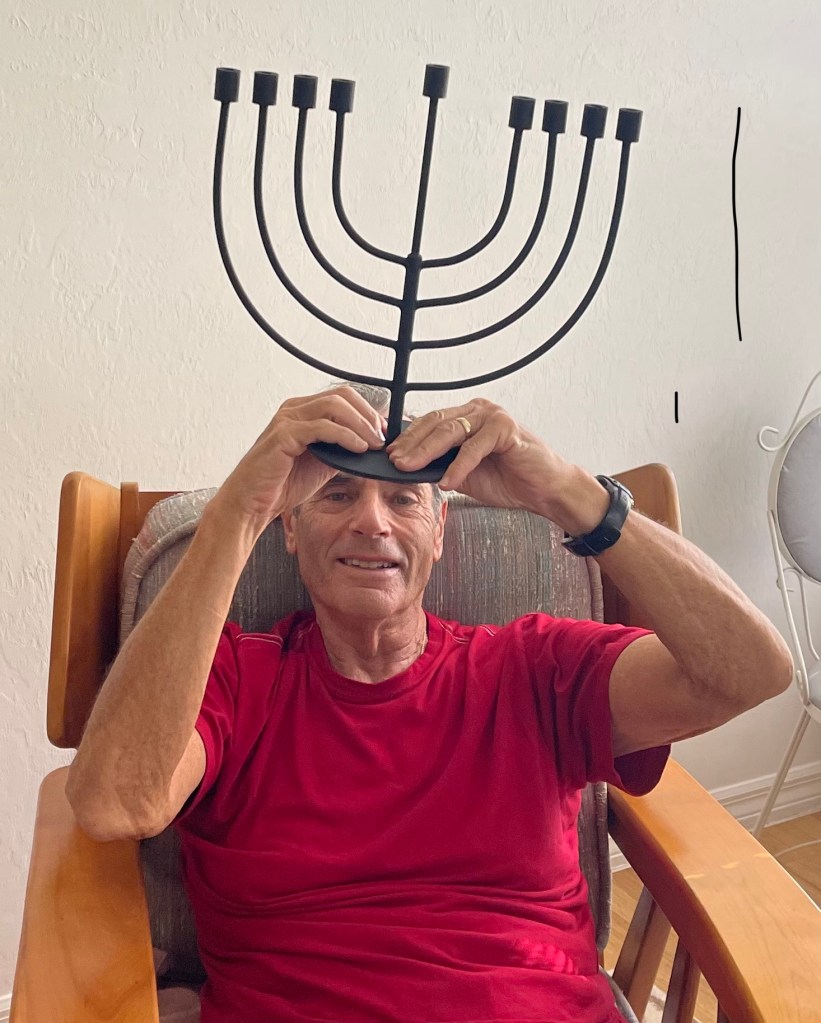
Our new Chanukah Lamp!

Chanukah is a holiday about miracles.  No, not the familiar “miracle” of the cute story of a little cruse of oil that burned for eight days. Rather it is the miracle of how a small group of Jews somehow resisted the strong forces of assimilation and kept our Jewish faith alive.

This year our family experienced a new miracle.

In the hurry to evacuate our Sanibel home before Hurricane Ian all but demolished it, and in our sure belief that after a couple of days we would return to our undamaged home, we did not rescue the eight or so different Chanukiot (Chanukah lamps) that we have acquired over the years from all over the world.  Not only did we not rescue them; we did not even think about them…until yesterday.  It was then that we realized that the festival will begin the next evening, and we had no candles and no Chanukiah in which to light them.

I scoured neighborhood stores in the non-Jewish area where our temporary home is and finally found a box of Chanukah candles. But there was no Chanukiah in any of the places I looked.

Sarah to the rescue!

When Vickie told our daughter Sarah of our plight she responded simply, “I just ordered one for you.”

“That’s so nice,” I thought, “but it will probably get here about the time the eight-day festival ends.”

A knock on the door, and a delivery from Bed Bath and Beyond (of all places) this afternoon brought a lovely new Chanukiah into our home. We lament the precious and emotionally priceless Chanukiot the storm swept away, but tonight when the festival arrives, a new family tradition with a new Chanukiah will begin.

Wishing all of you a joyful holiday season!

This Night

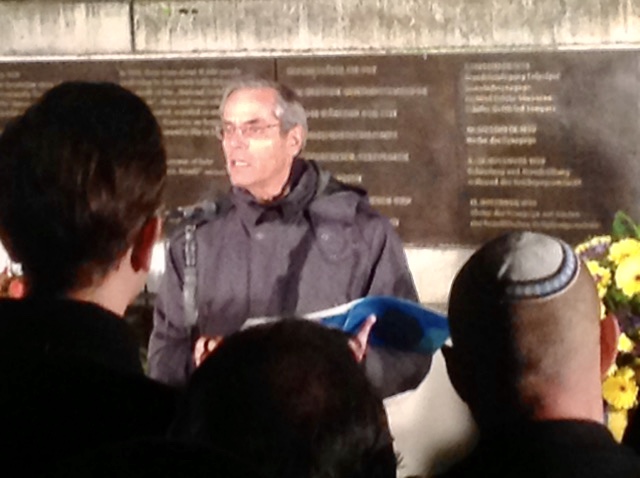
Speaking in Leipzig, Kristallnacht 2014

On this night in 1938 my father, Leo Fuchs was one of 500 Jewish men in Leipzig rounded up by the Gestapo in his native Leipzig and marched to the city Zoo.

There they were forced to stand in the stream that runs through the park, and citizens were directed to gather round and curse, jeer and throw mud at the “vermin Jews” who stood helplessly in the water. Then the Nazis took my dad to Dachau where they shaved his head and abused him.

84 years later this event continues to shape my life.

Fortunately, my father was one of the very lucky ones. An older brother and an uncle in New York gained his release through diplomatic channels, and he set sail for New York on December 10,1938.

I had never heard of Kristallnacht, let alone that my father was arrested on that horrific night, until I was a rabbinical student at the Hebrew Union College in Los Angeles.  In the spring of my first year, my father fell gravely ill. I flew home to New Jersey where my brother-in-law Jack drove me straight to the hospital where, for the first time in my life, my father did not recognize me.

In a state of delirium, he was shouting in German, which he never spoke at home as my mother was an American. I asked my uncle, the same one that had saved him, what he was saying, and he replied, “He is asking the guards to stop beating him.”

I like to think I was an alert and precocious kid. I loved my father dearly and felt very close to him. So, I keep asking myself.  How could I not know? It is a question that to this day I cannot answer.

My penance, as it were, for my ignorance, has impelled me to speak about Kristallnacht in churches, synagogues and schools in the United States, in German high schools and more than two dozen German churches, including the famous Thomaskirche in Leipzig, and at many of the 65 plus communities around the world I was privileged to visit during my tenure as President of the World Union for Progressive Judaism.

In every one of these venues, the people treated me with graciousness and respect that warmed my heart. In return I have tried to offer a message of hope especially in places where many of those sitting before me had relatives once connected to the Nazi regime: We cannot undo the past, but we can learn from it to create a better future for our children, our grandchildren and generations to come.

Do It Today!

The esteemed second- century Sage, Rabbi Eliezer taught, “Repent one day before your death!” (Pirke Avot 2:15)

When he heard this teaching, one of his disciples asked: “But how do I know when I shall die?”  

“That’s just the point,” the Sage responded.  “You do not.  So, you had better repent today before it is too late.”

To repent is to ponder the times we have failed to live up to our best selves and then to atone as best we can for the times we said or did the wrong thing and for the times we failed to say or do the right thing.

Rabbi Jack Riemer recalls a particularly sad funeral. The grieving widower remained standing next to his dead wife’s grave for a long time after the service ended. After he watched him patiently for some time, the Rabbi put his arm around the man’s shoulder and gently said to him, “It has been a long and stressful day, Jacob. I think it is time for you to go home and get some rest.”

  “I loved my wife,” the man responded.

“Yes,” the Rabbi answered, “I know you loved her. She was a fine woman, but you have been here for some time now.  Don’t you think it’s time to leave?”

“You don’t understand, Rabbi, the man insisted.  ‘I really loved my wife, and once …I almost told her.”

Once I ALMOST told her! 

How many times have we failed to say the things we needed to say? Or how many times have we said or done things we shouldn’t?

Rabbi Eliezer tried to teach us that God does not guarantee us tomorrow. Life can end for any of us in an instant.  

So, if you have someone to love, or someone you can help, or someone with whom you have quarreled and with whom you hope to reconcile, better do it today. Tomorrow may be too late.

Jerome Hantman, MD

There was an aura of dignity about Jerry Hantman. When he walked down the corridor of Howard County General with his white coat flowing behind him, I thought of him as “St. Jerome of the Patuxent.”

When as a neophyte rabbi I sat on the Ethics Committee of the hospital, I would occasionally pick the brain of the Chief of Cardiology about an issue that had come up. Many years later when the issue on the table was my second and quite complex open-heart surgery, I called him from the Cleveland Clinic to map out the proposed course of action the doctors there proposed for me. Only after Jerry told me, “The plan seems prudent,” did I feel confident going ahead with the procedure I underwent.

Jerry and I bonded over our mutual love for tennis.  We played often, and, when we would compete, my strategy was to avoid at all costs the hammer-like left-handed forehand around which he built his game. 

When Jerry decided to build his beloved court at his home, he shared with me all the details about the construction process. When it was finished, we played there so often that Danny Singer and I dubbed it “The Hantman Training Center.” There, we practiced more than we would compete, and in those sessions, I wanted him to blister that forehand over and over to my backhand which became a lot stronger as a result.

After we played, we often spent almost an equal amount of time talking about the game, about how much we each learned from it about life, about Bud Collins, his tennis coach at Brandeis before he became a famous commentator, and countless other topics.

There was one phone call from Jerry I can never forget. In 1985 at age 39 I somehow managed to reach the semifinals of the Annual Columbia Labor Day Tournament. I was going to give it my all, but logically the odds were very long that I would defeat my younger, stronger and faster opponent. So, I was more than surprised when Jerry called to tell me, “You’re going to be in the finals.”

“Do you really think I can beat that guy,” I asked?

“You won’t have to,” Jerry answered. “I examined him today, and there is no way I can allow him to play a competitive tennis match.”

Jerry was also a regular at services. He sat in the congregation, seemingly without blinking, listening to and processing every word I would say. I can still see his beatific half-smile in the congregation before me. Afterwards, often at the side of his court, he would ask probing questions that led to productive and, for me, enlightening conversations, often about God.

I confess I am angry at God for allowing Jerry to endure the horrible illness that marked his final years. When I think about it, I remind myself that God is ultimately a mystery. We answer to God, and God has no obligation to answer to us.

But if I was angry at God for Jerry’s affliction, I was and will always be grateful to God for sending Jerry Irene, who knowingly, willingly, lovingly and with inspiring dedication, shared the journey with him through the very difficult last chapter of Jerry’s life. 

In one of our last meetings, when he could still drive, Jerry took me out to the long-shuttered and by then forlorn looking tennis court where we had spent so many happy hours. There we sat and talked once again about the experiences we shared. Toward the end of our conversation, Jerry said wistfully, “Gosh I miss those days!”

So do I, Jerry! So do I!

Jerry Hantman: physician, confidante, coach and friend 

זכר צדיק לברכה

Your righteous memory will always endure!

The Sad but Vital Contemporary Lesson of Nadav and Abihu

“And Nadav and Abihu, the sons of Aaron, … offered strange fire before the Eternal one, which God had not commanded them. And there came forth fire from before the Eternal One and devoured them, and they died before God. (Leviticus 10:1-2)

We wring our hands over the sad fate of Nadav and Abihu.

Our hearts break for Aaron, their father.

Rabbis and Commentators of all religious stripes turn themselves into pretzels trying to interpret this sad story. It is easy to get caught up in their esoteric explanations of how they crossed the line in their striving for holiness so that they left their mundane bodies behind, and they died.

But what do we have to say to the kid or adult reading this story and asking, “Does it have a message for me?

Indeed it does.

The account of their death is followed by this strong command: “Drink no wine nor strong drink, you or your children with you when you go into the Tent of Meeting, so that you do not die.” (Leviticus 10:9)

An automobile is similar to the Tent of Meeting where Nadav and Abihu died suddenly because a motor vehicle is a place where one wrong move on your part or on the part of another can end your life in an instant.

Sometimes things happen on the road that we cannot control. For instance, a foolish decision by another driver can take your life. That is a risk we take every time we get behind the wheel. It is a calculated risk whose odds we choose to accept.

But there is another risk that we should never choose to accept. Driving while under the influence of alcohol or drugs.

Some commentaries, noting the proximity of the death of Aaron and Elisheva’s sons with the warning not to drink in the holy precinct assume that Nadav and Abihu were drinking and that caused their fatal accident. If we allow this possibility, and I think we should, then the passage, far from being a comment on God’s capricious cruelty, as some would have it, is a vital warning to all of us.

Don’t drink and drive!

Sometimes in our search for clever interpretations of biblical texts, we overlook a lesson staring us right in the face. The sad story of Nadav and Abihu offers us such a lesson. We fail to heed it at our own peril.