“So, who created God?”

Back to the Beginning

Each year as we begin to read the Torah again with the immortal words, “In the Beginning,” I think of my very first rabbinical assignment.

As a first year student at the Hebrew Union College-Jewish Institute of Religion, Los Angeles campus, I conducted Friday night worship at the Flora Terrace Convalescent Home on Pico Boulevard. I led Shabbat Eve worship and then visited patients in their rooms. I earned $10.00 for each visit.

One Friday night, not long after I began there, the attendant greeted me with, “Rabbi, you have a new congregant. Rabbi Rosenfeld, an 85-year-old Orthodox rabbi is with us, and he will attend your service.”

“What?!” I thought to myself. “An Orthodox rabbi is coming to my service! Many Orthodox rabbis hold Reform Judaism in disdain. What will he think? How will he react?”

These thoughts played on my mind during the service. Rabbi Rosenfeld sat there, alert but impassive. There was a large black Kipah on his head and the Union Prayer Book from which we prayed sat tightly shut in his hands the whole time.

After the service I made my rounds and approached his room with trepidation.

He was most gracious and told me a story.

“I am 85-years old,” he said, “and I have been studying Torah my whole life. And yet I still feel like I am at the beginning of my studies.”

“How is that?” I asked.

“When I was six-years old, my teacher handed me a Chumash (text of the five books of the Torah in book form) and said, ‘Read!’

So I read (in Hebrew) the first words of the Torah, ‘In the beginning God created the heavens and the earth.’

Then, I looked up and ask, ‘If in the beginning God created the heavens and the earth, then who created God?’

And WHAM! I got such a slap across the face that I still feel it, so I always feel I am at the beginning of my studies.”

In studying the first portion of the Torah, “Who created God?” is as appropriate a question as, “What was the (unnamed, and no where does it say ‘apple’) fruit that led to Adam and Eve’s expulsion from Eden?”

In traditional Jewish life, one who has strayed from religious observance but returns to the fold is considered one who, “hozer b’tshuvah, one who returns in repentance.” Literally translated the phrase means, “one who returns with answers.”

The late Rabbi Harold Schulweis taught he felt greater admiration for one “sheh hozer b’she’elah, one who returns with questions.”

Questions are the lifeblood of learning.

In the study of Torah, no questions should be out of bounds, so,“Who created God?”

I pray I never stop asking the question.


Chatting With Jesus in the Sukkah

I am very happy to repost this essay which appears on ReformJudaism.org on my web blog.  SLF

Outside view of a sukkah

During the Festival of Sukkot it is customary to invite famous people from the past to be our ushpizin(“guests” in Aramaic) in the sukkah, the temporary huts we build to celebrate the harvest festival.

This year, I would like to invite Jesus to be my guest in the sukkah – to chat about this verse from Genesis: “So God created the human beings in the Divine image, creating them in the image of God” (Genesis 1:27).

To begin the conversation, I would point to one of the most beautiful verses in Scripture from Psalm 8:6: “For you have made humanity little lower than the angels…” As much as I love the English translation, I think the German translation – “Du hast ihn wenig niedriger gemacht als Gott, mit Ehre und Herrlichkeit hast du ihn gekrönt.” – is closer to the original because it speaks of humanity as just a little less than God.

For our Rabbis, the idea that humans are a little less than God or a little lower than the angels was a commentary on the notion that God created humanity in God’s image. It does not mean that we look like God in a physical sense because, of course, God has no form or shape. Rather, it means we have awesome power that God wants us to use responsibly.

For example, we are the only creatures that can go to the side of a mountain, mine ore from the mountain, turn the ore into iron, the iron into steel, and from that steel forge the most delicate of instruments with which to operate on a human heart or brain. Likewise, we can fashion that same steel into bombs and bullets designed solely to maim and kill other humans.

With that idea in mind, I would pose this question to Jesus: In your famous Sermon on the Mount, you offer thoughts about how beings created in God’s image should act. Unfortunately, it appears some of your instructions have been misunderstood and misinterpreted over time, causing great harm to Jewish-Christian relations.

Then, I’d offer this discourse.

As the Gospel of Matthew recorded your words, you said, “You have heard, ‘an eye for an eye a tooth for a tooth.’” Of course, those words are found in Torah, but surely you know that there is not a single instance in the Hebrew Bible of mutilation being imposed as a punishment for a crime. Surely you know, too, that rabbis who were your contemporaries interpreted these verses to mean that fitting financial compensation should be set for criminals to pay victims.

You also said: “You have heard, ‘love your neighbor and hate your enemy.’” Had I been there to hear you speak, I would have liked to ask, “Where did people hear that expression? Surely not in our Torah.”

In fact, in Exodus 23:4-5, we read “When you encounter your enemy’s ox or ass wandering, you must take it back. When you see the ass of your enemy lying under its burden and would refrain from raising it, you must nevertheless help raise it.” With all due respect, Jesus, that certainly doesn’t sound like “hate your enemy” to me.

A wonderful story illustrates the Jewish perspective on this idea, and it’s an outlook I’m sure you share.

One year on the eve of Yom Kippur, the holiest night of the year, the synagogue was packed with worshippers waiting for the service to begin. To everyone’s surprise, the rabbi was not yet there. “Where can he be?” people wondered.

The synagogue leaders sent people to look for him, and finally someone found him, leading a frightened calf back into its stall.

“What are you doing?” the leader asked. “Everyone is waiting for you in the synagogue!”

“I know,” the rabbi answered, “but when I saw the lost animal, I had to bring it back to its owner.”

“But that man doesn’t even like you,” the lay leader said. “He has always been your enemy.”

“That is true,” the rabbi replied, “but our Torah teaches that we must be kind to our enemies.”

Another version of the story has a different ending. In this one, the leaders find the rabbi in a nearby house, rocking a baby in his arms. When asked why, the rabbi answered, “The child was crying. Comforting a crying child must take precedence over even the most important worship of the year.”

Jesus, I know we can agree that if we want to live up to our mandate as beings created in the Divine image, we must love our neighbors – including our enemies – as ourselves. Doing so means we extend a helping hand even to those who hate us and we dry the tears of crying children, including those who are homeless, hungry, or live in fear of violence – in our community, in our nation, and in this world that God has entrusted to our care.

Chag Sukkot sameach! (Happy Sukkot!) I’m glad you could come visit in my sukkah.

Contrasting Commandments

Each year the stark contrast between the inward focus of Yom Kippur and the outward thrust of Sukkot speaks to my soul in a louder voice.

Yom Kippur is all about quiet and contemplation. Sukkot is about building and action.

Yom Kippur asks us to look at ourselves. Sukkot asks us to look at the world.

Tradition teaches that after we rise from our Yom Kippur introspection and eat a bit, we should go outside and hammer the first nail in our sukkah.

The sukkah represents the frail huts where our ancestors lived on their 40-year journey from Egypt to the Promised Land. They also symbolize the temporary huts that farm workers lived in while bringing in the harvest from the fields.

For us who are neither nomads nor farmers the sukkah takes on different meanings.

Sitting in a sukkah, we are at the mercy of the sun’s heat, the wind’s chill and the rain’s wetness. These are temporary conditions for us, and we can retreat to our homes if we become uncomfortable. But so many in the world live without means to escape these elements.

Our tradition demands that we help them.

Sukkot celebrates the harvest.

  • But our celebration is vain unless it sharpens our concern for those who have no harvest. In the United States one in six people faces hunger.
  • Our celebration is an abomination if we ignore the wretched conditions and wages of those who bring food from fields and factories to our tables.

Our Torah teaches we must leave the corners of our field for the poor and needy (Leviticus 19:9-10). We also learn: God commands us to “open our hands wide for… your poor and your needy in your land.” (Deuteronomy 15:11)

The text does not say the poor and the needy but YOUR poor and YOUR needy. The poor and needy are OUR problem and OUR responsibility.

 Each of us has different talents and different capabilities. None of us can do everything but each of us can do something.

Contrasting Commandments

          Yom Kippur commands us to contemplate how we can make the world better.

          Sukkot commands us to do it.


Elijah’s Role on Yom Kippur

Many are aware that that the Prophet Elijah is the symbol of our hope that we can make the world a better place! That is why we invite Elijah to join us at our Passover Seders and at the close of each Shabbat during Havdalah, our ceremony of separation from our weekly day of spiritual refreshment.
Fewer people, though, are familiar with the direct reference to the hope Elijah represents for all humanity at the close of Yom Kippur. I hope this brief essay helps to make that connection.
To all who observe this most sacred day of the Jewish year I wish a most meaningful period of introspection and to those who are able an easy fast.

slfuchs's avatarFinding Ourselves In The Bible

It is for good reason that Jews close Yom Kippur — just before the blowing of the shofar with the triumphant cry from the wonderful passage (First Kings,chapter 19) in which Elijah vanquishes the prophets of Ba’al on Mt. Carmel:  “Adonai Hoo Ha Elohim!  The Eternal One (alone) is God!”  We chant it seven times before we hear the shofar (the ONLY time all day we hear the shofar on Yom Kippur) to signify the end of the most solemn holy day in our calendar.

Sadly, most Jews have no idea of this connection, but it is crucial!   King Ahab and (even more so) Queen Jezebel (a name known as a synonym for wickedness even for people who never read the Bible) had corrupted Israelite worship by setting up Ba’al and its prophets as their favored cultic practice.  They vowed to kill Elijah who was the champion of the one true…

View original post 344 more words

A Yom Kippur Carol: Ebenezer Scrooge Speaks Directly to Us

Whether you prefer the 1843 book or any of the many movie versions made since, there is no question that Charles Dickens’ A Christmas Carol is a classic.

Despite the season for which Dickens wrote it, A Christmas Carol is a Yom Kippur story if there ever was one.

As a small child, I lived to hear Ebenezer Scrooge say, “Bah! Humbug!” Only when I was a bit older did I start to appreciate the drama that unfolds after the first commercial.

Scrooge spends a restless night marked by four fateful encounters.

The first is with the ghost of his dead business partner Jacob Marley. In life, Marley was Scrooge’s tight-fisted clone. In death, he walks about chained to his account books, wailing in misery.

The frightened Scrooge cries out to Marley: “But you were always a good man of business, Jacob!”

“Business!” answers Marley. “Mankind was my business. The common welfare was my business; charity, mercy, benevolence, forbearance. These were all my business. The dealings of my trade were but a drop of water in the comprehensive ocean of my business!”

The Hassidic rabbi Levi Yitzhak of Berditchev, who died in 1810, two years before Charles Dickens was born, expressed Marley’s admonition to Scrooge in another way. Once, he saw a man hurrying down the street looking neither to the right or the left.

“Why are you hurrying so,” the rabbi inquired?

“I am pursuing my livelihood,” the man answered.

“And how do you know,” the rabbi continued, “that your livelihood is in front of you? Perhaps it is behind you, and you are running away from it.”

Such was Marley’s message to Scrooge:

You are running away from your livelihood, but “I am here tonight to warn you that you have yet a chance and hope of escaping my fate.” As Marley leaves, he promises Scrooge that the spirits of his past, present, and future will visit him.

The ghost of his past allows Scrooge to see the hurt people inflicted on him that turned his life in its miserable direction. He sees himself as a boy in school, sitting alone during the winter recess, in his words, “a solitary child … neglected by his friends.”

Then Scrooge sees himself as a young apprentice to kindly Mr. Fezziwig and remembers, “He has the power to render us happy or unhappy; to make our service light or burdensome; a pleasure or a toil.”

In his dream of the present, Scrooge learns from his nephew, Fred, and his clerk, Bob Cratchitt, that vast riches do not provide happiness, nor does their absence preclude it. In Bob’s ailing son, Tiny Tim, Scrooge sees opportunities to act righteously that he has spurned for so long.

Scrooge’s final lesson allows him to look into the future, to see how people scorn him after he is gone.

Yom Kippur asks us to experience a night like Scrooge’s Christmas Eve.

We need to hear and heed the lesson: Humanity is my business…charity, forbearance, mercy, and benevolence. These are all my business. We need to remember those who treat us kindly. We also need to ponder: Will our death cause sadness or occasion relief?

“Spirit,” cried Scrooge, clutching the robe of Christmas Future, “Why show me this if I am past all hope?”

Scrooge, of course, was not past all hope. And neither are we.

In one of his famous stories, the 18th-century Polish preacher, Jacob Krantz, known as the Dubner Maggid, told of a king who owned a precious diamond.

One morning to his horror, the king noted a scratch on one of the facets of the gem. The overwrought monarch sent word around the world offering a great reward to any jeweler who could remove the scratch from the gem, but none of them succeeded.

At last, a local lapidary asked to try. The king’s courtiers scoffed: “What can you do that the world’s greatest jewelers could not?”

“Certainly,” he replied, “I cannot do any worse than they.”

Skillfully, the jeweler used the scratch as a stem around which he etched a beautiful flower. When he finished, the king and all his courtiers agreed that the gem was more beautiful than it had been before.

Like Ebenezer Scrooge, we are flawed diamonds – with the opportunity to etch lives of beauty and meaning around our shortcomings.

Every year, the Yom Kippur Carol urges us to build lives of “charity, mercy, benevolence, and forbearance” around our flaws.

It is not an easy thing to do, but if our efforts are sincere, infinite rewards await us at the end of the day.


The Holy Day Sermons I Won’t Deliver

Aviary Photo_131406636981435832
Ceiling Tile Kof (Named by Akuokuo Vallis) who won our kof naming contest a few months ago.

The Hebrew letter Kof is the first letter of the word Kadosh. Kadosh means, “Holy.”For Jews this season of the year is holy ”

Simply defined, “Holy,” means different or opposite from the ordinary.

Our Holy Day table is beautifully set.

In just a few hours, we shall welcome a new Jewish year.

To prepare for this holy day I have just finished my annual reading of S. Y. Agnon’s The Days of Awe (See my essay, If It’s Elul, It Must Be Agnon) that I began mid-summer.

For Vickie and me it will be a new year, in a new home in a new congregation. It is a daunting challenge but one we eagerly embrace.

These are troubled times for our country and our world. Many rabbis will devote their Holy Day messages to these troubles. Some will read as part of their sermons a beautifully crafted statement written by leaders of our American Reform movement about these issues.

I will not. Here is why:

These problems will remain unchanged long after Yom Kippur ends in ten days. They will remain no matter how eloquent or how eloquently passionate a rabbi’s statements about Donald Trump or the problems faced by non Orthodox Jews in Israel, the threat of North Korea or any other issue will be.

No sermons will solve them.

But there is a chance, perhaps a small chance but still a chance, that my messages and those of others, will affect the way a person relates to these sacred days and their message of self reflection, repentance and change.

Because there is that chance, all the time, effort and thought that I put into those messages is worthwhile.

It is natural to want change in our country and in our world.

It is understandable that many are unhappy about any number of salient political issues.

Certainly some of these issues, like our Torah’s most frequently repeated imperative to welcome the stranger and treat him or her with dignity and respect touch the core of our values as a people.

But my messages will not change national policy.

But …

  • if they change the heart or mind of one person,
  • or if they enable someone to see meaning in a biblical passage in a different light that speaks to their lives …

Then I believe I will have fulfilled the purpose for which the Eternal One allowed me to become a rabbi. And I will be content


Rosh Hashanah 5778

“This is the day of the world’s creation,” our Rosh Hashanah prayer proclaims.
In this new year, may we recreate in ourselves all that is kind, gentle and compassionate …
And may we curb all that is cruel, violent and selfish …
And may our world be blessed by our actions!

L’shanah Tovah לשנה טובה
A happy New Year to all from Vickie and me!

2016-09-23 19.59.08

IMG_2087
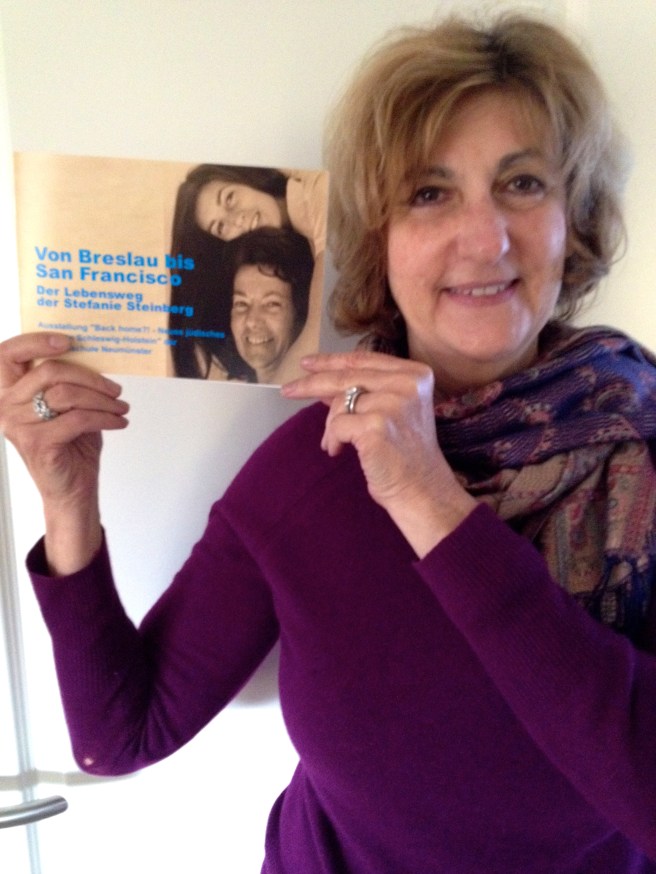
Vickie holding the recently published booklet about her mother’s life and journeys from Breslau in 1921 to Sand Francisco in 2015