Reflection on The Circumcision Controversy


This is a much longer essay than I usually post on my web page. I share it for those interested in a carefully considered (but certainly not the only) non Orthodox perspective on the circumcision debate.

Reflection on Circumcision

By Rabbi Stephen Lewis Fuchs, D.Min, DD,

Preface

The practice of circumcision has come under attack in recent days with unprecedented vigor. Growing numbers of Jewish parents are – to our sadness – making the choice not to circumcise their sons. Recently in Germany a court decision declared the procedure illegal on “humanitarian” grounds despite the considerable medical evidence that the procedure is beneficial. We know that there will be other legal challenges.

In response to these developments, I prepared the following position paper on circumcision. It is intended for those looking for guidance from a Progressive Jewish understanding of Jewish tradition – and why we, as Progressive Jews strongly recommend continuing this ancient practice. While we do not expect to convince those for whom our religious tradition has become irrelevant, we do hope it will be helpful to those eager to understand the place of Brit Milah (ritual circumcision) in Jewish thought and practice.

In preparing this paper I have received invaluable feedback from members of the Progressive Rabbinical community. My former colleagues at WUPJ, Rabbis Gary Bretton-Granatoor and Joel Oseran have endorsed and encouraged this project. They both offered very helpful suggestions

Rabbi Lewis Barth, founding Chair of the Brit Milah Board of Reform Judaism also offered thoughtful guidance. In addition to offering many valuable suggestions Rabbi Amy R. Scheinerman authored the section entitled: “Circumcision is Medically Beneficial.” In addition, Rabbis Deborah Ruth Bronstein, Beth D. Davidson, Stephen Einstein, Steven Kaplan, Mark Miller, Michael Pincus, John Rosove, Michael Zedek and Gersh Zylberman (MD) offered valuable guidance and corrections. I am grateful as well to Dr. Philip Bliss of Australia, Chairman of the WUPJ Advocacy Committee and Judy Smith, Marketing Committee Chair for their encouragement and suggestions.

Rabbi Stephen Fuchs, Erev Rosh Hashanah 5773

Introduction

On the ladder of Jewish mitzvot, circumcision ranks at or near the very top. Therefore two recent phenomena raise concern: The first is the campaign in some civil circles to view circumcision as a barbaric invasion on the body of an innocent child. There have even been some attempts to have the procedure of infant circumcision legally banned. The second is the decision of some Liberal, Reform and Progressive Jews to forgo the rite for their sons because they have been influenced by the movement referred to above, or for other reasons of personal choice. While personal choice is a hallmark of our Progressive movement, we believe that meaningful choice is always a choice informed by knowledge and understanding of our tradition’s teachings. To that end, we hope this paper will be helpful.

The Place of Circumcision in Jewish Tradition

Our connection to the rite of circumcision goes back to the very beginning of the story of our people. In Genesis 17, God commands Abraham to circumcise all male children at the age of 8 days. The language could not be stronger or less equivocal: “My covenant shall be in your flesh for an everlasting covenant. And the uncircumcised male, the flesh of whose foreskin is not circumcised, that soul shall be cut off from his people. He has broken my covenant (Genesis 17: especially verses “.)13-14

In a famous discussion in the Mechilta, (an halachic Midrash on the Book of – ברית Exodus, 3rd Cent. CE) Rabbi Akiva expresses the opinion that the very word Covenant – the basic understanding between God and our people upon which all Jewish religious practices are based – refers to circumcision and abstention from idol worship. (Mechilta d’Rabbi Yishmael, ba-hodesh, ch.2 Horovitz-Rabin, p.208). In Bereshit Rabba (Midrash on Genesis) (49:2), we read that Israel’s acceptance of circumcision led to our status as “the chosen people.”

Mishnah Nedarim (2nd – 3rd Cent CE) 3:11 contains strong rabbinic defenses of circumcision. The rabbis use the phrase גדולה מילה “Great is circumcision” to stress its central importance in Jewish life. Rabbi Ishmael points out that the covenant of circumcision was established thirteen times because the word ברית (covenant) appears in Genesis, chapter 17, 13 times. Rabbi Jose attributes the pre-eminence of circumcision to the fact that it is permissible to perform the rite on the eighth day even if the eighth day of the child’s life falls on Shabbat. By contrast other events that mark a change of status like weddings and funerals are forbidden on Shabbat.

Indeed the only thing according to Jewish law that should prevent circumcision on a boy’s eighth day of life is any concern – any concern whatsoever – that the procedure might be injurious to the baby’s health. (Maimonides, Mishneh Torah, 12th Cent. CE, Laws of Circumcision, 1:18)

Rabbi Joshua ben Karcha claims גדולה מילה because “it was not suspended for Moses the righteous for even one hour.” The reference here is to the mysterious three verses which suddenly appear-–seemingly without direct relation to what comes before or after–-in Exodus 4:24-26.

After God finally convinces Moses to accept the task of leading the Children of Israel from Egypt, we read: “At a night encampment along the way, the Eternal encountered him and sought to kill him. So Zipporah took a flint and cut off her son’s foreskin and touched his legs with it saying, ‘You are truly a bridegroom of blood to me.'”

One might fairly wonder, what do these verses mean, and why do they appear here, seemingly out of context? The rabbinic answer to this question is that God sought to kill Moses because he had neglected the cardinal commandment of circumcising his son. Only Zipporah’s quick action saved him. If God would have killed our greatest figure Moses for not circumcising his son, how much the more so are ordinary people required to circumcise their sons.

The Mishnah provides further support for the central position of circumcision in God’s Covenant with Israel in the statement by the Mishnah’s redactor, Rabbi Judah ha-Nasi who said: “גדולה מילה for in spite of all his virtues of Abraham our patriarch, he was not called ‘worthy” (my translation of Hebrew תמים, often translated “perfect” and used to refer to animals suitable for sacrifice, or “blameless”) until he was circumcised. The reference is to the covenantal imperative in Genesis 17:1: “Walk before me and be תמים” just before the Almighty commanded Abraham to circumcise himself and his household.

In chapter 29 of the Midrash Pirke de Rabbi Eleazar (2nd Cent. with material as late as 8th Cent.) we read that Abraham circumcised himself on Yom Kippur. Therefore on every Yom Kippur, God remembers Abraham’s circumcision and forgives the sins of Israel. (My father, Leo Fuchs, of blessed memory recalled a circumcision taking place in his boyhood synagogue in Leipzig, Germany on Yom Kippur.)

The Mishnah (Nedarim 3:11) concludes with the contention that were it not for circumcision, God would not have created the universe. This interpretation bases itself on Jeremiah 33:25: “If my covenant be not day and night, I had not appointed the ordinances of heaven and earth.” The covenant here is interpreted as circumcision, and according to this statement, the creation of the world depended upon it.

A subsequent Talmudic passage sums up the Mishnah’s equation of circumcision with our eternal covenant by asserting: “גדולה מילה because its importance is equal to that of all the other commandments in the Torah.” (B. Nedarim 32A)

This assertion is based on the Gematria (according numerical values to letters in a word) of ברית which totals 612. Our tradition teaches that there are 613 commandments for the good Jew to observe. The idea is that the act of circumcision is weighted equal to all the other 612. To be fair, though, other mitzvot (e.g. giving Tzedakah, honesty in business, and the study of Torah are also equated to all the other commandments in other places.) Still the importance of circumcision in rabbinic thought is beyond challenge. Indeed considering circumcision on the level of Tzedakah, honesty in business and the study of Torah is a strong argument for its primacy.

The logical question for us to ask is, “Why?” Why did the Sages who shaped normative Jewish practice equate circumcision, which, is described in the Torah as a symbol of the covenant with the covenant itself? In a study undertaken in 1969, Rabbi Sidney B. Hoeing, the late, eminent scholar of Yeshiva University provides a plausible answer. He wrote: “The designation of circumcision as covenant is due to rabbinic reaction to Christian attacks on circumcision.” Mishnah Nedarim 3:11 (to which we have referred) responded to Christian challenges, “in a most direct manner, even utilizing the exact terminology and similar expressions of the anti-circumcision concept in their response and rebuttal. (“Circumcision: The Covenant of Abraham,” The Jewish Quarterly Review, April 1969, pp.322-323)

The Mishnaic formula גדולה מילה is a direct response to Paul’s statement in I Corinthians 7:19: “Circumcision is nothing, and uncircumcision is nothing.” The Christian claim that the rabbis took such pains to rebut was that the new covenant made through Jesus nullified the old covenant which God made with Abraham through circumcision. By stressing the importance of circumcision – even interpreting that God would have killed Moses himself for neglecting it – the rabbis are appealing to Jews to remain within the fold and not believe that New Testament accounts of Jesus’ life, death, resurrection and ascension to heaven in any way supersede the commandments that underpin our Jewish covenant with God.

Circumcision Is Medically Beneficial

Circumcision alone has been found to reduce the rate of HIV infection by an astounding 50-60%. Extensive studies have been conducted in Africa where the HIV infection and AIDS rates are at epidemic proportion. The results are profound, so dramatic that some of the studies were stopped midway because it was deemed unethical to NOT circumcise the control group. Circumcision alone – with no other change in a person’s life or behavior – reduces the rates of HIV infection by 50-60%. Accordingly, the World Health Organization has endorsed male circumcision.

A meta-analysis of 27 research papers (scientists reviewing the research studies of other scientists) concludes: “Male circumcision is associated with a significantly reduced risk of HIV infection among men in sub-Saharan Africa, particularly those at high risk of HIV. These results suggest that consideration should be given to the acceptability and feasibility of providing safe services for male circumcision as an additional HIV prevention strategy in areas of Africa where men are not traditionally circumcised.” (http://journals.lww.com/aidsonline/Abstract/2000/10200/Male_circumcision_and_ris k_of_HIV_infection_in.18.aspx )

Another research study designed to look beyond HIV infection and assess, “the efficacy of male circumcision for the prevention of herpes simplex virus type 2 (HSV-2) and human papillomavirus (HPV) infections and syphilis in HIV-negative adolescent boys and men,” concludes: “In addition to decreasing the incidence of HIV infection, male circumcision significantly reduced the incidence of HSV-2 infection and the prevalence of HPV infection, findings that underscore the potential public health benefits of the procedure.” (http://www.nejm.org/doi/full/10.1056/NEJMoa0802556)

A 2011 study confirmed what has been widely taught for years: There is a significantly less risk of cervical cancer among women whose sexual partners are circumcised. (Salynn Boyles. Reviewed by Laura J. Martin, MD, “Male Circumcision Cuts Women’s Cervical Cancer Risk”, http://www.MDHelathnews, January 6, 2011)

On August 27, 2012 the American Academy of Pediatrics published a study that concludes: “Evaluation of current evidence indicates that the health benefits of newborn male circumcision outweigh the risks and that the procedure’s benefits justify access to this procedure for families who choose it. Specific benefits identified included prevention of urinary tract infections, including HIV. The American College of Obstetricians and Gynecologists has endorsed this statement. (Circumcision Policy Statement, Task Force on Circumcision, Pediatrics, Official Journal of the American Academy of Pediatrics, http://pediatrics.aappublications.org/content/early/2012/08/22/peds.2012-1989)

The primary purpose of this paper is to endorse circumcision as a sign of identity with the ancient Covenant of our people, but there is more than ample evidence to conclude that circumcision is a desirable health procedure.

Current Attacks on Circumcision

Today, circumcision has come under attack – sometimes viciously – from several quarters. Let me state at the outset that while (to paraphrase the late Supreme Court Justice Potter Stewart) it is hard for me to fully define anti-Semitism, I recognize it – after a long career as a rabbi – when I see it. There is no question in my mind that anti-Semitism is a major force behind the drive to demonize or ban circumcision.

Whenever I read – as I do with increasing frequency these days – yet another attack on circumcision, a famous response on the subject written in 1950 by the eminent and well-loved English pediatrician Sir James Spence jumps to mind. Spence – as a leading expert – was asked by another pediatrician whether he would advise the parents of a baby boy to circumcise him. I see Dr. Spence’s answer dripping with anti-Semitism.

“You ask me, with a note of persuasion in your question if (the child should be circumcised)? Am I to make this decision on scientific grounds, or am I to acquiesce in a ritual that took its origin at the behest of that arch-sanitarian Moses? (Sir James Spence, “On Circumcision”, Lancet, 1964, 2:902)

Over the years I have found Dr. Spence’s response a congruent grid to place over the ideas expressed by most of those who oppose circumcision. In 2011, in San Francisco, a serious attempt to legally ban circumcision garnered surprising support. It takes only 7,168 signatures in that city of 750,000 residents to place a referendum on the ballot. Those signatures were on a petition calling for a law that would have made circumcising a male under the age of 18 punishable by a fine of $1000 or a year in jail.

In 2011, the comic book character Foreskin Man appeared. “Created by Matthew Hess, the first and second volumes show graphic images of monster doctors and evil Mohels fighting for ‘the penile flesh of an 8-day-old infant boy.’ The hero, who some feel is of the Aryan variety, swoops in at the last second to save the infant’s foreskin.” (http://www.ImprfectParent.com, Nicholas Whitaker, “Foreskin Man: Anti-circ or Anti-Semitic”, Imperfect Parent, June 7, 2011).

The stereotypical hook nosed, grimy appearance of Foreskin Man and the clean, blond powerful and definitely Aryan look of the “hero” leave no doubt at all about the anti-Semitic nature of this comic.

Attempts to ban circumcision, of course are not new. The first and best known initiative was one of the causes of the Maccabean revolt (165 BCE) when the Assyrian Greek King Antiochus the IV imposed such a ban on the Jews of Judaea.

Those who inveigh against circumcision ignore or purposely overlook the many studies that show lower rates of HIV in circumcised males, lower rates of urinary tract infection and lower rates of cervical cancer in women whose sexual partners have been circumcised. Yes, I am indeed convinced that the ugly head of anti-Semitism lurks behind many of those who attack circumcision so vehemently.

Of course not all opposition to circumcision is rooted in anti-Semitism. Sympathy for a child undergoing a surgical procedures that does involve slight risk, and the visceral reaction (that any parent or rabbi who has officiated knows) of parents being conflicted at a procedure that brings pain – however momentary – to their child is understandable. Doubtless, as well there are some medical professionals who with pure motives feel the procedure is not in the child’s best interest. On balance, though, it is our hope that those concerns do not out weigh the many positive arguments for circumcision and the joy of entering another child into our Ancient Covenant with the Almighty.

A Spiritual Understanding of Circumcision for Modern Jews

We might well ask, aside from its primacy in the hierarchy of mitzvot, and aside from the preponderance of medical opinion attributing significant health benefits to the practice, is there a religious or spiritual basis for the practice today? I believe that there is.

In 1979 I heard a presentation by the renowned American professor, Rabbi Arthur Green, in which he made some eye-opening observations that I have shared – with very positive reception – at dozens of Brit Milah ceremonies that I have conducted over the years because they resonate with the very essence of Progressive Jewish ideals:

We human beings, the Torah teaches, are created in the image of God. That does not mean, of course that we look like God, because God has no shape or form. It means that we of all creatures are the most God-like in our ability to have an impact on the world around us.

We are neither as strong as an elephant nor as fast as the cheetah. But no elephant or cheetah will ever split the atom. We are the only creature who can go to the side of a mountain; mine ore from the mountain turn the ore into iron and the iron into steel with which to form the most delicate of instruments for operations to repair a damaged heart. At the same time we are also the only creatures on earth that can go to the same mountain, mine the same ore, turn it into iron and steel to make bombs and bullets whose only purpose is to kill or to maim. We have enormous power, and our covenant exists to urge us to use that power for good and not for evil.

The Midrash (Bereshit Rabba, 8:11) puts it this way: We human beings are the only creatures with characteristics both of God (or the celestial beings) and the lower animals. Like the animals we eat, sleep, drink, propagate our species, eliminate our waste, and die. Like the celestials, though, we have an intellect, a capacity to communicate and a spiritual potential which none of the other animals possess. Our Jewish teachings urge us to overcome our animal instincts and enhance the Divine Image in which God created us.

When, we might ask, are we – and men in particular though certainly not exclusively – most likely to succumb to our purely animal instincts? The answer is when we are sexually aroused. What better place then to have a sign that we are in Covenant with the Almighty than at the tip of the male sexual organ?

There are, of course, many reasons why humans engage in sexual contact ranging from gratifying a physical desire to the hope that they might become partners with the Almighty in creating a new life. At its best, sex between humans – unlike the other animals – is an act of physical and emotional love and unity. Again, what better place for a sign of our covenant with God than the one body part shared by men and women during the act of coitus? What better reminder could we have when we engage in sex that we are not merely animals but the creatures God made in the Divine image?

Because sexual intercourse – whether by design or not – might lead to the creation of a new life, what better place to have a sign of the Covenant than the spot from which the life force flows from the male and is received by the female?

Conclusion

Circumcision rose to the top of the list of important mitzvot because of its origin in the story of Abraham, at the very beginning of our emergence as a people. Its importance grew, and circumcision was a sine qua non for Jews in the rabbinic period in response to the challenge to Jewish life presented by early Christianity. It has maintained its position since then despite bans from time to time in various countries. In the State of Israel where the overwhelming majority of the Jewish population consider themselves “secular” or “non-religious,” eighth day circumcision for Jewish boys is universal.

In addition there are significant health benefits for the practice, and the scent of anti-Semitism wafts from the attempts in various places to outlaw the practice or label it barbaric.

To detach ourselves, therefore, from 4000 years of Jewish history and to abandon a practice considered so vital to Jewish identity throughout that history would be a grave error. It would give further ammunition to those more traditional Jews who wish to label us an aberrant sect who have renounced in the most fundamental way the Covenant of Abraham. When we add to these facts the uplifting ethical and spiritual dimension which we can – if we choose – attach to the Covenant of circumcision, there is every reason for Progressive Jews to continue the practice.


A Teachable Moment

Teachable moments can sneak up on us unexpectedly. 

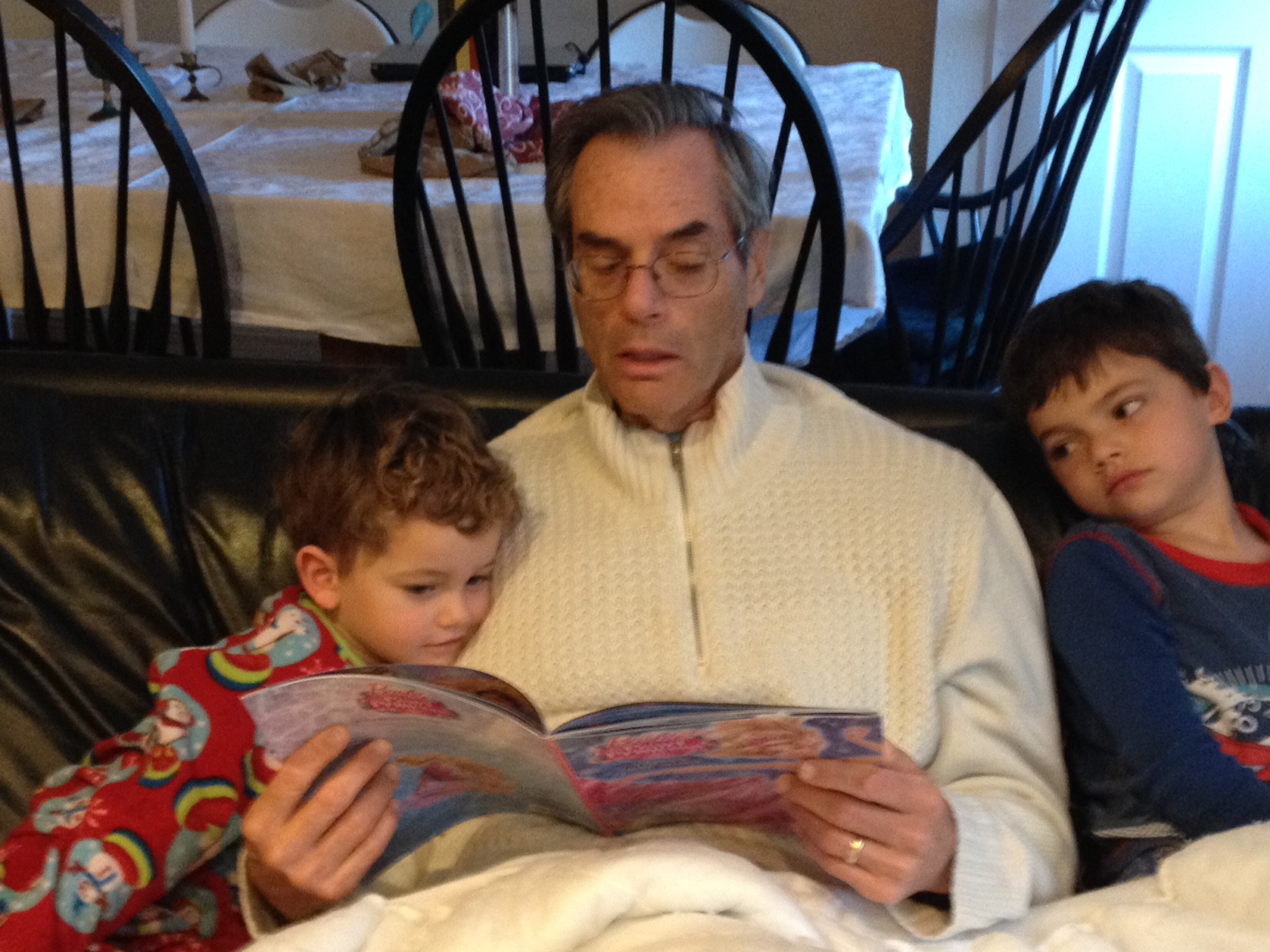
We were sitting in a restaurant waiting for our food when, out of the blue, my grandson Zachary leaned against me in the booth, and said, “Saba, will you tell me a story?” I was tired, and all I wanted to do was eat and relax, but my grandson had just made me an offer I could not refuse:

Once upon a time, I began, there was a king. He was not a nice king, and he had taken almost all of the people’s money in taxes. They marched and protested but to no avail. “That’s not MY problem,” the king responded. “That’s YOUR problem! I need money to run my kingdom, and if you don’t have enough, that’s just too bad!”

The people in the kingdom met everyday, but no one had a solution. Then, an elderly man spoke up: “I would like to see the king!” he said.

“You?” People responded. “What do you think YOU can do when nothing that we have tried has worked?”

“Can’t hurt,” the man responded and off he headed toward the palace.

 When the King saw him, he said, “If you have come about the money, you are wasting your time. That’s not MY problem! That’s YOUR problem…”

“Oh no, your majesty,” the man answered. “I haven’t come about the money. I came because it is such a nice day, and I want to invite your Highness for a ride in my boat.” 

The invitation took the king completely by surprise. “It is a nice day,” he allowed … “OK, I’ll go.”

The man rowed his small boat to the center of the lake. Then to the king’s shock, the man took out a hammer and an awl and began to drill a hole in the bottom of the boat!

”Stop!” shouted the king. “I am going to drown!”

”Oh,” the man said casually, “That’s not MY problem. That’s YOUR problem. You see, I’m just drilling the hole under my own seat!”

“I understand what you are teaching me,” the king said softly.

“Everything we do,” Zachary chimed in, “affects others,” and a proud Saba was glad his young grandson grasped one of life’s most important lessons.

Image

A Mothers’ Day Tribute to My Mom, Florence Fuchs

My sister and I owe my mother more than we can ever repay. When Rochelle wanted to become a Bat Mitzvah back in 1955-–and she became only the second Bat Mitzvah in the history of Temple Sharey Tefilo in East Orange, NJ–it was my mother who stood up for her when my father didn’t “see any reason for a girl to do that.”

When I developed every illness known to man on Sunday mornings to get out of religious school, I can still hear Mom say, “That’s too bad, dear. Get in the car.”

After my Bar Mitzvah when I absolutely knew that my career as a tennis, hockey, basketball, football or baseball player was the only important thing in my life and that I simply had no time for Confirmation classes, my Mother would not hear of that either. I often wonder what I would be doing today if Mom had let me become a “Bar Mitzvah Fade Away.”

I owe my mother so much, but when my father suffered through a long battle with kidney failure Florence Fuchs emerged as the greatest hero of my life.

In those days, when I was off studying, my bedroom became the “Dialysis Room.” My mother set up and operated an elaborate (and it was a much more complex matter in 1969 than it is today) dialysis machine, which along with the bed took up almost the entire room. She ran that machine faithfully, skillfully and lovingly for several hours three times a week, and prolonged both the length and quality of my father’s all too short life.

It is one thing for children to love their mother. It is more remarkable for people to love their spouses’ mother the way Jack and Vickie loved Mom. She delighted in ‘Chelle’s 50-year marriage to Jack and was always grateful for the scrupulous and loving way they have looked after her finances. Vickie treated Mom as a second Mother who was wise, kind, loving, and fair — and who never interfered.

I think of her often especially when Mother’s Day and her birthday, May 15 come around. When the little obstacles life places in my path seem to mount up, I remember how my mother handled the obstacles life placed before her, and my problems suddenly become less overwhelming.

As a rabbi, my life work is to teach that God created us human beings to be in charge of and responsible for this world and to use our talents to create a just, caring compassionate society. I am blessed that my Mother exemplified those ideals for me since I was old enough to remember.

When the company for which Dad worked went out of business when I was eight years old, I never knew that money was tight. It was a year before Dad and his partners set up their own business and some time after that before things became comfortable.

Now that I look back on it, we did not go on vacation or go out to eat in those days, but I never really noticed. She kept adult worries out of my childhood. I am so grateful for that and for so many other things:

She schlepped to the wilds of Arkansas, Maryland, Nashville and West Hartford to be wherever I was during the Holy Days and other special times.

She showed me the joys of Judaism and opened my eyes to its depth:

By lighting Shabbat candles,

Cooking a special and delicious Shabbat dinner each week,

Bringing me to services, and making me feel important for being there,

And teaching me to respect the religions of others the way she taught me to love my own.

The way Mom took care of Dad during the years when he was so sick showed me what to look for in a life partner, and in a few weeks Vickie and I will celebrate forty-six years of marriage.

It is hard to believe she has been gone almost fourteen years. I will always admire how she never stopped trying to do for herself even when the time had long arrived to let others do for her. At the end she moved slowly, saw poorly, and took so many medications that I often lost count.

In my mind and heart, though, she will always be young, vibrant, beautiful, and a shining example of what a Mother should be.


A Remarkable Woman of Whom Most of You Have Never Heard

One of the main activities that came to be associated with the Festival of Shavuot is study. Another custom of the festival is to recite special prayers in memory of special people who have died.

As I prepare to participate in our congregation’s annual Shavuot study session in a few weeks, my thoughts turn to one of the most dedicated students I have ever had who died a little more than four years ago, Leah Lantz.

Each year on my birthday, Leah sent me a hand written card that had יום הולדת שמח

(Happy Birthday) written in Hebrew.

Leah was a regular at Beth Israel at every Shabbat Eve service and at Torah study every Shabbat morning.   During the class she asked probing questions and often shared anecdotes about when she was a young girl growing up in Poland.

The one I will always remember was about her father who owned a small shop—jewelry store – if I recall correctly. Her father would keep a volume of Talmud under the shelf in his shop, and in between waiting on customers he would devote every spare minute to study. That example inspired Leah to enjoy a lifelong love of learning.

For me, Leah Lantz was an absolute inspiration. In her last years she could hardly hear, and she could hardly walk, and yet into her 90’s her indomitable spirit and thirst for knowledge propelled her to continue to participate in every imaginable learning opportunity. And she always greeted everyone she met with the most wonderful smile on her face!

Just before I left on a mini sabbatical at the end of 2009 Leah took my arm and told me how much she would miss me. “I’ll be back in two months,” I replied.

“But who knows what can happen in two months?” She answered.

When I returned, it was clear-–to my shock-–that Leah’s condition had deteriorated markedly. She came on the first Friday night after my return to Beth Israel, but there was no sparkle in her eyes, and she was in some pain. She also came to Torah study the next morning. She took her accustomed seat right at my side, which gave her the best chance of hearing, but she was unable to really focus and was in real discomfort.  I looked at her, and my heart told me that this was Leah’s last class with me. I felt like she had waited for me to return and she had come to say, “Goodbye.”

Now I imagine her alive in another realm walking briskly – not shuffling along with her walker – and taking her well-earned seat in the very first row of the ישיבה של מעלה, the Academy on High. There with her mind alert and her ears unclogged she will hold her own in any discussion with such fine minds and great spirits as our sages, Rabbi Akiva or Hillel, Beruria or Ima Shalom.

On the Shabbat after Leah died, I asked our Torah class to please leave the seat next to me-–Leah’s seat– empty in tribute to her. Four years later the void in our class and in my own heart left by Leah’s passing remains. Her memory, though, and the shining example of תלמוד תורה—the diligent study of Torah-–that she personified will always be with me particularly as Shavuot, the holiday we celebrate by studying Torah, approaches each year.


Shavuot: A Perfect Example of Ancient “Reform” Judaism

One of the great examples of Reform or Progressive Jewish thinking–some 2000 years before there was anything called Reform Judaism– regards the Festival of Shavuot.
In the Torah, Shavuot was strictly an agricultural holiday, a celebration of both the first summer fruits and the barley harvest. Our ingenious Rabbinic Sages reformed (and I use that word purposely) the festival into the anniversary of when our biblical ancestors received the Torah at Mount Sinai. We cannot be sure of exactly how it happened, but I imagine a scenario much like this:
A group of concerned rabbis was discussing the state of Jewish life. One Sage mused, “You know, Shavuot just doesn’t attract the great crowds to celebrate in Jerusalem that it once did.”
A second Rabbi answered: “That’s true, but it’s understandable. Times have changed!”
A third participant: “You are absolutely right! When we were primarily an agrarian society, first fruits and the barley harvest were compelling reasons to celebrate. Now, that we have become more urban, those occasions don’t mean so much to many people.”
First Sage: “What can we do?”
A fourth participant spoke up: “I’ve got it! If you look at the Torah, Shavuot comes 50 days after the first day of Pesach. That’s just about the same amount of time that it took our ancestors to travel to Mount Sinai after they left Egypt! Even though the Torah does not make the connection explicitly we can make the connection. From now on we can celebrate Shavuot—in addition to its biblical significance–as a joyous celebration of when we received Torah at Mount Sinai”.
A fifth Sage asks: “Can we do that?”
The fourth responds: “Not only can we, we must!! If we want our precious Jewish heritage to endure, we must be skilled interpreters of biblical texts so that they speak meaningfully to the present and future realities of our people.”
In this way, I imagine, the rabbis of the Talmudic period took a fading festival and gave it a historical underpinning and new life for future generations. In similar fashion, our early Reform leaders made Shavuot the time when ninth or tenth grade students celebrate Confirmation.
The example of what our ancient Sages did with Shavuot should continue to inspire our thinking as Reform or Liberal Jews today. If we want our precious heritage to remain vibrant and relevant, we must always be eager to embrace opportunities to make our traditions and celebrations speak more meaningfully to our children and grandchildren!
When we do, let us rejoice that the process of continually “reforming” Judaism is wholly consistent–not at odds–with the process by which our Rabbinic Sages reformed biblicalJudaism to speak to the realities of their time and place.

Why Israel Is So Special

As Israel celebrates its 66th year of independence, my mind replays a scene that could easily happen again today.
It was November 1975. The United Nations had just passed a horrific resolution condemning Zionism–-the very idea that there should be a Jewish State–as racism. Shocked, I knocked on the doors of one Christian pastor in our city after another asking for support.
Some were sympathetic, but I shall never forget one pastor’s response. “Steve,” he said, “you’ve taught me a lot about Judaism, and I consider you a friend. But I have neither interest in nor sympathy for Zionism.”
Today, on the land that made up the Turkish Ottoman Empire until the end of World War I, twenty-two Arab/Islamic peoples have realized their hopes for independent nationhood. Jews also lived in the erstwhile Ottoman Empire. Why does the world begrudge one tiny sliver of land for Jewish national aspirations when twenty-two Islamic nations have realized the same dream?
After the Holocaust, the world realized that had there been an Israel to which Jews could flee, Hitler never could have destroyed two-thirds of European Jewry. In other words had there been an Israel when Hitler came to power, there would not have been a Holocaust!
And so the United Nations voted to create two small states: One Arab and one Jewish. The tiny piece of land designated as the Jewish homeland was mostly desert, but no matter. We Jews rejoiced that our two-thousand-year-old hope for nationhood was finally a reality.
But the Arab world had other plans and vowed to drive the new Jewish nation into the sea. Azzam Pasha, Secretary-General of the Arab League, boasted that the rivers would flow with Jewish blood. “This will be a war,” he exulted, “like the Mongolian massacres, like the crusades.”
It turned out he was wrong. The Jewish nation, against overwhelming odds, did manage to establish itself, but the Arab dream to wipe her off the map persists to this day. If ever there will be peace, the Arab world in general and the Palestinians in particular must renounce this dream.
We cannot deny, nor should we, that the creation of Israel caused loss and displacement for many Palestinian Arabs. I hope that reality will always sober us. I hope Israel will make every reasonable effort to reach a peaceful accord, an accord that allows both the Jewish State of Israel and an Islamic/Christian Palestine to live side by side in mutual harmony.
When Palestinian spokespeople tell us that so many of their kinsmen lost their land when Israel came to be, they are correct. But they do not tell us that roughly the same number of Jews fled for their lives to Israel from political, economic, religious and physical persecution in Arab lands.
The difference, of course⎯and it is a crucial difference⎯is that Israel absorbed refugees from Yemen, Tunisia, Algeria, Egypt, Syria, Iraq, and Morocco and integrated them into Israeli society by providing them with language training, job skills, and housing. The Arab world, despite economic capabilities that dwarf those of all the Jews in the world, chose to maintain Palestinian refugees in squalid camps, which for sixty-six years have been breeding grounds for hatred of Israel and terrorism.
I do not believe that supporting Israel means that we should relinquish the right to criticize policies of Israel’s that we think is wrong. But none of us should allow our criticism to provide aid and political ammunition for those–Jews and non–Jews alike⎯who seek to destroy the Jewish State.
We must never forget that if the Arab states renounce terror, lay down their arms, and acknowledge Israel’s right to exist, there will be peace. But if Israel lays down its arms or relaxes its vigilance, there will be no Israel. I count myself among those who would consider “no Israel” a tragedy the world should spare no effort to prevent.

A Need to Remember What We’d Rather Forget

Holocaust Remembrance Day, which the world recently observed  forces us to confront what we would rather forget: the tragedy our people endured during World War II.

The number most people associate with the Holocaust is six million. That, of course is the number of Jews who perished due to Hitler’s madness in the years leading to 1945.

For me, though, other numbers are more telling. They are 1/3, 2/3 and 4/5. When I hear people compare other human tragedies to the Holocaust, I am convinced it is because they don’t understand these numbers.

Of the Jews in the world who were alive in 1935,  1/3 were dead because of Hitler by 1945. Among the Jews in Europe, the largest, most advanced community of Jews the world had ever known, 2/3’s perished. 4/5’s of Europe’s rabbis and communal leaders died at the hands of the Nazis. When another catastrophe of human failure approaches those numbers, then and only then will comparisons with the Holocaust be appropriate.

We owe it to those who died never to forget them nor to forget the depths of depravity to which human beings can descend. But if our commemorations on Holocaust Remembrance Day focus only on the sorrows of the past, we waste our time and our tears.

The Holocaust reminds us, as Deuteronomy (22:3) proclaims: “Lo too-chal l’heet-ah a lame!”, “You must not remain indifferent!”

As Jews  we must not remain indifferent to the suffering of anyone anywhere. After all, at the beginning of the Book of Genesis God told Cain, as God tells each of us: We are our brothers’ and sisters’ keepers!

One appropriate focus on this day is the example of Righteous Gentiles who risked their safety and their lives to save Jews during that horrible period. Rabbi Lawrence Kushner told the story of a German gentile man sitting on a bus next to a Jewish woman whom he had never met. A Nazi officer boarded the bus to check the passports of those who were riding and to arrest any Jews among them. Seeing the fear in the woman’s eyes the man knew she was Jewish. Suddenly, the gentile began shouting and cursing at her. When the Nazi rushed over to see what the commotion was, the man looked up calmly, handed the Nazi his Aryan passport and said, “I’m sorry officer, but my stupid wife has forgotten her passport again even though I have told her 100 times to remember it when she leaves the house.” The Nazi simply nodded and went on to the next passenger.

Hopefully, true stories like this inspire us to seek out and seize opportunities that present themselves to us to make a positive difference in the lives of others. Our primary mandate as Jews is to use our talents and abilities לתקו את העולם, to make this world a better place than it is now. The most meaningful Holocaust Remembrances then, begin with a sorrowful reflection on the past but hopefully look to the future and end with a resolve to leave a more just, caring and compassionate world for our children, grandchildren and all the generations to follow.

A Life Changing Event

Three years ago today  I was on my way from Fort Lauderdale to speak at Kabbalat Shabbat services at Temple Judea in Coral Gables, Florida, I suddenly realized that I was hearing nothing in my right ear. I thought it would pass. It did not, and it has not since.

The ear specialist had no explanation. He believes it is inner ear nerve damage and that it is permanent. An MRI showed a virus, but still there was no explanation. “Sudden complete hearing loss in one ear is unusual, ” the doctor explained, “but it is not unheard of.”

Life has been different ever since. Crowd noises are deafening. Large gatherings of people are no fun, and most of the time if I want to hear what someone says to me, I must look straight at their lips.

As I continue to adjust to the reality of having only one hearing ear, I am so very aware that so many people deal with much greater physical challenges.

It is my nature to look at things that happen to me in life with the same question I ask when I study a biblical story or narrative: What can I learn from this that can make me a better person? What can I take away from this unfortunate incident that can help me to better fulfill my Covenantal obligation to the Almighty to use whatever abilities I have to make the world a better place?

There is an old saying that has taken on new meaning for me since my hearing loss: “God gave us only one mouth but two ears, so that we would listen twice as much as we speak.”

Now I have only one ear that hears and that one–without my hearing aid–at considerably less than 100%. Listening is much harder now. As a result I choose to spend more time than before alone, reading, thinking and writing. When I am with people it is a much greater struggle than previously to absorb all that they are saying. I must concentrate on every word.

As I do, my silent prayer is: “Help me, O’ G-d, to really understand the word שמע, “Listen!” Help me to really LISTEN to thoughts, nuances and feelings better than I ever did before, even when I had two ears that heard.
Amen

An After Note on Partnering with Rabbi Renee Goldberg Edelman

A few days ago in a joint post Rabbi Renee Goldberg Edelman and I each shared our views on the mystery of God.

At the time of our posts Rabbi Edelman wrote me that she had tried mightily, but there was nothing she could do to remove a strange series of random letters, numbers and other characters that appeared at the end of our post. “OK, no big deal,” I replied.

Yesterday when I checked on our joint posting I found to my delight that Rabbi Edelman had magically transformed the collection of markings into a large beautiful question mark.

Today I see that question mark not as a nice decoration but as the main point both of us are trying to get across. We believe in God, but we still have lots of questions and doubts. The goal is to continue to ask them and struggle with them.

In a speech I heard several years ago Rabbi Harold Schulweis spoke of the phenomena of young people who become Ba’alay Teshuvah. The term describes those who were secular or who had even viewed Judaism with disdain. Somehow, though, they “saw the light” and became Orthodox Jews. They would describe their transformation as saying they chozrim b’ teshuvah, they “return in repentance” from the lives they had previously led. The word teshuvah also means, “answer.”

Much more meaningful, continued Schulweis, than “returning with the answer,” is to become chozrim b’she’elah, those who “return with the question.” The ideal is not for us to simply accept Orthodox belief and adopt Orthodox practice. The goal is to take our Judaism very seriously and struggle with it. We should freely question everything! But we should also infuse our lives with acts that affirm and re-enforce our Jewish identity and ideals.

The word Yisrael, Israel, does not mean one who believes in God or one who knows about God. It means, “one who struggles with God!” There can be no greater area of uncertainty than the nature of God, and faced with that uncertainty we have three options:

  1. Become Orthodox in our belief and practice.
  2. Discard religion because we can’t imagine a just God ruling over a world with as much evil in it as ours.
  3. Continue to ask and struggle with the questions that trouble us and try our best — with Jewish rituals and observances as inspiration –- to live up to the ideals of ethical conduct our Torah teaches the world.

Clearly Rabbi Edelman and I choose option three, and that is why I find her beautiful question mark such a perfect way to punctuate the messages we shared on the mystery of God.

Rabbi Renee Edelman and I each share thoughts on God inspired by the Torah reading for the Sabbath during Passover

God in Our Lives

Rabbi Renee Edelman

A little girl stands before the Community on her 12th birthday. It is Chol HaMoed Sukkot, the day that she will become a Bat Mitzvah and chant Torah for the first time. Her hands shake, as she stands behind the open Torah and begins to chant her parashah. She has lived with these words for two years. First, learning the Torah portion in English and Hebrew, and then learning the trope and putting the two together. Her voice is strong even as she shakes. Rabbi Lawrence Kushner and Cantor Lorel Zar Kessler cocoon the child. Even now, looking back upon that day, I felt that my stance matched the description of the Parashah. Rabbi and Cantor became the cleft in which I rested, and with the Torah before me and the congregation before the Torah, was the presence of God.

We read this week as we did then, the end of Ki Tissa. Frustrated with the people Israel over the incident with the Golden calf, Moses returns to the mountain to receive the second set of commandments. Moses asks God to lead the people Israel, “You go with us, so that we may be distinguished, Your people and I, from every people on the face of the earth?” (Exodus 33:16) Then Moses asks the question, which makes this parashah so special, “Moses said, “Oh, let me behold your Presence.” God responds, “I will make all my goodness pass before you…. But you cannot see My face, for a human being may not see Me and live… see there is a place near Me. Station yourself on the rock and, as My Presence passes you by, I will put you in the cleft of the rock and shield you with My hand until I have passed by. Then I will take My hand away and you will see My back; but My face shall not be seen.” (Exodus 33:17-23)

This is a substantially religiously uplifting scene. Moses leaves the camp after breaking the tablets. He leaves behind the noise of the people, their possessions and their fear, to enter the Tent of Ego. Moses is motivated by a pure desire to be in the presence of God. And that result is a religious moment so intense that Moses has to wear a veil over his face to shield himself from the radiance. By seeing God, as he does, Moses is able to lead the Jewish people with strength from within.

How do we get to be in God’s Presence, when we are not Moses and not able to see or speak with God? We find God in the moments of mystery. I have watched my kids when they are occupied and if the moment is right, I feel this bubbling in my chest that has no words and I am overcome with silent emotion. I don’t know why I received the feeling at that particular time, but I did and I can only call it God. When our bodies have betrayed us, and we are terrified of the future, and how we will take care of all we need to do; and we realize, that we are surrounded by friends and family members, who will be there, present for us, perhaps that is God. Not the illness, rather the cocoon of friends and family. Hearing a song on the radio that brings you back to a time of joy or one of despair and realizing that this song comes on for a reason. For me, who does not believe in consequence but in synchronicity- those moments that seem too planned, too directed, I call God. May we all find ways to deal with the mystery of God in our lives; whether by defining them or acknowledging them, or giving them a name.

Once a little girl stood on the Bimah chanting these words, cocooned by her Rabbi, Lawrence Kushner and her Cantor, Lorel Zar-Kessler and her congregation was the face of God, revealing God’s self to all present.


Much About God Will Always Be A Mystery

Rabbi Stephen Lewis Fuchs


Two months out of Egypt, Moses is on Mt Sinai to receive God’s Torah, but he took too long, to return, and the frightened Israelites slid back into idolatry. They demanded Aaron make a god they can see, and he fashioned a golden calf.

Furious at this apostasy, the Eternal One threatens to destroy the entire people but promises Moses a more worthy group to lead. But Moses — in one of his finest moments — talks God out it.

When we consider the Torah reading for the Shabbat during Passover it is Moses who is on the verge of giving up. “God, you have to show this people and me that You are with us,” he pleads. And God obliges him saying essentially, “I will make my goodness pass before you as you stand in the cleft of a rock, but no one can actually see my face. (Exodus 33:13-19)”

To me this is one of the most instructive statements in Torah. There is a reason we worship God and do not expect God to worship us. While Torah gives a good idea of how God wants us to act, much about God remains a mystery.

Many find the mystery of God hard to accept and create God in their image of what is just and right.   A horrific event like a child dying shakes their belief in God to the core.

Shaken belief inspired one of the best-selling religious books of all time, When Bad Things Happen to Good People by Harold Kushner. Reacting to the death of his son Aaron at 14 from premature aging disease, progeria, Rabbi Kushner concluded that he does not believe that God can be both all good and all-powerful. So he chooses to believe that God is good, but there is a force in nature beyond God’s control that claimed his son’s life. His theory brings comfort to millions and offers a palatable answer to the question implied in the book’s title.

But I do not think he is right. I choose to believe – as the Torah portion for the Shabbat during Passover teaches – that there is much about God that we cannot know.   I don’t know why a child gets sick and dies, and I never will. What I do know is that every day that I breathe, God desires me to use whatever talent I have to try to make this world a bit more kind, caring and compassionate.

I wish I could know why bad things happen to good people or why bad people often prosper. I do not know whether God’s power and knowledge are limited, but I know for sure that mine are.