

Source: This I Believe About God
Author: slfuchs
Loving husband, father, grandfather and rabbi. Author of, "What's in It for Me? Finding Ourselves in Biblical Narratives,” "ToraHighlights,” “Why the Kof?,” “Why Triple Chai?,” "Who Created God?," and "...And Often the First Jew."
On October 17, 2017, Rabbi Fuchs was selected as the recipient of the Vanderbilt Divinity School's Distinguished Alumnus Award. To be considered for this award, one must demonstrate excellence and distinction in justice-making through their efforts in congregational ministry, religious institutions, non-denominational/all-inclusive organizations, community–based organizations, government, or other social institutions.
Spent last four falls serving in Milan, Italy, (2013) and Germany (2014-2016). Otherwise, he enjoy writing and speaking after serving three congregations and as President of the World Union for Progressive Judaism.
He is currently serving as Rabbi of Bat Yam Temple of the Islands, Sanibel, Florida.
Manfred Embraces Selig’s Lamentable Legacy
In the tradition of “Gutless Bud” Selig (the most ridiculous Hall of Fame inductee in the history of baseball) Commissioner Rob Manfred refused to impose an immediate suspension on a player for a despicable act.
After hitting a home run off Los Angeles pitcher Yu Darvish, Houston first baseman Yuli Gurriel pulled up the corner of his eyes and uttered an anti Asian slur, an act insulting to everything for which baseball and the United States of America should stand.
But, while descrying the act, Manfred decided that the World Series was too important to sit a player down for an act of overt racism.
So he will have Gurriel serve an all but meaningless five-game suspension at the beginning of next season.
Give me a break!
But there was ample precedent for Manfred’s moral failure.
In September 1996, believe it or not Roberto Alomar actually spit on home plate umpire John Hirschbeck after Hirschbeck called him out on strikes in a crucial end of season game with a playoff berth at stake. If you didn’t see it you would find such an act hard to believe.
Nevertheless Gutless Bud, who (wink, wink) let steroids run rampant and counted the cash generated by balls flying out of the park while juiced players made a mockery of the game, did not sit Alomar down until (and once again it was a meaningless punishment) the beginning of the next season.
Baseball needs to follow the example of hockey and basketball. In those sports playoffs or no no playoffs, finals or no finals, you show blatant disrespect for the game that has made you wealthy beyond imagination, and you serve your suspension immediately.
When Manfred succeeded Selig, there was hope he would restore respect for what once was our national pastime. Manfred’s sorry response to the Gurriel racial slur shows me that hope is fading fast.
It All Begins with Abraham and Sarah, But It Comes Down to Us
What is the major difference between the one true God of the Torah and all the pagan gods people worshipped in ancient days?
It is not so much that they worshipped idols, and it is not so much that they had many gods and we have one.
The difference is God’s agenda!
Before the Torah people worshipped gods because they presumed these idols had power. The whole purpose of religion was to appease these gods.They made offerings to bribe the gods not to use their presumed power to harm the worshippers or perhaps to induce them to use their power to help them.
Our God’s agenda was and is different.
The God of the Torah created the world with the hope that we human beings, who are charged with responsibility for the quality of life on earth, would create on this planet a just, caring, compassionate and peaceful society.
God’s first attempt in the Garden of Eden failed!
So did God’s second attempt that ended with the flood because the world was full of violence, corruption and immorality.
But God does not give up!
After the flood God tried a third time, with the promise that the Eternal One would never destroy the earth again.
Take note: God promised never to destroy the earth again, but there was never a guarantee that we humans will not.
But that third society, after the flood, worked out no better than the other two.
After the Tower of Babel God had a serious three-pronged dilemma:
- God still cared and would not give up the hope that humans could create the society God wanted.
- God was still dismayed by human failure to do so.
- God had promised never to destroy the earth again.
God’s answer to this dilemma was to choose Abraham and Sarah and their descendants (that is all of us) to create the just, caring and compassionate society for which God has yearned since the time of creation.
God’s charge to Abraham, “Be a blessing,” is God’s charge to us today!
If each of us seeks to use our individual talents in ways that bring blessings to others and not just to ourselves, we can have—at last—the type of world God wants.
(For more detailed development of these ideas, please read, What’s in It for Me? Finding Ourselves in Biblical Narratives. The book is now available in English, German, Russian and Spanish. Here is the Amazon link:)
Thank You, Vanderbilt
Source: Thank You, Vanderbilt
Thank You, Vanderbilt
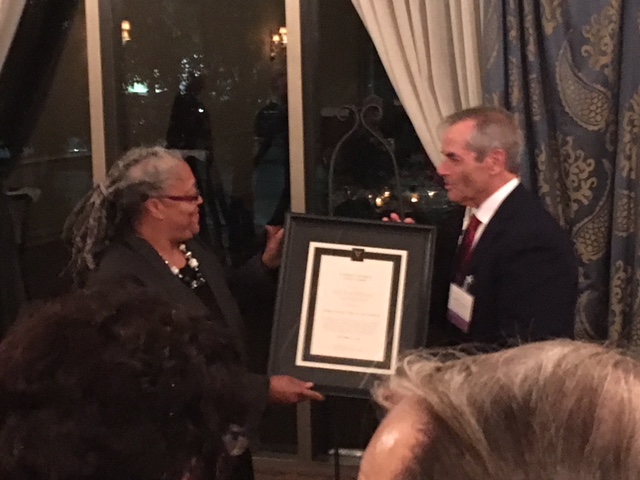
Vanderbilt Divinity School, where I studied for my D.Min. between 1988 and 1992 has named me its “Distinguished Alumnus of the year for 2017. In the photo, Dean Emilie Townes is presenting the award.
Here are my thoughts on that recognition:
When I was 15 I was walking to our synagogue in East Orange, NJ, for or annual outdoor lighting of the Chanukah, the Chanukah lamp. Walking up Main Street, I stopped in a gift shop to buy a present for my girlfriend at the time. I picked out a cute stuffed animal, and as I was approaching the owner of the store to pay at the cash register, a little girl walked in. She must have been about eleven. She was dressed very poorly and reminded me of the protagonist of Hans Christian Anderson’s The Little Match Girl.
She approached the counter and said to the owner, “I want to buy a Christmas present for my mother, but I don’t have much money.” The owner showed her several inexpensive items, and I saw her eyes light up at when she looked at one particular item.
“How much is this?” she asked.
When he told her, she carefully counted her money, and from her face it was clear that there was a gap between what she had and what the item cost.
To this day, I believe God put me in that store so that I could make up the difference for her. It was no great act of philanthropy, a couple of dollars at most. But the feeling was unmistakable!
That experience taught me to look for what I have come to call, “Esther Moments.”
In the Book of Esther Mordecai tells the courtier Hatach to give Queen Esther a message, that she must go to the King to plead with him to spare the lives of the Jews whom Haman, the King’s Prime Ministers, has vowed and planned to exterminate.
Esther responds that she cannot go to the King unless she is summoned. If she does—even though she is Queen—she risks death unless the King holds out his scepter to accept her.
Mordecai’s immortal response is:
“Who knows if you have become Queen for just such a time as this?” (Esther 4:14)
To her everlasting credit, Esther had the courage to seize her moment and do what she was in a unique position to do.
Another biblical example of such courage is Joseph. He was in Pharaoh’s dungeon on the trumped up charge of trying to seduce the wife of his master Potiphar. Because of his dream-interpreting talent, Joseph was whisked from the dungeon, given a shave and new clothes for what was intended to be a brief audience with Pharaoh to interpret the King’s dreams.
But Joseph had the chutzpah to not just interpret the dreams as requested but to actually offer Pharaoh advice as to what to do about them.
These biblical stories teach me that God gives each of us moments when we alone are in position to make a positive difference. The question we must ask ourselves is, “Will we recognize and seize our moments, or will we simply let them pass?”
The opportunity to study at Vanderbilt was such an “Esther Moment” for me.
I remember that shortly after I enrolled I had a conversation with Bill Jenkins, who was then Vanderbilt’s Vice Chancellor for Administration and a very good friend. “I am just doing this,” I said, “for my own enrichment. It’s not like I need this degree to get a job or advance my career.”
He looked at me incredulously and responded, “Steve, it’s certainly not going to hurt.”
He could not have been more correct.
I well remember my first meeting with Joseph Hough and the late Jack Forstman, then the Deans of Vanderbilt Divinity School. They emphasized that they never had a rabbi in the D.Min program; they wanted to be sure that I always felt welcome on campus. They then asked what I wished to study.
I responded that I did not wish to study Pastoral Counseling or synagogue organization, the curricula for many D.Min degrees. Instead I wanted to take every Ph.D. level course that I could in Hebrew Bible and write a curriculum aimed at tenth grad Confirmation students based on my studies.
With their blessing I plowed ahead for the next four years.
For my dissertation I wanted to explore—viewed through the lens of Midrashic and other traditional commentaries—the narratives from Creation to the Revelation at Sinai.
I shall never forget the day I submitted my project to Ms Aline Patte, the Registrar, who had always greeted me with warmth and encouragement. When I laid my pride and joy on her desk, she shocked me by immediately taking out a ruler to measure if the margins and page layout complied with the school’s guidelines. To my relief she smiled and said they were.
I treasure the day about a week later when I met with my wonderful Advisor, Professor Doug Knight (who I am thrilled was on hand to introduce me at the dinner) and Dean Forstman who smiled and told me, ”We really have a D.Min project to be proud of.”
I also treasure the fact that Professor Knight attended the Confirmation service at the temple based on my D. Min project.
For years I used a major chunk of that dissertation not only in Confirmation class at my synagogue but in courses that I taught at Hartford Seminary and St. Joseph College. I also used it when I conducting Elderhostel courses at my undergraduate alma mater, Hamilton College, and in several institutes that I have led over the years for non-Jewish clergy.
In 2014 I published a popular version—with several additions—of that dissertation as my first book, What’s in It for Me? Finding Ourselves in Biblical Narratives.
It has been my privilege, in my role as President of the World Union for Progressive Judaism and in my subsequent travels—to lecture on and teach the ideas in that book in more than 100 communities around the world, including the semester-opening lecture I delivered at University of Potsdam (Germany) School of Jewish Theology.
With deep gratitude to Pastor Ursula Sieg and mutual blessing edition, the Publishing Company she founded, What’s in It for Me? Finding Ourselves in Biblical Narratives has been translated into German, Russian and Spanish.
I will be ever thankful for the opportunity The Temple in Nashville gave me to study at Vanderbilt. The wisdom I gleaned from Doug Knight, Walter Harrelson, James Barr, Shemaryahu Talmon, Renita Weems, and my friend Amy Jill Levine, cross fertilized the wonderful foundation in Hebrew Bible that I received from Chanan Brichto, Samuel Sandmel, Sheldon Blank, Samson Levey, Alfred Gottschalk, and Arnold Band at Hebrew Union College as well as Nehama Leibowitz, Galit Hozen-Rokem, and Moshe Greenberg at the Hebrew University in Jerusalem.
Fifty years after I took “Introduction to the Old Testament” and got a C minus at Hamilton College, the professor who taught the course, Jay Gomer Williams, honored me by attending the lecture I gave about my book in the college chapel. It touched me deeply when he shook my hand and said, “I may have given you a C minus then, but I give you an A plus today”
I love the Bible passionately, but I recognized early that it was neither my gift nor my destiny to expand the boundaries of biblical Knowledge. Rather, my goal, and I believe, one of the reasons God put me on earth, is to show every day people biblical stories are really our stories than can have a positive impact on our lives.
I am very grateful to VDS for this recognition and take it as affirmation that I have succeeded at least to a degree in what I believe God wants me to do.
When I enrolled at Vanderbilt, it was, as I indicated for my own enrichment with no practical advantage in mind. But Bill Jenkins was more correct than I could have ever imagined when he said, “Steve, it’s certainly not going to hurt.”
Will We Accept the Challenge?
Since mid September Vickie and I live on Sanibel, an environmental paradise. And yet:
The increasing frequency and ferocity of hurricanes, tornadoes, wild fires and other natural disasters should convince all of us that we are not taking care of our environment as we should.
In religious terms we are not living up to God’s charge to humanity at the time of creation. The Bible (Gen. 1: 26) teaches: “And God said, “Be fruitful and multiply; fill up the earth and (my translation which differs from the traditional, “subdue it,” is) and take responsibility for it.”
A wonderful Jewish legend illustrates our dilemma:
Once there was a goat that roamed the earth with horns so long they could reach the sky. When the goat’s horns tickled the stars, they would sing a most beautiful melody that brought joy and contentment to all the earth.
One day a man was walking through the forest wondering what he might give his wife as a present for her upcoming birthday. He happened upon the goat and thought, “If I cut off just a small piece of one the goat’s horns I can fashion the most beautiful jewelry box for my wife.”
The goat was a friendly sort, and at the man’s polite request, he lowered his head, and allowed the man to cut off “just a small piece” of one of his horns.”
The jewelry box the man made was beautiful. In fact it was so beautiful that soon everyone wanted one just like it. One after the other people found the goat and cut off “just a small piece” of one of its horns.
The result: Many people had beautiful jewelry boxes, but the stars no longer sing their beautiful melody.
The message of the story is clear. We must do more to preserve our environment from further destruction. Our legislators on state and national levels must hear our concern about the ways big oil, big agriculture and other industries ravage our eco system.
We should also examine ways we as individuals can act in more environmentally responsible ways. God’s instructions at the time of creation are all the more urgent today.
A famous Midrash (Jewish legend) teaches that God addressed humanity at the time of creation: “You are responsible for my earth. But remember, this is the only earth you will get so take very good care of it.”
If we accept the challenge, people the world over can enjoy an environment as beautiful and healthy as the one we savor and strive to preserve on Sanibel.
And God Created Diversity, And God Saw That It Was Good!
A different angle on the Tower of Babel

“Why do we have to have all these different religions? Wouldn’t the world be better if there was one religion instead of all the problems caused by religious differences?”
My response to the question when the asker is a Christian is, “Whose religion would it be? Would it be yours, where the life, death on the cross, resurrection, and ascension to heaven of Jesus are guiding beliefs? Or would it be mine, in which the life and death of Jesus plays no role whatsoever?”
The conflicts are not the result of different religions.They are the result of our unwillingness to accept religions different from our own.
While I am a passionate Reform Jew, I do not believe that everyone should be Jewish.I believe that people should be what their minds and consciences call them to be. People should be free to believe what they believe and act on their beliefs…
View original post 108 more words
“He shall rule over you …” NOT!
Retranslating »… and he shall rule over you.« Quick Comment on Parashat Bereshit: Genesis 1:1–6:8
The verse is familiar: »And your sexual desire shall be for your husband, and he shall rule over you!« (Genesis 3:16). I would like to put this translation aside because for millennia it has supported female subservience.
The Hebrew root לשמ mashal does mean »rule.»But it can also connote similarity. A mashal in rabbinic literature is a parable. It is often preceded by the question, »What does the matter resemble?« Literally, »To what is it like?« Using this interpretation, I translate our verse this way: »Your sexual desire shall be for your husband, and (in that regard) he will be like you!«
An obstacle to this translation confronts us in the next chapter where the word הקושת »sex- ual desire« appears with the root לשמ (Genesis 4:7). Here God compares the strong urge to sin to sexual desire and declares to Cain that we have the power to »rule over it«. Our Sages teach that sexual desire is an innate human feature. Without it, we would never mar- ry or have children (Genesis Rabbah 9:7). Like re the sexual urge can add great meaning to our lives but unchecked it can cause great harm. So we can say the inclination to evil is »like us» in that it is innate to our nature, and God wants us to embrace and harness it for positive purposes. Real support for my translation of לשמ as »to be like« comes from the only other use of הקושת in Tanach. That is in Song of Songs (7:11) where the woman states that her lover’s sexual desire is towards her, a counterbalance to the Eden passage.
All evidence considered, I think there is very good reason to scrap, »he shall rule over you«, in Genesis 3:16 in favor of, »he shall be like you«.
“So, who created God?”
Back to the Beginning
Each year as we begin to read the Torah again with the immortal words, “In the Beginning,” I think of my very first rabbinical assignment.
As a first year student at the Hebrew Union College-Jewish Institute of Religion, Los Angeles campus, I conducted Friday night worship at the Flora Terrace Convalescent Home on Pico Boulevard. I led Shabbat Eve worship and then visited patients in their rooms. I earned $10.00 for each visit.
One Friday night, not long after I began there, the attendant greeted me with, “Rabbi, you have a new congregant. Rabbi Rosenfeld, an 85-year-old Orthodox rabbi is with us, and he will attend your service.”
“What?!” I thought to myself. “An Orthodox rabbi is coming to my service! Many Orthodox rabbis hold Reform Judaism in disdain. What will he think? How will he react?”
These thoughts played on my mind during the service. Rabbi Rosenfeld sat there, alert but impassive. There was a large black Kipah on his head and the Union Prayer Book from which we prayed sat tightly shut in his hands the whole time.
After the service I made my rounds and approached his room with trepidation.
He was most gracious and told me a story.
“I am 85-years old,” he said, “and I have been studying Torah my whole life. And yet I still feel like I am at the beginning of my studies.”
“How is that?” I asked.
“When I was six-years old, my teacher handed me a Chumash (text of the five books of the Torah in book form) and said, ‘Read!’
So I read (in Hebrew) the first words of the Torah, ‘In the beginning God created the heavens and the earth.’
Then, I looked up and ask, ‘If in the beginning God created the heavens and the earth, then who created God?’
And WHAM! I got such a slap across the face that I still feel it, so I always feel I am at the beginning of my studies.”
In studying the first portion of the Torah, “Who created God?” is as appropriate a question as, “What was the (unnamed, and no where does it say ‘apple’) fruit that led to Adam and Eve’s expulsion from Eden?”
In traditional Jewish life, one who has strayed from religious observance but returns to the fold is considered one who, “hozer b’tshuvah, one who returns in repentance.” Literally translated the phrase means, “one who returns with answers.”
The late Rabbi Harold Schulweis taught he felt greater admiration for one “sheh hozer b’she’elah, one who returns with questions.”
Questions are the lifeblood of learning.
In the study of Torah, no questions should be out of bounds, so,“Who created God?”
I pray I never stop asking the question.
Chatting With Jesus in the Sukkah
I am very happy to repost this essay which appears on ReformJudaism.org on my web blog. SLF
BY RABBI STEPHEN LEWIS FUCHS , 10/04/2017

During the Festival of Sukkot it is customary to invite famous people from the past to be our ushpizin(“guests” in Aramaic) in the sukkah, the temporary huts we build to celebrate the harvest festival.
This year, I would like to invite Jesus to be my guest in the sukkah – to chat about this verse from Genesis: “So God created the human beings in the Divine image, creating them in the image of God” (Genesis 1:27).
To begin the conversation, I would point to one of the most beautiful verses in Scripture from Psalm 8:6: “For you have made humanity little lower than the angels…” As much as I love the English translation, I think the German translation – “Du hast ihn wenig niedriger gemacht als Gott, mit Ehre und Herrlichkeit hast du ihn gekrönt.” – is closer to the original because it speaks of humanity as just a little less than God.
For our Rabbis, the idea that humans are a little less than God or a little lower than the angels was a commentary on the notion that God created humanity in God’s image. It does not mean that we look like God in a physical sense because, of course, God has no form or shape. Rather, it means we have awesome power that God wants us to use responsibly.
For example, we are the only creatures that can go to the side of a mountain, mine ore from the mountain, turn the ore into iron, the iron into steel, and from that steel forge the most delicate of instruments with which to operate on a human heart or brain. Likewise, we can fashion that same steel into bombs and bullets designed solely to maim and kill other humans.
With that idea in mind, I would pose this question to Jesus: In your famous Sermon on the Mount, you offer thoughts about how beings created in God’s image should act. Unfortunately, it appears some of your instructions have been misunderstood and misinterpreted over time, causing great harm to Jewish-Christian relations.
Then, I’d offer this discourse.
As the Gospel of Matthew recorded your words, you said, “You have heard, ‘an eye for an eye a tooth for a tooth.’” Of course, those words are found in Torah, but surely you know that there is not a single instance in the Hebrew Bible of mutilation being imposed as a punishment for a crime. Surely you know, too, that rabbis who were your contemporaries interpreted these verses to mean that fitting financial compensation should be set for criminals to pay victims.
You also said: “You have heard, ‘love your neighbor and hate your enemy.’” Had I been there to hear you speak, I would have liked to ask, “Where did people hear that expression? Surely not in our Torah.”
In fact, in Exodus 23:4-5, we read “When you encounter your enemy’s ox or ass wandering, you must take it back. When you see the ass of your enemy lying under its burden and would refrain from raising it, you must nevertheless help raise it.” With all due respect, Jesus, that certainly doesn’t sound like “hate your enemy” to me.
A wonderful story illustrates the Jewish perspective on this idea, and it’s an outlook I’m sure you share.
One year on the eve of Yom Kippur, the holiest night of the year, the synagogue was packed with worshippers waiting for the service to begin. To everyone’s surprise, the rabbi was not yet there. “Where can he be?” people wondered.
The synagogue leaders sent people to look for him, and finally someone found him, leading a frightened calf back into its stall.
“What are you doing?” the leader asked. “Everyone is waiting for you in the synagogue!”
“I know,” the rabbi answered, “but when I saw the lost animal, I had to bring it back to its owner.”
“But that man doesn’t even like you,” the lay leader said. “He has always been your enemy.”
“That is true,” the rabbi replied, “but our Torah teaches that we must be kind to our enemies.”
Another version of the story has a different ending. In this one, the leaders find the rabbi in a nearby house, rocking a baby in his arms. When asked why, the rabbi answered, “The child was crying. Comforting a crying child must take precedence over even the most important worship of the year.”
Jesus, I know we can agree that if we want to live up to our mandate as beings created in the Divine image, we must love our neighbors – including our enemies – as ourselves. Doing so means we extend a helping hand even to those who hate us and we dry the tears of crying children, including those who are homeless, hungry, or live in fear of violence – in our community, in our nation, and in this world that God has entrusted to our care.
Chag Sukkot sameach! (Happy Sukkot!) I’m glad you could come visit in my sukkah.
 Finding Ourselves In The Bible