

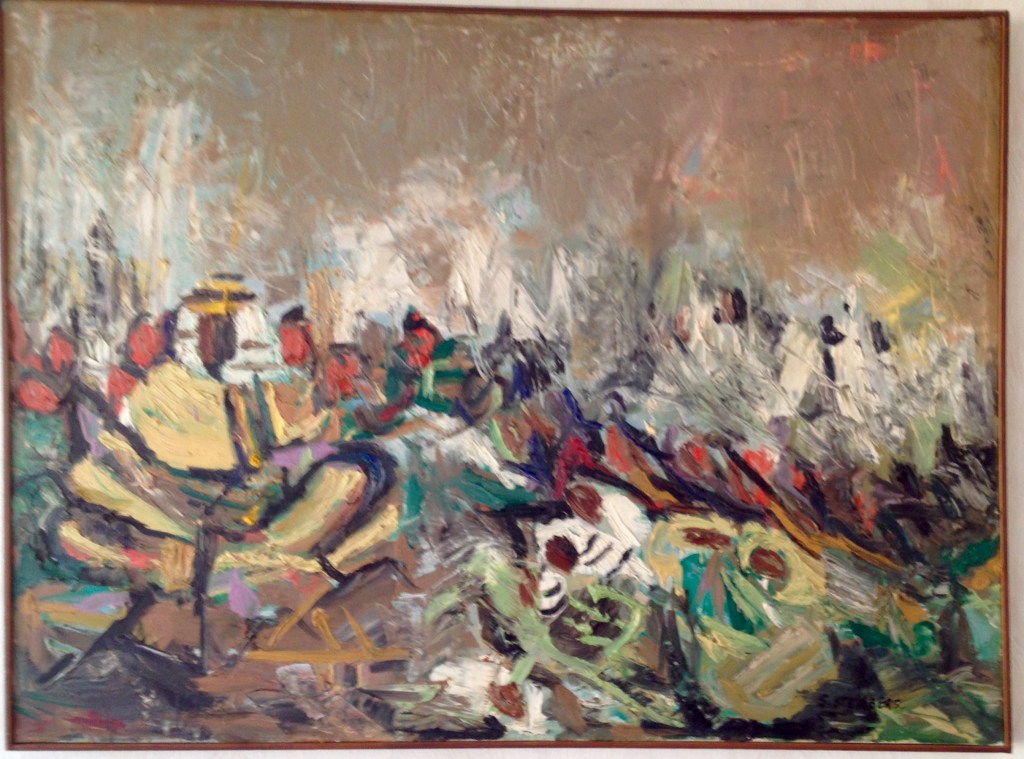
The painting above, by my late mother-in-law, captures the palpable anxiety of Joseph’s brothers. They fear for their lives as they bow before him in Egypt. At the climax of the story, Joseph reveals himself to his brothers. He forgives them for selling him as a slave to Egypt.
He moves his entire family to Egypt to escape the famine that gripped the Mediterranean world and set them up in the finest part of the land. After 17 years, their father Jacob dies. The brothers fear that Joseph will take revenge on them now that their father is dead.
But Joseph’s speaks tenderly to them saying, “Although you intended to do me harm, God has turned it to good…enabling me to save many lives.”
And so the book of Genesis ends with the animosity between Joseph and his brothers resolved, and his brothers ensconced comfortably in Egypt. If Genesis was a fairy tale it well have ended, “And they all lived happily ever after.
Unfortunately, we only get to enjoy this happy ending for one week. Then, we turn the page and begin the Book of Exodus.
For then we read that a new king arose. He either “knew not” or chose to ignore all that Joseph had done to save Egypt from famine and starvation. The economy, we may assume turned downward, and the Hebrews —once welcomed as honored guests — became personae non-grata.
The Torah’s narrative is the paradigm of our people’s experiences in every country we have ever lived. This has continued until the present time. We have no reason to think that our freedom and the status we enjoy here in North America will change. Still, we must not assume that the events that occurred in every place Jews have ever lived cannot happen here.
Iraq and Iran once hosted (as Babylonia and Persia) two of the most prosperous And well-acclimated Jewish communities in history. Ditto for the Jewish community in Spain before the expulsion and Inquisition beginning in 1492.
And of course, the Shoah perpetrated by the Nazis murdered one out of every three Jews in the world. It killed two out of every three Jews in Europe.
If you had asked a well-off Jewish person ten years before things went bad in any of the societies I cited above, they would have said, “It cannot happen here.”
So it should not surprise anyone that most Jews in North America today would also say, “It cannot happen here.”
I hope and pray that it won’t, and there are lots of good reasons to think that it won’t. But only a person who chooses to ignore history completely will say, “It can’t”

 Finding Ourselves In The Bible