And God Created Diversity, And God Saw That It Was Good!

“Why do we have to have all these different religions? Wouldn’t the world be better if there was one religion instead of all the problems caused by religious differences?”

My response to the question when the asker is a Christian is, “Whose religion would it be? Would it be yours, where the life, death on the cross, resurrection, and ascension to heaven of Jesus are guiding beliefs? Or would it be mine, in which the life and death of Jesus plays no role whatsoever?”

 The conflicts are not the result of different religions. They are the result of our unwillingness to accept religions different from our own.

While I am a passionate Reform Jew, I do not believe that everyone should be Jewish.I believe that people should be what their minds and consciences call them to be. People should be free to believe what they believe and act on their beliefs as long as their actions do not harm others.

I am so fond of the Tower of Babel story because it affirms the value of diversity of both language and belief. The story is not historical but its religious truth is profound.

Before the time of the tower humanity was of one mind and one language. God thought so little of all this unity that the Eternal One created diversity by scattering the people  and thereby creating different religions, languages, and cultures.

No! Religious unity should not be our goal. Rather, respect for and appreciation of honest religious differences is what will lead us to a better world.

Was It a Miracle?

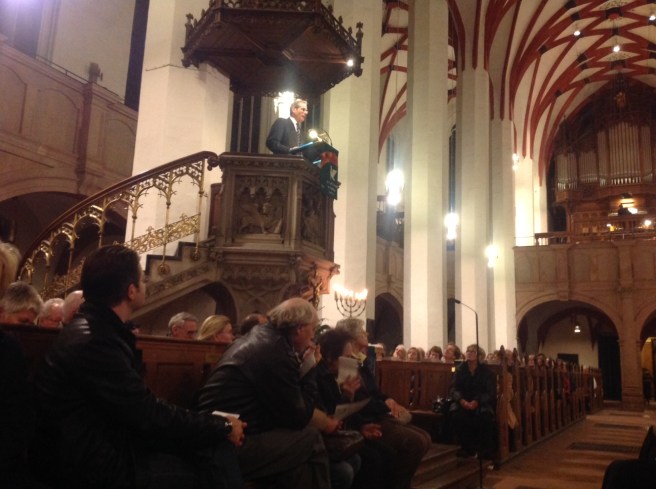
thomaskirche-photoSpeaking from the pulpit of the Thomaskirche in Leipzig:

And Elijah heard the voice of God: Not in a whirlwind, not in an earthquake, not in a fire, but “in the still small voice of calm.” (I Kings 19:12}

Two years ago, I stood in the pulpit of the Thomaskirche (Bach Cathedral) in Leipzig and told of my father’s arrest in that city on Reich’s Pogromnacht (Kristallnacht) on November 9, 1938. I told of how the German soldiers rounded up Leipzig’s Jews and made them stand in the stream that flows through the city zoo. I told how the Nazis commanded citizens to curse the Jews, spit on them and throw mud at them. I spoke of how I imagined my father in that stream.

I posted my message on my web site blog, and in the days that followed I received a number of heartfelt comments about it.

But I have received no comments about that message since then … until two years later, the day before I was to preach in the Thomaskirche again. In the middle of the night I woke up and felt compelled to check my email. There was a response to my Thomaskirche post from two years ago.

The message I received touched my soul!

 It came from an American artist living in Leipzig named, to my amazement, Stephen Lewis, who shared this story with me:

 When just by chance I came across your blog post, “Thomaskirche Kristallnacht Speech: A Trip I had to Make,” I read it, and now feel I must do my best to tell you a story told to me by a dear friend that I briefly new for a few years before he died. I am a painter and not the best with words but hope to be able to bring it across to you in the most sincere way.

One day shortly after moving my art studio into an old storefront on Arthur Hoffmann Str. in Leipzig, I was welcomed to the building by a kind elderly couple named the Bernstein’s. They lived on the first floor above my studio. My German was very poor and the Bernstein’s spoke only a few words of English but they told me many stories about their families, the war, and the GDR. The stories started out easy and simple and were often followed by questions for me asking if I had known about such events.  Herr Bernstein would visit me while I was painting, but I was soon helping them carry groceries or delivering coal to them from their basement. These chores were always followed by sweet coffee in their kitchen and occasionally a session of show and tell.

As time went on the stories became deeper and it seemed to me as though they had not been told before.

Once, while Frau Bernstein was out having her hair done, Herr Bernstein told me about a bright young man that was his mate, his friend, someone whom he quite adored. They were pals. He told me about the boy’s family and then mentioned they were Jewish.

Herr Bernstein froze standing at the edge of the table with his age-worn hands clenching the sides of the tabletop and he began to cry.

I could see him relive the moment when as a young man he was ordered to go to the Leipzig Zoo where many Jews were being held in a place where you could look down into the space from above.

Herr Bernstein wanted me to understand this story. It was important. He was confessing of his disgust for the Nazis and failure to do the right thing. He explained that as he went over to see what was going on, he went by a group of German soldiers and looked down in the pit. He said he was shocked to see all of the people. He could not believe it. He was ashamed and horrified. Soldiers were yelling down at them, spitting on them, one soldier even urinated on them from above.

Herr Bernstein was outraged and tried to shame the soldier to stop. Herr Bernstein was struck and knocked to the ground.

With tears running down his face he looked at me and pointed to the kitchen floor. He sobbed and told me he saw his school time friend down in the pit. He was so ashamed to confess he was not able to help his friend. That young man look up at him and recognized Herr Bernstein. He could see Herr Bernstein being kicked and spit on. He was silenced. Mr. Bernstein was there, saw the horror, but was not able to save his friend.

I share this story with you not to make light of your experience visiting the Zoo or to try to make excuses for the Germans. After reading your account of the captured Jews at the Zoo, I thought that if you knew about how at least one person tried stop the madness, how the victims might have witnessed how at least one German young man knew what was happening was wrong and tried to stop the soldiers, that this might mean that God was at work during this terrible and hopeless event.

Herr Bernstein said he could see strength in his friend’s eyes looking up at him. He could still see him and was crushed while telling me about this event.

The peculiar reason that I came across your blog–and somehow this article–is because you and I share the same name.

I wish you well.

Sincerely,

Stephen Lewis


A Jewish legend that I love teaches: “When the living think of the dead, the dead who are in paradise know they are loved and they rejoice. “**

After I shared a summary of this story with the worshippers, and announced with joy that Stephen Lewis, the artist, was in attendance, I said:

“Herr Bernstein, I stand here tonight with the hope that you rejoice in the knowledge that we remember and cherish your remarkable act of courageous resistance to Nazi terror.”

For Jews, Elijah the prophet represents the hope that one day we will have the world of peace and harmony that God has yearned for humans to create.

For that reason there are more Jewish stories and legends about Elijah than any other biblical character.***

One of my favorites tells that because of his righteousness, the third century Sage Rabbi Joshua ben Levi had the privilege of visits by the prophet.

One day the rabbi asked Elijah, When will the Messiah come to redeem the world?

“Today,” Elijah answered.

Rabbi Joshua waited expectantly the whole day, but he saw no Messiah.

When Elijah visited him again that evening, the rabbi asked, “Why didn’t the Messiah come?

“He is here, Elijah answered.

“Where,” the rabbi asked?

You can find him on the outskirts of town, among the outcasts, among the lepers.”

“How will I know which one he is,” the rabbi asked?

“He is the one who changes the bandages of the lepers,” Elijah answered. He changes them one by one.

I continued:

We can no longer wait for a grand sweeping act of redemption. We must each do what we can—one by one—to make the world better.

In the Bible, Elijah perceived God’s will not in a whirlwind, not in an earthquake and not in a fire but in a ”still small voice (I Kings 19:12).”

The still small voice speaks to all of us from time to time. Though the price he paid was very dear, Herr Bernstein heeded it when it spoke to him.

How will we respond when it speaks to us?


**Though I have tried I cannot trace the source of that particular legend further back than Noah Gordon’s wonderful 1964 novel, The Rabbi. I first read that novel when I was 18 years old. That is long enough for me to quote, with gratitude to Mr. Gordon, snippets of it as authentic Jewish folklore.


***Think of it, Moses, is the subject of four of the five books of the Torah. Elijah stories only take up 15 pages of text in the First Book of Kings. Yet we have far more rabbinic legends and stories about Elijah than about Moses.

Vote NO to Bigotry and Hate

I first posted this essay last December. Now it is the eleventh hour. My very real concerns about Hillary Clinton pale in comparison to the fear  a Trump presidency raises. So with less than a week before the election I share these thoughts again.

                                               . . . . . . . . . . . . . . . . . .

Donald Trump never really attracted my attention until recent months. But I have paid close attention to Elie Wiesel for almost half a century.

It is 47 years since I first saw and heard Elie Wiesel in 1968. He was then a 40 year-old activist on behalf of Soviet Jewry.

I had just finished my undergraduate thesis on The Jews of the Soviet Union Since the End of World War II. Wiesel’s book, The Jews of Silence was a primary source of my research.

Fifteen years later in Baltimore, I gave the invocation at an event where I again heard Wiesel speak. I treasure the fact that he complimented me on my presentation, and he said something that evening that I have remembered ever since.

“It says in Pirke Avot (3:1) “Keep in mind three things: from whence you came, to where you are going, and before whom we must eventually render account. “And which of these,” Wiesel asked, “is the most important for us Jews? From whence we came! Every Jew should always know that he or she came from Sinai. And before we came from Sinai we came from slavery and oppression.”

From that day to this he has endeavored to teach that the most important lesson we learn from Sinai is that, “We must not remain indifferent to the suffering of others.   The opposite of love is not hate. The opposite of love is indifference.”

Even in the face of danger Jews face in Israel and in many places around the world, we must not be indifferent to the suffering of others.

Our Muslim cousins are suffering, and we must do what we can to relieve their pain.

Yes there are radical elements in the Muslim world. We see their terrorism, and we hear their barbaric rhetoric.

But they do not represent vast majority of Muslim in the world who want the same things all decent humans want for ourselves and our children and our grandchildren.

They want a world where people live in peace and harmony. They want a world where people have houses that protect them from the heat, the cold the wind and the rain. They want good food for their children and all children to eat.

Yes, they want all of those things, and yet Donald Trump, the Republican candidate for President of the United States plays upon the fears and prejudices that we Jews know all too well. He takes the wretched example of a few radicals and makes proclamations that discriminate against, persecute and impugn all Muslims around the world. His method is not new.

  • In the thirties Father Charles Coughlin took to the airwaves with a rabidly anti-Semitic message. Finally the Catholic Church officially silenced him.
  • When I was a young boy Joseph McCarthy’s anti-communist campaign ruined the lives of many an innocent person. Finally Congress censured him.
  • Today Donald Trump; is fanning the flames of bigotry and hatred. It is time for people of good will to repudiate Donald Trump.

Let us consign him—like Coughlin and McCarthy—to the page of history reserved for demagogues whose rantings make us recoil.

As Elie Wiesel taught, the opposite of love is not hate. The opposite of love is indifference.

In the face of evil–and I believe in the face of the specific evil that Donald Trump represents–the Torah commands all people of good will, “You shall not remain indifferent.” (Deuteronomy 22:3)


Elijah’s Message to Us

For our Sages, no biblical figure symbolizes the overarching hope of Torah—that one day we human beings will create on this earth a just, caring and compassionate society—more than the prophet Elijah.

According to Jewish tradition, as we celebrate every week during Havdalah, our brief ceremony to bid goodbye to the Sabbath, we express a hope that has sustained us for 2500 years.

Since the time of the prophet Malachi in the fifth pre-Christian century, we have looked to Elijah as the symbol of the time when the world will be the just, caring and compassionate place that God has wanted us to make it since the dawn of creation.

As great as he was, though, even Elijah could sometimes not hear the voice of God. Like so many Elijah experienced deep despair!

Elijah had faith in God his whole life! But he had completely burned out. His strength, his zeal and his enthusiasm had all vanished. When we find him at Mt. Horeb (I Kings 19:10), he was ready to give up.

We marvel that he had sunk so low! And we ask:

Can this be the same Elijah who had once championed the Eternal One so boldly?

  • Is this the same Elijah who chastised King Ahab for confiscating Naboth’s vineyard?
  • Is this the same Elijah who stared down Queen Jezebel when she pronounced a death sentence upon him?
  • And is this the same Elijah who challenged the prophets of Baal on Mt. Carmel, where he said to the idol worshippers, “You set up an altar to your idol god and set a bull upon it, and I will set a bull on an altar to the One true God. But let neither of us light a fire under the bull. Let us see which God consumes the offering without benefit of fire!

The prophets of Baal went first. They prayed, they sang, and they gashed themselves, as was their custom. But nothing happened. Finally the prophets of Baal gave up!

Then Elijah poured buckets and buckets of water over the bull onto the altar, and the water even overflowed the trench below the altar. Then he cried out:

Anne Adonai Aneni  ענני ה׳ ענני

“Answer me, O Lord, Answer me!” And poof! The entire offering, the altar and even the trench below went up in smoke. And at that spectacle all those gathered on the mountain to witness the challenge cried out the words:

ה׳ הוא האלהים Adonai hu Ha-Elohim

“The Eternal One alone is God!!! (I Kings 18:19-39)”

Yes, that dramatic event was a great moment. But as often the case with big dramatic moments in our lives, its glow soon dimmed!

King Ahab and Queen Jezebel still sought to kill Elijah, and he was emotionally and spiritually exhausted. To try to regain his strength he journeyed forty days and forty nights to the site where God revealed Torah to our people, to Mount Sinai.

But there Elijah sunk even deeper into despair. He wanted another dramatic assurance of God’s support for him, but this time it did not come.

He listened and heard a fierce howling wind, and then there was an earthquake and then a raging fire. But God was not in the wind, not in the earthquake, and not in the fire. Elijah had to listen very closely and then at last God’s voice came to him in

קול דממה דקה    Kol d’mama daka

A still small voice.” (I Kings 19:8-12)

Elijah’s experience speaks directly to each of us. We yearn to hear God’s voice just as the prophet did. But we shall listen in vain if we always expect to hear it in claps of loud thunder, crackling lightning or in gale force winds!

The first word of Judaism’s most important prayer is

שמע  Shema

“Listen!”

Why, Our Sages ask, did God give us two ears but only one mouth? So that we should listen twice as much as we speak.

The voice will not inspire most of us to cure cancer or end war in the world although we pray for the success of those who try. But do we hear that voice when it urges us to do simple things like stop to assist a person who needs help?

Most of us do not.

I was not with her the day Vickie was walking alone on Kufurstendam in Berlin. She turned her ankle on an uneven stone and screamed as she fell to the ground.  Several people walked by, but only one stopped to help her up.

These are two examples from my life when I am glad that I listened to the voice speaking to me:

One summer night when I was twelve I could not sleep. I looked out the window and saw a magnificent full moon seeming to move across the sky. At times, the moon shone brightly. At times it appeared to hide—partially or completely—behind clouds. But each time the clouds hid it, the moon re-emerged to shine brightly once again.

And it was as if God spoke very softly to me and said:

”Such is life, Stephen. There will be moments of bright joy and moments of dark sadness. But watch the moon. It keeps going, and because it does, it eventually moves from darkness to light once again! So keep going! Do not give up, and do your best no matter what obstacles life puts in your path!”

No teacher ever taught me a more valuable lesson!

When I was fifteen, I heard the voice again.

It was a snowy winter night, and I was walking to our synagogue to participate in our annual service for the Festival of Chanukah. I had stepped into a gift shop to buy a present for my girlfriend when a little girl of about ten walked into the store. She was dressed very poorly and her tattered cloak was not sufficient to keep her warm in the winter chill.

“I want to buy a Christmas present for my mother,” she said to the shopkeeper, “but I don’t have very much money.”

The storekeeper showed her a few inexpensive items, and when she saw a nice bracelet, her eyes lit up! But they immediately dimmed when she counted her money and realized that she did not have enough to buy it.

To this day, I believe, the still small voice guided me into that store, so that I could make up the difference between the amount of money that she had and the amount that she needed to buy her mother that present.

Because Elijah finally heard the still small voice, he found the courage to continue his mission. Because Elijah listened to the still small voice Jews to this day—2500 years later—look to him as the symbol of the glorious era that will bring peace and harmony to the entire world.

People are unlikely to remember us in 2500 years as we do Elijah, but if we listen for and heed the still small voice, we can–in small but very real ways—-make a better world.

Out tradition (Yerushalmi, Sanhedrin 22a and other places) teaches that to help a single person is to save the entire world!

If we listen, all of us can hear the “still small voice” and use our talents to perform small acts that make a better world, and that, I believe, is what God wants each of us to do.