The Yom Kippur Carol

new-book

Whether you prefer the 1843 book or any of the many movie versions made since, there is no question that Charles Dickens’ A Christmas Carol is a classic.

Now, despite the season for which Dickens wrote it, A Christmas Carol is a Yom Kippur story if there ever was one.

As a small child, I lived to hear Ebenezer Scrooge say, “Bah! Humbug!” Only when I was a bit older did I start to appreciate the drama that unfolds after the first commercial.

Scrooge spends a restless night marked by four fateful encounters. The first is with the ghost of his dead business partner Jacob Marley. In life, Marley was Scrooge’s tight-fisted clone. In death, he walks about chained to his account books, wailing in misery.

The frightened Scrooge cries out to Marley: “But you were always a good man of business, Jacob!”

“Business!” answers Marley. “Mankind was my business. The common welfare was my business; charity, mercy, benevolence, forbearance. These were all my business. The dealings of my trade were but a drop of water in the comprehensive ocean of my business!”

The Hassidic rabbi Levi Yitzhak of Berditchev, who died in 1810, two years before Charles Dickens was born, expressed Marley’s admonition to Scrooge in another way. Once, he saw a man hurrying down the street looking neither to the right or the left.

“Why are you hurrying so,” the rabbi inquired?

“I am pursuing my livelihood,” the man answered.

“And how do you know,” the rabbi continued, “that your livelihood is in front of you? Perhaps it is behind you, and you are running away from it.”

Such was Marley’s message to Scrooge:

You are running away from your livelihood, but “I am here tonight to warn you that you have yet a chance and hope of escaping my fate.” As Marley leaves, he promises Scrooge that the spirits of his past, present, and future will visit him.

The ghost of his past allows Scrooge to see the hurt people inflicted on him that turned his life in its miserable direction. He sees himself as a boy in school, sitting alone during the winter recess, in his words, “a solitary child … neglected by his friends.”

Then Scrooge sees himself as a young apprentice to kindly Mr. Fezziwig and remembers, “He has the power to render us happy or unhappy; to make our service light or burdensome; a pleasure or a toil.”

In his dream of the present, Scrooge learns from his nephew, Fred, and his clerk, Bob Cratchitt, that vast riches do not provide happiness, nor does their absence preclude it. In Bob’s ailing son, Tiny Tim, Scrooge sees opportunities to act righteously that he has spurned for so long.

Scrooge’s final lesson allows him to look into the future, to see how people scorn him after he is gone.

Yom Kippur asks us to experience a night like Scrooge’s Christmas Eve. We need to hear and heed the lesson: Humanity is my business…charity, forbearance, mercy, and benevolence. These are all my business. We need to remember those who treat us kindly. We also need to ponder: Will our death cause sadness or occasion relief?

“Spirit,” cried Scrooge, clutching the robe of Christmas Future, “Why show me this if I am past all hope?”

Scrooge, of course, was not past all hope. And neither are we.

In one of his famous stories, the 18th-century Polish preacher, Jacob Krantz, known as the Dubner Maggid, told of a king who owned a precious diamond.

One morning to his horror, the king noted a scratch on one of the facets of the gem. The overwrought monarch sent word around the world offering a great reward to any jeweler who could remove the scratch from the gem, but none of them succeeded.

At last, a local lapidary asked to try. The king’s courtiers scoffed: “What can you do that the world’s greatest jewelers could not?”

“Certainly,” he replied, “I cannot do any worse than they.”

Skillfully, the jeweler used the scratch as a stem around which he etched a beautiful flower. When he finished, the king and all his courtiers agreed that the gem was more beautiful than it had been before.

Like Ebenezer Scrooge, we are flawed diamonds – with the opportunity to etch lives of beauty and meaning around our shortcomings.

Every year, the Yom Kippur Carol urges us to build lives of “charity, mercy, benevolence, and forbearance” around our flaws.

It is not an easy thing to do, but if our efforts are sincere, infinite rewards await us at the end of the day.
 

Yom Kippur Arrives Tomorrow!

new-book

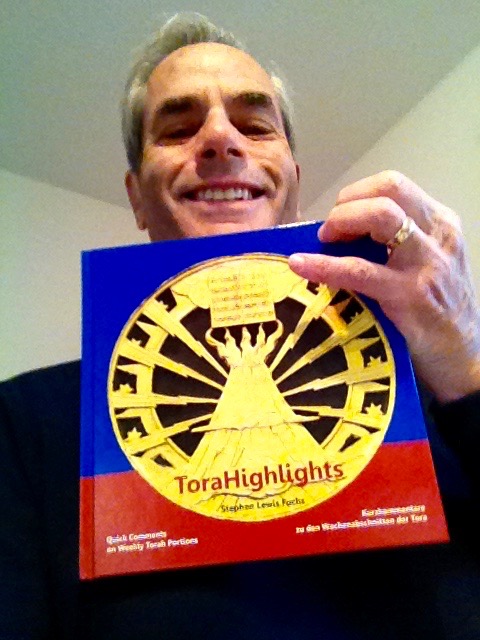
(An excerpt from my book: ToraHighlights)

The sacred day of Yom Kippur arrives tomorrow evening.

In biblical times the sacred Festival of Yom Kippur featured the ritual of the “scapegoat.” (Leviticus 16)

The high priest selected two goats, one for a sacrifice on the altar and the other to symbolically carry the sins of the Children of Israel away into the wilderness.

As the Torah says: ‘And Aaron shall lay both his hands upon the head of the live goat, and confess over him all the iniquities of the people of Israel … putting them on the head of the goat … and he shall send the goat off into the wilderness. (Leviticus 16:21-22)

Rabbinic literature attests that the person led the goat to a mountain peak and pushed the goat down. “Before it reached halfway down the hill it was dashed to pieces (B. Yoma 67a).”

Our modern sensibilities recoil at the notion that our wrongdoings can—even symbolically—transfer themselves onto an innocent goat whose death in the wilderness atones for our transgressions.

 Today we are responsible for our own atonement. We observe Yom Kippur by—if and only if our health permits—abstaining from food and drink. We then spend the day in serious contemplation of our wrongdoings and in prayer asking God to forgive our sins.

Our tradition insists that before we can expect God to answer our prayers for forgiveness we must first go to those we have wronged in the past year and try to appease them.

My Hebrew teacher in Israel, the late Sarah Rothbard, whom I revered, said: “It is not just a credit to the Jewish people that we invented a day like Yom Kippur. It is a credit to all humanity.”

What a wonderful concept. We humans can examine our actions, repent our wrongdoings and change for the better!

That is precisely the task Jews around the world will focus on for a full 24 plus hours beginning tomorrow evening.


Just Before the New Year Arrives

new-book

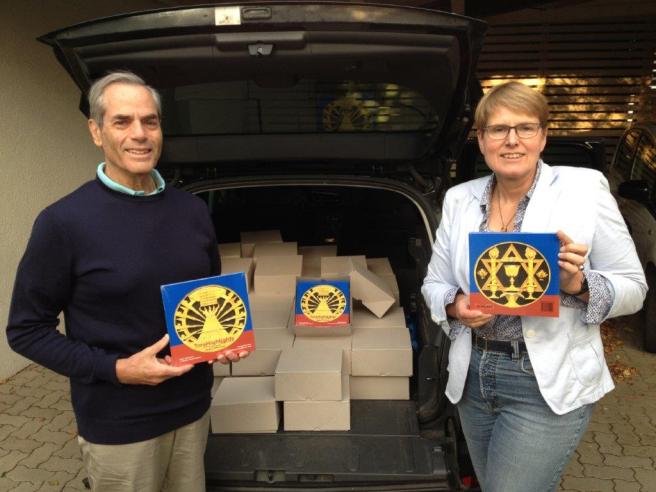
ToraHighlights: On the eve of the New Year translator and CEO of mutual blessing edition, Pastor Ursula Sieg and I welcome with gratitude the first shipment of my new book ToraHighlghts. We pray that the short commentaries it contains on each weekly Torah portion will bring insight and blessings to many people in the NewYear.


In just hours, now, Rosh Hashanah arrives

 For me that is the most important time in the year to remember the teaching of Rabbi Simcha Bunam, an 18th-19th C. Hasidic leader in Poland: Each of us should have two pockets, In each we should carry a different quotation.

When we feel puffed up and full of pride, may we pull from one pocket a note that reads, “I am but dust and ashes!” In the other pocket, when we feel that our efforts futile and have no consequence, let a note read: “For my sake the world was created.”

During the month of Elul we have, hopefully, dedicated our thoughts to examining our actions and thoughts during the past year with the goal of becoming kinder and more caring in the year ahead. If our self-scrutiny is honest we know that there are many times we have fallen short of our own ideals and God’s hopes for us.In those moments it is easy to fall into despair and see ourselves as without merit, or little more than dust and ashes.

At such times it is good to remember that our tradition teaches us that this world is no accident and that our lives are not accidents either. They can have purpose and meaning!

We celebrate Rosh Hashanah as the anniversary of the creation of the world.

God charged us at creation to use our talents to make the world a better place. Few of us will find the cure for cancer or bring about world peace, but that should not stop each of us from dong something. We each can teach a child to read, help an elderly person cross the street, cook and serve a meal at homeless shelter. The possibilities are endless.

But when we become puffed up in the pride of our accomplishments or even in our acts of kindness, it is good to remind ourselves that as Abraham realized when he addressed the Almighty (Genesis 18:27) we are ”but dust and ashes.”

One of life’s must difficult challenges is to find the balance between conceit and despair.

Henry David Thoreau reminded us: “We are double-edged blades, and every time we whet our virtue the return stroke straps our vice.”

I think that it is no accident that, as Bahia ben Asher of Saragossa (13-14th c.) noted, the zodiacal symbol for Tishri and the Jewish New year is usually a balance scale. As we count down the weeks toward Rosh Hashanah, our tradition enjoins us to think of our good and evil deeds as weighing equally on the scale of merit, and that our next act will tip the scale of judgment for good or for ill.

 Think of the power the image of the balance scale can have.

If each of us wakes upon this New Year feeling an urgent need to do a good deed, what an amazingly positive impact our collective actions will have on our families, our communities and our world.

Personally, I pray that God will consider the effort that went into ToraHighlights as a good deed and tip my wavering scale to the side of good and will bless me with a year of  life, health, and meaning.

Amen